
SLIDE 1
I DT MC IC
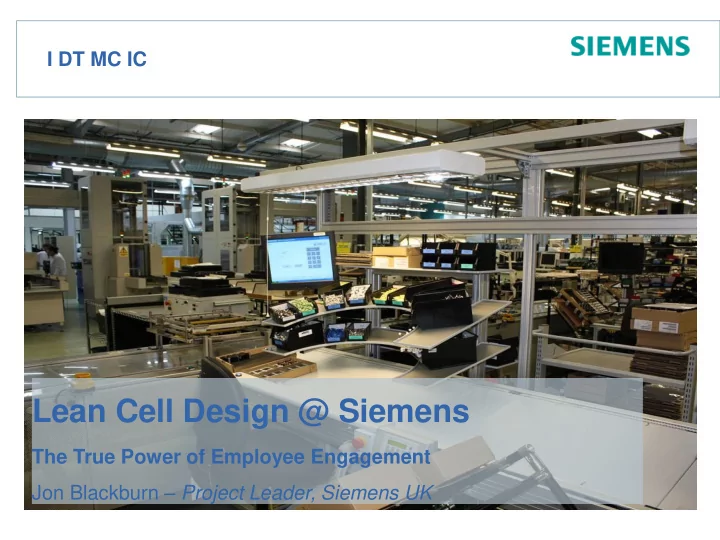
Lean Cell Design @ Siemens
The True Power of Employee Engagement Jon Blackburn – Project Leader, Siemens UK
Lean Cell Design @ Siemens The True Power of Employee Engagement Jon - - PowerPoint PPT Presentation
I DT MC IC Lean Cell Design @ Siemens The True Power of Employee Engagement Jon Blackburn Project Leader, Siemens UK Agenda 1. An Introduction 2. The Lean Cell Design Concept 3. How is it used? 4. How did we implement it? 5. The Results
I DT MC IC
The True Power of Employee Engagement Jon Blackburn – Project Leader, Siemens UK
Agenda
An Introduction
Lean Enterprise @ Siemens
‘93 ‘97 ‘00 ‘02 ‘03 ‘04 ‘05 ‘06 ‘07 ‘08
5S Office Ideas
Lean Toolbox
LCD Units per head
‘09
Lean Office
Lean Supply Chain
EFQM Assessment
Lean Vision 2011
“To establish the capability of delivering product to the customer in a 1 day window”
Lean Roadmap
CIP
Suggestio n Scheme
Direct Replenishment
Congleton 2011
TQ
6-Sigma
Strategy Alignment
Systematic Review
4th Quarter (July – Sept) 1st Quarter (Oct - Dec) 3rd Quarter (Apr - Jun) 2nd Quarter (Jan - Mar)
▪ CIP Quarterly Review ▪ Budget Agreement ▪ Half yearly Business Review UK/SD Senior Management (dates may vary) ▪ Lean@Congleton review ▪ Balanced Scorecard content & target setting review ▪ UK H&S Peer Audit ▪ Year End ▪ Leadership Feedback ▪ CIP Quarterly Review ▪ PMP Half Year Review ▪ Employee Feedback Session ▪ Budget Preparation ▪ Budget Review & Financial Target Setting ▪ Customer Satisfaction Survey Results (Erlangen) ▪ Supplier Day ▪ PMP evaluation & target setting ▪ Staff Dialogue cascade ▪ Congleton Policy & Strategy Review - Integrated Management Review (Quality, Environment & H&S) ▪ CIP Quarterly Review top+ Key Projects/ Initiatives review ▪ Supplier Evaluation ▪ Employee Feedback session ▪ PMP Round table ▪ Risk Management Review ▪ Employee Opinion Survey (every 2 yrs) ▪ CIP Quarterly Review ▪ Succession Planning ▪ Suggestion Scheme Review ▪ EFQM Initiative Review ▪ Product Portfolio Review ▪ Mid Year Congleton Policy & Strategy Review - Integrated Management Review (Quality, Environment & H&S) ▪Evaluative Compliance Assessment ▪Half yearly Business Review UK/SD Senior Management (dates may vary) ▪Our Values & Behaviours
Vision Strategy Wheel Mission Balanced Scorecard Strategy Definition
SWOT
Business Excellence “To achieve excellence in big things, you develop the habit through smaller issues. Excellence is not an exception, it is a prevailing attitude.”
The Business Excellence Team is focused on: ▪ Supporting the business in developing efficient business processes ▪ Optimising our resources ▪ Motivating our people ▪ Ultimately satisfying our customer
People make it work, but what makes the people?
Four Engagement Behaviours (Macey/Schneider/Barbera/Young 2009):
How did we approach this at Siemens Congleton……..
Adaptability @ Siemens
Preparation Workshop Prototype Final Install
2 weeks 1 week 5 weeks 4 weeks Stage Example
▪ Employees given opportunity to create their own work cells ▪ Alignment with organisational vision ▪ Skill Development & empowerment
Expanding Roles @ Siemens
Today's Standard Future Growth
VSM Segment Leader Cell Leader Operators
‘Kai’ translates as change ‘zen’ translates as good or better Shop Floor Management:
Persistence & Responsiveness @ Siemens
clear role concept
project order, target, define SFM Core Team
Kick Off with Infor- mation to shop floor 1st Pilot Concept phase Apr May June July Aug Sep Oct Nov Dec
F Dowling, N Eardley, S Nadin
roll out training and exercise phase project definition
training concept with budgeting costs Shop Floor Cell Leader, Cell and Value Stream Manager
2 people of MM4 VS1 training phase, follow up, evaluation, improvement final presentation self and mgmt. assessment feedback workshop project work experience & coaching training phase identify training needs selection phase Application phase Training offered by Internal, External (MI,EEF) and TMI Saving transfer through ▪CIP workshops on site ▪Project, using CIP tools and IT tools, consider costs, presentation Feedback workshop with CL & operator find out leadership Competence Self and mgmt. assessment 85% of all 19 criteria check ability to be SCL Show ability to be CL ▪using learned methods ▪talk about experience in improvement process hand out certificate by MD - celebration Self and mgmt. assessment Use of 19 criteria matrix qualification matrix difference between course attended” and “ability to use material learnt” Start Roll Out & Exercise Phase
The Key Driver
Our Vision – The 2011 Project
Early beginnings……
Frederick W. Taylor (1856-1915) - looked at individual workers and work methods. ▪ Time Study and Standardised Work - Scientific Management. ▪ Science to management was sound but Taylor simply ignored the behavioral sciences. ▪ He had a peculiar/controversial attitude towards factory workers:
“I can say, without the slightest hesitation, that the science of handling pig-iron is so great that the man who is ... physically able to handle pig-iron and is sufficiently phlegmatic and stupid to choose this for his occupation is rarely able to comprehend the science of handling pig-iron”
Frederick Winslow Taylor
A new approach, how did it all come about?
▪ Competitors in Central Europe adopting a new approach to Lean Cell Design Our approach……….. Computer Software!!!
Computer Software???? What about………
Lean Cell Design, the journey begins…….
LCD Project Plan
13 CW14 CW15 CW16 CW17 CW18 CW19 CW20 CW21 CW22 CW23 CW24 CW25 CW26 CW27 CW28 CW29 CW30 CW31 CW32 CW33 CW34 CW35 CW36 CW37 CW38 CW39 WS5.2 WS8.1 WS8.2 WS10 WS12 7.1 WS7.2 WS9 WS11 APRIL JUNE AUG SEP JUL MAI CW45 CW46 CW47 CW48 CW49 CW50 CW51 CW02 CW03 CW04 CW05 CW06 CW07 CW08 CW09 CW10 CW11 CW12 CW13 Jo WS1.1 BOP WS1.2 I/O WS1.3 Profibus WS4.1 WS4.2 WS4.3 WS5.1 Ade WS2.1 A6 FSC WS2.2 A6 FSB WS4.1 A6 FSA WS4.2 A6 FSA WS6 WS7.1 Sue Ana NOV DEC JAN X-Mas FEB MARLCD Workshop Timeschedule (21 WS planned)
The catalyst……
Costs: Develop value- added activities by designing work processes to improve time management and determining the best process and avoiding unnecessary waste. Quality: Define and standardise processes
efficient processes
Delivery: Improve reliability and throughput time by concentrating on value-added activities and parallelisation of secondary activities Goal: To improve competitiveness by
C - Costs Q - Quality Delivery - D
Ergonomics
Lean Cell Design: The Process
Preparation Workshop Prototype Final Install
2 weeks 1 week 5 weeks 4 weeks Stage Example
Current State PFA Data Gathering, Standard Times etc. CIP Brainstorm
Preparation
Cardboard Mock up:
packaging
Cardboard Mock Up
Theory:
Duration: approx. ½ day
Theory
Transport Lean@Congleton All Materials Movement, double handling The Seven Wastes Transport Lean@Congleton All Materials Movement, double handling The Seven Wastes Inventory Lean@Congleton Stores, buffers, batch sizes & their control systems The Seven Wastes Inventory Lean@Congleton Stores, buffers, batch sizes & their control systems The Seven Wastes Motion Lean@Congleton Reaching, bending, exertion, excess walking excess turns to loosen, unpack The Seven Wastes Motion Lean@Congleton Reaching, bending, exertion, excess walking excess turns to loosen, unpack The Seven Wastes Waiting Lean@Congleton Materials queuing, not moving, people not productively employed, expediting The Seven Wastes Waiting Lean@Congleton Materials queuing, not moving, people not productively employed, expediting The Seven Wastes Over Production Lean@Congleton Too early, too much, just-in-case The Seven Wastes Over Production Lean@Congleton Too early, too much, just-in-case The Seven Wastes Over processing Lean@Congleton Too fast, too big, too variable, one big machine instead of several smaller The Seven Wastes Over processing Lean@Congleton Too fast, too big, too variable, one big machine instead of several smaller The Seven Wastes Defects Lean@Congleton Rework, rejects, unnecessary inspection; consequences of not doing it right first time The Seven Wastes Defects Lean@Congleton Rework, rejects, unnecessary inspection; consequences of not doing it right first time The Seven Wastes WasteWorkshop
New Concept
Waste Reduction Wooden/Creform prototype:
and connect electricity and air pressure
raw materials
Duration:
Prototype
Prototype
What have we achieved:
New LCD Workstation
Workstation
Final Install
Remember: The Continuous Improvement process never ends!!
Final Install
▪ 50% Space reduction ▪ One Piece Flow Production ▪ Ergonomic Set Up ▪ WIP Reduction ▪ Cell Flexibility
Key Results LCD Achievements
Waiting time (removal
WIP Space Reduction Products through LCD process 3
12
% of Product Range
Options LCD Project
Nov08 Feb09
Pieces Nov08 Feb09
mins Nov08 Feb08 +85% Nov09 Feb09
▪ Flow Production ▪ Ergonomic Bench Set Up ▪ Changeover Reduction ▪ Value Stream Integration ▪ WIP Reduction
Key Results LCD Achievements
Waiting time (removal
WIP Changeover Reduction Products through LCD Process 3
12
Hours per day %of Products Oct08 Jan09
Pieces Oct08 Jan09
mins Oct08 Jan09 100% Oct08 Jan09
A6 LCD Project
▪ Reduction in headcount 2 to 1 ▪ Space reduction ▪ Key wastes exposed ▪ Piece Flow Production ▪ Cell Flexibility
Key Results LCD Achievements
Waiting time (removal
WIP Space Reduction Reduction in headcount 3
12
No of Operators May09 Aug09
Pieces May09 Aug09
mins May09 Aug09
May09 Aug09
CU LCD Project
▪ Value Stream Integration (2011 Vision) ▪ 50% Space Reduction ▪ One Piece Flow Production ▪ WIP Reduction ▪ 5S and Visual Management Improvements
Key Results LCD Achievements
Waiting time (removal
Inventory Space Reduction Reduction in headcount 3
12
No of Operators Jun09 Sep09
Pieces Jun09 Sep09
mins Jun09 Sep09
Jun09 Sep09
MM4 LCD Project
Our most recent success story….
Before: The G110 Improvement Project, where we began, a mess!!!
Our most recent success story….
After: LCD……50% reduction in space, single piece flow, 40% productivity improvement, £44,000 cost saving, 37 minute process time start to finish!
Key Achievements
▪ £270k+ Cost Savings ▪ Ave. 45% Space Reduction ▪ Ave. 37% WIP Reduction ▪ One Piece Flow Production ▪ Throughput time reduction ▪ Increased Quality
Key Considerations
▪ Change Management ▪ Training & Development ▪ ‘Bigger Picture’ Management ▪ Lean Evolution ▪ Project Commitment ▪ Each project is different! ▪ Feedback and Performance Review – Essential!
New Cell Designs, New Way of Thinking……..
LCD Awareness & Training
250+ Employees have taken part so far………..
Lean Cell Design – More then a new workstation…..
Teamwork Innovative Ownership Skills Development Fun!
So what’s next……
▪ Commitment to 6 projects per annum ▪ Monthly Lean Awareness Training ▪ Learning Circles; replicate best practice and gain feedback ▪ Siemens UK Best Practice ▪ Incorporate LCD into NPI process ▪ ‘Phase 2’ LCD Implementation ▪ Continue LCD Skill Development Programme
Summary & Feedback