LATTICE Simulating low dimensional QCD 2016 on Lefschetz thimbles - - PowerPoint PPT Presentation

lattice
SMART_READER_LITE
LIVE PREVIEW

LATTICE Simulating low dimensional QCD 2016 on Lefschetz thimbles - - PowerPoint PPT Presentation

LATTICE Simulating low dimensional QCD 2016 on Lefschetz thimbles Christian Schmidt with Felix Ziesch Thimble A thimble is a bell or ring shaped sheath of a hard substance, such as bone, leather, metal or wood, which is worn on the tip


slide-1
SLIDE 1

LATTICE

2016

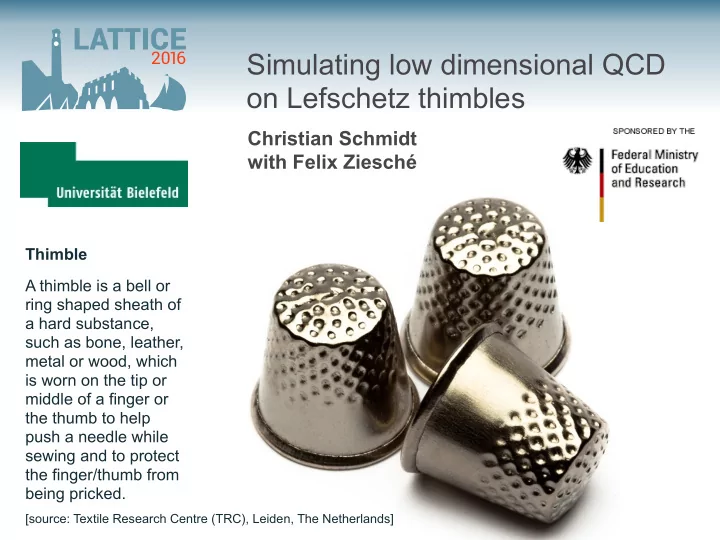
Thimble A thimble is a bell or ring shaped sheath of a hard substance, such as bone, leather, metal or wood, which is worn on the tip or middle of a finger or the thumb to help push a needle while sewing and to protect the finger/thumb from being pricked.

Simulating low dimensional QCD

  • n Lefschetz thimbles

Christian Schmidt with Felix Ziesché

[source: Textile Research Centre (TRC), Leiden, The Netherlands]

slide-2
SLIDE 2

LATTICE

2016

  • C. Schmidt, Lattice 2016, Southampton, UK

2

Motivation: The QCD sign problem

The QCD partition function

Z(T, V, m, µ) = Z DU detM[U] | {z } e−SG[U]

complex for µ > 0

302

  • 1. Barbour et al. / Simulations of lattice QCD

/d,a

(a)

0.3

*( 0.0

I

0.5

Re 5,

I

1.0

/.La

(b)

0.6

.< 0.0 0.5 1.0

Re 5,

  • Fig. 2. The distribution of eigenvalues )t of the Dirac matrix for staggered fermions at fl = 0. Shown are

the eigenvalues obtained from 6 random gauge configurations (fl = 0 quenched) on a 4 3 x g lattice for different values of the chemical potential, t* = 0.3 (a), 0,6 (b), 0.9 (c), and 1,2 (d).

[det M(µ)]∗ = det M(−µ∗)

  • standard MC techniques not applicable
  • highly oscillatory integral with

exponentially large cancellations Lattice Dirac spectrum

Barbour et al., 1986 Muroya et al., 2003

T = 0 T > 0 43 × 8 44

slide-3
SLIDE 3

LATTICE

2016

  • C. Schmidt, Lattice 2016, Southampton, UK

3

Idea: Deforming the domain of integration

Standard 1d-example: the Airy integral Ai[1] = 1 2π Z ∞

−∞

dx exp ⇢ i ✓x3 3 + x ◆

  • 6
  • 4
  • 2

2 4 6

  • 6
  • 4
  • 2

2 4 6 J1 real domain

  • 1
  • 0.5

0.5 1

  • 6
  • 4
  • 2

2 4 6 Re[exp(-S)] along real domain 0.1 0.2 0.3 0.4 0.5 0.6

  • 6
  • 4
  • 2

2 4 6 Re[exp(-S)] along J1

x → z = x + iy z numerical integration easy! numerical integration hopeless!

see also Witten: 1001.2933, 1009.6032

slide-4
SLIDE 4

LATTICE

2016

  • C. Schmidt, Lattice 2016, Southampton, UK

4

  • 6
  • 4
  • 2

2 4 6

  • 6
  • 4
  • 2

2 4 6 J1 real domain

x → z = x + iy z

see also Witten: 1001.2933, 1009.6032

Idea: Deforming the domain of integration

Standard 1d-example: the Airy integral Ai[1] = 1 2π Z ∞

−∞

dx exp ⇢ i ✓x3 3 + x ◆

  • use the real valued function

as a Morse function SR(z) = Re[−i(z3/3 + z)] Theory behind: Picard-Lefschetz theory

slide-5
SLIDE 5

LATTICE

2016

  • C. Schmidt, Lattice 2016, Southampton, UK

5 x → z = x + iy z

see also Witten: 1001.2933, 1009.6032

Idea: Deforming the domain of integration

Theory behind: Picard-Lefschetz theory

  • 6
  • 4
  • 2

2 4 6

  • 6
  • 4
  • 2

2 4 6 J1 real domain

σ1 σ2

  • find all separated saddle points ( )

Standard 1d-example: the Airy integral Ai[1] = 1 2π Z ∞

−∞

dx exp ⇢ i ✓x3 3 + x ◆

  • use the real valued function

as a Morse function SR(z) = Re[−i(z3/3 + z)] σi

slide-6
SLIDE 6

LATTICE

2016

  • C. Schmidt, Lattice 2016, Southampton, UK

6 x → z = x + iy z

see also Witten: 1001.2933, 1009.6032

Idea: Deforming the domain of integration

σ1 σ2

  • 6
  • 4
  • 2

2 4 6

  • 6
  • 4
  • 2

2 4 6 J1,J2 K1,K2 real domain

  • associated with each saddle point ( ),

find one stable ( ) and one unstable thimble ( ) as solutions of the steepest descent/ascent flow equation σi Ji Ki dz dt = ⌥rSR(z) J1 J2 K2 K1 Standard 1d-example: the Airy integral Ai[1] = 1 2π Z ∞

−∞

dx exp ⇢ i ✓x3 3 + x ◆

  • find all separated saddle points ( )

σi

  • use the real valued function

as a Morse function SR(z) = Re[−i(z3/3 + z)] (note: remains

  • const. along flow)

SI(z) Theory behind: Picard-Lefschetz theory

slide-7
SLIDE 7

LATTICE

2016

  • C. Schmidt, Lattice 2016, Southampton, UK

7 x → z = x + iy z

see also Witten: 1001.2933, 1009.6032

Idea: Deforming the domain of integration

σ1 σ2

  • 6
  • 4
  • 2

2 4 6

  • 6
  • 4
  • 2

2 4 6 J1,J2 K1,K2 real domain

  • associated with each saddle point ( ),

find one stable ( ) and one unstable thimble ( ) as solutions of the steepest descent/ascent flow equation σi Ji Ki dz dt = ⌥rSR(z) J1 J2 K2 K1 Standard 1d-example: the Airy integral Ai[1] = 1 2π Z ∞

−∞

dx exp ⇢ i ✓x3 3 + x ◆

  • decompose original integral into thimbles
  • find all separated saddle points ( )

σi

  • use the real valued function

as a Morse function SR(z) = Re[−i(z3/3 + z)] (note: remains

  • const. along flow)

SI(z) (here: ) n1 = 1, n2 = 0, SI(σ1) = 0 Theory behind: Picard-Lefschetz theory Z

R

dz e−S(z) = X

i

ni e−SI(σi) Z

Ji

dz e−SR(z)

slide-8
SLIDE 8

LATTICE

2016

  • C. Schmidt, Lattice 2016, Southampton, UK

8

Idea: Deforming the domain of integration

Original domain of integration Ux,ν ∈ SU(3) real dim. 4 × V × 8 ˜ Ux,ν ∈ SL(3, C) 4 × V × 8 × 2 real dim. Complexified space New domain(s) of integration: Lefschetz thimble U = exp ( −i X

a

ωaTa ) J0 := n ˜ Ux,ν | U(τ) is solution of the SD equation with U(0) = ˜ Ux,ν U(τ → ∞) = N and

  • N

here denotes the gauge orbit of the unity configuration real dim. 4 × V × 8 U 4V ˜ U 4V J0 + J1 + · · ·

slide-9
SLIDE 9

LATTICE

2016

  • C. Schmidt, Lattice 2016, Southampton, UK

9

Open questions:

How many relevant thimbles are there in full QCD? How to sample them?

  • Langevin on the thimble (Aurora-algorithm)

Cristoforetti et al., PRD 86 (2012) 074506

  • HMC on the thimble

Fujii et al., JHEP 1310 (2013) 147

  • Use a map of the thimble (projection-, contraction-algorithm)
  • A. Mukherjee et al., PRD 88 (2013) 051502; A. Alexandru et. al., PRD 93 (2016) 014504
  • Sample SD paths on the thimble

Di Renzo et al., PRD 88 (2013) 051502

slide-10
SLIDE 10

LATTICE

2016

  • C. Schmidt, Lattice 2016, Southampton, UK

10

Open questions:

How many relevant thimbles are there in full QCD? How to sample them? How to combine results from different thimbles?

  • input a number of physical quantities to determine relative weights

Xi = ⌦ eiφOi ↵

0 + α1

⌦ eiφOi ↵

1 + α2

⌦ eiφOi ↵

2

heiφi0 + α1 heiφi1 + α2 heiφi2 i = 1, 2 αi = nieSI(σi)Zi n0eSI(σ0)Z0 , ,

Di Renzo et al., PRD 88 (2013) 051502

here denotes the residual phase (see ) φ

Cristoforetti et al., PRD 89 (2014) 114505

slide-11
SLIDE 11

LATTICE

2016

  • C. Schmidt, Lattice 2016, Southampton, UK
  • 1.5
  • 1.0
  • 0.5

0.0 0.5 1.0 1.5 0.60 0.65 0.70 0.75 Re

  • Im
  • T=0.01

T=0.05 T=0.5

  • 1.0
  • 0.5

0.0 0.5 1.0

  • 4
  • 2

2 4 Re ( )far SR

11

Open questions:

How many relevant thimbles are there in full QCD? How to sample them? How to combine results from different thimbles?

  • input a number of physical quantities to determine relative weights
  • sample multiple thimbles at once, or one manifold that comes

arbitrary close to multiple thimbles

  • A. Alexandru et. al., JHEP 1605 (2016) 053
slide-12
SLIDE 12

LATTICE

2016

  • C. Schmidt, Lattice 2016, Southampton, UK

12

Open questions:

How many relevant thimbles are there in full QCD? How to sample them? How to combine results from different thimbles? How to deal with the gauge orbits?

  • perform simulations in a fixed gauge
  • make use of the gauge gauge transformations
slide-13
SLIDE 13

LATTICE

2016

  • C. Schmidt, Lattice 2016, Southampton, UK

13

Systems studied so far:

  • theory

φ4

Cristoforetti et al., PRD 88 (2013) 051501; Fujii et al., JHEP 1310 (2013) 147

Hubbard model, one-site Hubbard model

  • A. Mukherjee et al., PRD 88 (2013) 051502

Cristoforetti et al., PRD 89 (2014) 114505

(0+1)dim. Thirring model

Fujii et al., JHEP 1511 (2015) 078; Fujii et al., JHEP 1512 (2015) 125;

Chiral random matrix model

Di Renzo et al., PRD 88 (2013) 051502

. . .

(also applications to QM-systems in real time)

slide-14
SLIDE 14

LATTICE

2016

  • C. Schmidt, Lattice 2016, Southampton, UK

14

Agenda:

QCD in (0+1) dim. with std. staggered quarks

  • simulations in Polyakov loop diagonal form
  • simulations with a general Polyakov loop

QCD in (n+1) dim. with std. staggered quarks

  • simulations at strong coupling
  • simulations away from strong coupling
slide-15
SLIDE 15

LATTICE

2016

  • C. Schmidt, Lattice 2016, Southampton, UK

15

Agenda:

QCD in (0+1) dim. with std. staggered quarks

  • simulations in Polyakov loop diagonal form
  • simulations with a general Polyakov loop

QCD in (n+1) dim. with std. staggered quark

  • simulations at strong coupling
  • simulations away from strong coupling

}

this talk :-)

}

not yet :-(

slide-16
SLIDE 16

LATTICE

2016

  • C. Schmidt, Lattice 2016, Southampton, UK

16

(0+1) dimensional QCD

partition function in the reduced form diagonalize Polyakov loop P = diag(eiθ1, eiθ2, e−i(θ1+θ2)) J(θ1, θ2) = 8 3π2 sin2 ✓θ1 − θ2 2 ◆ sin2 ✓2θ1 + θ2 2 ◆ sin2 ✓θ1 + 2θ2 2 ◆ Z(Nf ) = Z dθ1dθ2 e−Seff (Nf ,θ1,θ2)

Ammon et al., arXiv:1607.05027

(see e.g. )

Bilic et al. Phys. Lett. B212 (1988) 83

Seff = −(ln J + Tr ln D) Z(Nf ) = Z dP detNf [A + eµ/T P + e−µ/T P −1] | {z } D A = 2 cosh(ˆ µc)13 ˆ µc = arcsinh( ˆ m)

slide-17
SLIDE 17

LATTICE

2016

  • C. Schmidt, Lattice 2016, Southampton, UK

17

(0+1) dimensional QCD

find saddle points: minimize , with

  • 4
  • 2

2 4

  • 4
  • 2

2 4 Re(1) Re(2)

µ/T = 0 m/T = 0.2

0.05 0.1 0.15 0.2 1 2 3 4 5 6 µ/T 0.1 · Re(1) Im(1)

  • 0.09
  • 0.08
  • 0.07
  • 0.06
  • 0.05
  • 0.04
  • 0.03
  • 0.02
  • 0.01

0.01 1 2 3 4 5 6 µ/T Re(2) Im(2)

  • thimbles are separated by lines of zero probability (infinite action)
  • saddle points are -dependent

µ

  • all thimbles are equivalent (give the same contribution)

||rzSR

eff||

z = (Reθ1, Reθ2, Imθ1, Imθ2)t

slide-18
SLIDE 18

LATTICE

2016

  • C. Schmidt, Lattice 2016, Southampton, UK

18

(0+1) dimensional QCD

find tangent space of the thimble at the saddle points: diagonalize hessian (at the saddle point) ∂zi∂zjSR

eff

  • eigenvectors with positive eigenvalues span the tangent space

sample the thimble using the contraction algorithm ( )

  • A. Alexandru et. al., PRD 93 (2016) 014504

< O >= Z dz O(z)e−Seff (z) = Z d¯ z detJ O(z(¯ z)) e−Seff (z(¯

z))

  • are elements of the tangent space

¯ z

  • is defined by flowing along the SA for a fixed time T (note: the SA flow is

numerically stable) z(¯ z) ¯ z

  • is the Jacobian, which is in practice obtained by transporting a

P (z) parallelepipet along the SA flow: detJ = detP (z(¯ z))/detP (¯ z) Jij = ∂zi/∂¯ zj

  • has a complex phase (residual phase), sample according to |detJ|e−SR

eff

detJ and take the residual phase into account by reweighting

slide-19
SLIDE 19

LATTICE

2016

  • C. Schmidt, Lattice 2016, Southampton, UK

19

(0+1) dimensional QCD

find tangent space of the thimble at the saddle points: diagonalize hessian (at the saddle point) ∂zi∂zjSR

eff

  • eigenvectors with positive eigenvalues span the tangent space

sample the thimble using the contraction algorithm ( )

  • A. Alexandru et. al., PRD 93 (2016) 014504
  • 1
  • 0.5

0.5 1 1 1.5 2 2.5

  • uter points

inner points

  • 0.1
  • 0.05

0.05 0.1 1.5 1.52 1.54 1.56 1.58 1.6 1.62 1.64 1.66 1.68 1.7

  • uter points

inner points

T = 0.7 flow time:

slide-20
SLIDE 20

LATTICE

2016

  • C. Schmidt, Lattice 2016, Southampton, UK

20

(0+1) dimensional QCD

results for the Polyakov loop:

  • exact results are reproduced
  • only one relevant thimble found

0.1 0.2 0.3 0.4 0.5 0.6 0.7 0.8 0.9 0.5 1 1.5 2 2.5 3 Re Tr[P] µ/T exact thimble-MC

slide-21
SLIDE 21

LATTICE

2016

  • C. Schmidt, Lattice 2016, Southampton, UK

21 sample non-diagonal Polyakov loops fist step: find saddle points (now in 16 dim.)

  • 5

5 10 15 20

  • 25
  • 20
  • 15
  • 10
  • 5

5 10 15 20 25 m=0.0

  • 5
  • 4
  • 3
  • 2
  • 1

1 2 3

  • 25
  • 20
  • 15
  • 10
  • 5

5 10 15 20 25 m=0.1

(0+1) dimensional QCD

µ/T = 0 SR

eff

SR

eff

  • find 3 thimbles, related to Z(3) symmetry

Re ω8 Re ω8 P = exp ( −i X

a

ωaTa )

  • at m=0, the thimbles are separated by singular points
slide-22
SLIDE 22

LATTICE

2016

  • C. Schmidt, Lattice 2016, Southampton, UK

22 sample non-diagonal Polyakov loops fist step: find saddle points (now in 16 dim.)

(0+1) dimensional QCD

P = exp ( −i X

a

ωaTa )

  • 4
  • 2

2 4 6 8

  • 20
  • 15
  • 10
  • 5

5 10 15 20 mu=0.03

  • 4
  • 2

2 4 6 8

  • 20
  • 15
  • 10
  • 5

5 10 15 20 mu=0.05

  • 4
  • 2

2 4 6 8

  • 20
  • 15
  • 10
  • 5

5 10 15 20 mu=0.08

am = 0.1

  • 4
  • 2

2 4 6 8

  • 20
  • 15
  • 10
  • 5

5 10 15 20 mu=0.1

  • 4
  • 2

2 4 6 8

  • 20
  • 15
  • 10
  • 5

5 10 15 20 mu=0.13

  • 4
  • 2

2 4 6 8

  • 20
  • 15
  • 10
  • 5

5 10 15 20 mu=0.15

Re ω8 Re ω8 Re ω8 Re ω8 Re ω8 Re ω8 SR

eff

SR

eff

SR

eff

SR

eff

SR

eff

SR

eff

slide-23
SLIDE 23

LATTICE

2016

  • C. Schmidt, Lattice 2016, Southampton, UK

23

  • find 3 thimbles, related to Z(3) symmetry
  • at , the thimbles are separated by singular points

sample non-diagonal Polyakov loops fist step: find saddle points (now in 16 dim.) P = exp ( −i X

a

ωaTa )

  • at , the thimbles are separated by singular points

m = µc m = 0

  • saddle points are not -dependent

µ

(0+1) dimensional QCD

second step: diagonalize the hessian

  • implementation is work in progress ...

∂a∂bSR

eff = Tr

⇥ D−1∂a∂bD ⇤ − Tr ⇥ D−1(∂aD)D−1(∂bD) ⇤

slide-24
SLIDE 24

LATTICE

2016

  • C. Schmidt, Lattice 2016, Southampton, UK

24

Summary

  • still many open question in the Lefschetz thimble approach that

need to be clarified before it can be applied to full QCD

  • (0+1) dimensional QCD is doable (at least in the reduced case)
  • (n+1) dimensional QCD will be the next
slide-25
SLIDE 25

LATTICE

2016

  • C. Schmidt, Lattice 2016, Southampton, UK

25

Advertisement 2017 workshop at Simulating QCD with Lefschetz thimbles

Organizers: A. Alexandru, P. Bedaque, CS. to vote for your favored date, goto

http://doodle.com/poll/8beimhb73ih286gq