Last time: Basics of Laurent series A Laurent series is like a power - - PowerPoint PPT Presentation

last time basics of laurent series
SMART_READER_LITE
LIVE PREVIEW

Last time: Basics of Laurent series A Laurent series is like a power - - PowerPoint PPT Presentation

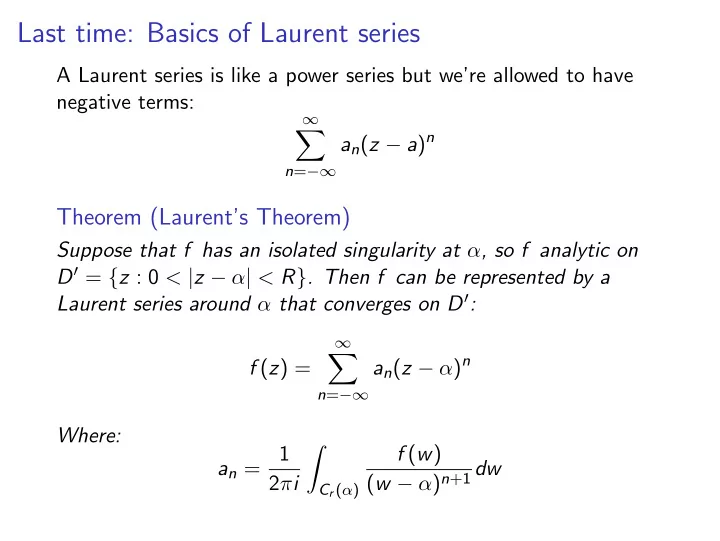
Last time: Basics of Laurent series A Laurent series is like a power series but were allowed to have negative terms: a n ( z a ) n n = Theorem (Laurents Theorem) Suppose that f has an isolated singularity at , so f


slide-1
SLIDE 1

Last time: Basics of Laurent series

A Laurent series is like a power series but we’re allowed to have negative terms:

  • n=−∞

an(z − a)n

Theorem (Laurent’s Theorem)

Suppose that f has an isolated singularity at α, so f analytic on D′ = {z : 0 < |z − α| < R}. Then f can be represented by a Laurent series around α that converges on D′: f (z) =

  • n=−∞

an(z − α)n Where: an = 1 2πi

  • Cr(α)

f (w) (w − α)n+1 dw

slide-2
SLIDE 2

What’s left to cover:

11.5+11.6 Classification of singularities 11.7+11.8 Calculating residues at poles 12+12.1 Residue Theorem 12.2 Application of Residue Theorem to real integrals

Definition (Residue)

Let f have an isolated singularity at α, and Laurent expansion: f (z) =

  • n=−∞

an(z − α)n Then a−1 is called The residue of f at α, and written Res{f ; α}.

Awkward ordering in notes:

The end of 11 is really about finding Residues, but we only care about these because of the Residue Theorem.

slide-3
SLIDE 3

To fix this, changing order of lectures

To motivate the material at the end of Section 11, going to cover the Residue Theorem first. Today Residue Theorem: Proof + first examples Thursday Classifying Singularities + finding residues Next Tuesday Applying Residue Theorem to real integrals Next Thursday Revision; focus on last two weeks The material next lecture will make applying Residue Theorem easier in nice cases.

slide-4
SLIDE 4

Theorem (The Residue Theorem)

Let D be a simply connected region containing a simple positively

  • riented contour γ. Suppose f is analytic on D except for finitely

many singularities β1, . . . , βn, none of which like on γ. Then

  • γ

f (z)dz = 2πi × (sum of the residues of f at the βi inside γ)

Proof.

The proof is really putting together things we’ve already done:

◮ Deform contour so one singularity in each piece ◮ Expand f in Laurent series ◮ Use formula for a−1 / our first important example

slide-5
SLIDE 5

Every mother on Christmas morning Every lecturer when they prove the big theorem of the module

slide-6
SLIDE 6

Using the Residue Theorem

Show you understand and check hypotheses!

  • 1. Find the bad points (isolated singularities) βi of f
  • 2. Draw picture showing γ and bad points to see which are inside
  • 3. Find the residues at the bad points inside γ

Examples; let c = 5eit (0 ≤ t ≤ 2π)

1.

  • c

dz z2(z−3)3

2.

  • c

dz tan(z)

3.

  • c z3 cos(1/z)dz

Take-away:

Using Residue Theorem from definition can be slightly painful; can we find residue without finding whole Laurent expansion?