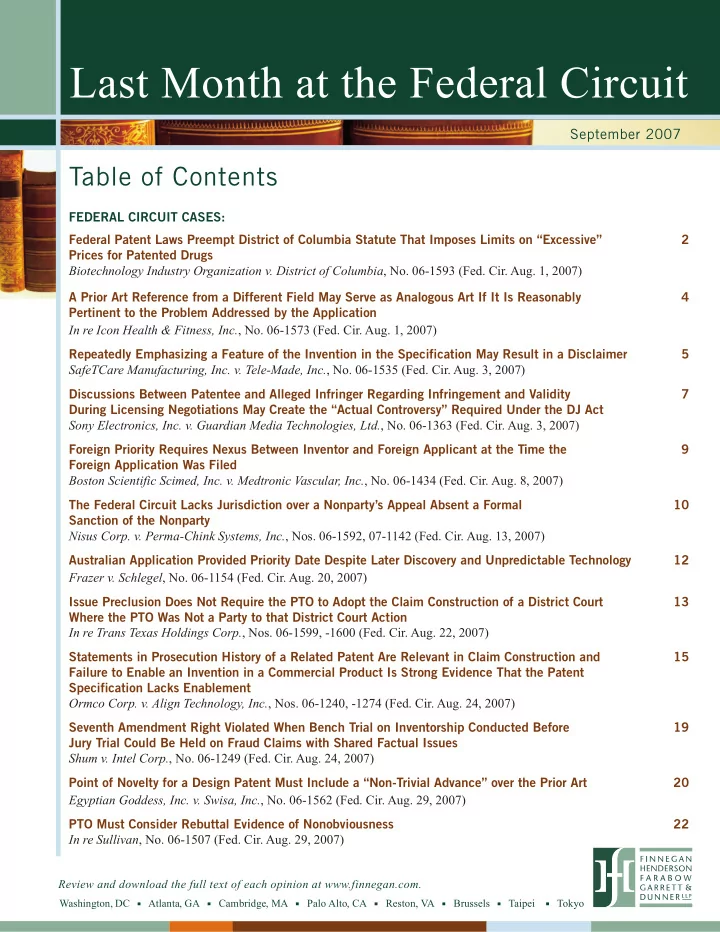
Last Month at the Federal Circuit September 2007 Table of Contents - - PDF document

last month at the federal circuit
SMART_READER_LITE
LIVE PREVIEW

Last Month at the Federal Circuit September 2007 Table of Contents - - PDF document

Last Month at the Federal Circuit September 2007 Table of Contents FEDERAL CIRCUIT CASES: Federal Patent Laws Preempt District of Columbia Statute That Imposes Limits on Excessive 2 Prices for Patented Drugs Biotechnology Industry


slide-1
SLIDE 1

September 2007

Last Month at the Federal Circuit

Washington, DC

■ Atlanta, GA ■ Cambridge, MA ■ Palo Alto, CA ■ Reston, VA ■ Brussels ■ Taipei ■ Tokyo

Review and download the full text of each opinion at www.finnegan.com.

Table of Contents

FEDERAL CIRCUIT CASES: Federal Patent Laws Preempt District of Columbia Statute That Imposes Limits on “Excessive” 2 Prices for Patented Drugs Biotechnology Industry Organization v. District of Columbia, No. 06-1593 (Fed. Cir. Aug. 1, 2007) A Prior Art Reference from a Different Field May Serve as Analogous Art If It Is Reasonably 4 Pertinent to the Problem Addressed by the Application In re Icon Health & Fitness, Inc., No. 06-1573 (Fed. Cir. Aug. 1, 2007) Repeatedly Emphasizing a Feature of the Invention in the Specification May Result in a Disclaimer 5 SafeTCare Manufacturing, Inc. v. Tele-Made, Inc., No. 06-1535 (Fed. Cir. Aug. 3, 2007) Discussions Between Patentee and Alleged Infringer Regarding Infringement and Validity 7 During Licensing Negotiations May Create the “Actual Controversy” Required Under the DJ Act Sony Electronics, Inc. v. Guardian Media Technologies, Ltd., No. 06-1363 (Fed. Cir. Aug. 3, 2007) Foreign Priority Requires Nexus Between Inventor and Foreign Applicant at the Time the 9 Foreign Application Was Filed Boston Scientific Scimed, Inc. v. Medtronic Vascular, Inc., No. 06-1434 (Fed. Cir. Aug. 8, 2007) The Federal Circuit Lacks Jurisdiction over a Nonparty’s Appeal Absent a Formal 10 Sanction of the Nonparty Nisus Corp. v. Perma-Chink Systems, Inc., Nos. 06-1592, 07-1142 (Fed. Cir. Aug. 13, 2007) Australian Application Provided Priority Date Despite Later Discovery and Unpredictable Technology 12 Frazer v. Schlegel, No. 06-1154 (Fed. Cir. Aug. 20, 2007) Issue Preclusion Does Not Require the PTO to Adopt the Claim Construction of a District Court 13 Where the PTO Was Not a Party to that District Court Action In re Trans Texas Holdings Corp., Nos. 06-1599, -1600 (Fed. Cir. Aug. 22, 2007) Statements in Prosecution History of a Related Patent Are Relevant in Claim Construction and 15 Failure to Enable an Invention in a Commercial Product Is Strong Evidence That the Patent Specification Lacks Enablement Ormco Corp. v. Align Technology, Inc., Nos. 06-1240, -1274 (Fed. Cir. Aug. 24, 2007) Seventh Amendment Right Violated When Bench Trial on Inventorship Conducted Before 19 Jury Trial Could Be Held on Fraud Claims with Shared Factual Issues Shum v. Intel Corp., No. 06-1249 (Fed. Cir. Aug. 24, 2007) Point of Novelty for a Design Patent Must Include a “Non-Trivial Advance” over the Prior Art 20 Egyptian Goddess, Inc. v. Swisa, Inc., No. 06-1562 (Fed. Cir. Aug. 29, 2007) PTO Must Consider Rebuttal Evidence of Nonobviousness 22 In re Sullivan, No. 06-1507 (Fed. Cir. Aug. 29, 2007)

slide-2
SLIDE 2

Federal Patent Laws Preempt District of Columbia Statute That Imposes Limits on “Excessive” Prices for Patented Drugs

Mary K. Ferguson Judges: Bryson, Plager, Gajarsa (author) [Appealed from D.D.C., Judge Leon] In Biotechnology Industry Organization v. District

  • f Columbia, No. 06-1593 (Fed. Cir. Aug. 1,

2007), the Federal Circuit affirmed the district court’s ruling that the District of Columbia’s (“the District” or “D.C.”) Prescription Drug Excessive Price Act of 2005, codified at D.C. Code § 28-4551 to 28-4555 (“the Act”), is preempted by federal patent laws, and affirmed an injunction that prevents its enforcement. This case arises from an industry challenge to D.C. City Council legislation that prohibits selling any patented drug in the District for an excessive

  • price. While the term “excessive price” is not

expressly defined in the Act, the statute provides that a prima facie case of excessive pricing exists when “the wholesale price of a patented prescription drug in the District is over 30% higher than the comparable price in any high income country in which the product is protected by patents or other exclusive marketing rights.” D.C. Code § 28-4554(a). The United Kingdom, Germany, Canada, and Australia are, by definition, high income countries. Shortly after the legislation was approved, the Pharmaceutical Research and Manufacturers of America (“PhRMA”) and the Biotechnology Industry Organization (“BIO”) filed separate DJ lawsuits in the U.S. District Court for the District

  • f Columbia to challenge the legality of the
  • statute. The plaintiffs alleged that the Act is

preempted by the patent laws, invalid in light of the Commerce Clause, and preempted by the Foreign Commerce Clause. After consolidating the actions, the district court determined that the plaintiffs represent members who complained of “realistic and imminent injuries,” establishing their standing to sue. The district court then held that the Act is preempted by the patent laws and that it is invalidated by the Commerce Clause to the extent that the price limitation applies to

2 September 2007

  • In Biotechnology Industry Organization v. District of Columbia, No. 06-1593 (Fed. Cir. Aug. 1, 2007), the Federal

Circuit affirmed a judgment of the U.S. District Court for the District of Columbia, holding that the District of Columbia’s Prescription Drug Excessive Price Act of 2005, which prohibits selling any patented drug in the District for an excessive price, is preempted by federal patent laws. The Court also affirmed an injunction that prevents the Act’s

  • enforcement. See the full summary in this issue.
  • Also in this month’s issue, in Sony Electronics, Inc. v. Guardian Media Technologies, Ltd., No. 06-1363 (Fed. Cir.
  • Aug. 3, 2007), the Federal Circuit once again addressed the issue of what is required for jurisdiction under the DJ Act.

Specifically, the Federal Circuit vacated the district court’s dismissals of several DJ actions and remanded for the district court to determine in its discretion whether to entertain them. In vacating and remanding to the district court, the Federal Circuit noted that it has “made clear that a [DJ] plaintiff does not need to establish a reasonable apprehension of a lawsuit in order to establish that there is an actual controversy between the parties.” Slip op. at 22. Instead, the Court noted that “jurisdiction may be met where the patentee takes a position that puts the [DJ] plaintiff in the position of either pursuing arguably illegal behavior or abandoning that which he claims a right to do.” Id. at 23 (citation omitted). The Court also rejected the patentee’s argument that there can be no jurisdiction in the courts because it was at all times willing to negotiate a “business resolution” to the dispute.

Spotlight Info

“The underlying determination about the proper balance between innovators’ profit and consumer access to medication . . . is exclusively one for Congress to make.” Slip op. at 18. “[When] the plaintiffs’ claim is created by principles of supremacy law, its resolution necessarily requires us to construe the patent statutes.

  • Id. at 7.
slide-3
SLIDE 3

transactions between parties not located within the District’s borders. The district court also held that while the Foreign Commerce Clause does not preempt the Act, it prevents establishing an “excessive price” based on the price of the same drug in a foreign country. The district court therefore enjoined enforcement of the Act. The District appealed the patent law and Foreign Commerce Clause rulings to the U.S. Court of Appeals for the District of Columbia Circuit, but did not challenge the Commerce Clause ruling. On an unopposed motion by the District, the appeal was transferred to the Federal Circuit. Before reaching the questions on appeal, the Federal Circuit sua sponte raised the issue of whether the Federal Circuit, rather than the District of Columbia Circuit, has jurisdiction to decide the case. Summarizing the law on its subject matter jurisdiction, the Federal Circuit noted that a well-pleaded complaint must state a claim arising under the patent laws to establish Federal Circuit jurisdiction. The complaint must include a claim, not merely a defense to a claim, that is created by the patent laws or for which a party’s right to relief necessarily depends on resolution of a substantial question of federal patent law. In this instance, the plaintiffs sought an injunction to prevent enforcement of the Act. The Federal Circuit determined that a claim to enjoin enforcement of a state or local statute on the ground that it is preempted by the federal patent laws presents a claim arising under the patent laws. Specifically, the Federal Circuit found that the plaintiffs had pleaded a claim in which interpretation of a patent law will decide their right to relief and that patent law is a necessary element of the claim. It therefore found that the patent law preemption claim brought the case within Federal Circuit jurisdiction. To complete the jurisdictional analysis, the Federal Circuit next considered whether PhRMA and BIO had standing to challenge the Act. Applying the standard articulated in United Food & Commercial Workers Union Local 751 v. Brown Group, Inc., 517 U.S. 544, 553 (1996), the Federal Circuit first determined that the claims seek to address interests related to the associations’ purpose and that member participation is not required to decide the claims or to grant relief. Further, the Federal Circuit determined that the associations each represent at least one member that has standing in its own right, i.e., the member is suffering immediate or threatened redressable injury that is caused by the Act. In reaching this conclusion, the Federal Circuit noted that the findings and legislative history of the Act indicate that current prices of specific patented drugs do not meet a codified standard for a prima facie “excessive price,” indicating that association members are at imminent risk for enforcement. Because this imminent injury flows directly from the Act and an injunction would prevent the injury from

  • ccurring, the Federal Circuit found that PhRMA

and BIO have standing to bring suit. The Federal Circuit then turned to the question of whether the patent laws preempt the District’s attempt to regulate the price of patented goods. Preemption is decided under Federal Circuit law by evaluating the objectives of the federal patent laws, which are defined in Article I, Section 8, Clause 8 of the Constitution (“To promote the Progress of Science and useful Arts, by securing for limited Times to Authors and Inventors the exclusive Right to their respective Writings and Discoveries.”). The Federal Circuit reasoned that Congress has established a statutory scheme in the patent laws that is consistent with the constitutional objectives, and that enhanced profits are central to Congress’s statutory incentives. As part of its mandate to promulgate patent policy, Congress is charged with balancing disparate goals “to reward innovators with higher profits and to keep prices reasonable for consumers,” the Federal Circuit explained. Slip op. at 17. Thus, the Federal Circuit concluded that the District’s Act is an attempt to rebalance the statutory framework of incentives and rewards by limiting the prices of new prescription drugs. Finding that this is contrary to the goals established by Congress in enacting the patent laws, the Federal Circuit held that the patent laws preempt the Act. The Federal Circuit declined to reach the alternative argument for preemption under the Foreign Commerce Clause, and affirmed the district court’s injunction against the Act’s enforcement.

3 Last Month at the Federal Circuit

slide-4
SLIDE 4

A Prior Art Reference from a Different Field May Serve as Analogous Art If It Is Reasonably Pertinent to the Problem Addressed by the Application

Cathy C. Ding Judges: Mayer, Schall, Prost (author) [Appealed from the Board] In In re Icon Health & Fitness, Inc., No. 06-1573 (Fed. Cir. Aug. 1, 2007), the Federal Circuit affirmed the Board’s decision holding claims of Icon Health and Fitness, Inc.’s (“Icon”) U.S. Patent

  • No. 5,676,624 (“the ’624 patent”) unpatentable as
  • bvious.

Icon owns the ’624 patent and sought reexamination by the PTO. The ’624 patent claims a treadmill with a folding base, allowing the base to swivel into an upright storage position. Claim 1, from which all other claims at issue depend, requires a gas spring “to assist in stably retaining” the tread base in an upright position. During reexamination, the PTO rejected Icon’s claims as obvious under 35 U.S.C. § 103(a) based

  • n a combination of an advertisement for a folding

treadmill by Damark International, Inc. (“Damark”) and U.S. Patent No. 4,370,766 to Teague, Jr. (“Teague”), which discloses gas springs for a folding bed. Icon appealed to the Board, which affirmed. In so doing, it rejected Icon’s argument that Teague was not analogous art and held that Teague’s teachings fell within the broad scope of Icon’s claims. Icon appealed. On appeal, the Federal Circuit noted that Icon had not challenged the Board’s finding that Damark demonstrated all claim elements other than the gas

  • spring. It noted that the present inquiry, therefore,

focused on Teague’s disclosure of gas springs and the applicability of Teague to Icon’s invention. The Court observed that although neither party argued for any particular construction of the gas spring limitation, each party’s obviousness argument turned on the breadth of that limitation. It explained that during reexamination, as with

  • riginal examination, the PTO must give claims

their broadest reasonable construction consistent with the specification. The Court noted that the Board found that claim 1 did not limit the degree

  • r manner in which the gas spring assists in stably

retaining the tread base. It rejected Icon’s argument that the gas spring must provide a force continuing to urge the mechanism closed when in the closed position. The Court reasoned that the specification of the ’624 patent provided only minimal discussion of the gas springs and the phrase “stably retain.” It further noted that because Icon could have amended its claims to more clearly define “stably retain” and did not do so, it now must submit to the Board’s

  • interpretation. Accordingly, given the “little

guidance” in the specification, the Court concluded that the Board’s construction properly represented the broadest reasonable construction and that Icon’s claims encompassed “everything reasonably seen to assist in stably retaining the tread base.” Slip op. at 6. Using this claim interpretation, the Court next analyzed the Board’s factual findings and conclusion of obviousness. Icon argued that Teague fell outside the “treadmill art” since it was directed to a folding bed and that it addressed a different problem than its application, removing it from the relevant prior art. The Federal Circuit

  • disagreed. The Court reasoned that Teague may

serve as analogous art if it was “reasonably pertinent to the problem addressed by Icon.”

  • Id. at 7. The Court noted that a “reference is

reasonably pertinent if, even though it may be in a different field from that of the inventor’s endeavor, it is one which, because of the matter with which it deals, logically would have commended itself to an inventor’s attention in considering his problem.” Id. (citation omitted). Applying these principles, the Court found that nothing about Icon’s folding mechanism required any particular focus on treadmills and that Icon’s application rather generally addressed problems of supporting the weight of such a mechanism and providing a stable resting position. The Court reasoned that “[a]nalogous art to Icon’s application, when considering the folding mechanism and gas spring limitation, may come from any area describing hinges, springs, latches, counterweights, or other

4 September 2007

slide-5
SLIDE 5

similar mechanisms—such as the folding bed in Teague.” Id. at 8. Accordingly, the Court concluded that substantial evidence supported the Board’s finding that Teague provided analogous art. The Court also found that several factors supported the Board’s conclusion of obviousness. In particular, the Court noted that a variety of sources may have led one skilled in the art to combine the teachings of Damark and Teague. “[A]ny need or problem known in the field of endeavor at the time of invention and addressed by the patent can provide a reason for combining the elements in the manner claimed,” stated the Court.

  • Id. (quoting KSR Int’l Co. v. Teleflex, Inc.,

127 S. Ct. 1727, 1742 (2007)). The Court

  • bserved that Teague provided an example of a

mechanism clearly satisfying Icon’s gas spring claim limitation. It explained that “while perhaps not dispositive of the issue, the finding that Teague, by addressing a similar problem, provides analogous art to Icon’s application goes a long way towards demonstrating a reason to combine the two references.” Id. at 9. It noted that because Icon’s broad claims read on embodiments addressing that problem as described by Teague, the prior art here indicated a reason to incorporate its teachings. In addition, the Court noted that “[t]he striking similarity between Icon’s application and Teague clearly illustrate[d] the similarity of problems they address[ed] and solutions to that problem, further supporting the idea that one skilled in the art would combine Teague with Damark.” Id. at 9-10. Accordingly, the Court concluded that these connections between Teague and Icon’s application provided a sufficient basis to conclude that one skilled in the art would combine the teachings of Teague and Damark. Finally, the Court rejected Icon’s argument that Teague taught away from Icon’s invention. It

  • bserved that to the contrary, one skilled in the art

would naturally look to Damark and Teague, finding reason to combine them and that the combination would produce a device meeting all

  • f Icon’s claim limitations. The Court, therefore,

affirmed the Board’s holding of obviousness.

Repeatedly Emphasizing a Feature of the Invention in the Specification May Result in a Disclaimer

Adriana L. Burgy Judges: Michel, Gajarsa (author), Robinson (District Judge sitting by designation) [Appealed from S.D. Tex., Judge Gilmore] In SafeTCare Manufacturing, Inc. v. Tele-Made, Inc., No. 06-1535 (Fed. Cir. Aug. 3, 2007), the Federal Circuit affirmed the district court’s grant

  • f SJ of noninfringement, holding that the patentee

had disavowed certain features in the specification precluding a finding of literal or DOE infringement. SafeTCare Manufacturing, Inc. (“SafeTCare”) sued seven defendants alleging infringement

  • f SafeTCare’s U.S.

Patent No. 6,357,065 (“the ’065 patent”). The ’065 patent is directed to a variable width bariatric modular bed that is particularly suitable for use by

  • bese patients.

Specifically, the bariatric bed disclosed in the ’065 patent is able to lift three times the weight of a typical hospital bed and is also wider, enabling better support for large patients. SafeTCare asserted infringement only of claim 12 of the ’065 patent. That claim recites, inter alia, “a plurality of electric motors carried by said frame and coupled to . . . deck sections for exerting a pushing force on said . . . deck sections . . . .” Slip op. at 3 (emphasis added). The parties agreed that the term “pushing force” in claim 12 meant “a physical force applied in a

5 Last Month at the Federal Circuit

“[Because] the written description repeatedly emphasizes that the motor

  • f the patented invention

applies a pushing force, not a pulling force . . . , we are persuaded by the language used by the patentee that the invention disclaims motors that use pulling forces . . . .” Slip op. at 12-13.

slide-6
SLIDE 6

6 September 2007

direction away from the body exerting it.” Id. at 4. The district court subsequently issued an order construing the term in the same manner. Two of the defendants then moved separately for SJ of

  • noninfringement. The district court granted both

motions, docketed a “Final Judgment,” and dismissed the action. SafeTCare appealed. On appeal, the Federal Circuit initially addressed the issue of whether it had jurisdiction. The Court noted that the parties had failed to determine the finality of the appealed judgment. It observed that the district court had not dismissed all the claims and counterclaims of all the defendants. The Court explained that “a statement by the district court that the judgment is final is by itself insufficient to establish [its] appellate jurisdiction . . . .” Id. at 6. Instead, the Court explained that it has appellate jurisdiction pursuant to 28 U.S.C. § 1295(a)(1)

  • nly “from a final decision of a district court” and

that for a judgment to be appealable to the Federal Circuit, “the district court must issue a judgment that decides or dismisses all claims and counterclaims for each party or that makes an express . . . determination under [Fed. R. Civ. P. 54(b)] that there is no just reason for delay.”

  • Id. at 6-7.

The Court explained that because litigation on the merits remained pending in the district court, the parties’ reliance on the district court’s order labeled “Final Judgment” was misplaced. It noted that the judgment standing alone as issued by the district court was insufficient to establish dismissal

  • f the entire action and, therefore, it could not be

the basis for providing it with subject matter

  • jurisdiction. Accordingly, the Court notified the

parties before oral argument that they had failed to comply with Federal Rule of Appellate Procedure 28, which requires that an appellant establish the basis for the Court’s jurisdiction on appeal, and that there was no final decision providing for appellate jurisdiction pursuant to § 1295(a)(1). As a result, the district court entered a final judgment nunc pro tunc pursuant to Rule 54(b). The Federal Circuit explained that as a result of the district court’s Rule 54(b) judgment, it was vested with jurisdiction over the appeal. The Court next turned to the merits of the appeal. It observed that the source of disagreement between the parties was not a factual issue. Rather, it was a question of claim construction. Specifically, noted the Court, the question was whether the limitation in claim 12 of a motor “exerting a pushing force on said . . . deck sections” included within its scope a motor that indirectly exerts a force on the deck section and away from the motor. Specifically, the defendant argued that claim 12 did not include a motor that exerted a pulling force. The Court resolved this issue by looking to the specification of the ’065 patent. The Court noted that “the specification ‘is always highly relevant to the claim construction analysis’” and that “it is dispositive; it is the single best guide to the meaning of a disputed term.” Id. at 10 (quoting Phillips v. AWH Corp., 415 F.3d 1303, 1315 (Fed. Cir. 2005) (en banc)). The Court explained that “the specification may reveal an intentional disclaimer, or disavowal, of claim scope by the inventor” and that in such a case, “the inventor’s intention, as expressed in the specification, is regarded as dispositive.” Id. at 11 (quoting Phillips, 415 F.3d at 1316). Applying these principles to the present case, the Court concluded that the patentee had disavowed motors that exert pulling forces because the patentee had repeatedly emphasized its invention as applying pushing forces as opposed to pulling forces, as evidenced by statements made in the “Background of the Invention” section, statements distinguishing its invention from the prior art, and statements in the “Detailed Description” section of the ’065 patent. In finding disavowal, the Federal Circuit recognized the distinction between using the specification to interpret the meaning of a claim and importing a limitation from the specification. In this case, however, noted the Court, there was no danger of importing a limitation from the specification to the claims and that rather, it had relied on the specification merely to understand what the patentee had claimed and disclaimed. The Court observed that the written description repeatedly emphasized that the motor of the patented invention applies a pushing force, not a pulling force, and that the inventor made clear that this attribute of the invention was important in distinguishing the invention over the prior art. Accordingly, the Court concluded that the patentee had disclaimed motors that use pulling forces. Because the motor at issue in the accused device

slide-7
SLIDE 7

7 Last Month at the Federal Circuit

exerted a pulling force, the Federal Circuit affirmed the district court’s grant of SJ of no literal and DOE infringement.

Discussions Between Patentee and Alleged Infringer Regarding Infringement and Validity During Licensing Negotiations May Create the “Actual Controversy” Required Under the DJ Act

Louis L. Campbell Judges: Newman, Friedman, Prost (author) [Appealed from S.D. Cal., Judge Brewster] In Sony Electronics, Inc. v. Guardian Media Technologies, Ltd., No. 06-1363 (Fed. Cir. Aug. 3, 2007), the Federal Circuit vacated the district court’s dismissals of several DJ actions and remanded for the district court to determine in its discretion whether to entertain them. In 1999, an attorney acting on behalf of an inventor, Peter S. Vogel, sent Sony Electronics,

  • Inc. (“Sony”), Matsushita Electric Industrial Co.,
  • Ltd. (“Matsushita”), Victor Company of Japan,
  • Ltd. (“JVC”), and Mitsubishi Digital Electronics

America, Inc. (“Mitsubishi”) a substantially similar letter entitled, “Notice of Patent Infringement,” stating that their products infringed Vogel’s U.S. Patent Nos. 4,930,158 (“the ’158 patent”) and 4,930,160 (“the ’160 patent”). The ’158 and ’160 patents describe a system in which users can selectively block the viewing or playing

  • f programs that have particular program

classification codes. Such a system can be used, for example, by parents wishing to prevent their children from viewing television programs designated unsuitable for children. Sony, Matsushita, and Mitsubishi responded, claiming that the asserted patents were not infringed, invalid, or both. Vogel never responded. In 2003, the ’158 and ’160 patents were assigned to Guardian Media Technologies, Ltd. (“Guardian”) and in 2004, nearly five years after the initial letters from Vogel, Guardian sent letters to Sony, Matsushita, JVC, and Mitsubishi offering licenses to the ’158 and ’160 patents. An exchange of letters between each company and Guardian followed. At some point during the exchange of correspondence, each company asserted that the ’158 and ’160 patents were not infringed, invalid, or both. Then, on September 14, 2005, Sony and Mitsubishi filed separate DJ complaints alleging that the asserted patents were not infringed, invalid, and unenforceable due to laches and equitable estoppel. Two days later, Matsushita and JVC filed a DJ complaint with the same allegations. After filing their complaints, Sony, Mitsubishi, JVC, Matsushita, and Thomson, Inc. (“Thomson”), which had also filed a DJ action against Guardian, filed requests for ex parte reexamination of both

  • patents. The PTO

granted the requests in late 2005. Subsequently, the district court, on its

  • wn motion,

consolidated all the suits for purposes of pretrial proceedings. Shortly thereafter, Guardian filed a motion to dismiss the complaints for lack of subject matter jurisdiction and the plaintiffs filed a joint motion to stay the cases pending the reexamination of the ’158 and ’160 patents. The district court granted Guardian’s motion to dismiss, holding that there was no “actual controversy” between Guardian and any of the

  • plaintiffs. The district court found that Guardian

had not expressly threatened to sue any of the plaintiffs and that none of Guardian’s actions amounted to an “implicit threat of immediate litigation.” Slip op. at 17. The district court further stated that even if it did have jurisdiction, it would exercise its discretion not to hear the cases because the jurisdictional question was “close”

“[A DJ] plaintiff does not need to establish a reasonable apprehension

  • f a lawsuit in order to

establish that there is an actual controversy between the parties.” Slip op. at 22. “[W]e reject [the patentee’s] suggestion that there can be no [DJ] jurisdiction in the courts because it was at all times willing to negotiate a ‘business resolution’ to the dispute.” Id. at 25.

slide-8
SLIDE 8

8 September 2007

and because “the facts as a whole create[d] an appearance that Plaintiffs filed these lawsuits as an intimidation tactic to gain leverage in the licensing negotiations.” Id. (alteration in original). The district court also denied the plaintiffs’ motions to stay as moot. Sony, Mitsubishi, Matsushita, and JVC appealed. On appeal, the Federal Circuit noted that the DJ Act provides that, “[i]n a case of actual controversy within its jurisdiction . . . any court of the United States, upon filing of an appropriate pleading, may declare the rights and other legal relations of any interested party seeking such declaration, whether or not further relief is or could be sought.” Id. at 20 (alteration in original) (quoting 28 U.S.C. § 2201(a)). The Court noted that the Supreme Court has not articulated a bright-line test for distinguishing those cases that satisfy the actual controversy requirement from those that do not. Instead of fashioning a precise test, observed the Court, the Supreme Court has required only that the dispute be “‘definite and concrete, touching the legal relations of parties having adverse legal interests’; and that it be ‘real and substantial’ and ‘admi[t] of specific relief through a decree of a conclusive character, as distinguished from an opinion advising what the law would be upon a hypothetical state of facts.’”

  • Id. at 20-21 (alteration in original) (quoting

MedImmune v. Genentech, Inc., 127 S. Ct. 764, 771 (2007)). The Court stated that “[b]asically, the question in each case is whether the facts alleged, under all circumstances, show that there is a substantial controversy, between parties having adverse legal interests, of sufficient immediacy and reality to warrant the issuance of a [DJ].”

  • Id. at 21 (citation omitted).

The Court explained that prior to the Supreme Court’s decision in MedImmune, it applied a two-part test to determine whether there was an actual controversy in suits requesting a declaration

  • f patent noninfringement, invalidity, or
  • unenforceability. One prong of the test examined

whether the DJ plaintiff actually produced or was prepared to produce an allegedly infringing product, whereas the other prong looked to see whether conduct by the patentee had created on the part of the DJ plaintiff a reasonable apprehension that the patentee would file suit if the allegedly infringing activity continued. The Court noted that in MedImmune, however, the Supreme Court abrogated this “reasonable apprehension of suit” test because it conflicted with Supreme Court

  • precedent. As a result, observed the Court, its

post-MedImmune decisions, “while not attempting to define the outer boundaries of [DJ] jurisdiction, have made clear that a [DJ] plaintiff does not need to establish a reasonable apprehension of a lawsuit in order to establish that there is an actual controversy between the parties.” Id. at 22. The Court added that it has recognized that “jurisdiction may be met where the patentee takes a position that puts the [DJ] plaintiff in the position

  • f either pursuing arguably illegal behavior or

abandoning that which he claims a right to do.”

  • Id. at 23 (citation omitted).

Applying these principles to the current cases, the Court held that “because Guardian asserts that it is

  • wed royalties based on specific past and ongoing

activities by Sony, and because Sony contends that it has a right to engage in those activities without a license, there is an actual controversy between the parties within the meaning of the [DJ] Act.”

  • Id. at 26. In so holding, the Court rejected

Guardian’s suggestion that there can be no jurisdiction in the courts because it was at all times willing to negotiate a “business resolution” to the

  • dispute. The Court explained that Sony was within

its rights to terminate the “negotiations” when it determined further negotiations would be

  • unproductive. This analysis, according to the

Court, applied equally to facts presented for the

  • ther appellants, Mitsubishi, Matsushita, and JVC.

Thus, the Court concluded that it was error for the district court to dismiss the complaints for lack of subject matter jurisdiction. The Court added that even though it holds that there are actual controversies between Guardian and each of the appellants within the meaning of the DJ Act, the DJ Act states that courts “may” grant relief; it does not require courts to grant

  • relief. It noted that the Supreme Court has held

that the DJ Act confers on federal courts “unique and substantial discretion in deciding whether to declare the rights of litigants.” Id. at 29 (citation

  • mitted). The Court observed that in this case, the

district court had exercised that discretion and decided to decline jurisdiction, articulating “two

slide-9
SLIDE 9

9 Last Month at the Federal Circuit

primary reasons.” The Court, however, did not agree with either reason. It noted that the district court’s first reason—its belief that this is a “close case”—was based on an erroneous conclusion of law in that it was based on the “reasonable apprehension of suit” test. The district court’s second reason underlying the district court’s decision to decline jurisdiction—its belief that “the facts as a whole create[d] an appearance that Plaintiffs filed these lawsuits as an intimidation tactic to gain leverage in the licensing negotiations”—also “troubled” the Court. Id. at 31. It observed that based on the record before it, it did not think that “a nefarious motive on the part of the appellants [could] be so easily inferred.” Id. The Court noted that even if the suits have had the effect of placing appellants in a more favorable negotiating position, that effect is not a sufficient reason to decline to hear the suit. Nonetheless, given the circumstances of the case, the Court remanded for the district court to reconsider whether to exercise its discretion to dismiss the cases or stay them pending the

  • utcome of the reexamination proceedings.

Foreign Priority Requires Nexus Between Inventor and Foreign Applicant at the Time the Foreign Application Was Filed

Jason E. Stach Judges: Mayer (author), Bryson, Prost [Appealed from D.D.C., Judge Leon] In Boston Scientific Scimed, Inc. v. Medtronic Vascular, Inc., No. 06-1434 (Fed. Cir. Aug. 8, 2007), the Federal Circuit affirmed a district court’s grant of SJ affirming a Board’ s final decision relating to priority in an interference. In so doing, the Federal Circuit held that “a foreign application may only form the basis for priority under [35 U.S.C.] section 119(a) if that application was filed by either the U.S. applicant himself, or by someone acting on his behalf at the time the foreign application was filed.” Slip op. at 6. The issue arose in the context of an interference between three parties, Boston Scientific Scimed, Inc. (“Scimed”), Medtronic Vascular, Inc. (“Medtronic”), and an individual named Eric Martin. Both Scimed and Medtronic had earlier priority dates than Mr. Martin, but they disputed which party was actually the senior party to the interference. Medtronic’s application claimed priority to an earlier U.S. filing dated June 8, 1994. Scimed’s application claimed priority to two European patent applications that were filed by MinTec SARL (“MinTec”), an unrelated French company, with the earlier of the two applications bearing a date of February 9, 1994. Medtronic attacked Scimed’s priority claim on the basis that Scimed’s inventors had not yet assigned their rights to MinTec when the European applications were filed, so they could not rely on those documents for priority. The Board agreed with Medtronic, refusing to award priority to Scimed, and declaring Medtronic the senior party. Scimed appealed the decision to the U.S. District Court for the District

  • f Columbia, but the district court affirmed the

Board’s decision. Scimed appealed to the Federal Circuit. To support its case on appeal, Scimed relied primarily on Vogel v. Jones, 486 F.2d 1068 (C.C.P.A. 1973). According to Scimed, that case permitted priority claims to foreign applications that were not initially assigned to the U.S. patent

  • applicant. Thus, Scimed argued, the identity of the

applicant of the foreign application was irrelevant as long the invention described was the same one actually made by the U.S. applicant. The Federal Circuit found Scimed’s reading of Vogel to be overly broad, citing the following two narrower passages of the case: (i) “an applicant for a United States patent can rely for priority on the

“[A] foreign application may only form the basis for priority under [35 U.S.C.] section 119(a) if that application was filed by either the U.S. applicant himself, or by someone acting on his behalf at the time the foreign application was filed.” Slip op. at 6.

slide-10
SLIDE 10

10 September 2007

‘first filed’ application by an assignee on his behalf,” Vogel, 486 F.2d at 1072; and (ii) “the existence of an application made by [the inventor’s] assignee in a foreign country on behalf

  • f one other than the United States inventor is

irrelevant to his right of priority based on applications made on his behalf.” Id. (alteration in

  • riginal).

Relying primarily on the “on his behalf” language

  • f Vogel, the Federal Circuit clarified that “while

the foreign application must obviously be for the same invention and may be filed by someone other than the inventor, section 119(a) also requires that a nexus exist between the inventor and the foreign applicant at the time the foreign application was filed.” Slip op. at 6. The Federal Circuit also rejected Scimed’s contention that the district court erred by precluding it from presenting evidence relating to theories of constructive trust and equitable

  • assignment. Scimed had attempted to introduce

these legal theories to the district court in an attempt to prove that the European applications were assigned to MinTec. However, the district court precluded Scimed from presenting these theories, which had not been presented to the

  • Board. The Federal Circuit affirmed, holding that

although a “party may present new evidence to the trial court when appealing a board decision in an interference proceeding,” a party may not “advance new legal theories at the trial court level, even if the overarching legal issue was presented below.” Id.

The Federal Circuit Lacks Jurisdiction over a Nonparty’s Appeal Absent a Formal Sanction

  • f the Nonparty

Srikala P. Atluri Judges: Rader, Bryson (author), Linn [Appealed from D. Tenn., Judge Varlan] In Nisus Corp. v. Perma-Chink Systems, Inc.,

  • Nos. 06-1592, 07-1142 (Fed. Cir. Aug. 13, 2007),

the Federal Circuit dismissed a first appeal of a nonparty, Michael Teschner, for lack of

  • jurisdiction. However, with respect to his second

appeal from the district court’s order denying his motion to intervene, the Federal Circuit affirmed. Nisus Corporation (“Nisus”) sued Perma-Chink Systems, Inc. (“Perma-Chink”) for infringement of Nisus’s U.S. Patent No. 6,426,095 (“the ’095 patent”). Perma-Chink asserted the affirmative defense that the patent was unenforceable due to inequitable conduct. Perma-Chink alleged that the attorneys who prosecuted the patent—Mr. Teschner and Mr. Allan Altera—engaged in inequitable conduct when they failed to disclose to the PTO certain information and materials. Following a bench trial, the district court held that the ’095 patent was unenforceable because of inequitable conduct and entered judgment in Perma-Chink’s favor. Nisus and Perma-Chink subsequently settled and disclaimed any interest in appealing from the judgment. After the district court entered its judgment,

  • Mr. Teschner filed a

motion to intervene in the litigation and a motion to amend and reconsider the

  • judgment. He

alleged that the district court erred in finding that he engaged in inequitable conduct. The district court denied the motion to

  • intervene. And

although the court amended its opinion in response to the motion to amend the judgment, it

  • therwise denied the motion. Mr. Teschner

appealed from both orders. The Federal Circuit first addressed the issue of whether it had jurisdiction over Mr. Teschner’s appeal from the district court’s order that he characterized as adjudging him guilty of inequitable conduct. The Court noted that,

“[A]bsent a court’s invocation of its authority to punish persons before it for misconduct, actions by the court such as making adverse findings as to the credibility of a witness or including critical language in a court opinion regarding the conduct of a third party do not give nonparties the right to appeal either from the ultimate judgment in the case or from the particular court statement or finding that they find

  • bjectionable.”

Slip op. at 7.

slide-11
SLIDE 11

11 Last Month at the Federal Circuit

generally, nonparties may not appeal district court judgments even if they are adversely affected. However, where a court exercises its power to regulate the proceedings before it via sanctions or some other form of punishment directed toward a nonparty, that nonparty may appeal. The Federal Circuit noted, though, that a court’s power to punish is not exercised simply because the court, in the course of resolving the issues in the underlying case, criticizes the conduct of a

  • nonparty. The Court explained that “the fact that a

statement made by a court may have incidental effects on the reputations of nonparties does not convert the court’s statement into a decision from which anyone who is criticized by the court may pursue an appeal.” Slip op. at 4. The Court recognized that it is not always easy to determine whether a court’s criticism of an attorney should be regarded as a sanction in a collateral proceeding and that there is some disagreement among the courts of appeals as to the circumstances in which an appeal from a court’s criticism is permitted. The Court noted that it has taken the position that “a court’s order that criticizes an attorney and that is intended to be a ‘formal judicial action’ in a disciplinary proceeding is an appealable decision, but that other kinds of judicial criticisms of lawyers’ actions are not reviewable.” Id. at 5. It explained that “[i]n the absence of some type of formal judicial action directed at Mr. Teschner, such as an explicit reprimand or the issuance of some mandatory directive, . . . a court’s criticism of an attorney is simply commentary made in the course of an action to which the attorney is, legally speaking, a stranger.” Id. at 6 (citation omitted). It observed that “[t]o allow appeals by attorneys, or others concerned about their professional or public reputations, merely because a court criticized them

  • r characterized their conduct in an unfavorable

way would invite an appeal by any nonparty who feels aggrieved by some critical statement made by the court in an opinion or from the bench.” Id. Treating such critical comments by a court as final decisions in collateral proceedings, explained the Court, would “not only stretch the concept of collateral proceedings into [an] unrecognizable form, but would potentially result in a multiplicity

  • f appeals from attorneys, witnesses, and others

whose conduct may have been relevant to the court’s disposition of the case but who were not parties to the underlying dispute.” Id. Accordingly, the Court held that “absent a court’s invocation of its authority to punish persons before it for misconduct, actions by the court such as making adverse findings as to the credibility of a witness or including critical language in a court

  • pinion regarding the conduct of a third party do

not give nonparties the right to appeal either from the ultimate judgment in the case or from the particular court statement or finding that they find

  • bjectionable.” Id. at 7.

Applying these principles to the instant case, the Federal Circuit noted that the district court did not exercise its power to sanction Mr. Teschner. It explained that the district court’s comments about

  • Mr. Teschner “were simply subsidiary findings

made in support of the court’s ultimate findings and legal conclusion that Nisus’s patent was unenforceable.” Id. The Court found that at no point did the district court purport to affect the legal rights or obligations of Mr. Teschner. The Court explained that “[w]ithout the exercise of the sanctioning power, a finding of inequitable conduct is insufficient to confer appellate jurisdiction over an appeal by the aggrieved attorney.” Id. The Federal Circuit also distinguished this case from others in which attorneys have been allowed to appeal from both formal and informal sanctions by a court. In those cases, noted the Court, the attorney was before the court as a participant in the underlying litigation, and the court’s action was directed at regulating the proceedings before the court or over which the court had supervisory

  • authority. Conversely, here Mr. Teschner was not

a participant in the district court proceedings other than as a witness, and the district court was not regulating, and in fact could not regulate, the proceedings before it by sanctioning Mr. Teschner.

  • Mr. Teschner’s actions were “plainly outside the

scope of the court’s authority to impose disciplinary sanctions” as they occurred long before the litigation had even begun. Id. at 8. Accordingly, the Federal Circuit dismissed

  • Mr. Teschner’s first appeal for lack of jurisdiction.

The Court added that the dismissal of a nonparty’s appeal from derogatory comments by a court does not leave the nonparty without a remedy. It noted that to the extent that an individual is harmed by the mere existence of a statement in an opinion, that individual is free to petition for a writ of

slide-12
SLIDE 12

12 September 2007

mandamus and request that offending commentary be expunged from the public record. Moreover, to the extent that Mr. Teschner is concerned about the collateral effects of the district court’s findings in the underlying case, the Court noted that he has not had a full and fair opportunity to respond to the district court’s characterizations of his conduct and that it expects that he would be accorded an

  • pportunity to make his case before any sanctions

were imposed on him based on the comments made by the district court. The Federal Circuit next turned to Mr. Teschner’s appeal of the district court’s denial of his motion to

  • intervene. The district court denied the motion on

the ground that the motion, which was filed after the entry of judgment in the case, was untimely. The Federal Circuit affirmed, holding that the district court did not err in denying the motion to intervene because, even if Mr. Teschner had been permitted to intervene in the proceedings, the grant

  • f intervention would not have affected his rights,

as the Court would still lack jurisdiction over his

  • appeal. The Court explained that the district

court’s findings regarding Mr. Teschner’s conduct did not constitute a final decision sufficient to confer jurisdiction, and his status as an intervener would not have given him a right to appeal a judgment resolving the rights of Nisus and Perma-Chink.

Australian Application Provided Priority Date Despite Later Discovery and Unpredictable Technology

Jeffrey A. Freeman Judges: Newman (author), Friedman, Rader [Appealed from the Board] In Frazer v. Schlegel, No. 06-1154 (Fed. Cir.

  • Aug. 20, 2007), the Federal Circuit reversed the

Board’s decision to award priority in an interference proceeding to Dr. C. Richard Schlegel and Dr. A. Bennett Jenson (collectively “Schlegel”), holding that Dr. Ian Frazer and

  • Dr. Jian Zhou (collectively “Frazer”) were entitled

to an earlier priority date based on an Australian filing date, representing a constructive reduction to practice of an invention whose disclosure was in compliance with the requirements of 35 U.S.C. § 112.

  • Dr. Frazer and Dr. Zhou, working at the University
  • f Queensland in Australia and using procedures

derived from recombinant DNA technology, succeeded in preparing what they called “papilloma virus-like particles” that had the external shape of the papilloma virus capsid, but lacked the disease-causing genetic material. Their idea was to create a vaccine from the virus-like

  • particles. They first reported their work in a

scientific article that was received by the journal Virology in California on May 21, 1991. Subsequently, they filed a patent application in Australia including the text and experimental data from that article on July 19, 1991; filed a PCT application with additional text and experimental data, and claiming priority to the Australian application on July 20, 1992; and filed an application with the PTO claiming priority to both the PCT application and the Australian application

  • n January 19, 1994. Meanwhile, Dr. Schlegel and
  • Dr. Jenson of Georgetown University Medical

Center filed an application with the PTO directed to the same subject matter as Frazer’s application

  • n June 25, 1992. The two applications were

placed in interference and became the subject matter of the present case. Having the earlier U.S. filing date, Schlegel was initially declared the senior party to the

  • interference. Subsequently, Frazer was granted the

benefit of the Australian filing date and was then declared the senior party. However, that benefit was later withdrawn by the patent examiner during the interference. The Board held that Frazer was not entitled to the benefit of the Australian application’s filing date because the Australian

“‘Where, as here, the claimed invention is the application of an unpredictable technology in the early stages of development, an enabling description in the specification must provide those skilled in the art with a specific and useful teaching,’ recognizing the stage of development of the technology.” Slip op. at 11.

slide-13
SLIDE 13

application’s disclosure was inadequate. In particular, the Board had found that Frazer’s Australian application did not provide “a described and enabled anticipation under 35 U.S.C. § 102(g)

  • f the subject matter of the count” because, at the

time the Australian application was filed, Frazer believed that both the L1 and L2 genes had to be expressed together from the same plasmid, whereas their later work, including that described in the claims of the U.S. application, showed that

  • nly the L1 protein was necessary. While

recognizing the uncertainties of the science at the time Frazer’s work was done, the Board ultimately concluded that Frazer was not entitled to any date

  • f disclosure until they had accurately and fully

understood the mechanism. Thus, the Board declared Schlegel the first inventor based on Schlegel’s earlier U.S. filing date. The Federal Circuit reversed the Board’s decision, finding that the Australian application contained complete details of the subject matter of the interference count and depicted the papilloma virus-like particle with full disclosure of how to produce it. The specification also included the DNA sequences encoding the papilloma virus L1 and L2 proteins. Although Frazer had reported expression of both the L1 protein and the L2 protein in the Australian application, and he testified at that time he believed both proteins were involved, his later discovery that either the L1 protein or both the L1 and L2 proteins led to capsid formation did not negate or contradict his earlier disclosure and constructive reduction to practice of the interference count. The Court noted that it was not disputed that the procedures set forth in the Australian application produce the papilloma virus-like particles shown in the PCT and U.S. applications. And although Frazer testified that this was new science, the Court held that “acknowledgment of the complexities of the science does not negate the disclosure of the production of these virus-like particles.” Slip op. at 11. The Court further held that it was of no matter that Frazer had not appreciated that they had been working with a wildtype virus because, nonetheless, the description and procedures used, and the successful production of the virus-like particles there achieved and reported, disclosed and enabled a species within the counts. The Court also found that, where the claimed invention is the application

  • f an unpredictable technology in the early stages
  • f development, an enabling description in the

specification must provide those skilled in the art with a specific and useful teaching, recognizing the stage of development of the technology. The Court concluded that the Australian application was not merely proposing an unproved hypothesis

  • r guess, but was an enabling disclosure.

Therefore, Frazer was entitled to rely upon it for the benefit of priority.

Issue Preclusion Does Not Require the PTO to Adopt the Claim Construction of a District Court Where the PTO Was Not a Party to that District Court Action

Dinesh N. Melwani Judges: Michel, Mayer, Dyk (author) [Appealed from the Board] In In re Trans Texas Holdings Corp., Nos. 06-1599, -1600 (Fed. Cir. Aug. 22, 2007), the Federal Circuit affirmed the Board, holding that the Board did not err in finding that all claims of U.S. Patent Nos. 5,832,461 (“the ’461 patent”) and 6,052,673 (“the ’673 patent”) would have been

  • bvious over the prior art.

Trans Texas Holdings Corporation (“Trans Texas”) is the assignee of the ’461 and ’673 patents. The ’673 patent is a continuation of the ’461 patent. The specifications of the two patents, which are nearly identical, describe a system of inflation- adjusted deposit and loan accounts. By adjusting the interest paid on deposit accounts or received on loan accounts, to compensate for inflation, the patented system purports to insulate the value of assets from inflationary fluctuations. In addition, the patented system seeks to match, or “hedge,” any increased interest a financial institution must pay to depositors as a result of inflation adjustments with the increased inflation-adjusted interest payments it receives from borrowers, thereby providing stability to the financial institution.

13 Last Month at the Federal Circuit

slide-14
SLIDE 14

14 September 2007

Each of the independent claims of the ’461 patent includes a limitation that requires adjusting an account in a manner “responsive to the rate of inflation,” which the specification defines as “directly responsive to a market indicator of prior actual inflation and it is not meant to include the market’s expectation of future inflation.” Slip op. at 2. Similarly, each of the independent claims of the ’673 patent includes a limitation that requires adjusting an account “as a function of a rate of inflation” or an account that pays the depositor a rate of return on funds “based on a rate of inflation.” Id. at 4-5. In this case, Trans Texas treated the terms “responsive to the rate of inflation” in the ’461 patent and “as a function of a rate of inflation” and “based on a rate of inflation” in the ’673 patent, as equivalent and focused on the “responsive to the rate of inflation” limitation. Trans Texas requested reexamination of the ’461 and ’673 patents. The PTO granted its requests and initiated reexamination. During the reexamination proceedings, Trans Texas urged that the PTO was bound by a claim construction rendered in an earlier district court infringement proceeding to which the PTO was not a

  • party. The PTO did not agree and rejected all

claims of the ’461 and ’673 patents as obvious

  • ver prior art. Trans Texas appealed to the Board,

which affirmed. In so doing, the Board rejected Trans Texas’s arguments that issue preclusion bound the Board to apply the district court’s claim construction and that, even apart from issue preclusion, the claims required such a

  • construction. Trans Texas appealed.

On appeal, the Federal Circuit first addressed the issue of whether the Board erred in construing the claims of the ’461 and ’673 patents. Trans Texas argued that the Board should have given preclusive effect to the district court’s construction, which construed “responsive to the rate of inflation” to mean “directly responsive to a market indicator of prior actual inflation and is not meant to include the market’s expectation of future inflation.”

  • Id. at 10. Trans Texas noted that the district court

also construed this term to require a “continuous,

  • ne-to-one correlation with the inflation rate.” Id.

In rejecting Trans Texas’s argument, the Federal Circuit noted that traditionally, issue preclusion, also known as collateral estoppel, applied only where the same parties to an earlier proceeding were involved in later litigation involving the same

  • issue. It recognized that more modern decisions in

some circumstances apply issue preclusion even where the parties to the subsequent suit are not the

  • same. The Court noted that it is the latter doctrine,

which is known as nonmutual collateral estoppel, that is at issue in this case. The Court explained that its case law has identified four prerequisites to the application of issue preclusion: (1) identity of the issues in the prior proceeding; (2) the issues were actually litigated; (3) the determination of the issues was necessary to the resulting judgment; and (4) the party defending against preclusion had a full and fair

  • pportunity to litigate the issues. Applying these

four prerequisites, the Court noted that the PTO, as the party against whom the earlier decision is asserted, thus must have been accorded a full and fair opportunity to litigate that issue in the earlier

  • case. The Court observed that the PTO was not

even a party to the earlier district court litigation and, thus, cannot be bound by its outcome. The Court noted that it has never applied issue preclusion against a nonparty to the first action. Recognizing this general rule, Trans Texas argued that it somehow represented the PTO’s interests in the earlier district court action. The Court also rejected this argument, noting that the presumption that nonparties are not bound by a judgment can

  • nly be rebutted in limited circumstances, such as

when the nonparty was in privity with a party, has interests that are derivative from a party, or participated in an active and controlling way in the

  • litigation. In this case, noted the Court, the PTO’s

interests were not represented in the earlier

“The PTO as the party against whom the earlier decision is asserted . . . must have been accorded a full and fair opportunity to litigate that issue in the earlier case. However, the PTO was not even a party to the earlier district court litigation and cannot be bound by its outcome.” Slip op. at 11 (citations and internal quotation marks omitted).

slide-15
SLIDE 15

litigation, even though Trans Texas there urged that the district court reject the construction that the court adopted. Trans Texas alternatively argued that the Board erroneously rejected its proposed claim construction and that the claims required continuous, one-to-one inflation adjustments. Understanding this argument as requiring that for every increase in the reported rate of inflation, there must be an immediate and equal inflation adjustment, the Federal Circuit rejected this argument as well. The Court noted that “[c]laims are given ‘their broadest reasonable interpretation, consistent with the specification, in reexamination proceedings.’” Id. at 14 (citation omitted). It

  • bserved that there was nothing in the

specification or the prosecution history that requires an immediate inflation adjustment every time the rate of inflation increases. The Court was not persuaded by Trans Texas’s argument that immediate responsiveness is the only construction consistent with the specification because each of the examples in the ’461 patent requires adjustment on a one-to-one basis. The Court found that even if the examples were so limited, Trans Texas’s arguments conflicted with its decision in Phillips v. AWH Corp., 415 F.3d 1303 (Fed. Cir. 2005) (en banc), in that it is improper to confine the claims to the embodiments found in the specification. The Court, relying on Phillips, then noted that dictionary definitions are also pertinent. The Court observed that the dictionary definition of “directly” confirms that the specification’s requirement that the adjustment be “directly responsive” to a market indicator does not require that an inflation adjustment occur immediately after any increase in the reported rate of inflation. It observed that while some definitions define “directly” as “simultaneously and exactly or equally” or “immediately,” other definitions define it as “after a little” or “in a little while.” In view of the latter definitions, the Court concluded that the broadest reasonable interpretation of “directly responsive” is not limited to situations in which the inflation adjustment occurs immediately after an increase in the reported rate of inflation. Accordingly, the Court found that the Board did not err in concluding that the broadest reasonable interpretation of the term “responsive to the rate of inflation” is not limited to a continuous one-to-one relationship. The Federal Circuit next turned to the Board’s

  • bviousness determination and concluded that the

Board had not erred in holding that all of the claims of the ’461 and ’673 patents would have been obvious over the prior art. Accordingly, it affirmed the Board’s obviousness determination.

Statements in Prosecution History

  • f a Related Patent Are Relevant

in Claim Construction and Failure to Enable an Invention in a Commercial Product Is Strong Evidence That the Patent Specification Lacks Enablement

Ruby Jain Judges: Lourie (author), Dyk, O’Malley (concurring-in-part and dissenting-in part, District Judge sitting by designation) [Appealed from C.D. Cal., Judge Snyder] In Ormco Corp. v. Align Technology, Inc., Nos. 06-1240, -1274 (Fed. Cir. Aug. 24, 2007), the Federal Circuit affirmed-in-part and reversed-in- part the district court’s grant of SJ in favor of Align Technology, Inc. (“Align”), holding that the district court correctly granted SJ of noninfringement and nonenablement as to some, but not all, of the claims of Ormco Corporation’s (“Ormco”) patents. The Court also affirmed the district court’s grant of SJ in favor of Ormco and Ormco’s subsidiary, Allesee Orthodontic Appliances, Inc. (“AOA”), holding that the district court correctly granted SJ of invalidity with respect to Align’s patent. Ormco sued Align for infringement of Ormco’s U.S. Patent Nos. 6,616,444 (“the ’444 patent”), 6,244,861 (“the ’861 patent”), 5,683,243 (“the ’243 patent”), and 5,447,432 (“the ’432 patent”) (collectively the “Ormco patents”). The Ormco patents relate to a computer-aided design and

15 Last Month at the Federal Circuit

slide-16
SLIDE 16

16 September 2007

manufacture of custom orthodontic appliances. They share a common specification, which is also shared with additional patents not asserted in this case, including U.S. Patent No. 5,431,562 (“the ’562 patent”). The ’562 patent is the parent

  • f the ’243, ’861, and ’444 patents. Ormco alleged

that Align’s Invisalign process infringed the Ormco patents. Align counterclaimed for DJ of noninfringement and invalidity, and also alleged infringement by Ormco and AOA of U.S. Patent Nos. 6,554,611 (“the ’611 patent”) and 6,398,548 (“the ’548 patent”). The ’611 and the ’548 patents relate to the use of a series of individual orthodontic appliances to incrementally reposition teeth. Align moved for SJ of noninfringement and nonenablement with respect to the Ormco patents, while Ormco and AOA moved for SJ of invalidity with respect to Align’s ’548 patent. The district court granted all three motions. With respect to Align’s noninfringement motion, the district court found that statements in the shared specification of the Ormco patents, the prosecution history of the ’562 patent, the prosecution history of the application of which the ’432 patent is a continuation-in-part, and the prosecution history of the ’432 patent limited the claims of the Ormco patents to a process in which final treatment positions for teeth are automatically determined. Because Align’s system relied on “skilled

  • perators” rather than computers to determine the

finish positions of the teeth, the district court granted Align’s SJ motion of noninfringement. As for Align’s nonenablement motion, the district court found that the testimony of the inventors indicated that Ormco’s software had never been used to automatically determine tooth positions without any human intervention and that other inventor and expert testimony was either unpersuasive or not credible. Accordingly, the district court granted Align’s SJ motion of

  • nonenablement. With respect to Ormco’s SJ

motion, the district court found that prior use of a certain system for orthodontic treatment anticipated certain claims of the ’548 patent and, thus, granted Ormco’s SJ motion of invalidity. Ormco appealed and Align cross-appealed. On appeal, the Federal Circuit first addressed the district court’s SJ of noninfringement. Ormco argued that the district court erred when it interpreted the claims to require automatic determination of finish tooth positions, contrary to their plain language, and when it failed to tie that interpretation to specific language in each claim. Ormco further argued that the statements referenced by the district court to support its application of the automatic determination limitation did not meet the standard for an intentional disavowal of claim scope and that statements from the prosecution history of the ’562 patent were limiting only as to the particular claim language with respect to which they were

  • made. The Federal Circuit, however, rejected

these arguments. The Court noted that “[i]t is a bedrock principle of patent law that the claims of a patent define the invention to which the patentee is entitled the right to exclude.” Slip op. at 6 (citation omitted). It

  • bserved that the “claims must be read in view of

the specification, of which they are a part,” and that “[t]he construction that stays true to the claim language and most naturally aligns with the patent’s description of the invention will be, in the end, the correct construction, . . . .” Id. at 6-7 (alteration in original) (citations and internal quotation marks omitted). Consistent with these principles, the Court concluded that the district court correctly determined, as to most, but not all,

  • f the asserted claims of the Ormco patents, that

requiring automatic determination of finish tooth positions was a proper construction of the asserted

  • claims. The Court explained that “[i]nterpreting

most of the claims to require automatic determination of finish tooth positions ‘most naturally align[ed] with the patent’s description of the invention.’” Id. at 7. Specifically, the Court found that from the beginning of the common specification of the Ormco patents, it was clear that the inventors’ primary basis for distinguishing their invention was its high level of automation in the design of custom orthodontic appliances as compared to the prior art. It noted that “[n]owhere [did] the specification suggest or even allow for human adjustment of the computer-calculated tooth finish

slide-17
SLIDE 17

positions.” Id. at 8. Accordingly, it concluded that “[t]he specification . . . provide[d] clear indication that the invention is in the automatic determination

  • f tooth position.” Id. at 9.

The Court added that “[w]hile all those statements by the inventors in the specification of the Ormco patents, standing alone, may not be conclusive in showing that the claims require completely automatic determination of final tooth positions, those in the prosecution history [made] it even clearer.” Id. It noted that “[t]he prosecution history can often inform the meaning of the claim language,” id. (alteration in original) (citation

  • mitted), and that “prosecution disclaimer may

arise from disavowals made during the prosecution

  • f ancestor patent applications.” Id. (citation
  • mitted). The Court observed that “[w]hen the

application of prosecution disclaimer involves statements from prosecution of a familial patent relating to the same subject matter as the claim language at issue in the patent being construed, those statements in the familial application are relevant in construing the claims at issue.” Id. The Court noted that in this case, the specification

  • f the prior ’562 patent, which is the parent of the

three patents at issue, and all presently litigated patents have the same content. Accordingly, it concluded that the prosecution history of the claims of the application that led to the ’562 patent is relevant in construing the claims of the Ormco

  • patents. The Court then reviewed the prosecution

history of the ’562 patent and noted that the statements made in that prosecution history were not limited to particular claims of that patent. Based on a review of the specification and the prosecution history, the Court concluded that all of the asserted claims of the Ormco patents, except for claims 37-40, 45, and 69 of the ’444 patent, require automatic computer determination of the finish positions of the teeth without human adjustment of the final results. The Court

  • bserved that although the claim language did not

expressly recite automatic control of the finish tooth position, that is what they meant, and that was all that the specification described. It added that the prosecution history of the ’562 patent, with the same specification, made clear that the inventors understood their invention to encompass

  • nly automatic positioning because they so argued

in order to distinguish their claims over prior art. The Court recognized that it must not incorporate into the claims limitations only found in the specification and that it was not doing so here. Instead, noted the Court, it was interpreting the claims in light of the specification. It found that “to attribute to the claims a meaning broader than any indicated in the patents and their prosecution history would be to ignore the totality of the facts

  • f the case and exalt slogans over real meaning.”
  • Id. at 13.

With respect to claims 37-40, 45, and 69 of the ’444 patent, the Court found that those claims related to the preliminary gathering and organization of tooth data, not to the specific automatic determination of finish tooth positions. It therefore concluded that those claims did not require automatic computer determination of finish positions of teeth, and that the district court thus erred in its conclusions. The Court then turned to the district court’s noninfringement

  • determination. It
  • bserved that Ormco

had not challenged the district court’s finding that Align relied on skilled operators rather than a fully automated computerized process to determine the finish positions of the teeth. Accordingly, it affirmed the district court’s grant of SJ of noninfringement with respect to all claims, except for claims 37-40, 45, and 69 of the ’444 patent. With respect to these latter claims, because the Court determined that these claims did not require automatic computer determination of teeth finish positions, it reversed and remanded. In deciding the noninfringement issue, the Federal Circuit noted that the district court had failed to

17 Last Month at the Federal Circuit

“When the application of prosecution disclaimer involves statements from prosecution of a familial patent relating to the same subject matter as the claim language at issue in the patent being construed, those statements in the familial application are relevant in construing the claims at issue.” Slip op. at 9. “If an inventor attempts but fails to enable his invention in a commercial product that purports to be an embodiment of the patented invention, that is strong evidence that the patent specification lacks enablement.” Id. at 18.

slide-18
SLIDE 18

18 September 2007

conduct a claim construction in this case focusing

  • n the specific claim language. It observed,

however, that it “review[s] decisions, not

  • pinions.” Id. at 16. The Court explained that

“when [it is] able to fully comprehend the specification, prosecution history, and claims and can determine that, to the extent [it has] indicated, the district court arrived at the correct conclusion, [it] need not exalt form over substance and vacate what is essentially a correct decision.” Id. The Federal Circuit next turned to the district court’s SJ grant of nonenablement. The Court

  • bserved that the district court’s grant of SJ of

nonenablement hinged upon its construction of the claims of the Ormco patents. Because it had already concluded that the district court erred in construing claims 37-40, 45, and 69 of the ’444 patent, the Federal Circuit reversed the grant

  • f SJ of nonenablement as to those claims and
  • remanded. With respect to the other claims, the

Federal Circuit affirmed. In so holding, the Court explained that “[i]f an inventor attempts but fails to enable his invention in a commercial product that purports to be an embodiment of the patented invention, that is strong evidence that the patent specification lacks enablement.” Id. at 18. The Court found that “[s]ubstantial doubt concerning the enablement of the invention was cast by the inventors in this case.” Id. For instance, the Court noted that one of the inventors of the Ormco patents testified that Ormco had never attempted to create a computerized system that automatically determined tooth positions without human decision making. He also testified that the manual

  • verride had been used on all of the approximately

forty cases treated using Ormco’s software and that, while it was a goal to have the software generate final tooth positions that would not require use of the override, variations in human anatomy had prevented the attainment of the goal. The Court observed that no convincing countering evidence was produced by Ormco. Accordingly, it affirmed the district court’s SJ of nonenablement with respect to the claims that were limited to automatic computer determination of teeth finish positions. Finally, the Federal Circuit turned to Align’s cross-appeal from the district court’s grant of Ormco’s SJ motion of invalidity due to

  • anticipation. Align argued that the district court

erred in construing certain claim terms and that there was no public use with respect to one limitation of its claims. Ormco, on the other hand, argued that the Court’s recent decision in Ormco

  • Corp. v. Align Technology, Inc., 463 F.3d 1299

(Fed. Cir. 2006) (“Ormco I”), required it to affirm the district court’s decision and that alternatively, the district court correctly construed the claims and found anticipation. The Federal Circuit agreed with Ormco and held that under the law of the case doctrine, its decision in Ormco I controlled the

  • utcome of the cross-appeal. The Court explained

that under the law of the case doctrine, “a court adheres to a decision in a prior appeal in the same case unless one of three exceptional circumstances exist: (1) the evidence in a subsequent trial is substantially different; (2) controlling authority has since made a contrary decision of the law applicable to the issues; or (3) the earlier ruling was clearly erroneous and would work a manifest injustice.” Slip op. at 19 (citation omitted). The Court noted that none of those exceptional circumstances existed in the present case. Therefore, applying the law of the case doctrine, the Court noted that in Ormco I, it had found certain claims of the ’548 patent invalid as obvious and that as a result, those claims were invalid and that the other claims at issue in this case were invalid as obvious as well. Accordingly, it affirmed the district court’s grant of SJ of invalidity with respect to the ’548 patent. Judge O’Malley concurred-in-part and dissented-in-part. She agreed with the majority’s decision with respect to claims 37-40, 45, and 69

  • f the ’444 patent and that the law of the case

doctrine barred Align’s cross-appeal. She dissented, however, from those portions of the majority’s decision that affirmed the district court’s grants of SJ to Align on the issues of noninfringement and nonenablement. In her

  • pinion, the district court failed to construe

properly the relevant claim terms and that an insufficient record existed to support an attempt to correct the district court’s omissions by construing

slide-19
SLIDE 19

the claims on appeal. In addition, according to Judge O’Malley, the majority improperly imported limitations from both the specification and an ancestor patent into the claims. With respect to nonenablement, she noted that an enablement inquiry turns on whether the specification of a challenged patent provides sufficient teaching such that one skilled in the art could make and use the full scope of the invention without undue experimentation and that undue experimentation is determined based on a number

  • f factors. She noted that here, the district court

did no such analysis. She opined that the district court only focused on evidence of whether Ormco had perfected a commercially successful version of the invention. According to her, commercial success is not determinative of enablement. She therefore believed that “the district court’s limited, improper examination of the enablement issue could not have supported [SJ] in Align’s favor on this issue.” O’Malley Dissent at 14.

Seventh Amendment Right Violated When Bench Trial on Inventorship Conducted Before Jury Trial Could Be Held on Fraud Claims with Shared Factual Issues

Amy E. Purcell Judges: Newman, Friedman (dissenting), Lourie (author) [Appealed from N.D. Cal., Judge Jensen] In Shum v. Intel Corp., No. 06-1249 (Fed. Cir.

  • Aug. 24, 2007), the Federal Circuit vacated the

district court’s rejection of a correction of inventorship claim and its grant of SJ on state law claims, holding that the district court violated Shum’s Seventh Amendment rights by conducting a bench trial on a correction of inventorship issue before a jury trial could be held on state law fraud claims involving shared factual issues. The Federal Circuit also reversed the district court’s dismissal of an unjust enrichment claim on the pleadings, finding that the claim was not merely duplicative of the fraudulent concealment claims, and remanded the case. Frank Shum and Jean-Marc Verdiell formed a company called Radiance Design (“Radiance”) for the purposes of developing optoelectronic packaging technology. On behalf of Radiance, Shum filed a patent application naming himself as the sole inventor. Unbeknownst to Shum, Verdiell formed a new company called LightLogic, Inc. (“LightLogic”) several days before the application was abandoned. The relationship between Shum and Verdiell deteriorated and Radiance was dissolved, with both partners individually retaining the right to exploit the technology developed by the company. After the dissolution, Verdiell filed a patent application on behalf of LightLogic, naming himself as the sole inventor, which Shum alleged was virtually identical to Radiance’s abandoned

  • application. This application matured into a patent

and LightLogic obtained additional patents relating to similar subject matter. Intel ultimately acquired LightLogic and its developed IP rights. Shum filed an action against numerous defendants, including Verdiell, LightLogic, and Intel (“appellees”), alleging fraud, unjust enrichment, and other state law tort claims, as well as a cause

  • f action for correction of inventorship under

35 U.S.C. § 256. The district court ordered that the inventorship and state law claims be bifurcated, and that the inventorship cause of action be tried to the court before the state law claims were tried to a jury. After a bench trial on the correction of inventorship issue, the district court found that Shum had not proven that he was an inventor on any of the patents at issue and granted SJ on the remaining state law claims in favor of the appellees.

19 Last Month at the Federal Circuit

“While Shum would not be entitled to a jury trial on the § 256 inventorship claim standing alone, given the co-pendency of the asserted fraud claim, a jury should determine the facts regarding inventorship.” Slip op. at 11.

slide-20
SLIDE 20

20 September 2007

On appeal, the Federal Circuit agreed with Shum that under Beacon Theatres, Inc. v. Westover, 359 U.S. 500 (1959), the district court’s decision to bifurcate the claims and to conduct a bench trial

  • n the inventorship issue prior to a jury trial of the

state law claims violated his constitutional right to a jury. Relying on Supreme Court precedent, the Court noted that “when legal claims involve factual issues that are ‘common with those upon which [the] claim to equitable relief is based, the legal claims involved in the action must be determined prior to any final court determination

  • f [the] equitable claims.’” Slip op. at 7

(alterations in original) (quoting Dairy Queen,

  • Inc. v. Wood, 369 U.S. 469, 479 (1962)).

Applying this rule to the present case, the Federal Circuit first found that the case involved both legal and equitable claims in the form of the state law fraud claims and correction of inventorship claim under § 256, respectively. With respect to the second inquiry, the Court determined that the equitable and legal claims indeed shared common factual issues. Specifically, the critical question regarding both Shum’s fraud claim and inventorship claim centered on conception. The Court explained that in order to prove that he was an inventor of the claimed inventions, Shum was required to demonstrate that he conceived the

  • inventions. Furthermore, Schum’s fraud-based

claims focus on the allegation that Verdiell lied about being the true inventor of the subject

  • technology. As such, “the critical question

regarding the fraud claim again centers on conception.” Slip op. at 9. The Court also noted that the trial court and the appellees acknowledged the commonality between the two claims at various points in the record. In addressing the commonality issue, the Federal Circuit rejected appellees’ reliance on Ethicon v. U.S. Surgical Corp., 135 F.3d 1456 (Fed. Cir. 1998), finding that “[w]hile a § 256 cause of action was the equitable claim at issue in Ethicon, the legal claim involved infringement,” which did not share common factual issues with a claim for

  • inventorship. Slip op. at 10. Thus, the Court held

that “[w]hile Shum would not be entitled to a jury trial on the § 256 inventorship claim standing alone, given the co-pendency of the asserted fraud claim, a jury should determine the facts regarding inventorship.” Id. at 11. Finally, the Federal Circuit agreed that the district court erred in dismissing Shum’s unjust enrichment claim on the pleadings. The Court held that the claim was not “merely duplicative” of the fraudulent concealment claim, agreeing with Shum that “the elements of a fraudulent concealment claim and an unjust enrichment claim differ.” Id. at 12-13. Further, the Court found that unjust enrichment claims can exist as a separate cause of action under California law, when the claim is grounded in equitable principles of restitution. In a dissenting opinion, Judge Friedman stated that the district court did not violate Shum’s Seventh Amendment right to a trial by jury. He noted that if Shum’s attempt to correct inventorship under 35 U.S.C. § 256 had been his only claim, he would not have been entitled to a jury trial and, therefore, Shum should not be entitled to a jury trial merely because he combined the inventorship claim with legal state law claims. Furthermore, Judge Friedman opined that the state law claims were related to and dependent upon, but significantly different from, Shum’s inventorship claim. In addition, Shum was responsible for the loss of a jury trial on the state law claims, because he added the inventorship claim in his first amended complaint.

Point of Novelty for a Design Patent Must Include a “Non-Trivial Advance” over the Prior Art

James G. Bell Judges: Dyk (dissenting), Archer, Moore (author) [Appealed from N.D. Texas, Judge Godbey] In Egyptian Goddess, Inc. v. Swisa, Inc.,

  • No. 06-1562 (Fed. Cir. Aug. 29, 2007), the Federal

Circuit affirmed the district court’s grant of SJ for

slide-21
SLIDE 21

noninfringement of U.S. Design Patent No. 467,389 (“the ’389 patent”), holding that there was no genuine issue of material fact as to whether the alleged infringing product utilized the point of novelty of the claimed design. Egyptian Goddess, Inc. (“EGI”), owner of the ’389 patent drawn to a design for an ornamental nail buffer, sued Swisa, Inc. and Dror Swisa (collectively “Swisa”) in the U.S. District Court for the Northern District of Texas, alleging infringement of the ’389 patent. The district court granted SJ of noninfringement on the ground that the Swisa nail buffers did not contain the point of novelty of the patented design. Specifically, the district court stated that the only point of novelty in the ’389 patent over the prior art Nailco patent was the addition of a fourth side without a pad, which the Swisa nail buffers did not have. On appeal, the Federal Circuit began by stating that infringement of a design patent requires satisfaction of both the ordinary observer test and the point of novelty test. The Court further noted that each of these tests is generally a matter for the fact-finder during the infringement stage of the proceedings, after the claim has been construed. Because the point of novelty test is part of the infringement determination, a patentee must assert at least a single novel design element or a combination of design elements that are individually known in the prior art. Citing to Smith v. Whitman Saddle Co., 148 U.S. 674, 682 (1893), among other cases, the Court then held that “[f]or a combination of individually known design elements to constitute a point of novelty, the combination must be a non-trivial advance

  • ver the prior art.” Slip op. at 5. The Court stated

that, contrary to the dissenting opinion, this requirement was not inconsistent with the decision in Lawman Armor Corp. v. Winner International, LLC, 437 F.3d 1383 (Fed. Cir. 2006), because Lawman did not reject a “non-trivial advance” requirement, but instead rejected the idea that a motivation to combine prior art references must be shown during an infringement analysis. The Court next examined the ’389 patent and the asserted point of novelty in view of the “non-trivial advance” requirement. EGI’s asserted point of novelty included four elements: (1) an

  • pen and hollow body, (2) a square cross section,

(3) raised rectangular pads, and (4) exposed

  • corners. The Court noted that except for the

square cross section, each element was disclosed in the prior art Nailco patent. Further, because there was no dispute that square cross-sectioned nail buffers were well known in the art, the Court reasoned that no reasonable juror could conclude that EGI’s asserted point of novelty was a “non-trivial advance” over the prior art and, therefore, the district court’s rejection of the asserted point of novelty was proper. Further affirming the district court’s determination, the Court stated that only an asserted point of novelty including a fourth side without a raised pad could arguably meet the “non-trivial advance”

  • requirement. Because there was no dispute that

the Swisa buffer included pads on all four sides, and because this difference was not minor in view

  • f the prior art, the Federal Circuit held that SJ of

noninfringement was properly granted. In a dissenting opinion, Judge Dyk criticized the majority’s departure from precedent in creating the new “non-trivial advance” requirement and the application of this requirement only to combinations of prior art design elements. Judge Dyk enumerated five alleged flaws in the “non-trivial advance” requirement: (1) it eviscerates the presumption of validity by requiring the patentee to prove nonobviousness to establish infringement; (2) it is too narrow as applying a special test only to designs that involve a combination of design elements, and is too broad because it extends an obviousness-like test to each point of novelty, not merely the overall design;

21 Last Month at the Federal Circuit

“For a combination of individually known design elements to constitute a point of novelty, the combination must be a non-trivial advance over the prior art.” Slip op. at 5.

slide-22
SLIDE 22

22 September 2007

(3) it requires the Court to make a difficult determination of what is a trivial or a substantial advance over the prior art, a determination that should be left to the fact-finder; (4) it lacks support in case law because it requires a showing of nonobviousness by the patentee and the Court has never required such a showing during the point of novelty inquiry; and (5) the majority’s test is in fact contrary to several previous Federal Circuit

  • decisions. Therefore, Judge Dyk believed the case

should be addressed without reliance on the majority’s “non-trivial advance” standard.

PTO Must Consider Rebuttal Evidence of Nonobviousness

William B. Raich Judges: Newman, Lourie (author), Gajarsa [Appealed from the Board] In In re Sullivan, No. 06-1507 (Fed. Cir. Aug. 29, 2007), the Federal Circuit vacated the final rejection of claims 40-42 and 50 of U.S. Application No. 08/405,454 (“the ’454 application”) under 35 U.S.C. § 103 as obvious

  • ver two prior art references. The Court remanded

the proceedings to the Board with instructions to consider the rebuttal evidence of record. John B. Sullivan and Findlay E. Russell (collectively “applicant”) filed the ’454 application, which describes pharmaceutical compositions used to treat venomous rattlesnake

  • bites. Most commercially available antivenoms

include either whole antibodies or antibody fragments called F(ab)2 fragments. However, the compositions described in the ’454 application instead use smaller antibody fragments called Fab

  • fragments. These antivenom compositions were
  • bserved to neutralize the toxicity of rattlesnake

venom with less occurrence of adverse reactions. The Board and the Federal Circuit considered claim 40 as representative and limited their discussions to this claim. Claim 40 was rejected by the examiner as obvious over an earlier publication by the named inventors (“Sullivan”) in view of a publication by Coulter and Harris (“Coulter”) and two additional references. In the first appeal to the Board, the Board affirmed the rejection of claim 40 as obvious, but relied only upon the Sullivan and Coulter publications. The Board found that Sullivan taught the use of a rattlesnake antivenom composed of whole antibodies, and that Coulter taught a method of producing Fab fragments from whole antibodies. The Board further found that a person of ordinary skill in the art would have been motivated to use Fab fragments because Coulter disclosed that Fab fragments could be used to detect toxins from the venom of the Australian brown snake. Applicant subsequently amended the preamble of claim 40 to state that the antivenom composition was intended to be used “for treating a snakebite victim.” Applicant also amended the claim to add a “wherein” clause specifying that the antivenom composition “neutralizes the lethality of the venom of a snake

  • f the Crotalus genus.” Despite these

amendments, the examiner maintained the

  • bviousness rejection, reasoning that the originally

claimed composition and the amended composition contained exactly the same components. The Board affirmed the obviousness rejection of amended claim 40. The Board held that the amended preamble could not confer patentability, because a new use for an otherwise old or obvious composition cannot render a claim to the composition patentable. With regard to the added “wherein” clause, the Board held that a person of

  • rdinary skill would have expected that the

composition taught by the combination of Sullivan and Coulter would neutralize rattlesnake venom

“[W]hen an applicant puts forth relevant rebuttal evidence, as it did here, the Board must consider such evidence. The claimed composition cannot be held to have been obvious if competent evidence rebuts the prima facie case of obviousness.” Slip op. at 12.

slide-23
SLIDE 23

because Coulter showed that whole antibodies and Fab fragments were equivalent in their neutralizing ability. Critically, the Board decided that it would not consider other evidence of record, including several declarations, asserting that this evidence related only to the intended use of the composition as an antivenom. The Board reasoned that since the intended use could not confer patentability, it did not need to consider arguments or declarations that related to this intended use. On appeal, applicant argued that the Board failed to establish that the claimed composition was prima facie obvious. In particular, applicant argued that a person of ordinary skill in the art would not have been motivated to combine the Sullivan and Coulter publications, because Coulter taught using Fab fragments to detect, rather than treat, venom. Applicant also argued that even if the Board had shown that the invention was prima facie obvious, the Board erred by ignoring extensive rebuttal evidence. Applicant argued that this rebuttal evidence described how the prior art taught away from using Fab fragments to neutralize rattlesnake venom and how Fab fragment antivenom exhibited unexpected properties. The Federal Circuit accepted that the Board had established a prima facie case of unpatentability under § 103. However, the Court also held that the Board had improperly failed to consider the rebuttal evidence, which included evidence of unexpected results, evidence that the prior art taught away, and evidence of secondary considerations such as long-felt but unresolved

  • need. According to the Court, “[w]hen a patent

applicant puts forth rebuttal evidence, the Board must consider that evidence.” Slip op. at 9. The Court found that the previously submitted declarations constituted important rebuttal

  • evidence. For example, a declaration from one of

the inventors explained that Fab fragments, unlike whole antibodies or F(ab)2 fragments, are cleared quickly from the body. The declaration further explained that the field had not experimented with these relatively short-lived Fab fragments, because rattlesnake venom remains in the body for an extended period of time. Based on the substance of these declarations, the Court held that the Board was mistaken in its assertion that the declarations related only to the intended use of the claimed composition. In particular, the Court found that the declarations showed unexpected results, teaching away, and long-felt need. The Court stated that “[h]ad the Board considered or reviewed the declarations in a meaningful way, it might have arrived at a different conclusion than it did.” Id. at 12-13. The Court differentiated the facts of this case from those in In re Zierden, 411 F.2d 1325 (C.C.P.A. 1969), which was relied upon by the Board. The applicant in Zierden conceded that his composition was distinguished from a prior art composition

  • nly by the statement of intended use. In contrast,

the applicant in this case argued that the claimed antivenom compositions exhibited the unexpected property of neutralizing rattlesnake venom while producing reduced adverse events. According to the Court, “[t]hat unexpected property is relevant, and thus the declarations describing it should have been considered by the Board.” Slip op. at 13. The Board also asserted that the applicant raised secondary considerations for the first time on appeal, and that the Court should therefore consider this argument as waived. The Federal Circuit dismissed this assertion, noting that the previously submitted declarations extensively described these unexpected properties.

23 Last Month at the Federal Circuit

slide-24
SLIDE 24
  • On September 25, 2007, the Supreme Court granted a writ of certiorari in Quanta Computer Inc. v.

LG Electronics Inc., No. 06-937. At issue is the scope of the patent-exhaustion doctrine and whether a patent holder can place any restrictions through a license on a patented product after a first sale has taken place. The Solicitor General filed an amicus brief earlier this year urging the Court to hear the case.

  • On August 21, 2007, the PTO published final rules regarding continuation and claim examination
  • practice. The rules go into effect on November 1, 2007. The proposed rules would limit claims in an

application to a single invention, limit the use of “Markush” claims or other alternative claim-drafting language (e.g., “selected from the group consisting of A, B, and C”), and require a patent applicant to elect a single species within an application if the examiner determines that claims encompass patentably distinct species.

  • A lawsuit has been filed against PTO Director Jon Dudas in the U.S. District Court for the Eastern

District of Virginia by inventor Triantafyllos Tafas, who contends that the new rules issued by the PTO are inconsistent with various provisions of the Patent Act and with the U.S. Constitution. Among other things, the new PTO rules restrict the number of continuations that may be filed and the number of claims per application.

Abbreviations Acronyms Looking Ahead

Last Month at the Federal Circuit

DISCLAIMER:

The case summaries are intended to convey general information

  • nly and should not be construed as a legal opinion or as legal
  • advice. The firm disclaims liability for any errors or omissions and

readers should not take any action that relies upon the information contained in this newsletter. You should consult your own lawyer concerning your own situation and any specific legal questions. This promotional newsletter does not establish any form of attorney-client relationship with our firm or with any of our attorneys.

If you have any questions or need additional information, please contact:

Esther H. Lim

Editor-in-Chief 202.408.4121 esther.lim@finnegan.com

Edward J. Naidich

Assistant Editor 202.408.4365 ed.naidich@finnegan.com

Naveen Modi

Assistant Editor 202.408.4065 naveen.modi@finnegan.com

Finnegan, Henderson, Farabow, Garrett & Dunner, LLP www.finnegan.com ALJ Administrative Law Judge ANDA Abbreviated New Drug Application APA Administrative Procedures Act APJ Administrative Patent Judge Board Board of Patent Appeals and Interferences Commissioner Commissioner of Patents and Trademarks CIP Continuation-in-Part DJ Declaratory Judgment DOE Doctrine of Equivalents FDA Food & Drug Administration IDS Information Disclosure Statement IP Intellectual Property ITC International Trade Commission JMOL Judgment as a Matter of Law MPEP Manual of Patent Examining Procedure PCT Patent Cooperation Treaty PTO United States Patent and Trademark Office SEC Securities and Exchange Commission SJ Summary Judgment SM Special Master TTAB Trademark Trial and Appeal Board