The Federal Circuit Last month at PRE-CRITICAL DATE - - PDF document

the federal circuit
SMART_READER_LITE
LIVE PREVIEW

The Federal Circuit Last month at PRE-CRITICAL DATE - - PDF document

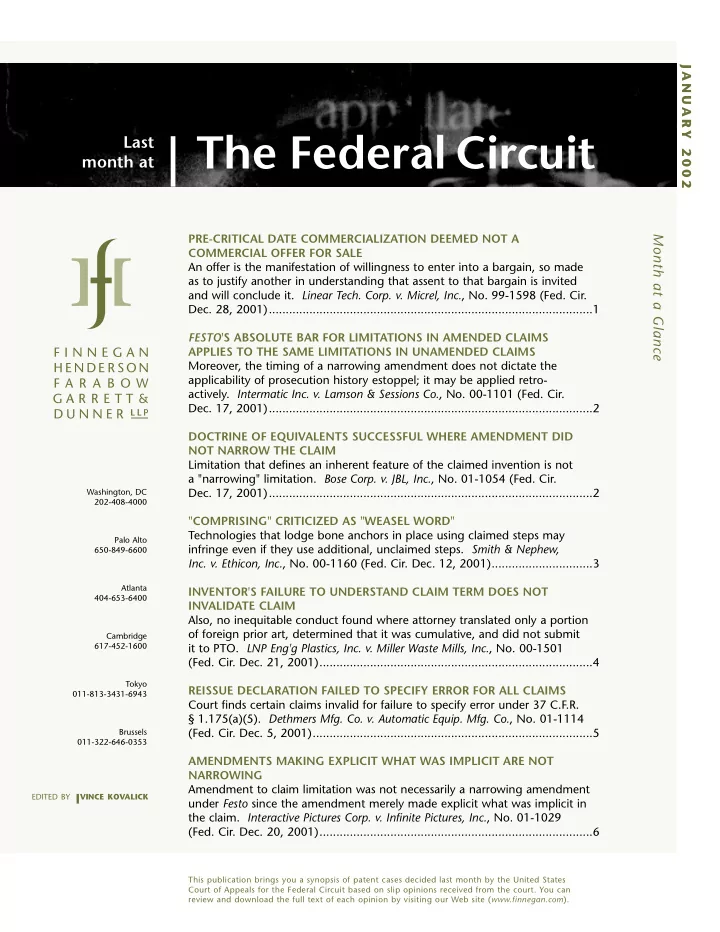
J A N U A R Y 2 0 0 2 The Federal Circuit Last month at PRE-CRITICAL DATE COMMERCIALIZATION DEEMED NOT A Month at a Glance COMMERCIAL OFFER FOR SALE An offer is the manifestation of willingness to enter into a bargain, so made as to justify


slide-1
SLIDE 1

EDITED BY VINCE KOVALICK This publication brings you a synopsis of patent cases decided last month by the United States Court of Appeals for the Federal Circuit based on slip opinions received from the court. You can review and download the full text of each opinion by visiting our Web site (www.finnegan.com). Washington, DC 202-408-4000 Palo Alto 650-849-6600 Atlanta 404-653-6400 Cambridge 617-452-1600 Tokyo 011-813-3431-6943 Brussels 011-322-646-0353

PRE-CRITICAL DATE COMMERCIALIZATION DEEMED NOT A COMMERCIAL OFFER FOR SALE An offer is the manifestation of willingness to enter into a bargain, so made as to justify another in understanding that assent to that bargain is invited and will conclude it. Linear Tech. Corp. v. Micrel, Inc., No. 99-1598 (Fed. Cir.

  • Dec. 28, 2001)................................................................................................1

FESTO'S ABSOLUTE BAR FOR LIMITATIONS IN AMENDED CLAIMS APPLIES TO THE SAME LIMITATIONS IN UNAMENDED CLAIMS Moreover, the timing of a narrowing amendment does not dictate the applicability of prosecution history estoppel; it may be applied retro-

  • actively. Intermatic Inc. v. Lamson & Sessions Co., No. 00-1101 (Fed. Cir.
  • Dec. 17, 2001)................................................................................................2

DOCTRINE OF EQUIVALENTS SUCCESSFUL WHERE AMENDMENT DID NOT NARROW THE CLAIM Limitation that defines an inherent feature of the claimed invention is not a "narrowing" limitation. Bose Corp. v. JBL, Inc., No. 01-1054 (Fed. Cir.

  • Dec. 17, 2001)................................................................................................2

"COMPRISING" CRITICIZED AS "WEASEL WORD" Technologies that lodge bone anchors in place using claimed steps may infringe even if they use additional, unclaimed steps. Smith & Nephew,

  • Inc. v. Ethicon, Inc., No. 00-1160 (Fed. Cir. Dec. 12, 2001)..............................3

INVENTOR'S FAILURE TO UNDERSTAND CLAIM TERM DOES NOT INVALIDATE CLAIM Also, no inequitable conduct found where attorney translated only a portion

  • f foreign prior art, determined that it was cumulative, and did not submit

it to PTO. LNP Eng'g Plastics, Inc. v. Miller Waste Mills, Inc., No. 00-1501 (Fed. Cir. Dec. 21, 2001).................................................................................4 REISSUE DECLARATION FAILED TO SPECIFY ERROR FOR ALL CLAIMS Court finds certain claims invalid for failure to specify error under 37 C.F.R. § 1.175(a)(5). Dethmers Mfg. Co. v. Automatic Equip. Mfg. Co., No. 01-1114 (Fed. Cir. Dec. 5, 2001)...................................................................................5 AMENDMENTS MAKING EXPLICIT WHAT WAS IMPLICIT ARE NOT NARROWING Amendment to claim limitation was not necessarily a narrowing amendment under Festo since the amendment merely made explicit what was implicit in the claim. Interactive Pictures Corp. v. Infinite Pictures, Inc., No. 01-1029 (Fed. Cir. Dec. 20, 2001).................................................................................6

J A N U A R Y 2 0 0 2

The Federal Circuit

Last month at

Month at a Glance

slide-2
SLIDE 2

Pre-critical Date Commercialization Deemed Not a Commercial Offer for Sale

Malcolm T. Meeks [Judges: Clevenger (author), Gajarsa, and Dyk] In Linear Technology Corp. v. Micrel, Inc.,

  • No. 99-1598 (Fed. Cir. Dec. 28, 2001), the

Federal Circuit reversed a district court's holding

  • f invalidity under the on-sale bar of U.S. Patent
  • No. 4,755,741 and its Reexamination Certificate

(collectively "the '741 patent"). The '741 patent relates to linear integrated circuits that provide regulated voltages and cur- rents to electrical devices within the context of adaptive transistor-drive circuitry. The '741 patent application was filed on November 18,

  • 1986. Linear Technology Corporation ("LTC"),

the assignee of the '741 patent, incorporated the technology taught in the patent into a product known as the LT1070 chip. Before the critical date, LTC had engaged in extensive marketing and commercialization of the LT1070 chip both in the United States and

  • abroad. LTC provided its sales force with prelim-

inary data sheets and newsletters concerning the LT1070 chip, which were forwarded to prospec- tive customers. LTC also conducted a sales con- ference for its foreign and domestic sales repre- sentatives where it provided information about the LT1070 chip and touted its capabilities. LTC even received purchase orders for the chip from four of its European distributors. Following its protocol for unreleased products, LTC entered the orders in its order-tracking system under a "WILL ADVISE" and "ORDER NOT BOOKED" notation rather than entering part number, quantity, and price terms. LTC then faxed the

  • rder form with these notations to its foreign dis-

tributors acknowledging their request. LTC released the chip for sale on the critical date, November 18, 1985. LTC sued Micrel, Inc. ("Micrel") for infringe- ment of the '741 patent. The district court had bifurcated the case to hold a separate early trial

  • n the on-sale bar issue and stayed all other

issues pending the outcome of the early trial. The district court had found the '741 patent invalid because LTC (1) had actively promoted the LT1070 chip to customers before the critical date; and (2) actually sold the LT1070 chip under its "WILL ADVISE" procedure to four of its European distributors prior to the critical date. In so finding, the district court had relied on the Federal Circuit's precedent in RCA Corp. v. Data General Corp., 887 F.2d 1056 (Fed. Cir. 1989), which held that an on-sale bar could be trig- gered by commercial activity not rising to the level of a formal offer for sale. LTC appealed the decision, arguing that under the Federal Circuit's decision in Group One

  • v. Hallmark Cards, Inc., 254 F.3d 1041 (Fed. Cir.

2001), decided after the district court had entered judgment, its activities did not trigger the on-sale bar. In Group One, the Federal Circuit clarified the test for determining an offer for sale using tradi- tional principles of contract law. Thus, an offer that could create a binding contract by simple acceptance (assuming consideration) constitutes an offer under 35 U.S.C. § 102(b). Applying the principles of Group One, the Court found that LTC's promotion of the LT1070 chip and offers to purchase by LTC's customers before the critical date did not trigger the on- sale bar because none of these activities consti- tuted an offer under contract-law principles. Specifically, the Court reasoned that LTC's publication of preliminary data sheets, promo- tional information, and newsletters about the chip amounted only to preparation to put the chip on sale and communicated nothing about LTC's intent to be bound. The purchase orders received from the European distributors, the Court concluded, may be considered offers to buy the chip, but, under LTC's "WILL ADVISE" procedure, LTC did not accept the offers. LTC had made no objective manifestation of assent that the offeror reasonably could have believed to be an acceptance of the offer, as required by contract law. Entry of the purchase requests into LTC's order-tracking system communicated noth- ing to the customers who had requested pur-

  • chases. In addition, LTC's faxed confirmation of

receipt of the purchase requests indicated that LTC had received but not booked the orders. Micrel had offered no evidence to show that the distributors had thought otherwise.

page 01 L A S T M O N T H A T T H E F E D E R A L C I R C U I T F I N N E G A N H E N D E R S O N F A R A B O W G A R R E T T D U N N E R L L P.

slide-3
SLIDE 3

2 0 0 2 J A N U A R Y

02 page F I N N E G A N H E N D E R S O N F A R A B O W G A R R E T T D U N N E R L L P.

Festo's Absolute Bar for Limitations in Amended Claims Applies to the Same Limitations in Unamended Claims

Lawrence F. Galvin [Judges: Lourie (author), Newman, and Rader] In Intermatic Inc. v. Lamson & Sessions Co.,

  • No. 00-1101 (Fed. Cir. Dec. 17, 2001), the

Federal Circuit affirmed-in-part and reversed-in- part several decisions of the district court con- cerning infringement. Intermatic Inc. ("Intermatic") owns U.S. Patent No. 5,280,135 ("the '135 patent") direct- ed to weatherproof electrical-outlet covers. These patented covers accommodate a variety of electrical-outlet orientations by combining a base plate with an aperture, a removable insert, and a protective housing. The claims of the '135 patent include two key limitations: the first requires the insert to be adapted to fit within the aperture of the base plate (the "insert within the aperture" limitation); and the second requires the insert to accommodate electrical outlets posi- tioned in a first orientation and a second orienta- tion (the "multiple orientation" limitation). The Lamson & Sessions Company ("Lamson") manufactures weatherproof electrical-

  • utlet covers, including a base plate with an

aperture, one or two removable inserts, and a protective housing. Lamson's inserts, however, do not fit within the aperture of the base plate. Some of these inserts include ribs that extend into the aperture (the "ribbed products"), while

  • thers do not (the "ribless products"). And,

although Lamson's inserts can accommodate either horizontally oriented or vertically oriented

  • utlets, a single insert cannot accommodate

both orientations. Intermatic sued Lamson for infringement of the '135 patent by the ribbed products ("Intermatic I"). Although the district court had granted Lamson's motion for SJ that the ribbed products did not literally infringe, it denied Lamson's motion as to infringement under the

  • DOE. A jury subsequently found that the ribbed

products infringed a group of fifteen claims under the DOE. The jury also found three dependent claims invalid for obviousness, but not the corresponding independent claims. The district court had granted Intermatic's motion for JMOL that these three dependent claims were not invalid, given the inconsistency in the jury's verdict. During Intermatic I, Lamson initiated a reex- amination of the '135 patent that resulted in a narrowing amendment adding the "insert within the aperture" limitation to one independent claim of that group for a reason related to patentability. After the reexamination, Intermatic sued Lamson again, alleging infringement of the '135 patent by the ribless products ("Intermatic II"). Here, the district court granted Lamson's motion for SJ of noninfringement, holding that the rib- less products did not literally infringe and that prosecution history estoppel barred a finding of infringement under the DOE. On appeal, the Federal Circuit first agreed with the district court's claim construction of the two key limitations and the finding of no literal

  • infringement. In addressing infringement under

the DOE, the Court noted that under Festo Corp.

  • v. Shoketsu Kinzoku Kogyo Kabushiki Co., 234 F.3d

558 (Fed. Cir. 2000) (en banc), the narrowing amendment during reexamination absolutely barred any range of equivalents for that limita- tion in the amended claim. Additionally, the Court extended that absolute bar to all of the claims in which the "insert within the aperture" limitation appeared, even if they had not been amended. Finding no infringement by the ribbed prod- ucts, the Federal Circuit affirmed-in-part (literal infringement) and reversed-in-part (infringement under the DOE) Intermatic I. Similarly, finding no infringement by the ribless products, the Court affirmed Intermatic II. Dissenting-in-part, Judge Newman argued that Festo does not go so far as to require a nar- rowed limitation in an amended claim to absolutely bar any range of equivalents for the same limitation in an unamended claim.

Doctrine of Equivalents Successful Where Amendment Did Not Narrow the Claim

Gregory A. Chopskie [Judges: Mayer (author), Newman, and Bryson] In Bose Corp. v. JBL, Inc., No. 01-1054 (Fed.

  • Cir. Dec. 17, 2001), the Federal Circuit affirmed

a district court’s holding of infringement under

slide-4
SLIDE 4

the DOE, its exclusion of evidence, and its dam- ages calculation. Bose Corporation ("Bose") charged JBL, Inc. ("JBL") with infringement of U.S. Patent No. 5,714,721 ("the '721 patent") relating to porting in a loudspeaker system. "Porting" pertains to a port tube inside a loudspeaker used to radiate sound from inside the speaker at high, crisp audible levels. Bose alleged that JBL products using the "Linear A" curve or the "Exponential" curve infringed claims 1-3 of the '721 patent. JBL asserted defenses of noninfringement and invalidity and moved for SJ of noninfringe- ment with respect to both literal infringement and infringement under the DOE. The district court had granted JBL's motion with respect to literal infringement, but denied it with respect to the DOE. After a bench trial, the district court held the '721 patent not invalid and infringed under the DOE and awarded damages of $5,676,718. JBL appealed, arguing that the dis- trict court had erred in denying its motion for SJ under the DOE, had abused its discretion in excluding evidence, and had erred in its determi- nation of an applicable royalty rate. Independent claim 1 was originally filed as dependent claim 2 and recited a "boundary being defined by an ellipse." Bose contended that that limitation was met by an equivalent in JBL products. During prosecution, independent claim 1 had been objected to as being depend- ent on a rejected claim, but the Examiner had indicated that it would be allowable if rewritten in independent form to include all the limitations

  • f the rejected claim on which it depended.

After revision, the Examiner had then required the insertion of the phrase "having a major diam- eter" to provide antecedent basis for claim 3 of the '721 patent, thus complying with the defi- niteness requirement of 35 U.S.C. § 112, ¶ 2. On appeal, JBL argued that the Examiner's rejection under § 112 and the subsequent inser- tion of the phrase "having a major diameter" nar- rowed the scope of the claim, thus barring Bose from obtaining any range of equivalents for that

  • limitation. The Federal Circuit disagreed, con-

cluding that an inherent characteristic of an ellipse is a major diameter. Thus, the insertion of that phrase during prosecution did not satisfy the "narrowing amendment" requirement of Festo. Next, JBL argued that the district court had abused its discretion by refusing to admit a French patent application during trial on which JBL relied to demonstrate invalidity and nonin- fringement under the DOE. The district court had held that the French application, first offered well after the final pretrial order and on the sev- enth day of trial, was untimely and, in any event, lacked probative value because it disclosed a hyperbola rather than an ellipse. Applying First Circuit law, the Federal Circuit agreed, conclud- ing that the district court's decision was not an abuse of discretion. Finally, JBL argued that the district court had erred in its royalty-rate determination because it was based on the entire market value of the loudspeaker system incorporating the infringing

  • element. The Federal Circuit disagreed.

Although acknowledging that the claimed device comprised only a small component of the entire system, the Federal Circuit affirmed the damages award because that "small component" inextrica- bly worked with other components of the sys- tem, contributed substantially to the large demand for the product, and was integral to the

  • verall performance of the product. Moreover,

Bose presented evidence detailing its efforts to market the benefits of loudspeakers using the device claimed in the '721 patent and the increase in sales following introduction of those

  • loudspeakers. Accordingly, the Federal Circuit

held that substantial evidence supported the dis- trict court's award of a reasonable royalty based

  • n the entire market value of the loudspeakers.

"Comprising" Criticized as "Weasel Word"

Jason R. Buratti [Judges: Newman (author), Gajarsa, and Michel (dissenting)] The Federal Circuit vacated a SJ finding of noninfringement in Smith & Nephew, Inc. v. Ethicon, Inc., No. 00-1160 (Fed. Cir. Dec. 12, 2001). Smith & Nephew, Inc. ("S&N") filed suit against Ethicon, Inc. ("Ethicon") for infringement and induced infringement of the claims of its U.S. Patent No. 5,601,557 ("the '557 patent") directed to a method for anchoring tissue to

  • bone. According to the district court's construc-

tion, the claimed method requires a suture anchor with resilient legs to be lodged in the bone after insertion (the resilient legs returning to their natural position makes the anchor immovable). The district court also had found

page 03 L A S T M O N T H A T T H E F E D E R A L C I R C U I T F I N N E G A N H E N D E R S O N F A R A B O W G A R R E T T D U N N E R L L P.

slide-5
SLIDE 5

2 0 0 2 J A N U A R Y

04 page F I N N E G A N H E N D E R S O N F A R A B O W G A R R E T T D U N N E R L L P.

that the claims did not preclude manipulation of the anchor after insertion in the bone, and that the written description instructed users to apply tension (e.g., tugging) to ensure that the anchor was seated. The Federal Circuit affirmed the district court's claim construction over Ethicon's argu- ments of prosecution history estoppel and dedi- cation to the public. It further clarified that the claims of the '557 patent neither required nor excluded a postinsertion-tensioning step to lodge the anchor. In reaching its conclusion, the Court explained that the claim, which contained "com- prising" as the transition signal, could be prac- ticed with steps in addition to those listed in the claims. With respect to infringement, Ethicon argued that its device, which had legs that could be manipulated after insertion, required a ten- sioning step (e.g., tugging) by a surgeon to lodge the anchor in the bone. The district court agreed, finding that because the tensioning step is required to lodge the Ethicon device, the use

  • f Ethicon's device could not infringe the '557

patent claims. On appeal, S&N disputed that Ethicon's device in fact required a tensioning step and argued that even if tensioning were required, the use of Ethicon's device infringed the claims of the '557 patent because a surgeon using Ethicon's device necessarily performs all of the steps of the claimed method prior to the ten- sioning step. The Federal Circuit ruled that a disputed material fact existed as to whether the Ethicon anchor was "lodged" in the bone within the meaning of the district court's claim construc-

  • tion. The Court reasoned that Ethicon's product

literature did not require the tensioning step and found that the parties did not dispute that the legs of Ethicon's accused anchors returned to their relaxed position after insertion and could not be removed. Based on that finding, the majority vacated the district court's entry of SJ. In dissent, Judge Michel took issue with the district court's claim construction, reasoning that the tensioning step was outside the scope of the asserted claims. According to him, the prosecu- tion history and the inventor's testimony both touted that the invention did not require a postinsertion manipulation, i.e., tensioning, to lodge the anchor. Therefore, he concluded, the majority had added a step to the claimed method that the inventor himself had given up. Further, he observed that the tugging instruction in the written description of the '557 patent did not appear in any claim–and was specifically eliminated by one of the claims of the '557 patent–which dedicated that separate step to the

  • public. Judge Michel characterized the majority's

view as permitting the use of the signal "com- prising"–which he characterized as a "weasel word"–to obliterate the dedication to the public rule of Maxwell v. J. Baker, Inc., 86 F.3d 1098 (Fed. Cir. 1996), and to permit the recapture of disclaimed subject matter. With respect to infringement, Judge Michel

  • pined that S&N had offered no evidence to dis-

pute Ethicon's evidence and that postinsertion tensioning of the anchor was required to use its

  • device. Moreover, Ethicon's device did not have

resilient legs and, therefore, did not contain an element of the claimed invention. For these rea- sons, Judge Michel concluded, no reasonable juror could have concluded that the use of Ethicon's device infringed the claim of the '557 patent and entry of SJ was proper.

Inventor's Failure to Understand Claim Term Does Not Invalidate Claim

Vince Kovalick [Judges: Rader (author), Newman, and Bryson] In LNP Engineering Plastics, Inc. v. Miller Waste Mills, Inc., No. 00-1501 (Fed. Cir. Dec. 21, 2001), the Federal Circuit affirmed several find- ings of JMOL concerning infringement, willful- ness, and inequitable conduct, and reversed one finding on JMOL concerning validity of a patent. LNP Engineering Plastics, Inc. ("LNP") owns U.S. Patent Nos. 5,019,450 ("the '450 patent") and 5,213,889 ("the '889 patent"). The patents relate to plastic products produced with long fiber reinforced thermoplastics ("LFRTs"). Three inventors at Imperial Chemical Industries, PLC ("ICI") discovered that the use of lower molecular weight thermoplastics produces a less viscous melt bath and better wetting of fibers for plas-

  • tics. Their techniques lead to more flexible and

stronger LFRTs. The inventors initially applied for a patent in 1983, which issued as U.S. Patent

  • No. 4,559,262 ("the '262 patent"), and assigned

their rights to the invention to ICI. In 1989, ICI

slide-6
SLIDE 6

filed a continuation of the '262 patent, which issued as the '450 patent. The '889 patent issued out of the same family of patents in 1993. In 1991, ICI granted Kawasaki Chemical Holding Company, Inc. ("Kawasaki") a license to the '262 and '450 patents. Kawasaki then grant- ed LNP a license to these patents. In 1995, ICI assigned its interest in all three patents to

  • Kawasaki. Kawasaki then requested a reexamina-

tion of the '450 and '889 patents. The reexami- nation was granted in 1996. In September 1996, LNP sued RTP Company ("RTP") for infringement of all three patents. After a nine-day trial, the jury returned its ver-

  • dict. A year later, the district court reversed the

jury's verdict, determining that: (1) RTP's accused products infringe the '450 and '889 patents; (2) claim 1 of the '889 patent is not invalid for obviousness; (3) the asserted claims are not invalid for indefiniteness; and (4) claim 1

  • f the '889 patent is invalid for failure to meet

the written description requirement. Thereafter, a jury found that RTP did not willfully infringe, and the district court rejected RTP's inequitable-conduct defense. Initially, the Federal Circuit reviewed certain claim-construction issues and, after affirming the district court's construction, affirmed the finding

  • f infringement since the record (1) contained

substantial evidence to support the finding and no evidence to the contrary to support RTP's position based on the improper claim construc- tion; and (2) contained substantial evidence to support a finding of infringement based on the proper claim construction. Concerning invalidity, the Federal Circuit reviewed the prior art and determined that cer- tain processes disclosed in the prior art would have motivated one of ordinary skill in the art to use those processes in a normal operation to cre- ate the claimed product. Thus, the claimed products were obvious over the disclosed

  • processes. The Court concluded that the record

provided substantial evidence to support the jury's finding that claim 1 of the '889 patent was

  • bvious over the prior art.

Concerning indefiniteness of the claims, one

  • f the inventors had testified that he did not

know what the phrase "substantially completely wetted" meant. The Federal Circuit agreed with the district court, however, that an inventor's inability to understand this claim phrase does not automatically mean that the claim is indefinite. The Court concluded that the full disclosure of the patent and testimony by other parties and experts sufficiently informed one of ordinary skill in the art as to the bounds of the claims such that they were not indefinite. Concerning willful infringement, RTP relied

  • n opinions of counsel obtained in 1994, two

years after the alleged notice of potential

  • infringement. On appeal, LNP asserted that
  • pinions of counsel obtained two years after

such notice are insufficient to rebut an accusa- tion of willful infringement and are therefore

  • inadmissible. The Federal Circuit rejected this

argument because LNP did not make it at the district court level, and, in fact, LNP had moved the opinion letters into evidence itself. Finally, the Court refused to disturb the dis- trict court's finding of no inequitable conduct. The prosecuting attorney had received a Japanese publication in a related Japanese appli-

  • cation. He had a portion of the Japanese publi-

cation translated and determined that it was merely cumulative of other prior art before the

  • PTO. Thus, he did not submit it. Although the

Federal Circuit agreed with the district court's determination that the omitted prior art was material and noncumulative, it refused to reeval- uate the district court's assessment of the prose- cuting attorney's credibility and motives from the

  • trial. Thus, the Court found no clear error with

the district court's finding of no intent to deceive the PTO.

Reissue Declaration Failed to Specify Error for All Claims

Donald D. Min [Judges: Schall (author), Clevenger, and Dyk (dissenting)] In Dethmers Manufacturing Co. v. Automatic Equipment Manufacturing Co., No. 01-1114 (Fed.

  • Cir. Dec. 5, 2001), the Federal Circuit affirmed-

in-part, reversed-in-part, and remanded for fur- ther proceedings a SJ that all claims of U.S. Patent No. Re. 35,482 ("the reissue patent") were

  • invalid. In addition, the Federal Circuit affirmed

a SJ of noninfringement of U.S. Patent No. 5,356,166 ("the '166 patent"). Dethmers Manufacturing Company ("Dethmers") sued Automatic Equipment Manufacturing Company ("Automatic") for infringement of the reissue patent, which con- cerns collapsible and removable hitches for tow-

page 05 L A S T M O N T H A T T H E F E D E R A L C I R C U I T F I N N E G A N H E N D E R S O N F A R A B O W G A R R E T T D U N N E R L L P.

slide-7
SLIDE 7

2 0 0 2 J A N U A R Y

06 page F I N N E G A N H E N D E R S O N F A R A B O W G A R R E T T D U N N E R L L P.

ing vehicles, such as a hitch for towing a car behind a motor home. In response, Automatic counterclaimed that Dethmers's EXCALIBAR product infringed the '166 patent, which con- cerns a lockable, telescoping bar assembly. At trial, the district court had found that a substitute reissue declaration filed in the reissue patent failed to satisfy the requirements of 37 C.F.R. § 1.175(a)(5) ("Rule 175") and, thus, ren- dered all claims invalid. During prosecution of the reissue patent, the applicant had filed a reis- sue declaration to correct two errors in U.S. Patent No. 5,232,240 ("the '240 patent"). The Examiner objected to the reissue declaration for failing to specify how asserted errors in the speci- fication and abstract arose. In response, the applicant submitted a substitute reissue declara- tion that specified the errors in the specification and abstract, and included a table summarizing the differences between the claims in the reissue patent and the '240 patent. Shortly thereafter, the PTO allowed the reissue patent. Although the PTO determined that the substitute reissue declaration satisfied the requirements of Rule 175, the trial court, in granting a SJ motion by Automatic, applied a de novo standard of review to this determination, found the substitute reis- sue declaration deficient, and held all claims

  • invalid. Dethmers then appealed this SJ to the

Federal Circuit. The district court also had granted Dethmers's motion for SJ that the EXCALIBAR product did not literally infringe the '166 patent, but denied the motion for SJ with respect to infringement under the DOE. Later, the district court reconsidered its decision on infringement under the DOE and found that prosecution histo- ry estoppel barred application of the doctrine. On appeal, Dethmers argued that the reissue declaration used in the reissue patent satisfied the requirements of Rule 175. The Federal Circuit determined that, at the time the reissue declaration was filed, Rule 175 required that the reissue declaration explain the source of every error, state that there was no deceptive intent, and describe how the amendment corrects the

  • error. The Federal Circuit noted that the validity
  • f each claim turned on whether the reissue dec-

laration explained every difference in that claim. In its analysis, the Federal Circuit identified the changes made to each claim during reissue and found that the reissue declaration properly addressed the changes made to claims 1-3 and 8-10. However, the Federal Circuit ruled that the reissue declaration failed to address the changes made to claims 4-7. The Federal Circuit reversed the district court's judgment with respect to the invalidity of claims 1-3 and 8-10, and affirmed the district court's judgment with respect to the invalidity of claims 4-7. With respect to the '166 patent, Automatic argued that the amendments made to the claims did not give rise to prosecution history estoppel because they were not made to avoid prior art and were voluntary. The Federal Circuit dis- agreed with Automatic and ruled that any amendment related to patentability can give rise to prosecution history estoppel. Therefore, since the amendments gave rise to prosecution history estoppel, the Federal Circuit affirmed the district court's determination that the amendments barred application of the DOE. Judge Dyk dissented, preferring to give def- erence to the PTO's determination that the reis- sue declaration satisfied Rule 175 for all claims.

Amendments Making Explicit What Was Implicit Are Not Narrowing

Vince Kovalick [Judges: Lourie (author), Archer, and Gajarsa] In Interactive Pictures Corp. v. Infinite Pictures, Inc., No. 01-1029 (Fed. Cir. Dec. 20, 2001), the Federal Circuit affirmed a jury's finding of infringement under the DOE and a related dam- ages award. The patent at issue, U.S. Patent No. 5,185,667 ("the '667 patent"), is directed to an image-viewing system that allows a user to view a portion of a hemispherical field in corrected

  • perspective. The original hemispherical image

captured by a fisheye-lens camera has distortion that will cause straight lines to appear to be

  • curved. The image-transform processor takes

the distorted image, accepts user input specify- ing a region of interest in the image, and mathe- matically transforms the selected region into a perspectively correct output. The originally filed claim 1 of the '667 patent was rejected by the PTO over the prior art. The applicant amended claim 1 and specifically amended the "image transform processor means" limitation by changing "output signals" to "out- put transformation calculation signals." The

slide-8
SLIDE 8

applicant also made arguments distinguishing the invention over the prior art, but did not explicitly provide a reason for the amendment to the "out- put signals." The claim was allowed thereafter. The Federal Circuit found that the amend- ment made to the "image transform processor means" limitation was not a narrowing amend- ment under Festo Corp. v. Shoketsu Kinzoku Kogyo Kabushiki Co., 234 F.3d 558 (Fed. Cir. 2000), and, therefore, the DOE was not precluded. The amendment made explicit what had been implicit and, therefore, was not done for a substantial rea- son related to patentability. Furthermore, the Federal Circuit found that the arguments made over the prior art did not create prosecution history estoppel. The Federal Circuit also rejected the argument that the prior art limited the scope of equivalents, finding that a hypothetical claim that ensnared the accused device would have been patentable over the cited prior art. Finally, the Court found substantial evidence supporting the jury's finding of equivalence, citing to testimony by the patentee's expert. The expert had testified that portions of the patented device and the accused device were interchangeable in theory, despite the physical inability to inter- change those portions. The Court attributed the physical inability to interchange them to differ- ences in software format and stated that inter- changeability is judged from the perspective of a skilled artisan making a design choice, not the realities of software compatibility. The jury's award of $1 million in damages was affirmed as supported by substantial evidence. The patentee's reliance on an outdated business plan, with overly optimistic sales projections that were never met, was upheld as not based on spec- ulation or guesswork. In addition, the inclusion of all of the alleged infringer's products into the roy- alty base, as well as factoring in bundling and con- voyed sales into the royalty rate, was not double

  • recovery. The Court explained that the bundling

and convoyed sales were only one of thirteen Georgia-Pacific factors applied to reach the royalty rate and, thus, did not warrant upsetting the jury's award.

page 07 F I N N E G A N H E N D E R S O N F A R A B O W G A R R E T T D U N N E R L L P.

DISCLAIMER:

The case summaries reflect the understanding of the authors only and are not meant to convey legal

  • pinions or advice of any kind. The firm disclaims

any liability for any errors or omissions in these

  • summaries. This promotional newsletter does not

establish any form of attorney-client relationship with our firm or with any of our attorneys.

In Last month at The Federal Circuit, certain terms, titles, and names of fed- eral agencies that are frequently referred to in text, appear in abbreviated forms or as acronyms. These abbreviated forms and acronyms are listed below. ALJ Administrative Law Judge APJ Administrative Patent Judge Board Board of Patent Appeals and Interferences Commissioner Commissioner of Patents and Trademarks CIP Continuation-in-Part DJ Declaratory Judgment DOE Doctrine of Equivalents IP Intellectual Property ITC International Trade Commission JMOL Judgment as a Matter of Law MPEP Manual of Patent Examining Procedure PCT Patent Cooperation Treaty PTO United States Patent and Trademark Office SEC Securities and Exchange Commission SM Special Master SJ Summary Judgment