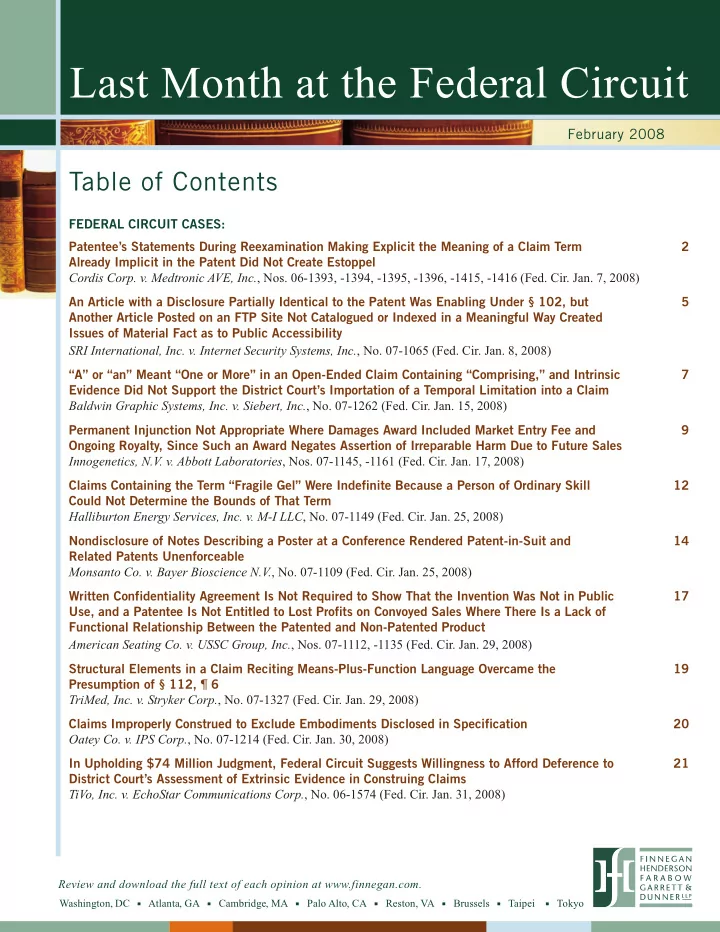
Last Month at the Federal Circuit February 2008 Table of Contents - - PDF document

last month at the federal circuit
SMART_READER_LITE
LIVE PREVIEW

Last Month at the Federal Circuit February 2008 Table of Contents - - PDF document

Last Month at the Federal Circuit February 2008 Table of Contents FEDERAL CIRCUIT CASES: Patentees Statements During Reexamination Making Explicit the Meaning of a Claim Term 2 Already Implicit in the Patent Did Not Create Estoppel Cordis


slide-1
SLIDE 1

February 2008

Last Month at the Federal Circuit

Washington, DC

■ Atlanta, GA ■ Cambridge, MA ■ Palo Alto, CA ■ Reston, VA ■ Brussels ■ Taipei ■ Tokyo

Review and download the full text of each opinion at www.finnegan.com.

Table of Contents

FEDERAL CIRCUIT CASES: Patentee’s Statements During Reexamination Making Explicit the Meaning of a Claim Term 2 Already Implicit in the Patent Did Not Create Estoppel Cordis Corp. v. Medtronic AVE, Inc., Nos. 06-1393, -1394, -1395, -1396, -1415, -1416 (Fed. Cir. Jan. 7, 2008) An Article with a Disclosure Partially Identical to the Patent Was Enabling Under § 102, but 5 Another Article Posted on an FTP Site Not Catalogued or Indexed in a Meaningful Way Created Issues of Material Fact as to Public Accessibility SRI International, Inc. v. Internet Security Systems, Inc., No. 07-1065 (Fed. Cir. Jan. 8, 2008) “A” or “an” Meant “One or More” in an Open-Ended Claim Containing “Comprising,” and Intrinsic 7 Evidence Did Not Support the District Court’s Importation of a Temporal Limitation into a Claim Baldwin Graphic Systems, Inc. v. Siebert, Inc., No. 07-1262 (Fed. Cir. Jan. 15, 2008) Permanent Injunction Not Appropriate Where Damages Award Included Market Entry Fee and 9 Ongoing Royalty, Since Such an Award Negates Assertion of Irreparable Harm Due to Future Sales Innogenetics, N.V. v. Abbott Laboratories, Nos. 07-1145, -1161 (Fed. Cir. Jan. 17, 2008) Claims Containing the Term “Fragile Gel” Were Indefinite Because a Person of Ordinary Skill 12 Could Not Determine the Bounds of That Term Halliburton Energy Services, Inc. v. M-I LLC, No. 07-1149 (Fed. Cir. Jan. 25, 2008) Nondisclosure of Notes Describing a Poster at a Conference Rendered Patent-in-Suit and 14 Related Patents Unenforceable Monsanto Co. v. Bayer Bioscience N.V., No. 07-1109 (Fed. Cir. Jan. 25, 2008) Written Confidentiality Agreement Is Not Required to Show That the Invention Was Not in Public 17 Use, and a Patentee Is Not Entitled to Lost Profits on Convoyed Sales Where There Is a Lack of Functional Relationship Between the Patented and Non-Patented Product American Seating Co. v. USSC Group, Inc., Nos. 07-1112, -1135 (Fed. Cir. Jan. 29, 2008) Structural Elements in a Claim Reciting Means-Plus-Function Language Overcame the 19 Presumption of § 112, ¶ 6 TriMed, Inc. v. Stryker Corp., No. 07-1327 (Fed. Cir. Jan. 29, 2008) Claims Improperly Construed to Exclude Embodiments Disclosed in Specification 20 Oatey Co. v. IPS Corp., No. 07-1214 (Fed. Cir. Jan. 30, 2008) In Upholding $74 Million Judgment, Federal Circuit Suggests Willingness to Afford Deference to 21 District Court’s Assessment of Extrinsic Evidence in Construing Claims TiVo, Inc. v. EchoStar Communications Corp., No. 06-1574 (Fed. Cir. Jan. 31, 2008)

slide-2
SLIDE 2

Patentee’s Statements During Reexamination Making Explicit the Meaning of a Claim Term Already Implicit in the Patent Did Not Create Estoppel

Eric C. Jeschke Judges: Bryson (author), Friedman, Keeley (Chief District Judge sitting by designation) [Appealed from D. Del., Judge Robinson] In Cordis Corp. v. Medtronic AVE, Inc.,

  • Nos. 06-1393, -1394, -1395, -1396, -1415, -1416

(Fed. Cir. Jan. 7, 2008), the Federal Circuit affirmed the district court’s denials of both Medtronic AVE, Inc.’s (“AVE”) and codefendants Boston Scientific’s and Boston Scientific Scimed, Inc.’s (collectively “BSC”) motions for a new trial and JMOL, reversed the district court’s invalidation of a claim that the jury found to have been infringed by BSC, and remanded. U.S. Patent Nos. 4,739,762 (“the ’762 patent”) and 5,195,984 (“the ’984 patent”) relate to vascular stents used to treat coronary artery disease. The ’762 patent discloses a stent that can be mounted on an angioplasty balloon and delivered intraluminally (i.e., through the vascular system) to the target

  • location. Once this stent reaches the location, the

balloon and stent are expanded and the stent props

  • pen a constriction in the blood vessel. Claim 23 of

the ’762 patent covers an expandable intraluminal vascular stent comprising “a . . . tubular member having . . . a wall surface . . . , the wall surface having a substantially uniform thickness and a plurality of slots formed therein.” In addition, claim 23 requires the wall surface to be a “smooth surface.” The ’984 patent discloses a flexible stent manufactured by joining tubular members, such as those disclosed in the ’762 patent, by a connector to provide the flexibility to negotiate curves in body passageways such as the vascular system. In separate cases in the District of Delaware, Cordis Corporation (“Cordis”) alleged that three AVE stents infringed both the ’762 and the ’984 patents, and that BSC’s NIR stent infringed claim 23 of the ’762

  • patent. After these litigations began, Cordis sought

reexamination of the ’762 patent. During reexamination, Cordis narrowed the scope of the ’762 patent by distinguishing the claimed invention from a prior art patent. Cordis also cancelled independent claim 13 and incorporated all the limitations from that claim into claim 23, previously dependent from claim 13. In the remarks accompanying the amendment, Cordis distinguished the claimed invention from a prior art patent based

  • n the “wall surface,” “smooth surface,” and

“substantially uniform thickness” limitations. Cordis obtained separate jury verdicts of infringement against AVE and BSC. AVE and BSC each filed a motion for a new trial and for JMOL of

  • noninfringement. Both appealed the district court’s

denial of those motions and the appeals were

  • consolidated. In addition, Cordis cross-appealed the

district court’s invalidation of a claim found to have been infringed by BSC.

2 February 2008

  • On February 15, 2008, the Federal Circuit issued an Order granting hearing en banc in In re Bilski, No. 07-1130. The

Order requested the parties to file supplemental briefs addressing five questions relating to whether abstract ideas or mental processes are patentable subject matter under 35 U.S.C. § 101, and whether a method must result in a physical transformation of an article or be tied to a machine to be patentable subject matter. The Order also asked whether State Street Bank & Trust Co. v. Signature Financial Group, Inc., 149 F.3d 1368 (Fed. Cir. 1998), and AT&T Corp. v. Excel Communications, Inc., 172 F.3d 1352 (Fed. Cir. 1999), should be overruled in any respect.

  • On February 11, 2008, the Federal Circuit denied a petition for panel rehearing and rehearing en banc in In re Nuijten,
  • No. 06-1371. Judge Linn, joined by Judges Newman and Rader, wrote a dissent. Judge Linn stated that the panel’s

conclusion in the case that something “transient” or “fleeting” cannot constitute a “manufacture” under 35 U.S.C. § 101, conflicted with precedent of the CCPA in In re Breslow, 616 F.2d 516 (C.C.P.A. 1980). Moreover, he wrote that the panel’s decision conflicted with Supreme Court precedent such as Diamond v. Chakrabarty, 447 U.S. 303, 309 (1980), which stated that “anything under the sun that is made by man” is patentable subject matter except for certain enumerated exceptions: “The laws of nature, physical phenomena, and abstract ideas.” Lastly, Judge Linn wrote that it makes no sense to hold that a signal is not patentable subject matter, while a storage medium containing the very same signal is patentable subject matter under § 101.

Spotlight Info

slide-3
SLIDE 3

On appeal, AVE argued it was entitled to JMOL of noninfringement of the ’762 patent because its stents do not have walls of “substantially uniform thickness,” as recited by claim 23. AVE’s stent is formed by a group of rings made of metal strands with circular cross-sections. The rings are bent into a sinusoidal shape along their circumference. Multiple rings are welded together to make the stent. The walls of the stent thus consist of straight sections, called struts, that connect the rings as well as curved sections, called crowns, between the struts. Regarding the “substantially uniform thickness” claim limitation, AVE acknowledged that the cross-section of the metal strands in the strut sections was uniform. AVE nevertheless argued that the thickness of the stent wall should not be measured by the cross-section of the metal but rather by the length

  • f the chords that cross the curved tip of the crowns,

as measured along a line drawn from the center of the stent perpendicular to the wall. The Federal Circuit disagreed with AVE’s measuring technique, holding that “a stent with round crowns can have substantially uniform thickness as long as the round crowns have substantially the same diameter.” Slip op. at 9. In addition, AVE argued that the district court erred in leaving the issue of how to measure thickness of the stent wall to the jury. According to AVE, the methodology of measurement should have been deemed an issue of law. The Federal Circuit explained that even if the methodology issue had been an issue of law, it rejected the idea that the district court should have adopted AVE’s

  • methodology. For that reason, AVE could not have

been prejudiced by the district court’s treatment of the methodology as an issue of fact. AVE also argued that it was entitled to JMOL of noninfringement of the ’984 patent because its stents did not infringe the “flexibly connect” limitation. The Federal Circuit stated that neither the claim language nor the district court’s claim construction required the connector members themselves to be

  • flexible. Rather, the claim language required the

connector members to “flexibly connect adjacent tubular members,” and the district court construed that phrase to require the connector members to “provide flexibility.” Even if the connector members themselves were not flexible, the Court concluded that Cordis’s evidence was sufficient to demonstrate that the connector members nevertheless provide flexibility to AVE’s accused stents. AVE also argued it was entitled to a new trial on several grounds. First, AVE challenged the district court’s decision to prevent AVE and its experts from telling the jury that AVE’s methodology of measuring stent wall thickness was endorsed by the Federal Circuit in a prior appeal. The Federal Circuit determined, however, that it had not in fact agreed with the methodology in the prior appeal and, thus, the district court properly barred AVE from telling the jury that the earlier panel supported AVE’s methodology. Second, AVE argued it was prejudiced by the district court’s exclusion of evidence demonstrating clinical advantages of AVE’s stents. The Federal Circuit disagreed, stating that the excluded evidence was irrelevant to the question of infringement and that such evidence was introduced through other sources. Finally, AVE argued that the jury instruction regarding obviousness conflicted with KSR International v. Teleflex Inc., 127 S. Ct. 1727 (2007), because the jury instruction, which AVE actually proposed, was based on pre-KSR law. The Federal Circuit explained that KSR did not represent a significant change in the law and that “even in the case of a change in the law, the Supreme Court has held that the plain error standard applies to a jury instruction to which no objection was made.” Slip

  • p. at 19. Thus, the Court determined that AVE had

not “remotely demonstrated that it is entitled to a new trial on obviousness.” Id. at 20. Turning next to BSC’s appeal, the Federal Circuit addressed BSC’s argument that the term “slots” in claim 23 of the ’762 patent should have been construed to cover only “complete” slots (slots that are bounded on all sides), and the district court erred by construing the term to also include “half” slots (slots that are not completely bounded). The Federal Circuit disagreed, finding that the specification’s

3 Last Month at the Federal Circuit

“[T]here is no reason to treat Cordis’s definitional explanation in the prosecution history as having the effect of surrendering all equivalents that would otherwise have been available under the patent.” Slip op. at 29.

slide-4
SLIDE 4

reference to “half-slots” did not “foreclose the generic term ‘slots’ from being used to refer to both half slots and complete slots.” Id. at 22. BSC also argued that the district court’s construction of “slots” was incorrect because, under that construction, the claim would cover inoperable embodiments. The Court again disagreed, stating that a construction is

  • nly “viewed with extreme skepticism” when that

construction renders all embodiments inoperable as

  • pposed to rendering some embodiments inoperable.
  • Id. at 23.

Second, BSC argued that no reasonable jury could have found that the NIR stent infringed the “wall surface” and “smooth surface” claim limitations of claim 23 of the ’762 patent. The district court defined the “wall surface” limitation to require that the “outer surface of the tubular member must be disposed in a common cylindrical plane.” The jury returned a general verdict of infringement under the

  • DOE. BSC advocated a narrow reading of “wall

surface” such that the outer surface had to be a perfect cylinder. Because the NIR stent had weld points on the outer surface, BSC argued it could not literally infringe. The Federal Circuit found that definition too narrow and held that, even without applying the DOE, a jury could reasonably conclude that the presence of weld spots on the stent’s surface does not sufficiently alter the cylindrical character of the outer surface to preclude a finding of literal infringement. BSC also argued it was entitled to a new trial on infringement because the district court should have ruled that prosecution history estoppel barred equivalents of the “wall surface” limitation. The Court disagreed, explaining that prosecution history estoppel applies when a party makes clear and unmistakable statements disavowing subject matter such that “a competitor would reasonably believe that the applicant had surrendered the relevant subject matter.” Id. at 28 (citation omitted). Here, the Court determined that Cordis made no disavowing statements during reexamination when it simply made explicit the meaning of the term “wall surface” that was already implicit in the ’762 patent. The Court reasoned that “there is no reason to treat Cordis’s definitional explanation in the prosecution history as having the effect of surrendering all equivalents that would otherwise be available under the patent.” Id. at 29. Thus, prosecution history estoppel did not apply. As to BSC’s motion for JMOL of noninfringement with respect to the “smooth surface” limitation, the district court defined “smooth surface” to require that the “outside of the wall surface of the unexpanded tubular member [have] a continuously even surface, without roughness, points, bumps or ridges, especially to the touch.” Id. at 24-25. The Federal Circuit determined that the district court’s definition was unnecessarily restrictive. Based on the prosecution history, the Court would have defined “smooth surface” functionally to mean “smooth enough to be capable of intraluminal delivery.”

  • Id. at 33. Thus, the Court found that it was

unnecessary to look to the DOE as the basis for upholding the jury’s finding of infringement, because a reasonable jury under the Court’s broader definition would have found the NIR stent literally infringed. The district court thus properly denied BSC’s motion for JMOL of noninfringement with respect to the “smooth surface” limitation. The Court did note that BSC may be entitled to another trial based on

  • bviousness in light of this broader definition of

“smooth surface” but left that matter to the district court on remand. Third, BSC argued that the wall surface of its NIR stent does not exhibit “substantially uniform thickness” and that the district court erred in not granting JMOL of noninfringement. The district court followed the Federal Circuit’s guidance in a prior appeal that “substantially uniform thickness” means “[t]he wall of a tubular member must be of largely or approximately uniform thickness.” BSC argued that the weld spots produce variations in thickness of the stent’s walls and, therefore, the wall cannot be of “substantially uniform thickness.” The Court rejected this argument, finding that the method to measure wall thickness was a question of fact. Thus, the jury reasonably concluded, based on expert testimony by Cordis’s expert, that the proper method to measure wall thickness was to measure the thickness of the stent struts. BSC also argued that the district court instruction saying, “[l]et me remind you that the ‘wall surface’ limitation is not in dispute in this case” was prejudicial because it suggested that the “wall surface” limitation was literally infringed. The Court rejected this argument because the instruction said nothing about infringement of the “wall surface” limitation and, thus, the instruction was appropriate.

4 February 2008

slide-5
SLIDE 5

Finally, BSC challenged two evidentiary rulings regarding the issue of obviousness. Because claim 23 is an apparatus claim rather than a method claim, BSC sought to introduce evidence regarding several of the ’762 patent’s method claims in an effort to point out the differences between those method claims and claim 23 as well as counter Cordis’s evidence of commercial success. The district court excluded such evidence under

  • Fed. R. Evid. 403. The Federal Circuit determined

that because claim 23 was the only claim asserted in that trial, the district court properly excluded evidence of other nonasserted claims. BSC also sought to introduce evidence about Cordis’s interest in acquiring rights to the NIR stent from BSC. BSC hoped to counter evidence of Cordis’s commercial success by demonstrating any success was due to the stent’s flexibility, a feature not covered by claim 23. The district court again excluded such evidence under Fed. R. Evid. 403. The Federal Circuit determined that the district court had properly focused the jury’s attention on the prior art and the claimed invention instead of the accused device. In a cross-appeal, Cordis challenged the district court’s invalidation of claim 44 of the ’762 patent under 35 U.S.C. § 305, providing “[n]o proposed amended or new claim enlarging the scope of a claim

  • f the patent will be permitted in a reexamination

proceeding.” During reexamination, Cordis added claims 44 to 59 in response to a 1998 Office Action. The district court decided claim 44 was invalid because it was not added to either “(1) distinguish the invention as claimed from the prior art” or “(2) in response to a decision adverse to the patentability of a claim of a patent,” as required by § 305. The district court determined that claim 44 was “added solely to cover competitors’ stents, and not for a permissible reason under § 305.” The Court determined that the district court misinterpreted § 305, stating that the addition of claims 44 to 59 fell under option two because they were intended to distinguish the invention in response to the 1998 Office Action. Because these claims did not “enlarge the scope of the original claims,” the claims satisfied the validity requirements of § 305. Slip op. at 43.

An Article with a Disclosure Partially Identical to the Patent Was Enabling Under § 102, but Another Article Posted on an FTP Site Not Catalogued or Indexed in a Meaningful Way Created Issues

  • f Material Fact as to Public

Accessibility

Matthew R. Van Eman Judges: Mayer, Rader (author), Moore (dissenting-in-part) [Appealed from D. Del., Judge Robinson] In SRI International, Inc. v. Internet Security Systems, Inc., No. 07-1065 (Fed. Cir. Jan. 8, 2008), the Federal Circuit affirmed the district court’s grant

  • f SJ of invalidity under 35 U.S.C. § 102(b) with

respect to a first article, finding that the article was

  • enabling. The Court, however, vacated and

remanded the district court’s grant of SJ of invalidity with respect to a second article, finding that genuine issues of material fact existed about the public accessibility of that article. SRI International, Inc. (“SRI”) owns U.S. Patent

  • Nos. 6,484,203 (“the ’203 patent”), 6,708,212 (“the

’212 patent”), 6,321,338 (“the ’338 patent”), and 6,711,615 (“the ’615 patent”). All four patents relate to cyber security and intrusion detection, and

  • riginated from a November 1998 application by

inventors Phillip Porras and Alfonso Valdes. SRI sued Internet Security Systems, Inc. (a Delaware corporation), Internet Security Systems, Inc. (a Georgia corporation), and Symantec Corporation (collectively “Defendants”) for infringement of the ’203, ’212, ’338, and ’615 patents. Defendants moved for SJ, arguing that all four patents were invalid under 35 U.S.C. § 102(b). Specifically, Defendants argued that all four patents were invalid as anticipated by SRI’s paper entitled “Live Traffic Analysis of TCP/IP Analysis of TCP/IP Gateways” (“Live Traffic paper”) and that the ’212 patent was additionally invalid as anticipated by SRI’s paper entitled “EMERALD: Event Monitoring Enabling Responses to Anomalous Live Disturbances” (“EMERALD paper”). SRI countered with a motion

5 Last Month at the Federal Circuit

slide-6
SLIDE 6

for partial SJ that the Live Traffic paper did not qualify as a printed publication under § 102(b) and that the EMERALD paper was not enabling and, thus, did not anticipate. The district court granted SJ to Defendants, finding that the Live Traffic paper was a printed publication that anticipated all asserted claims of the four patents-in-suit and that the EMERALD paper was enabling and anticipated the ’212 patent. SRI appealed. On appeal, the Federal Circuit first addressed the district court’s grant

  • f SJ with respect to the

EMERALD paper. SRI asserted that the EMERALD paper could not anticipate because it did not provide an enabling disclosure of the claimed invention. The Federal Circuit

  • disagreed. The Court explained that the standard for

enablement of a prior art reference for purposes of anticipation under section 102 differs from the enablement standard under section 112. It observed that “[s]ignificantly, . . . anticipation does not require actual performance of suggestions in a disclosure. Rather, anticipation only requires that those suggestions be enabled to one skilled in the art.” Slip op. at 9 (citations and internal quotation marks

  • mitted).

Applying these principles, the Court noted that the ’212 patent and the EMERALD paper included similar sections explaining statistical detection and identical figures. It reasoned that these disclosures helped the inventors obtain issuance of the ’212 patent and that the issuance itself showed that the specification satisfied the enablement requirement under 35 U.S.C. § 112, ¶ 1. Thus, the Court concluded that the 1997 EMERALD paper with its similarities in technical scope and description to the specification of the ’212 patent met the enablement

  • hurdle. In so concluding, the Court rejected the

testimony of SRI’s expert, finding that his testimony contained only generalized conclusions and was not sufficient to overcome the weight of evidence that the EMERALD paper offered an enabling disclosure. Accordingly, the Court affirmed the district court’s grant of SJ of invalidity with respect to the EMERALD paper. The Federal Circuit then turned to the district court’s grant of SJ with respect to the Live Traffic paper. It noted that it must determine its accessibility to the public before the critical date. If the Live Traffic paper qualified as prior art, the parties had agreed that its disclosure rendered all four patents-in-suit

  • invalid. The district court found that the Live Traffic

paper was available on a publicly accessible file transfer protocol (“FTP”) site and that the inventor,

  • Mr. Porras, provided the address to the FTP site to
  • ther members of the intrusion detection community

both in presentations and via e-mail. The district court thus determined that the FTP site gave access to the article to a person of ordinary skill in the art. The Federal Circuit disagreed, finding that there was insufficient evidence to show public accessibility as a printed publication under § 102(b). The Federal Circuit explained that “[a] given reference is ‘publicly accessible’ upon a satisfactory showing that such document has been disseminated

  • r otherwise made available to the extent that persons

interested and ordinarily skilled in the subject matter

  • r art exercising reasonable diligence, can locate it.”
  • Id. at 14 (citation omitted). It noted that its case law

has discussed public accessibility in one line of cases showing a lack of public accessibility and in another line of cases showing public accessibility. For instance, noted the Court, Application of Bayer, 568 F.2d 1357 (C.C.P.A. 1978), and In re Cronyn, 890 F.2d 1158 (Fed. Cir. 1989), illustrate situations that do not warrant a finding of public accessibility, whereas In re Wyer, 655 F.2d 221 (C.C.P.A. 1981), In re Klopfenstein, 380 F.3d 1345 (Fed. Cir. 2004), and Bruckelmyer v. Ground Heaters, Inc., 445 F.3d 1374 (Fed. Cir. 2006), illustrate situations that found public accessibility. The Court reasoned that, based on the record on appeal, this case fell somewhere between Bayer, in which a graduate thesis, not catalogued or placed on a library shelf and known to only three faculty members, was found not to be a printed publication because of lack of public accessibility, and Klopfenstein, in which posters displayed at professional conferences were found to be printed publications because their entire purpose was public communication of the relevant information. Like the uncatalogued thesis placed “in” the library in Bayer, the Live Traffic paper was placed “on” the FTP site. Yet, the FTP site did not contain an index or catalogue or other tools for customary and meaningful research. The Court added that the

“[O]n summary judgment, this court finds that the pre-publication Live Traffic paper, though on the FTP server, was not catalogued or indexed in a meaningful way and not intended for dissemination to the public.” Slip op. at 20.

6 February 2008

slide-7
SLIDE 7

record on SJ did not indicate that an anonymous user skilled in the art in 1997 would have gained access to the FTP site and would have freely navigated through the directory structure to find the Live Traffic paper. It noted that the public accessibility factors in this case were less compelling than in Bayer, because, unlike the thesis in Bayer, the Live Traffic paper was not complete and ready for consumption, but was posted only to facilitate peer

  • review. On the other hand, like in Klopfenstein, the

paper was posted on a site and might have been available to anyone with the right knowledge. But unlike Klopfenstein, the Live Traffic paper was not publicized or placed in front of the interested public and “was most closely analogous to placing posters at an unpublicized conference with no attendees.” Slip op. at 19. Further, the Federal Circuit stated that although the inventor, Mr. Porras, previously directed people to the same directory in which the Live Traffic paper was contained to find other papers, he always directed people to a specific paper, presumably to provide adequate aid to locate the paper. Thus, the Court found that there was no suggestion that people who had previously accessed the FTP site to obtain papers would—unprompted—look there for an unpublicized paper with a relatively obscure

  • filename. Accordingly, the Court determined that the

record placed the Live Traffic paper on the Bayer nonaccessible side of this principle, not the Klopfenstein side of public accessibility, and that the prepublication Live Traffic paper, though on the FTP site, was not catalogued or indexed in a meaningful way and not intended for dissemination to the public. It concluded that without additional evidence as to the details of the FTP site accessibility, it must vacate and remand for a more thorough determination of the public accessibility of the Live Traffic paper. Judge Moore dissented-in-part. She opined that there was no genuine issue of fact as to the public accessibility of the Live Traffic paper because SRI failed to introduce any evidence showing an issue of

  • fact. She noted that in light of the “mountain of

evidence” presented by Defendants and the complete absence of any contrary evidence presented by SRI, the district court’s determination that the FTP site was publicly accessible must be affirmed. Dissent at 6. In addition, Judge Moore disagreed with the majority’s analysis of the case law. She noted that this case was distinguished from library cases in which theses were not catalogued adequately because the Live Traffic Paper was made available in a known and navigable directory. Further, in her

  • pinion, several factors outlined in Klopfenstein

supported a finding of public accessibility, including the length of time that the file was available, the expertise of those who might look to the FTP site for information, and the ease and simplicity with which the paper could be copied.

“A” or “an” Meant “One or More” in an Open-Ended Claim Containing “Comprising,” and Intrinsic Evidence Did Not Support the District Court’s Importation of a Temporal Limitation into a Claim

Jin Zhang Judges: Michel, Rader (author), Moore [Appealed from N.D. Ill., Judge Moran] In Baldwin Graphic Systems, Inc. v. Siebert, Inc.,

  • No. 07-1262 (Fed. Cir. Jan. 15, 2008), the Federal

Circuit determined that the district court correctly construed one of the claim terms of Baldwin Graphic Systems, Inc.’s (“Baldwin”) U.S. Patent No. Re. 35,976 (“the Reissue patent”), erred in construing another term, and affirmed its grant of SJ of noninfringement with respect to that patent. However, the Court found that the district court erred in its construction of Baldwin’s U.S. Patent No. 5,974,976 (“the ’976 patent”) and, thus, reversed the district court’s grant of SJ of noninfringement with respect to that patent and remanded. Baldwin’s patents claim a system for cleaning a cylinder of a printing press using strips of cleaning fabric, and methods for making those systems. Baldwin sued Siebert, Inc. (“Siebert”), asserting that Siebert’s packaged fabric rolls infringed claim 32 of the Reissue patent, and independent claims 1 and 14 and certain dependent claims of the ’976 patent. Claim 32 of the Reissue patent recites, inter alia, “[a] pre-packaged, pre-soaked cleaning system . . . comprising . . . a pre-soaked-fabric roll . . . having a sealed sleeve.” The district court construed “a

7 Last Month at the Federal Circuit

slide-8
SLIDE 8

8 February 2008

pre-soaked fabric roll” to mean “a single pre-soaked fabric roll” and “sealed sleeve” to mean “heat-sealed sleeve.” Based on these constructions, the district court granted SJ of noninfringement to Siebert with respect to the Reissue patent. Similarly, the district court construed the claims of the ’976 patent and granted SJ of noninfringement to Siebert with respect to that patent as well. Specifically, claim 1 of the ’976 patent recites, inter alia, “reduced air content cleaning fabric,” and claim 14 recites, inter alia, “reducing air content of a strip of cleaning fabric.” Addressing these terms together, the district court initially concluded that “reduced air content cleaning fabric” was not limited to a particular method for producing reduced air content cleaning fabric. However, on reconsideration, the district court construed “reduced air content cleaning fabric” to mean “a fabric whose air content has been reduced by some method prior to being wound on a roll” and as a result, granted SJ of noninfringement to Siebert. Baldwin appealed. On appeal, the Federal Circuit first addressed the district court’s grant of SJ with respect to the Reissue

  • patent. The Court determined that the district court

erred in construing “a pre-soaked fabric roll” as being limited to a single roll. It noted that it has repeatedly emphasized that an indefinite article “a”

  • r “an” in patent parlance carries the meaning of

“one or more” in open-ended claims containing the transitional phrase “comprising.” Slip op. at 7. It explained that “‘a’ or ‘an’ can mean ‘one or more’ is best described as a rule, rather than merely as a presumption or even a convention.” Id. The Court noted that the exceptions to this rule are extremely limited and that a patentee must evince a clear intent to limit “a” or “an” to “one.” It observed that the subsequent use of definite articles “the” or “said” in a claim to refer back to the same claim term does not change the general plural rule, but simply reinvokes that nonsingular meaning. Applying these principles, the Federal Circuit noted that nothing in the claim language, specification, or prosecution history compelled an exceptional reading

  • f “a” in this case. It reasoned that the district court

erred by misapplying the term “said fabric roll” in the claim to arrive at its construction. It noted that the use of “said” or “the” to refer back to an initial indefinite article did not imply the singular and that because the initial indefinite article “a” carries either a singular or plural meaning, any later reference to that same claim element merely reflects the same potential plurality. In addition, contrary to the district court’s analysis, the Federal Circuit held that M.P.E.P. § 2173.05(e), which describes the need for claim terms to have proper antecedent bases, was inapposite here because the confusion or indefiniteness problem addressed by § 2173.05(e) did not arise in this claim. Accordingly, the Federal Circuit found that “a pre-soaked fabric roll” was not limited to a single roll. The Federal Circuit, however, agreed with the district court’s construction of “sealed sleeve” as being limited to “heat-sealed sleeve.” It explained that it has consistently recognized that the Patent Act prevents an applicant from adding new subject matter during prosecution. In this case, during the prosecution of the Reissue patent, the examiner refused to allow the applicants to amend the specification to remove references to “heat” as the way of sealing the sleeve because this change would have broadened the patent and introduced impermissible new matter not included in the initial

  • disclosure. In light of these facts, the Court

concluded that the district court correctly construed “sealed sleeve,” rendering Siebert’s fabric rolls noninfringing, and thus affirmed the district court’s grant of SJ of noninfringement with respect to the Reissue patent. The Federal Circuit then turned to the district court’s grant of SJ of noninfringement with respect to the ’976 patent. It determined that the district court erred by limiting the claimed phrase “reduced air content cleaning fabric” to “a fabric whose air content has been reduced by some method prior to being wound

  • n a roll.” The Court explained that although the

parties agreed that the terms “reduced air content cleaning fabric” in claim 1 and “reducing air content

  • f a strip of cleaning fabric” in claim 14 were

substantially similar, the district court erred in construing them together. Doing so, noted the Court, blurred an important difference between the two independent claims, namely, that claim 1 is an apparatus claim and claim 14 is a method claim. It noted that courts must generally take care to avoid reading process limitations into an apparatus claim because the process by which a product is made is irrelevant to the question of whether that product infringes a pure apparatus claim.

slide-9
SLIDE 9

9 Last Month at the Federal Circuit

The Court observed that claim 1 and its dependent claims did not have any process limitations and that, therefore, they were not limited to any particular process or method of making the claimed system or to any particular sequence of air content reduction relative to winding. And unlike claim 1, noted the Court, claim 14 and its dependent claims were method claims and recited a series of steps and specified the limits on the performance of those

  • steps. It added that courts must carefully avoid

importing limitations from the specification into method claims and that although a method claim necessarily recites the steps of the method in a particular order, as a general rule, the claim is not limited to performance of the steps in the order recited unless the claim explicitly or implicitly requires a specific order. The Court reasoned that in this case, the claims themselves contained no basis to require air content reduction before winding. It noted that though the claims, specification, and prosecution history required that the air content of the cleaning fabric be reduced before saturation, this did not mean that the air content must be reduced prior to winding on the

  • roll. It found that in relying on the dependent claims

to inform the meaning of “reduced air content cleaning fabric,” the district court effectively imported limitations from dependent claims into the independent claims, contrary to basic claim construction principles. The Court added that the dependent claims simply did not support the district court’s determination that the fabric in all instances must have its air content reduced before being wound

  • n a roll.

In addition, the Court reasoned that neither the specification nor the prosecution history supported the district court’s construction. It explained that the language in the specification relied upon by the district court did not support the temporal constraint imposed by the district court. In addition, noted the Court, the district court’s reliance on the prosecution history—namely, the singular comment by the applicants during prosecution that the air content reduction occurs before saturation—provided no support whatsoever for the district court’s construction requiring air content reduction before

  • winding. “By no means [did] this statement

constitute something akin to a disavowel of claim scope,” stated the Court. Id. at 14. Accordingly, the Federal Circuit held that the district court’s final construction of “reduced air content cleaning fabric” was erroneous and that the district court’s initial construction of this term as not limited to a particular method for producing reduced air content cleaning fabric was correct. In light of this conclusion, the Federal Circuit reversed the district court’s grant of SJ of noninfringement with respect to the ’976 patent and remanded.

Permanent Injunction Not Appropriate Where Damages Award Included Market Entry Fee and Ongoing Royalty, Since Such an Award Negates Assertion of Irreparable Harm Due to Future Sales

Bart A. Gerstenblith Judges: Bryson, Clevenger, Moore (author) [Appealed from W.D. Wis., Judge Crabb] In Innogenetics, N.V. v. Abbott Laboratories,

  • Nos. 07-1145, -1161 (Fed. Cir. Jan. 17, 2008), the

Federal Circuit affirmed the district court on several issues, including its claim construction, its grant of SJ of infringement, its evidentiary rulings, its grant of SJ of no inequitable conduct, and its grant of JMOL

  • f no willful infringement. The Federal Circuit,

however, reversed the district court’s grant of JMOL with respect to anticipation, vacated its grant of a permanent injunction, and remanded. Innogenetics, N.V. (“Innogenetics”) owns U.S. Patent

  • No. 5,846,704 (“the ’704 patent”). The ’704 patent

pertains to diagnostic tools that not only detect, but also classify, hepatitis C virus (“HCV”) genotypes in a biological sample, which facilitates tailoring the treatment of patients with different genotypes. Claim 1 of the ’704 patent recites, inter alia, “[a] method of genotyping HCV present in a biological sample comprising hybridizing nucleic acids in a biological sample with at least one probe and detecting a complex as formed with said probe and said nucleic acids of HC, . . . .” Innogenetics sued Abbott Laboratories (“Abbott”), asserting that Abbott’s genotyping assay kits

slide-10
SLIDE 10

infringed the ’704 patent. The district court construed the relevant claim limitations, including the limitation “detecting a complex as formed,” to mean “detecting a complex that is or has been formed.” Because Abbott conceded that its noninfringement position was based on its construction of the claims that the district court had not adopted, the district court entered SJ of literal infringement against Abbott. In addition, on cross-motions for SJ on inequitable conduct, the district court denied Abbott’s motion and granted Innogenetics’s motion, concluding that Abbott had failed to adduce sufficient evidence to require a trial

  • n the issue of inequitable conduct. Furthermore, the

district court deemed Abbott’s inequitable conduct claim “exceptional” and awarded attorneys’ fees to Innogenetics. Moreover, before trial, the district court excluded testimony on obviousness by Abbott’s expert witness, limited testimony of a prior art author on anticipation, and excluded a prior art reference. At trial, Abbott presented some evidence on anticipation, but the district court granted JMOL before the case went to the jury, finding that Abbott’s expert’s testimony was based on an inaccurate understanding of the court’s claim construction. The jury found that claim 1 of the ’704 patent was not anticipated, awarded $7 million in damages to Innogenetics, and found Abbott’s infringement to be

  • willful. Abbott filed post-trial motions on

infringement, invalidity, and damages. The district court granted Abbott’s motion for JMOL of no willful infringement, but otherwise denied its

  • motions. The district court also granted

Innogenetics’s motion for a permanent injunction. Abbott appealed and Innogenetics cross-appealed. On appeal, the Federal Circuit first addressed the district court’s construction of “as” in the claim limitation “detecting a complex as formed with said probe and said nucleic acids of HVC.” Abbott contended that the word “as” limited the claims to detecting hybridized complexes in a contemporaneous manner, and that Abbott’s products did not infringe because they detected the complex after it ceased to exist. In rejecting this argument, the Federal Circuit noted that a plain reading of the claim limitation suggested that it does just what it says—it detects the formation of a complex between a probe and nucleic acids of the HCV—and that nowhere did the claim language suggest that it only detects the complex itself. It noted that Innogenetics’s expert

  • pined that one of ordinary skill in the art would

understand claim 1 to include detecting any complexes that have been formed, an opinion Abbott did not rebut. In addition, the Federal Circuit reasoned that the specification of the ’704 patent supported the district court’s construction and that Abbott was improperly narrowing the claim language. The Court also rejected Abbott’s reliance on a single dictionary definition

  • f the word “as,”

stating that it had committed the “very error of construction . . . warned against” in Phillips v. AWH Corp., 415 F.3d 1303, 1325 (Fed. Cir. 2005)—focusing on the abstract meaning

  • f words rather than on the meaning within the

context of the ’704 patent. The Court concluded that there was little meaningful distinction between a method of detecting the hybridized complex itself and a method of detecting the hybridized complex after it is destroyed and that what is detected is still a complex “formed with said probe and said nucleic acids of HCV.” Accordingly, it upheld the district court’s construction of “as.” The Federal Circuit next addressed the district court’s grant of SJ of literal infringement. Abbott argued that its kits could not infringe because its method of detection was not known to the ordinary artisan at the time the ’704 patent was filed. The district court deemed this issue forfeited because Abbott raised it for the first time on the eve of trial. On appeal, Abbott argued that it did not need to raise this argument earlier. The Federal Circuit disagreed. Applying the law of the Seventh Circuit, which requires a showing of extraordinary circumstances before reaching arguments forfeited in civil litigation, the Federal Circuit affirmed, stating that Abbott had not shown such extraordinary

“This case aptly demonstrates the pitfalls of playing fast and loose with rules of discovery. Conclusory expert reports, eleventh hour disclosures, and attempts to proffer expert testimony without compliance with Rule 26 violate both the rules and principles of discovery, and the obligations lawyers have to the court. Exclusion and forfeiture are appropriate consequences to avoid repeated occurrences of such manipulation of the litigation process.” Slip op. at 17-18 n.4.

10 February 2008

slide-11
SLIDE 11

11 Last Month at the Federal Circuit

  • circumstances. Additionally, the Court noted that

Abbott’s argument lacked merit because its case law does not preclude a finding of a literal infringement by after-arising technology and Abbott itself put forth evidence that its method did in fact exist at the time the ’704 patent was filed. The Federal Circuit next addressed the district court’s rulings on obviousness. Specifically, at the final pretrial conference, the district court had granted Innogenetics’s motion in limine, excluding Abbott’s expert testimony on obviousness. The written order commemorating the conference rulings, however, inaccurately stated that Abbott was precluded from entering any evidence of obviousness at trial. Although aware of the mistake, Abbott never moved for correction or reconsideration of the written order, instead choosing only to object on the record. Post-trial, the district court denied Abbott’s motion for a new trial on obviousness because Abbott, despite its knowledge from the very beginning that the written order was inaccurate, was only then seeking correction by way of overturning the jury’s unfavorable verdict against it. On appeal, Abbott contended that it was clear error for the district court to preclude Abbott’s obviousness defense. The Federal Circuit disagreed. In affirming the district court, the Federal Circuit noted that the district court had not abused its discretion in excluding Abbott’s expert testimony on

  • bviousness since it was vague and conclusory.

Additionally, noted the Court, the district court did not abuse its discretion in denying Abbott a new trial

  • n the issue of obviousness because Abbott not only

failed to demonstrate the specific prejudice suffered by not being able to present evidence on obviousness, it did not provide any satisfactory explanation as to why it waited until the conclusion of trial to alert the district court regarding the inaccurate order. The Federal Circuit next turned to the district court’s rulings on anticipation. Abbott sought to introduce at trial the testimony of Dr. Tai-An Cha, the inventor and author of three prior art references, sought to use U.S. Patent No. 6,071,693 (“the Cha patent”) as an anticipatory reference, and presented testimony at trial that U.S. Patent No. 5,580,718 (“the Resnick patent”) anticipated the claimed invention. The district court, however, confined Dr. Cha’s testimony to the actual words and content of the references, excluded the Cha patent on the grounds that Abbott did not disclose it until the last day of discovery, and granted JMOL of no anticipation by the Resnick patent based on its determination that Abbott’s expert testimony rested on an inaccurate understanding of the district court’s claim construction. Abbott challenged all of these rulings on appeal. With respect to the testimony of Dr. Cha and the Cha patent, the Federal Circuit affirmed, noting that the district court had not abused its discretion in limiting

  • Dr. Cha’s testimony or excluding the Cha patent.

However, the Federal Circuit reversed the district court’s grant of JMOL with respect to the Resnick patent and remanded. The Court noted that the district court erroneously found that Abbott’s expert’s testimony regarding the Resnick patent was based on an inaccurate understanding of the district court’s claim construction. Although Abbott’s expert did not use the district court’s exact claim construction language, observed the Court, the substance of the testimony was consistent with the district court’s

  • construction. Accordingly, the Federal Circuit

reversed the district court’s entry of JMOL and remanded for a new trial on the issue of whether the Resnick patent anticipated the ’704 patent. The Federal Circuit next addressed the district court’s grant of SJ of no inequitable conduct and its award of attorneys’ fees. Abbott contended that Innogenetics’s representation to the PTO of the relevance of one of

  • Dr. Cha’s applications (“the Cha PCT application”)

during prosecution of the ’704 patent amounted to inequitable conduct. Specifically, during prosecution

  • f a corresponding European application,

Innogenetics identified the Cha PCT application as the “closest prior art.” However, when Innogenetics submitted the Cha PCT application and an international search report citing the Cha PCT application to the PTO, it stated that “the references [did] not relate to the invention and, therefore, further discussion of the same [was] not necessary.” Slip op. at 23. Abbott contended that the statements to the PTO constituted material omission or

  • misrepresentation. The district court disagreed and

granted SJ of no inequitable conduct and awarded attorneys’ fees to Innogenetics. The Federal Circuit agreed with the district court’s determination on inequitable conduct. It rejected Abbott’s assertion that statements regarding the Cha PCT application constituted a material

  • misrepresentation. The Court found such statements
slide-12
SLIDE 12

to be “mere attorney argument,” stating that “an applicant is free to advocate its interpretation of its claims and the teachings of prior art.” Id. In addition, the Court reasoned that because the specific reference complained of, the Cha PCT application, was disclosed to the PTO along with the international search report identifying the same reference, the examiner was free to accept or reject the applicant’s

  • arguments. Accordingly, the Court affirmed the

district court’s grant of SJ of no inequitable conduct and the district court’s award of attorneys’ fees. The Federal Circuit next addressed the district court’s grant of Innogenetics’s motion for a permanent

  • injunction. It vacated the injunction, finding that the

district court had abused its discretion. The Court noted that the jury’s damage award tracked the testimony of Innogenetics’s expert and was based on a market entry fee and an ongoing royalty payment. Contrary to Innogenetics’s assertions, noted the Court, the jury’s calculated damages were not compensating solely for Abbott’s past infringement. Rather, the record clearly established that the market entry fee was an amount paid in anticipation of Abbott’s long-term license to sell its products. As a result, the Court stated that because the reasonable royalties award to Innogenetics included an upfront entry fee that contemplated or was based upon future sales by Abbott, Innogenetics could not “complain that it will be irreparably harmed by future sales.”

  • Id. at 26. Moreover, the Court noted that while the

market entry fee was based upon the projection that Abbott could sell its products through the expiration

  • f the patent, even Abbott acknowledged that such

future sales would be subject to a compulsory

  • license. Accordingly, the Court vacated the

injunction and remanded to the district court to delineate the terms of the compulsory license to Abbott, such as conditioning the future sales of the infringing products on payment of a running royalty. Finally, the Federal Circuit turned to the district court’s grant of JMOL, overturning the jury’s verdict

  • f willful infringement. It observed that In re

Seagate Technology, LLC, 497 F.3d 1360, 1371 (Fed. Cir. 2007) (en banc), requires that the patentee show that “the infringer acted despite an objectively high likelihood that its actions constituted infringement of a valid patent” and that “this

  • bjectively-defined risk (determined by the record

developed in the infringement proceeding) was either known or so obvious that it should have been known to the accused infringer.” Slip op. at 27. The Court noted that the record failed to indicate how Abbott’s “development and sale of its genotyping products were at risk of an objectively high likelihood of infringement.” Id. Accordingly, the Court affirmed the district court’s grant of JMOL of no willful infringement.

Claims Containing the Term “Fragile Gel” Were Indefinite Because a Person of Ordinary Skill Could Not Determine the Bounds

  • f That Term

Stephanie L. Willatt Judges: Michel (author), Bryson, Fogel (District Judge sitting by designation) [Appealed from E.D. Tex., Judge Davis] In Halliburton Energy Services, Inc. v. M-I LLC,

  • No. 07-1149 (Fed. Cir. Jan. 25, 2008), the Federal

Circuit affirmed the district court’s grant of SJ in favor of M-I LLC (“M-I”) that the asserted claims of Halliburton Energy Services, Inc.’s (“Halliburton”) U.S. Patent No. 6,887,832 (“the ’832 patent”) were invalid as indefinite under 35 U.S.C. § 112, ¶ 2. The ’832 patent and its claims relate to oil field drilling fluids that are fragile gels. For example, claim 1 recites, inter alia, “[a] method for conducting a drilling operation in a subterranean formation using a fragile gel drilling fluid . . . .” Slip op. at 2. Halliburton sued M-I, alleging that M-I’s Rheliant drilling mud system infringed certain claims of the ’832 patent. M-I moved for SJ of invalidity, arguing, inter alia, that the asserted claims of the ’832 patent were invalid as indefinite. After holding a combined Markman and motion hearing, the district court granted M-I’s SJ motion, finding that all asserted claims of the ’832 patent, which contained the limitation that the drilling fluid be a “fragile gel,” were invalid as indefinite. Halliburton appealed. On appeal, the Federal Circuit explained that § 112, ¶ 2 requires that the specification of a patent “conclude with one or more claims particularly pointing out and distinctly claiming the subject matter which the applicant regards as his invention.”

  • Id. at 6. It noted that it has held claims to be

12 February 2008

slide-13
SLIDE 13

indefinite only where a person of ordinary skill in the art could not determine the bounds of the claims, i.e., the claims were insolubly ambiguous. It added that “[i]f the meaning of the claim is discernible, even though the task may be formidable and the conclusion may be one over which reasonable persons will disagree, [it has] held the claim sufficiently clear to avoid invalidity on indefiniteness grounds.” Id. at 7 (first alteration in original). Nevertheless, observed the Court, “this standard is met where an accused infringer shows by clear and convincing evidence that a skilled artisan could not discern the boundaries of the claim based on the claim language, the specification, and the prosecution history, as well as [the] knowledge of the relevant art area.” Id. Applying these principles, the Court concluded that because neither Halliburton’s proposed definition nor any other possible construction resolved the ambiguity in the scope of the term “fragile gel,” the claims containing that term were indefinite. In so concluding, the Court analyzed the three-part definition of “fragile-gel” set forth by Halliburton, starting with the third part. With respect to the third part, i.e., no or low organophilic clay or lignite, the Court concluded that “fragile gels” that have no or low organophilic clay or lignite were merely preferred embodiments of the invention covered by certain dependent claims, and thus “fragile gel” as used in the independent claims was not limited to those embodiments. Although the specification of the ’832 patent stated that there was no need for

  • rganophilic clays, the Federal Circuit asserted that

“[a]bsence of need for a component [did] not necessarily mean that that component [was] absent,

  • r present only in low amounts.” Id. at 9.

The Federal Circuit then reviewed the remainder of Halliburton’s definition, i.e., a fragile gel was one that easily transitioned to a liquid state upon the introduction of force and returned to a gel when the force is removed, and that was capable of suspending drill cuttings and weighting materials at rest. While the Court agreed that the remainder of the definition was supported by the specification, it found that this did not end the inquiry. The Court noted that “[e]ven if a claim term’s definition can be reduced to words, the claim is still indefinite if a person of ordinary skill in the art cannot translate the definition into meaningfully precise claim scope.” Id. at 10. The Court explained that here, Halliburton’s definition did not resolve the ambiguity as to the scope of “fragile gel” even when it is considered in the context of the intrinsic record and the knowledge of a person of ordinary skill in the art. Specifically, Halliburton argued, relying on Figure 3

  • f the ’832 patent, that the first part of its definition,

i.e., a gel that easily transitions from gel to liquid and back again, was sufficiently objective so that a skilled artisan would understand the limits of the claimed “fragile gel.” Rejecting this argument, the Federal Circuit reasoned that the inclusion of a prior art fluid in Figure 3 made the distinction between “fragile gels” and the prior art unclear. The Court added that “Halliburton’s failure to distinguish the fragileness of the drilling fluids of the invention from the close prior art . . . [was] fatal.” Id. at 13. The Court found that even if the ’832 patent distinguished “fragile gels” of the invention from those of the prior art, it did not place any limit on the scope of what was invented beyond the prior art. The Court observed that by failing to identify the degree of the fragility of its invention, Halliburton’s proposed definition would allow the claims to cover not only that which it invented that was superior to the prior art, but also all future improvements to the gel’s fragility. Accordingly, the Court noted that it was unclear whether a person of ordinary skill in the art would have interpreted Halliburton’s claims as having an upper bound of fragility. The Federal Circuit observed that “where a claim is ambiguous as to its scope[, it has] adopted a narrowing construction when doing so would still serve the notice function of the claims.” Id. at 14. In this case, however, noted the Court, Halliburton was asking that the Court resolve the ambiguity in a way that gives it the broadest possible construction, i.e., that its claims cover all future improvements without regard to whether Halliburton invented such

  • improvements. The Court found that such a

construction would undermine the notice function of the claims because it would allow Halliburton to

13 Last Month at the Federal Circuit

“Because . . . neither Halliburton’s proposed definition nor any other possible construction resolves the ambiguity in the scope of the term ‘fragile gel,’ we agree with the district court that claims containing that term are indefinite.” Slip op. at 8.

slide-14
SLIDE 14

benefit from the ambiguity, rather than requiring Halliburton to give proper notice of the scope of the claims to competitors. The Court thus held that the term “fragile gel” was not sufficiently definite if construed in accordance with the first part of Halliburton’s proposed definition because a person of

  • rdinary skill in the art could not determine how

quickly the gel must transition to a liquid when force is applied and how quickly it must return to a gel when the force is removed. The Federal Circuit also found that the second part of Halliburton’s definition, i.e., the fragile gel was capable of suspending drill cuttings and weighting materials at rest, fared no better because nothing in the record suggested what degree of such capability was sufficient. The Court noted that under Halliburton’s construction, an artisan would not know from one well to the next whether a certain drilling fluid was within the scope of the claims because a wide variety of factors could affect

  • adequacy. In other words, explained the Court, a

given fluid might be adequate to suspend drill cuttings in some formations and/or well configurations, whereas in others it would not be. The Court added that “[w]hen a proposed construction requires that an artisan make a separate infringement determination for every set of circumstances in which the composition may be used, and when such determinations are likely to result in differing outcomes (sometimes infringing and sometimes not), that construction is likely to be indefinite.” Id. at 16-17. The Federal Circuit also observed that the first two parts of Halliburton’s definition were functional. It noted that in some instances, use of functional language can fail “‘to provide a clear-cut indication

  • f the scope of subject matter embraced by the claim’

and thus can be indefinite.” Id. at 17 (citation

  • mitted). It added that when a claim limitation is

defined in purely functional terms, the task of determining whether that limitation is sufficiently definite is a difficult one that is highly dependent on

  • context. The Court stated that the patent drafter is in

the best position to resolve the ambiguity in patent claims, and that a functional limitation can be made more definite by using, for example, “quantitative metric (e.g., numeric limitation as to a physical property) rather than a qualitative functional feature.”

  • Id. at 18. The Court also suggested that functional

language can be clarified by providing “a formula for calculating a property along with examples that meet the claim limitation and examples that do not.” Id. The Court did not discern any other construction that could properly be adopted that would render the claims definite. Accordingly, it affirmed the district court’s SJ decision, holding that M-I provided clear and convincing evidence that the term “fragile gel” was indefinite.

Nondisclosure of Notes Describing a Poster at a Conference Rendered Patent-in-Suit and Related Patents Unenforceable

Kenneth M. Motolenich-Salas Judges: Bryson, Gajarsa (author), Dyk [Appealed from E.D. Mo., Judge Webber] In Monsanto Co. v. Bayer Bioscience N.V.,

  • No. 07-1109 (Fed. Cir. Jan. 25, 2008), the Federal

Circuit (1) affirmed the district court’s holding that U.S. Patent No. 5,545,565 (“the ’565 patent”) was unenforceable for inequitable conduct; and (2) held that the district court had jurisdiction to find three related patents—U.S. Patent Nos. 5,767,372 (“the ’372 patent”), 6,107,546 (“the ’546 patent”), and 5,254,799 (“the ’799 patent”)—all of which the patentee had earlier withdrawn from the lawsuit, unenforceable for inequitable conduct. Bayer Bioscience N.V. (“Bayer”) is the owner of the above-listed patents, which relate to insect-resistant

  • plants. Strains of the bacteria Bacillus thuringiensis

(“Bt”) produce proteins, known as Bt toxins, that are toxic to certain crop-destroying insects. Difficulties in getting plants to produce a full-length Bt toxin gene led a predecessor of Bayer to produce a truncated form of Bt toxin. The ’565 patent claimed chimeric genes (artificial genes created by linking together separate segments of natural or synthetic DNA from different sources) comprising a truncated Bt toxin gene and the regulatory region of a naturally

  • ccurring gene that enabled the chimeric genes to be

transcribed in plants. The ’372, ’546, and ’799 patents were directed towards other aspects of the technology. Monsanto sells genetically modified corn that expresses a Bt toxin with the same amino acid

14 February 2008

slide-15
SLIDE 15

sequence claimed by Bayer. In 2000, Monsanto filed a DJ action seeking a declaration that its product did not infringe Bayer’s patents and that these patents were invalid and unenforceable. Bayer counterclaimed, alleging infringement of certain claims in each patent. The district court initially granted SJ to Monsanto, holding that (1) all four patents were unenforceable for inequitable conduct, (2) certain patent claims were invalid, and (3) the ’565 patent was not infringed. In 2004, the Federal Circuit reversed the district court’s claim construction and vacated the unenforceability and invalidity judgments. Monsanto Co. v. Bayer Bioscience N.V., 363 F.3d 1235 (Fed. Cir. 2004). On remand, Bayer dismissed all claims that Monsanto infringed the ’799, ’372, and ’546 patents, and filed a Statement of Non-Liability, covenanting not to sue Monsanto for infringement of these patents. Thus, the case proceeded to trial only on the ’565 patent. The jury concluded that the ’565 patent was not infringed and was invalid for obviousness and prior invention by Monsanto. Then, following a bench trial on inequitable conduct, the district court found materiality and intent for two separate acts relating to the ’565 patent and concluded that inequitable conduct rendered the ’565 patent unenforceable. The district court also found inequitable conduct in the prosecution of the ’799, ’372, and ’546 patents, and accordingly held these patents unenforceable. On appeal, the Federal Circuit began by reviewing the facts underlying the district court’s inequitable conduct finding. During prosecution, Bayer disclosed as prior art an abstract by Dr. Wayne Barnes entitled “A Bifunctional Gene for Insecticide and Kanamycin Resistance” that had been prepared for a conference at which Barnes made a presentation by displaying a poster presenting his findings (“the Barnes Poster”). The abstract stated that the second half of the Bt toxin gene “may be deleted” and replaced, and that the resulting chimeric gene “may” be inserted in T-DNA and “should” express an insecticide. The examiner rejected all claims of the ’565 patent as

  • bvious over various prior art references, including

the abstract. The examiner noted that the abstract provided motivation to genetically engineer plant cells with a truncated Bt gene and, in the absence of unexpected results, it was obvious that a truncated version of the Bt protein would result in plants that were insecticidal. Moreover, the examiner rejected the claims for lack of enablement, noting that the prior art showed that “expression of [Bt] toxin genes in a plant cell is highly unpredictable” and concluded that “[i]n view of the unpredictability of [production]

  • f foreign genes . . . it does not appear that any Bt

toxin would be effective in plant cells against any species of insect.” Slip op. at 8 (alterations in

  • riginal).

To overcome the abstract, Bayer argued that deletion of the second half of the Bt gene, as suggested by Barnes, would result in a nontoxic protein. Additionally, Bayer contended that the Barnes construct was nonenabled since the abstract stated that the fused gene “may” be inserted and that the plant gene “should” express the insecticide, but that the abstract presented “no concrete evidence.” Although Bayer disclosed the abstract during prosecution, it did not disclose notes taken by Bayer employee Dr. Celestina Mariani that described in detail the contents of the Barnes Poster. In her deposition, Mariani explained that the Barnes Poster contained much more information than the abstract. Additionally, Mariani explained that her notes illustrated that the poster disclosed that Barnes had (1) truncated a Bt toxin gene at or near the restriction enzyme site xho and discovered that this gene fragment encoded a truncated Bt toxin protein which retained toxicity; (2) created a chimeric gene which encoded this truncated Bt toxin protein; and (3) produced this protein in a bacterial system and demonstrated that the protein was toxic to insects when applied to plants “in drops.” Moreover, Mariani emphasized that the Barnes construct had in fact been created. The notes were widely circulated within Bayer, including to Dr. Wouter Meulemanns, who was responsible for prosecution of the ’565 patent. Meulemanns admitted that he had seen Mariani’s

15 Last Month at the Federal Circuit

“The question facing this court is . . . whether a district court’s jurisdiction under § 285 to determine whether there was inequitable conduct in the prosecution of patents that are otherwise no longer in suit confers on that court the jurisdiction to hold such patents unenforceable for inequitable conduct. We hold that it does.” Slip op. at 22-23.

slide-16
SLIDE 16

16 February 2008

notes during prosecution and remembered talking to her about the Barnes Poster and her notes. Meulemanns stated Mariani was unable to remember anything about the presentation or poster during their

  • conversation. Nevertheless, he conceded that if the

notes contained reliable information that could add to the abstract, the notes could be important to an examiner. In finding inequitable conduct, the district court found that “it [was] very obvious that the poster notes, if they were disclosed to the patent examiner, . . . would stand in sharp contradiction to the Bayer argument before the patent examiner.” Id. at 11. The district court further stated that it was “clear that the Barnes notes coded for the same . . . toxic protein Bayer wanted to claim” and “that because of the identified xho site, it would be easy to determine the identity of the Bt gene being used.” Id. Moreover, the district court stated that “[t]here [was] a substantial likelihood that a reasonable examiner would have considered the Barnes notes important in deciding whether to allow the application to issue as a patent.” Id. at 11-12. As such, the district court found that the notes, if disclosed, would establish a prima facie case of unpatentability of the ’565 patent

  • claims. Furthermore, the district court found

Meulemanns’s explanation for not disclosing the notes lacked credibility, and inferred intent to

  • deceive. Thus, the district court held the ’565 patent

unenforceable for inequitable conduct, concluding that Bayer made “a deliberate decision to withhold the known highly material reference with the specific intent to deceive or mislead the PTO examiner.”

  • Id. at 12 (citation omitted).

On appeal, Bayer argued that the sole basis for the determination that the notes were material was the district court’s one-sentence finding that the construct in the Barnes notes coded for the identical species of Bt toxin claimed by Bayer. Bayer argued that this finding was clearly erroneous since it was based on unsupported speculation and that without this erroneous finding of fact, there could be no materiality. The Federal Circuit disagreed. Although the Court acknowledged that Bayer was correct that there was nothing in the record to support a finding that the Bt toxins used by Barnes and claimed in the ’565 patent were identical, the Court stressed that this finding was not required for the district court to conclude that the notes were material. First, at the time of the rejection, Bayer was not limiting its claims to one species of Bt toxin protein but was broadly claiming a chimeric construct encoding any fragment of a Bt toxin protein. As such, any species of chimeric gene created by Barnes within this genus would directly implicate the allowability of Bayer’s claims. Second, the examiner’s rejection did not rely on the exact sequence of Bt toxin used by Barnes. Rather, the issue raised by the examiner was whether the abstract made Bayer’s invention obvious absent unexpected results because Barnes’s work, regardless of the specific species used, provided motivation to genetically engineer plant cells with a truncated Bt gene and taught truncated Bt proteins. Nor was the district court’s one-sentence summary the sole basis for its materiality finding, the Court

  • concluded. The Court pointed to the district court’s

“critical finding” that the Mariani notes showed that the Barnes chimeric gene was toxic when applied to plants as a drop. Moreover, Mariani’s testimony established that the Barnes Poster, as recorded in the notes, disclosed that Barnes succeeded in (1) truncating a Bt toxin gene, (2) discovering this gene fragment encoded a truncated Bt toxin protein that retained toxicity, (3) creating a chimeric gene that encoded this truncated Bt toxin protein, and (4) producing this protein in a bacterial system and demonstrating that the protein was toxic to insects when applied as a drop. Accordingly, the Court concluded that the notes would stand in “sharp contradiction” to Bayer’s argument before the examiner that the Barnes construct described in the abstract was nontoxic and

  • nonenabled. Id. at 16. In light of this contradiction,

the Court held that the notes clearly and convincingly “refute[] or [are] inconsistent with” Bayer’s position in opposing the examiner’s argument of unpatentability and were therefore material under 37 C.F.R. § 1.56(2)(i). Id. at 17. However, the Court noted that it was not suggesting that all internal documents of potential relevance must be submitted to the PTO as a matter of course, but that “it is the particular circumstances that render the internal documents material in this case.” Id. The Court also upheld the district court’s finding that Meulemanns withheld the notes with intent to

slide-17
SLIDE 17
  • deceive. Although Meulemanns explained that he

failed to disclose the information contained in the notes since the notes were indecipherable and that Mariani had been unable to remember anything about them, the Court agreed with the district court that this explanation lacked credibility, particularly in light of Mariani’s ability to testify “with clarity and detail” about the content of the notes. Id. at 20. Declaring that “[i]ntent is easily inferred when, as here, an applicant makes arguments to the PTO that it knows,

  • r obviously should have known, are false in light of

information not before the examiner, and the applicant knowingly withholds that additional information,” the Court concluded that the district court did not clearly err in inferring intent. Id. Thus, the Court affirmed the district court’s holding that the ’565 patent was unenforceable for inequitable conduct. Bayer also argued that, because it had dismissed its infringement claims as to the ’799, ’372, and ’546 patents and covenanted not to sue Monsanto for infringement, the district court lacked jurisdiction to hold these patents unenforceable. The Court noted that even if filing a covenant not to sue with the district court may divest it of jurisdiction regarding these patents, the district court retained independent jurisdiction over Monsanto’s request for attorneys’ fees, which included fees accumulated before withdrawal of the three patents, under 35 U.S.C. § 285. The Court pointed to its ruling in Nilssen v. Osram Sylvania, Inc., 504 F.3d 1223 (Fed. Cir. 2007), where the Court held that because inequitable conduct with respect to one or more patents in a family can infect related applications, a district court has the power to declare related patents that are no longer in suit unenforceable for inequitable conduct. The Court noted that in Nilssen, the district court’s jurisdiction to reach the inequitable conduct inquiry for the patents withdrawn from suit was in question because the district court reached the issue only collaterally to determining whether there was inequitable conduct regarding patents that remained in suit. As such, the Court noted that in this case, the district court’s jurisdiction was even clearer as there was no dispute that the district court has an independent grant of jurisdiction under § 285 to consider inequitable conduct relating to the withdrawn patents. Therefore, the Court concluded that the district court had jurisdiction to declare the ’799, ’372, and ’546 patents unenforceable.

Written Confidentiality Agreement Is Not Required to Show That the Invention Was Not in Public Use, and a Patentee Is Not Entitled to Lost Profits on Convoyed Sales Where There Is a Lack of Functional Relationship Between the Patented and Non-Patented Product

Meredith H. Schoenfeld Judges: Mayer (author), Bryson, Fogel (District Judge sitting by designation) [Appealed from W.D. Mich., Judge Cohn] In American Seating Co. v. USSC Group, Inc.,

  • Nos. 07-1112, -1135 (Fed. Cir. Jan. 29, 2008), the

Federal Circuit affirmed the district court’s decision that upheld the jury verdict that U.S. Patent No. 5,888,038 (“the ’038 patent”) was not invalid for public use and that set aside the portion of the jury’s verdict compensating the patentee, American Seating Company (“American Seating”), for convoyed sales. In addition, the Court affirmed the district court’s decision to uphold the jury’s verdict on sales of noninfringing systems where USSC Group, Inc. (“USSC”) first made offers to sell the infringing systems, but ultimately delivered noninfringing systems. American Seating owns the ’038 patent, entitled “Tie-Down for Wheelchairs.” The ’038 patent is directed to a wheelchair restraint system that secures wheelchairs and holds them in place while buses and trains are in motion. USSC manufactures wheelchair tie-down devices, the VPRo I and VPRo II. American Seating sued USSC for infringement. The district court granted SJ of literal infringement with respect to VPRo I, but left for the jury issues of validity and infringement by VPRo II. The jury concluded that USSC failed to show that American Seating’s restraint system was in public use before the critical date and awarded American Seating $2.3 million in lost profits, which included lost profits from diverted sales of American Seating’s patented system and from diverted collateral sales of

17 Last Month at the Federal Circuit

slide-18
SLIDE 18

18 February 2008

accompanying passenger seats. USSC moved for JMOL, a new trial, or remittitur. The district court granted-in-part USSC’s motion by setting aside the portion of the verdict relating to convoyed sales, thereby reducing the award to $676,850. American Seating appealed, and USSC cross-appealed. On appeal, the Federal Circuit first addressed the public use issue. The test, noted the Court, for whether an invention is ineligible for a patent due to public use “is whether the purported use: (1) was accessible to the public; or (2) was commercially exploited.” Slip op. at 4-5 (citation omitted). The Court explained that consideration of public use includes analysis of, inter alia, the nature of and public access to activities involving the invention, confidentiality obligations imposed upon observers, commercial exploitation, and the circumstances surrounding testing and

  • experimentation. It noted that an invention is in

public use if it is shown to or used by an individual

  • ther than the inventor under no limitation,

restriction, or obligation of confidentiality. However, noted the Court, “use of an invention by the inventor himself, or [by] any other person under his direction, by way of experiment, and in order to bring the invention to perfection, has never been regarded as such a use.” Id. at 5 (quoting City of Elizabeth v.

  • Am. Nicholson Pavement Co., 97 U.S. 126 (1877)).

Applying these principles, the Federal Circuit concluded that the district court was correct in upholding the jury verdict that the ’038 patent was not invalid for public use. The Court explained that the fact that the inventors revealed the prototype of their invention to a select group of individuals without a written confidentiality agreement was not

  • dispositive. It reasoned that “[w]hen access to an

invention is clearly limited and controlled by the inventor, depending upon the relationships of the

  • bservers and the inventor, an understanding of

confidentiality can be implied.” Id. at 6. It determined that in this case, the jury was entitled to conclude that the inventors and the limited number of people permitted to view the tie-down restraint system prototype shared a general understanding of

  • confidentiality. The Court added that there was no

evidence that the prototype was placed in service before the critical date or that an unrestricted number

  • f people unconnected with the development of the

invention observed the invention in use. The Federal Circuit next turned to the district court’s decision to set aside the verdict for convoyed sales. Specifically, the district court set aside the damages award that did not relate to sales of the patented restraint system and instead related to collateral sales

  • f passenger seats. In affirming the district court’s

decision on this issue, the Federal Circuit noted that a “convoyed sale” refers to the relationship between the sale of a patented product and a functionally associated non-patented product. It explained that “[a] patentee may recover lost profits on unpatented components sold with a patented item, a convoyed sale, if both the patented and unpatented products ‘together were considered to be components of a single assembly or parts of a complete machine, or they together constituted a functional unit.’” Id. at 7 (quoting Rite-Hite Corp. v. Kelly Co., 56 F.3d 1538, 1560 (Fed. Cir. 1998)). The Court added, however, that “[a] functional relationship does not exist when independently operating patented and unpatented products are purchased as a package solely because

  • f customer demand.” Id.

The Federal Circuit found that although the restraint system and passenger seats were usually purchased from the same company, package sales were for reasons of convenience and “one-stop shopping,” not because of an absolute requirement that the two items function together. Id. It noted that the evidence showed that passenger seats commanded a market value and served a useful purpose independent of the patented product. Accordingly, the Court concluded that because “no interrelated or functional relationship inhere[d] between the seats and the tie-down restraint system on a passenger bus, the district court was correct that the jury had no basis to conclude that lost profits on collateral sales of passenger seats were due [to] American Seating.”

  • Id. at 9.

Finally, the Federal Circuit turned to the issue of whether the jury was correct in awarding American Seating lost profits based on sales of the noninfringing VPRo II systems where USSC first made offers to sell VPRo I, but ultimately delivered

“When access to an invention is clearly limited and controlled by the inventor, depending upon the relationships of the

  • bservers and the inventor,

an understanding of confidentiality can be implied.” Slip op. at 6. “[A] non-infringing replacement product is not considered a substitute unless it is ‘acceptable to all purchasers of the infringing product.’”

  • Id. at 11 (citation omitted).
slide-19
SLIDE 19

the VPRo II system. In holding that the jury properly awarded such damages, the Federal Circuit noted that to prove lost profits, the patent owner bears the initial burden of showing a reasonable probability that “but for” the infringement, he would have made the sales. Once this reasonable probability is shown, noted the Court, the burden shifts to the infringer to show that the “but for” causation analysis is unreasonable under the specific circumstances. The Court

  • bserved that here, the jury appears to have

determined that American Seating met its initial burden, and that USSC failed to persuasively rebut. The Federal Circuit reasoned that “a non-infringing replacement product is not considered a substitute unless it is ‘acceptable to all purchasers of the infringing product.’” Id. at 11 (quoting Grain Processing Corp. v. Am. Maize-Prods. Co., 185 F.3d 1341, 1343 (Fed. Cir. 1999)). In other words, noted the Court, “buyers must view the substitute as equivalent to the patented device.” Id. The Court found that here, the jury did not conclude that customers viewed the VPRo II system as an equivalent substitute for American Seating’s patented system and that based on all the evidence, it was reasonable for the jury to decline to find that the VPRo II was an acceptable substitute for the patented device and the infringing VPRo I. The Federal Circuit concluded that although the evidence in this case was “relatively sparse,” it sufficed for the jury to find that absent USSC’s offer to sell the VPRo I, the sales would have gone to American Seating. Id.

Structural Elements in a Claim Reciting Means-Plus-Function Language Overcame the Presumption of § 112, ¶ 6

Jeremy S. Forest Judges: Linn, Dyk, Moore (author) [Appealed from C.D. Cal., Judge Real] In TriMed, Inc. v. Stryker Corp., No. 07-1327 (Fed. Cir. Jan. 29, 2008), the Federal Circuit reversed the district court’s grant of SJ of noninfringement of U.S. Patent No. 5,931,839 (“the ’839 patent”) and remanded the case for further proceedings. TriMed, Inc. (“TriMed”) sued Stryker Corporation (“Stryker”) for infringement of the ’839 patent. The ’839 patent is drawn to an implantable device for fixing bone fractures using screws, pins, and a plate with holes on one end for receiving screws and on the opposite end for receiving pins. In a particular embodiment, the plate is fitted across a bone fracture such that the pin holes are positioned over the fractured bone fragment and the screw holes over the stable bone fragment. The screws affix the plate to the stable bone fragment. The pins fixate the fracture by passing through the pin holes of the plate, traversing the fracture such that the pins penetrate the fractured bone fragments and embed in the stable bone fragment. Claim 1 of the ’839 patent requires, among other things, that the holes in the plate are structured in a manner that provides “means for allowing the pin to slide axially therein but preventing compression across the fracture, and stabilizing said near end of the pin against displacement in the plane of the plate.” Slip op. at 3. According to an examiner interview summary, this language was added during prosecution to better define the holes of the plate in an effort to distinguish over the prior art of record. At the district court proceedings, Stryker argued that the claim language at issue required surgeons to perform the functions of allowing the pin to slide laterally therein but prevent compression across the

  • fracture. Additionally, Stryker alleged that the

specific actions of a surgeon were required to stabilize the near end of the pin to prevent against displacement in the plane of the plate. Because, Stryker contended, its accused devices do not by themselves perform the claimed functions and that it does not supply the surgeons who may use the devices to perform the claimed functions, it cannot be held liable for infringement. Stryker also argued that the corresponding structures disclosed in the specification of the ’839 patent for performing the claimed functions require holes and some additional

19 Last Month at the Federal Circuit

“As our precedent makes clear, the presence of the word ‘means’ and the articulation of a function is not the end of the inquiry. Just as clearly, the claim articulates the structure performing the claimed function—the holes.” Slip op. at 5.

slide-20
SLIDE 20

20 February 2008

structural component. The district court adopted Stryker’s proposed claim construction and granted SJ

  • f noninfringement.

On appeal, the Federal Circuit reversed. The Court held that the district court erred in concluding that the language at issue in claim 1 was means-plus- function language that invoked § 112, ¶ 6. According to the Court, “the presence of the word ‘means’ and the articulation of a function is not the end of the

  • inquiry. Just as clearly, the claim articulates the

structure for performing the claimed function—the holes.” Slip op. at 5. Thus, the Court reasoned that it was unnecessary and inappropriate for the district court to employ § 112, ¶ 6. The Court also noted that even if they were to construe the disputed language

  • f claim 1 under § 112, ¶ 6, the specification still

disclosed an embodiment that has precisely the same structure as found in the accused Stryker devices. The Court was not persuaded by Stryker’s argument regarding TriMed’s amendment to claim 1 during the prosecution of the ’839 patent. According to Stryker, TriMed’s addition of the word “means” to claim 1 requires that the language be construed as a means-plus-function limitation. However, the Court pointed out that the attorney remarks accompanying TriMed’s amendment indicate that the holes themselves were sufficient to impart the structure necessary to allow the pins to slide axially through without compressing the fracture and stabilizing the

  • pin. Nowhere, according to the Court, did TriMed

suggest the importance of any structure in addition to the holes. The Federal Circuit noted that Stryker’s motion for SJ was premised solely upon reading the claim language at issue as a means-plus-function limitation. Accordingly, the Court ruled Stryker had failed to demonstrate that there was no genuine issue of material fact that its accused devices did not infringe the ’839 patent. The Court was not persuaded by Stryker’s counterargument that it did not supply the surgeons who were purportedly required to perform the claimed functions of the ’839 patent. The Court found that no credible reading of the claim language requires human input to perform the functions of the pinholes in TriMed’s plate.

Claims Improperly Construed to Exclude Embodiments Disclosed in Specification

Tara C. Stuart Judges: Newman (author), Schall, Linn [Appealed from N.D. Ohio, Judge O’Malley] In Oatey Co. v. IPS Corp., No. 07-1214 (Fed. Cir.

  • Jan. 30, 2008), the Federal Circuit modified the

district court’s claim construction, vacated the district court’s grant of SJ of noninfringement, and remanded. The Oatey Company (“Oatey”) owns U.S. Patent No. 6,148,850 (“the ’850 patent”) directed to washing machine “outlet boxes.” Some municipal plumbing codes prohibit sharing of waste water ports from washing machines with the waste water ports of other appliances, such as air conditioners. The outlet box

  • f the ’850 patent accommodates two output drain

ports that comply with these plumbing codes, the ports feeding into a “tailpiece.” Oatey asserted several claims of the ’850 patent against IPS Corporation (“IPS”). The district court construed the term “first and second juxtaposed drain ports in said bottom wall” in claim 1 to exclude the embodiment shown in Figure 3, which employed a single opening divided by a wall. The district court granted SJ of noninfringement. Oatey appealed. On appeal, the Federal Circuit concluded that the district court improperly excluded the embodiment shown in Figure 3 from the scope of claim 1. The Court explained, “We normally do not interpret claim terms in a way that excludes embodiments disclosed in the specification.” Slip op. at 8. The Court noted

“At leas[t] where claims can reasonably [be] interpreted to include a specific embodiment, it is incorrect to construe the claims to exclude that embodiment, absent probative evidence on the contrary.” Slip op. at 9.

slide-21
SLIDE 21

that it has interpreted claims to exclude embodiments where those embodiments are clearly disclaimed in the specification or prosecution history, but found no such disclaimer in this case. The Court found that the specification confirmed a broader construction by disclosing “that if a test cap is not used, the oblong

  • pening in the bottom wall (in conjunction with the

tailpiece) may itself define the drain ports.” Id. at 9. Thus, the Court held “[a]t leas[t] where claims can reasonably [be] interpreted to include a specific embodiment, it is incorrect to construe the claims to exclude that embodiment, absent probative evidence

  • n the contrary.” Id.

The Court further rejected IPS’s argument that the inclusion of Figure 3 in the scope of claim 1 would encompass the prior art, which shows only a single drain port. The Court concluded that “Figure 3 shows the structure whereby the two juxtaposed drain ports are formed, and the claims require two drain ports; we discern no merit to the argument that including Figure 3 in claim 1 would include prior art.” Id. at 10. The Court also rejected IPS’s argument that the term “fluid passageways” in other claims restricted the scope of claim 1. The Court acknowledged the presumption of different scope among claims, but noted that claims may cover the same subject matter in different words. The Court concluded that although “first and second juxtaposed drain ports in said bottom wall” define distinct openings, that did not exclude the distinct openings shown by the structure in Figure 3.

In Upholding $74 Million Judgment, Federal Circuit Suggests Willingness to Afford Deference to District Court’s Assessment of Extrinsic Evidence in Construing Claims

Joyce Craig Judges: Bryson (author), Plager, Keeley (Chief District Judge sitting by designation) [Appealed from E.D. Tex., Judge Folsom] In TiVo, Inc. v. EchoStar Communications Corp.,

  • No. 06-1574 (Fed. Cir. Jan. 31, 2008), the Federal

Circuit reversed a judgment that EchoStar Communications Corporation’s (“EchoStar”) digital video recorder (“DVR”) devices infringe TiVo, Inc.’s (“TiVo”) hardware claims, but affirmed the judgment

  • f infringement of TiVo’s software claims. Because

the damages calculation at trial was not predicated on the infringement of particular claims, the Court affirmed the damages entered by the district court. TiVo owns U.S. Patent No. 6,233,389 (“the ’389 patent”), which allows television users to “time-shift” television signals—that is, to record a television program in digital format and enable the user to replay, pause, fast forward, or reverse while the program is playing on the television set. In 2004, TiVo sued EchoStar and others for patent infringement, alleging that two types of EchoStar DVRs—the 50X and the Broadcom—infringed the ’389 patent. The accused DVRs receive analog and digital signals, but perform time shifting only for digital satellite signals. The accused DVRs store data relating to digital signals on a hard disk in MPEG format. Two hardware claims at issue relate to the process and apparatus used to effect time shifting according to the invention. Two software claims were also at issue. A jury found that the 50X DVRs literally infringed the asserted hardware and software claims, and that the Broadcom DVRs literally infringed the asserted hardware claims and infringed the asserted software claims under the DOE. The jury awarded TiVo $73.9 million in damages—$32.6 million in lost profits and $41.3 million in reasonable royalties. The district court entered judgment and issued a permanent injunction against EchoStar. The Federal Circuit granted a stay of the injunction pending appeal. Claims 1 and 32 of the ’389 patent, the two asserted hardware claims, recite the step of “accepting . . . broadcast signals . . . based on a multitude of standards, including, but not limited to, National Television Standards Committee (NTSC) broadcast, PAL broadcast, satellite transmission, DSS, DBS, or ATSC; . . . .” They also require (1) “tuning said TV signals to a specific program”; (2) that “at least one Input Section” converts the program to a Moving Pictures Experts Group (MPEG) formatted stream for internal transfer and manipulation; (3) that “said MPEG stream is separated into its video and audio components”; and (4) that “at least one Output Section . . . assembles said video and audio components into an MPEG stream; . . . .” On appeal, EchoStar argued that the hardware claims do not apply to DVRs that only time shift digital

21 Last Month at the Federal Circuit

slide-22
SLIDE 22

22 February 2008

  • signals. The Federal Circuit rejected EchoStar’s

argument that the “accepting,” “tuning,” and “converts” limitations required that the DVRs of the invention be capable of processing analog as well as digital signals. First, the Court agreed with TiVo that the hardware claims only require that the accused products “accept” television signals based on a multitude of broadcast standards, not that they “process” all such standards. Because evidence at trial showed that EchoStar’s devices were capable of accepting and processing television signals based on numerous data standards, the Court held that the jury’s verdict with respect to the “accepting” limitation was supported by substantial evidence. The Federal Circuit next rejected EchoStar’s argument that because its DVRs process only digital signals and not analog signals, they do not satisfy the second limitation of the asserted hardware claims, which recites the step of “tuning said TV signals to a specific program.” EchoStar argued that, because the six-MHz band used to transmit digital television signals carries a multiplexed signal that contains data for multiple television programs, tuning to a particular six-MHz band does not constitute tuning to a specific program. The Court rejected this argument, finding that the “tuning . . . to a specific program” limitation is not limited to locating a place

  • n the broadcast band that carries only a single
  • program. Accordingly, the Court upheld the jury’s

conclusion that EchoStar’s devices infringed that limitation. With regard to the “converts” limitation, EchoStar argued that the specification uses this term to refer to the process of encoding a non-MPEG analog program into MPEG format and not to refer to the process of transforming an MPEG signal into an internally storable format. Thus, EchoStar contended that the term “converts” does not encompass transforming MPEG data from a satellite signal that already contains MPEG-encoded data. Because its DVRs process only satellite transmissions that contain MPEG-encoded data, EchoStar argued they do not satisfy the “converts” limitation and, therefore, are not covered by the hardware claims. The Court found that the invention disclosed in the specification and recited in the claims “converts” the signal to which the device has tuned into an MPEG formatted stream for internal transfer and

  • manipulation. Accordingly, the Court held that the

accused DVRs, which accept satellite transmissions and convert them into a form for internal transfer and manipulation, satisfy that limitation. At EchoStar’s urging, the Court went on to construe the fourth limitation of the hardware claims that the MPEG stream be “separated into its video and audio components.” TiVo contended that a device satisfies the “separation” limitation even if the audio and video streams were not copied to separate buffers but were maintained in a single interleaved buffer, as long as the separate audio and video components were logically indexed by their locations in the

  • buffer. The Court rejected this argument and found

that the specification supported a construction of the term “is separated” that requires separation into distinct buffers and not to encompass more logical separation, as performed by the Broadcom DVRs. Thus, the Federal Circuit agreed with EchoStar that the trial evidence did not show that the accused Broadcom DVRs satisfy the “is separated” limitation

  • f the hardware claims.

The Court also construed the language referring to the assembly of audio and video components into “an MPEG stream” to mean a single stream, not one or more streams. Despite TiVo’s argument that “an MPEG stream” should be read as one or more streams, the Court concluded that the claims and written description here show that a singular meaning

  • applies. In so holding, the Court distinguished its

recent ruling in Baldwin Graphic Systems, Inc. v. Siebert Inc., No. 07-1262 (Fed. Cir. Jan. 15, 2008). Baldwin Graphic followed the general rule that “a”

  • r “an” can mean “one or more.” The Court,

however, noted that whether “a” or “an” is treated as singular or plural depends on the context of the use, and “[t]he general rule does not apply when the context clearly evinces that the usage is limited to the singular.” Slip op. at 20. Here, the Court found that, although “comprising” is used to refer generally to the limitations of the hardware claims, the “assembles” limitation itself

“Although we have characterized claim construction as a question

  • f law even when it

involves competing presentations of extrinsic evidence, Cybor Corp. v. FAS Techs., Inc., 138 F.3d 1448, 1456 (Fed. Cir. 1998) (en banc), we recognize that there is substantial force to the proposition that such a conclusion is indistinguishable in any significant respect from a conventional finding of fact, to which we typically accord deference.” Slip op. at 28, n.2.

slide-23
SLIDE 23

does not contain that term. Rather, the claim language simply refers to the assembly of two components into “an MPEG stream.” The Federal Circuit observed that the MPEG stream is mentioned as being “reassembled” as a single stream, not two different streams. Accordingly, the Court concluded that the 50X device could not infringe this limitation

  • f the hardware claims because it was not shown to

assemble the audio and video components into a single, interleaved stream. Because the Court found that the Broadcom device did not literally infringe the “is separated” limitation and that the 50X device did not infringe the “assembles” limitation, it reversed the district court’s judgment that the hardware claims were infringed. In so doing, the Court declined to uphold the judgment on the basis of the DOE because the parties had not briefed that issue. Instead, the Court remanded to the district court to decide whether any further proceedings regarding the equivalents issue were appropriate. Turning to the software claims, claims 31 and 61, the Court affirmed the district court’s construction of the term “object,” as used in the software claim terms “source object,” “transform object,” and “control

  • bject.” The Federal Circuit first rejected EchoStar’s

argument that the claims were limited to embodiments using C++ or a similar object-oriented programming language. Instead, the Court affirmed that “object” is a software term that describes “a collection of data or operations.” TiVo argued that EchoStar’s software constitutes “a collection of data and operations.” EchoStar disagreed, arguing that its software was not a “collection” because all “data and

  • perations” are not grouped together within the

software code. The Court found no objective support for EchoStar’s contention and concluded that the jury’s verdict on this issue was supported by substantial evidence. EchoStar also argued that its DVRs do not satisfy a portion of the “source object” limitation that requires the source object to “extract video and audio data” from a physical data source. EchoStar contended that the software in its DVRs does not extract data, but rather that its devices use a “hardware push” to move data from the physical data source to a temporary data buffer. The Court was not persuaded by EchoStar’s distinction between hardware and software in this context because, in the Court’s view, software alone cannot extract data from a physical device and certain hardware operations are always

  • necessary. Accordingly, the Court concluded that the

“extracting” limitation was found in EchoStar’s DVRs and upheld the jury’s verdict that the DVRs infringe the software claims of the ’389 patent. In reviewing the district court’s use of extrinsic evidence to construe the software claims, the Court took the opportunity to address its en banc ruling in Cybor Corp. v. FAS Technologies, Inc., 138 F.3d 1448 (Fed. Cir. 1998), that claim construction is a question of law subject to de novo review on appeal. The Court stated that, although it has characterized claim construction as a question of law even when it involves competing presentations of extrinsic evidence, it recognizes that “there is substantial force to the proposition that such a conclusion is indistinguishable in any significant respect from a conventional finding of fact, to which we typically accord deference.” Slip op. at 28 n.2. Although the Court upheld the district court’s ruling on the software claims under the governing nondeferential standard of review, it stated that it would also uphold the district court’s ruling a fortiori in light of the more deferential “clear error” standard applicable to factual findings. Next, the Court turned to EchoStar’s argument that TiVo made misleading and false statements in its arguments to the jury on the issue of willfulness and that those statements were so prejudicial that they required a new trial. TiVo responded, and the Court agreed, that its lawyer’s remarks about the failure to seek a written opinion applied only to a particular law firm, that there was nothing false or misleading about the comments when viewed in that context, and that the lawyer’s comments did not deny EchoStar a fair trial. The Court also rejected EchoStar’s argument that the district court improperly limited the testimony of its expert on the issue of invalidity of the ’389 patent. The Court concluded that the district court did not abuse its discretion in limiting the expert’s testimony to the court’s claim construction and the prior art, and did not deprive EchoStar of any evidence it was entitled to produce. Finally, because the Court upheld the jury’s verdict that all of the accused devices infringe TiVo’s software claims, the Court affirmed the damages award entered by the district court, but directed the district court to determine any additional damages that TiVo sustained while the stay of the permanent injunction had been in effect during appeal.

23 Last Month at the Federal Circuit

slide-24
SLIDE 24
  • On February 8, 2008, in Tafas v. Dudas, No. 1:07cv846 (E.D. Va. 2007), the district court heard
  • ral arguments on cross-motions for SJ on the validity of the new PTO rules relating to patent

continuation applications. After more than two hours of argument, the district court took the case under advisement, indicating that it would issue a decision as soon as possible.

Abbreviations Acronyms Looking Ahead

Last Month at the Federal Circuit

DISCLAIMER:

The case summaries are intended to convey general information

  • nly and should not be construed as a legal opinion or as legal
  • advice. The firm disclaims liability for any errors or omissions and

readers should not take any action that relies upon the information contained in this newsletter. You should consult your own lawyer concerning your own situation and any specific legal questions. This promotional newsletter does not establish any form of attorney-client relationship with our firm or with any of our attorneys.

If you have any questions or need additional information, please contact:

Esther H. Lim

Editor-in-Chief 202.408.4121 esther.lim@finnegan.com

Edward J. Naidich

Assistant Editor 202.408.4365 ed.naidich@finnegan.com

Naveen Modi

Assistant Editor 202.408.4065 naveen.modi@finnegan.com

Finnegan, Henderson, Farabow, Garrett & Dunner, LLP www.finnegan.com ALJ Administrative Law Judge ANDA Abbreviated New Drug Application APA Administrative Procedures Act APJ Administrative Patent Judge Board Board of Patent Appeals and Interferences Commissioner Commissioner of Patents and Trademarks CIP Continuation-in-Part DJ Declaratory Judgment DOE Doctrine of Equivalents FDA Food & Drug Administration IDS Information Disclosure Statement IP Intellectual Property ITC International Trade Commission JMOL Judgment as a Matter of Law MPEP Manual of Patent Examining Procedure PCT Patent Cooperation Treaty PTO United States Patent and Trademark Office SEC Securities and Exchange Commission SJ Summary Judgment SM Special Master TTAB Trademark Trial and Appeal Board