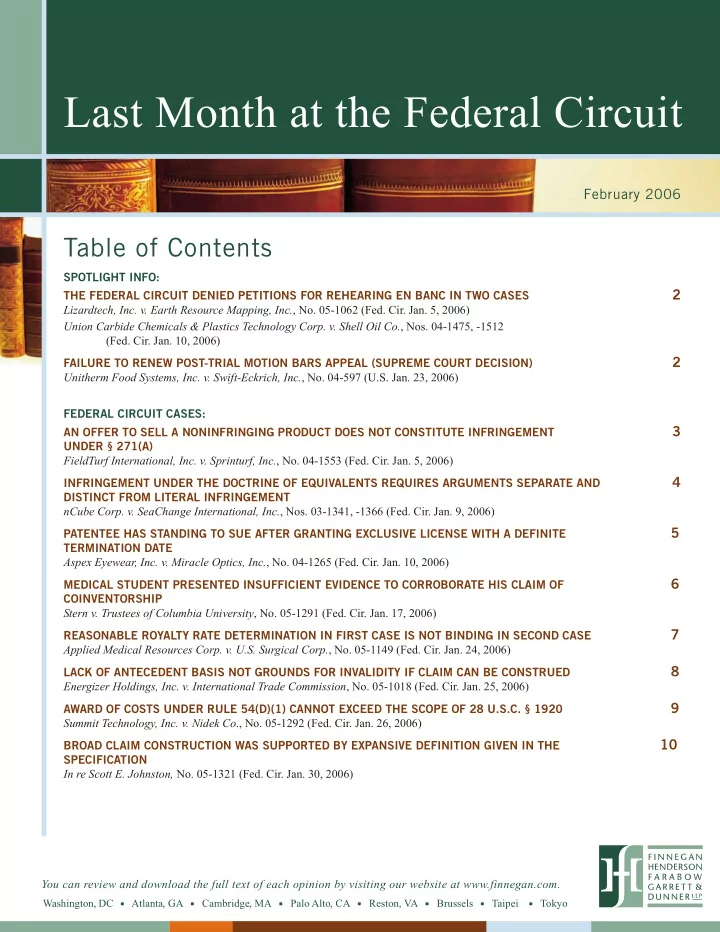
Last Month at the Federal Circuit February 2006 Table of Contents - - PDF document

last month at the federal circuit
SMART_READER_LITE
LIVE PREVIEW

Last Month at the Federal Circuit February 2006 Table of Contents - - PDF document

Last Month at the Federal Circuit February 2006 Table of Contents SPOTLIGHT INFO: 2 THE FEDERAL CIRCUIT DENIED PETITIONS FOR REHEARING EN BANC IN TWO CASES Lizardtech, Inc. v. Earth Resource Mapping, Inc. , No. 05-1062 (Fed. Cir. Jan. 5, 2006)


slide-1
SLIDE 1

February 2006

Last Month at the Federal Circuit

Washington, DC

■ Atlanta, GA ■ Cambridge, MA ■ Palo Alto, CA ■ Reston, VA ■ Brussels ■ Taipei ■ Tokyo

SPOTLIGHT INFO: THE FEDERAL CIRCUIT DENIED PETITIONS FOR REHEARING EN BANC IN TWO CASES

2

Lizardtech, Inc. v. Earth Resource Mapping, Inc., No. 05-1062 (Fed. Cir. Jan. 5, 2006) Union Carbide Chemicals & Plastics Technology Corp. v. Shell Oil Co., Nos. 04-1475, -1512 (Fed. Cir. Jan. 10, 2006) FAILURE TO RENEW POST-TRIAL MOTION BARS APPEAL (SUPREME COURT DECISION)

2

Unitherm Food Systems, Inc. v. Swift-Eckrich, Inc., No. 04-597 (U.S. Jan. 23, 2006) FEDERAL CIRCUIT CASES: AN OFFER TO SELL A NONINFRINGING PRODUCT DOES NOT CONSTITUTE INFRINGEMENT

3

UNDER § 271(A) FieldTurf International, Inc. v. Sprinturf, Inc., No. 04-1553 (Fed. Cir. Jan. 5, 2006) INFRINGEMENT UNDER THE DOCTRINE OF EQUIVALENTS REQUIRES ARGUMENTS SEPARATE AND

4

DISTINCT FROM LITERAL INFRINGEMENT nCube Corp. v. SeaChange International, Inc., Nos. 03-1341, -1366 (Fed. Cir. Jan. 9, 2006) PATENTEE HAS STANDING TO SUE AFTER GRANTING EXCLUSIVE LICENSE WITH A DEFINITE

5

TERMINATION DATE Aspex Eyewear, Inc. v. Miracle Optics, Inc., No. 04-1265 (Fed. Cir. Jan. 10, 2006) MEDICAL STUDENT PRESENTED INSUFFICIENT EVIDENCE TO CORROBORATE HIS CLAIM OF

6

COINVENTORSHIP Stern v. Trustees of Columbia University, No. 05-1291 (Fed. Cir. Jan. 17, 2006) REASONABLE ROYALTY RATE DETERMINATION IN FIRST CASE IS NOT BINDING IN SECOND CASE

7

Applied Medical Resources Corp. v. U.S. Surgical Corp., No. 05-1149 (Fed. Cir. Jan. 24, 2006) LACK OF ANTECEDENT BASIS NOT GROUNDS FOR INVALIDITY IF CLAIM CAN BE CONSTRUED

8

Energizer Holdings, Inc. v. International Trade Commission, No. 05-1018 (Fed. Cir. Jan. 25, 2006) AWARD OF COSTS UNDER RULE 54(D)(1) CANNOT EXCEED THE SCOPE OF 28 U.S.C. § 1920

9

Summit Technology, Inc. v. Nidek Co., No. 05-1292 (Fed. Cir. Jan. 26, 2006) BROAD CLAIM CONSTRUCTION WAS SUPPORTED BY EXPANSIVE DEFINITION GIVEN IN THE

10

SPECIFICATION In re Scott E. Johnston, No. 05-1321 (Fed. Cir. Jan. 30, 2006) You can review and download the full text of each opinion by visiting our website at www.finnegan.com.

Table of Contents

slide-2
SLIDE 2

Failure to Renew Post-Trial Motion Bars Appeal

Joyce Craig-Rient [Justice Thomas delivered the opinion of the Court, in which Chief Justice Roberts and Justices O’Connor, Scalia, Souter, Ginsburg, and Breyer joined. Justice Stevens filed a dissenting opinion, in which Justice Kennedy joined.] In Unitherm Food Systems, Inc. v. Swift-Eckrich, Inc., No. 04-597 (U.S. Jan. 23, 2006), the Supreme Court reversed the Federal Circuit’s decision to vacate an $18 million jury award and remand for a new trial. The Court held that the Federal Circuit had no basis on which to review the appellant’s challenge to the sufficiency of the evidence with regard to a patent fraud antitrust claim because the appellant failed to renew its preverdict motion pursuant to Rule 50(b). Unitherm Food Systems, Inc. (“Unitherm”) sued Swift-Eckrich, Inc. (doing business as “ConAgra”), alleging that ConAgra violated § 2 of the Sherman Act by attempting to enforce a patent that ConAgra had obtained by fraud. Unitherm’s antitrust claim proceeded to trial in the United States District Court for the Western District of

  • Oklahoma. Prior to the district court’s submission
  • f the case to the jury, ConAgra moved for a

directed verdict pursuant to Rule 50(a) based on the legal insufficiency of the evidence. The district court denied the motion, and the jury returned an $18 million verdict in favor of

  • Unitherm. ConAgra neither renewed its motion

for JMOL pursuant to Rule 50(b) nor moved for a new trial pursuant to Rule 59. On appeal, ConAgra argued that there was insufficient evidence to sustain the jury’s verdict

  • n the antitrust claim. The Federal Circuit applied

Tenth Circuit law, which allowed a party that had failed to file a postverdict motion challenging the

2 February 2006

Last month, the Federal Circuit denied petitions for rehearing en banc in two cases:

  • Lizardtech, Inc. v. Earth Resource Mapping, Inc., No. 05-1062 (Fed. Cir. Jan. 5, 2006).

In his concurrence to the denial, Judge Lourie, joined by Judges Michel and Newman, explained that the Federal Circuit has consistently held that patent law requires a patent contain a written description of a claimed invention independent of the enablement requirement. “Whatever inconsistencies may exist in application of the law lie in the different fact situations with which the courts are faced.” In his dissent, Judge Rader, joined by Judge Gajarsa, stated that “this [C]ourt provides no neutral standard of application for its evolving written description doctrine.” Noting that “the present confusion” started in 1997 when the Court “strayed from the statute and modified the written description requirement” in Regents of the University of California v. Eli Lilly & Co., 119 F.3d 1559 (Fed. Cir. 1997), Judge Rader urged that “this [C]ourt should not postpone further en banc reconsideration of its evolving written description doctrine.”

  • Union Carbide Chemicals & Plastics Technology Corp. v. Shell Oil Co., Nos. 04-1475, -1512 (Fed. Cir. Jan. 10, 2006).

Judge Lourie, joined by Judges Michel and Linn, dissented from the denial, stating that he believes the panel opinion holding that 35 U.S.C. § 271(f) “governs method/process inventions” is “contrary to the statutory scheme and to recent case law.” He explained that it is an “incorrect extension of the statutory language” to hold that supplying a component to be used in a process step creates infringement. Furthermore, it is contrary to the Court’s holding in Standard Havens Products, Inc. v. Gencor Industries, Inc., 953 F.2d 1360, 1374 (Fed. Cir. 1991), that § 271(f) is not implicated where an apparatus for use in a patented process is sent abroad. Judge Dyk also dissented from the denial.

Spotlight Info

“A postverdict motion is necessary because ‘[d]etermination of whether a new trial should be granted or a judgment entered under Rule 50(b) calls for the judgment in the first instance

  • f the judge who saw and heard the witnesses

and has the feel of the case which no appellate printed transcript can impart.’” Slip op. at 6.

slide-3
SLIDE 3

sufficiency of the evidence to raise such a claim on appeal as long as the party had filed a Rule 50(a) motion prior to submission of the case to the jury. The Federal Circuit concluded that Unitherm failed to present evidence sufficient to support all elements of its antitrust claim. Accordingly, the Federal Circuit vacated the jury’s judgment in favor of Unitherm and remanded the case for a new trial. The Supreme Court reversed, noting that Fed. R.

  • Civ. P. 50 establishes two stages for challenging

the sufficiency of the evidence in a civil jury trial. Rule 50(a) allows a party to challenge the sufficiency of the evidence prior to submission of the case to the jury. Rule 50(b) sets forth the procedural requirement for renewing a sufficiency

  • f the evidence challenge after the jury verdict and

entry of judgment, and allows the district court to choose between ordering a new trial or entering

  • judgment. Three Supreme Court cases decided

soon after World War II establish that the absence

  • f a Rule 50(b) motion divests an appellate court
  • f power to review the sufficiency of the evidence.

Following the holdings in those cases, the Court concluded that the Federal Circuit lacked power to enter judgment for ConAgra in these

  • circumstances. Further, the Court concluded that

the Federal Circuit lacked power to grant a new trial because ConAgra never sought a new trial before the district court and ConAgra’s unsuccessful Rule 50(a) motion did not present the district court with the option of ordering one. Accordingly, the Court held that a party is not entitled to pursue a new trial on appeal unless that party makes an appropriate postverdict motion in the district court. In dissent, Justice Stevens concluded that, while there may be reasons for an appellate court to decline to direct a verdict in favor of the party that lost below if that party failed to make a timely Rule 50(b) motion, the appellate court does not lack power to direct such a verdict or order appropriate relief to prevent manifest injustice.

An Offer to Sell a Noninfringing Product Does Not Constitute Infringement Under § 271(a)

Maria T. Bautista [Judges: Newman (author), Schall, and Dyk] In FieldTurf International, Inc. v. Sprinturf, Inc., No. 04-1553 (Fed. Cir. Jan. 5, 2006), the Federal Circuit affirmed the grant of SJ of noninfringement in favor of SportFields LLC and other related companies (collectively “SportFields,” as Sprinturf,

  • Inc. was not a party to the

appeal), reversed the grant of SJ of interference with prospective economic advantage and unfair competition, and vacated the award of attorney fees. FieldTurf International, Inc. and its related company (collectively “FieldTurf”) manufactures a synthetic turf covered by two of its patents. A school district issued a Request for Proposal (“RFP”) for an athletic field, specifying a “[p]ro series soccer synthetic grass system manufactured by FieldTurf . . . or approved equal.” SportFields, a competitor and manufacturer of a noninfringing product, complained that listing FieldTurf’s patented product as a sole source in the RFP violated California law. In response, the school district deleted the language “FieldTurf . . . or approved equal” and added specific requirements directed to FieldTurf’s patented product. Although SportFields continued to protest that the amendments did not permit substitute products, it submitted a bid and was awarded the contract. FieldTurf informed the school district and SportFields that SportFields’s bid was an infringing “offer to sell” under 35 U.S.C. § 271(a). “It is not unfair competition for a patentee to enforce its patent against a competitor, for the patentee has the right to exclude others.” Slip op. at 8.

3 Last Month at the Federal Circuit

slide-4
SLIDE 4

In response, the school district withdrew the RFP, issued a new RFP omitting the requirements relating to FieldTurf’s patented product, and again awarded SportFields the contract. FieldTurf sued SportFields for patent infringement, alleging that the first bid was an offer to sell under § 271(a), and further charging SportFields with commercial torts. SportFields denied infringement and counterclaimed, alleging intentional interference with prospective economic advantage and unfair competition. The district court awarded SportFields SJ of noninfringement because the bid, though an offer for sale, was an offer to sell a noninfringing product. The district court also granted SportFields SJ on its counterclaims and awarded attorney fees. On appeal, the Federal Circuit affirmed the district court’s grant of SJ of noninfringement. Although a bid to supply a product in an RFP is traditionally an offer to sell, the Court reasoned that it was appropriate for the district court to consider SportFields’s intent to sell its noninfringing product despite the RFP specifications. The district court was not required to ignore that SportFields’s products differed from FieldTurf’s and that SportFields emphasized those differences to the school district. The Federal Circuit reversed the grant of SJ on the state law claims that FieldTurf committed tortious interference and unfair competition. FieldTurf’s efforts to obtain specifications in the RFP that favored its patented product were not illegal absent fraud or deception, and it was not established as a matter of law that FieldTurf’s conduct was

  • wrongful. Likewise, the Court concluded that

FieldTurf’s infringement action was not an unfair business practice because it is not unlawful, unfair,

  • r fraudulent business practice for a patentee to

enforce its right to exclude others. Additionally, the Federal Circuit vacated the district court’s award of attorney fees, concluding that FieldTurf’s patent position was not without support and that it had committed no egregious

  • action. Therefore, this was not an exceptional case

under 35 U.S.C. § 285 warranting the award of attorney fees.

Infringement Under the Doctrine of Equivalents Requires Arguments Separate and Distinct from Literal Infringement

Jeffrey E. Danley [Judges: Rader (author), Friedman, and Dyk (dissenting)] In nCube Corp. v. SeaChange International, Inc.,

  • Nos. 03-1341, -1366 (Fed. Cir. Jan. 9, 2006), the

Federal Circuit affirmed the trial judge’s denial of SeaChange International, Inc.’s (“SeaChange”) motion for JMOL on literal infringement, willfulness, and indirect infringement and the denial of SeaChange’s motion for a new trial. The Court also affirmed the trial judge’s decision to vacate the jury’s finding of infringement under the DOE and affirmed the trial judge’s award of enhanced damages and attorney fees. nCube Corporation’s (“nCube”) U.S. Patent No. 5,805,804 claims “a better means and method for providing multi-media data in a structured system” by giving clients access to multimedia resources

  • n different networks,

even when those networks use different addressing schemes. The invention uses an upstream manager, a downstream manager, and a media server. The

  • nly embodiment

discloses creating its

  • wn network protocol by superimposing “logical”

addresses over the physical addresses of objects in the various networks, relieving the client of keeping track of the physical addresses. The Federal Circuit agreed with the trial judge’s claim construction and rejected SeaChange’s narrower construction that the upstream manager routes messages using only logical addresses. According to the Court, SeaChange’s proposed construction would impermissibly read the

4 February 2006

“The evidence and argument on the doctrine of equivalents cannot merely be subsumed in plaintiff’s case of literal infringement.” Slip op. at 14.

slide-5
SLIDE 5

limitation of a “virtual connection” into the asserted claim and would render a dependent claim redundant. Additionally, the Court noted that the patentee is not limited to the only embodiment disclosed in the specification. Although the jury found that SeaChange willfully infringed nCube’s patent, both literally and under the DOE, the Federal Circuit upheld the trial judge’s holding that only literal infringement

  • ccurred. In so doing, the Court took note of the

extensive evidence on infringement while SeaChange cited no expert or other testimony to the jury that contradicted nCube’s expert opinion. The Court refused to second guess the jury’s finding that nCube’s expert was credible. The Federal Circuit also upheld the trial judge’s decision to vacate the jury’s finding of infringement under the DOE. To successfully prove infringement under the DOE, a party must present evidence and arguments concerning each claim element. nCube failed to satisfy that burden. The Court upheld the trial judge’s holding on willful infringement despite SeaChange’s opinion letter of noninfringement obtained after nCube filed suit. Because SeaChange did not supply an important technical document to counsel, the

  • pinion can no longer serve its “prophylactic

purpose” of negating a finding of willfulness. The Federal Circuit also upheld the trial judge’s holding on indirect infringement because the jury had sufficient evidence to infer that SeaChange intended its customers to use their equipment with the SeaChange device to practice the patented

  • method. In finding willful infringement, the jury

determined that SeaChange possessed the requisite intent. In upholding the trial judge’s award of enhanced damages, the Court emphasized that the case for literal infringement was “not close.” Further, because SeaChange deliberately copied the patented invention without a good-faith excuse, the Court held that the trial judge did not abuse his discretion in finding the case exceptional and awarding enhanced damages and attorney fees. Judge Dyk dissented on the issue of literal

  • infringement. Judge Dyk agreed with SeaChange

that the claim construction erroneously omitted the additional requirement that the upstream manager route messages using logical addresses. Under that narrower claim construction, there would be insufficient evidence to support a finding of infringement.

Patentee Has Standing to Sue After Granting Exclusive License with a Definite Termination Date

Adriana L. Burgy [Judges: Lourie (author), Archer, and Gajarsa] In Aspex Eyewear, Inc. v. Miracle Optics, Inc.,

  • No. 04-1265 (Fed. Cir. Jan. 10, 2006), the Federal

Circuit vacated the district court’s dismissal of the action for lack of standing and remanded to determine whether all necessary parties to the action were joined. Contour Optik, Inc. (“Contour”) owns U.S. Patent

  • No. 6,109,747 (“the ’747 patent”) directed to an

improved eyeglass combination. On March 20, 2001, Contour and Chic Optic, Inc. (“Chic”) entered into an agreement entitled “Distribution and License Agreement” of the ’747 patent (“the Contour-Chic agreement”). The Contour-Chic agreement granted to Chic certain rights, including “(1) the exclusive right to make, use, and sell in the United States products covered by the patent, (2) the first right to commence legal action against third parties for infringement of the patent and the right to retain any award of damages from actions initiated by Chic, and (3) a virtually unfettered right to sublicense all of its rights to a third party.” Slip op. at 2. The Contour-Chic agreement also contained a clause that limited the term of the agreement to expire on March 6, 2003, and in no

5 Last Month at the Federal Circuit

“By having rights for only a limited portion of the patent term, [licensee] simply did not own the patent.” Slip op. at 11.

slide-6
SLIDE 6

6 February 2006

event later than March 16, 2006. On April 5, 2001, under the agreement, Chic executed a sublicense to Aspex Eyewear, Inc. (“Aspex”) granting to Aspex all of Chic’s rights under the Contour-Chic agreement. On March 28, 2001, before the execution of the sublicense, Aspex and Contour sued Miracle Optics, Inc. (“Miracle”) for infringement of the ’747 patent. The district court granted Miracle’s motion to dismiss the action on the ground that neither Contour nor Aspex had standing to sue as they both lacked “rights of the patentee.” On appeal, Contour argued that the Contour-Chic agreement did not transfer to Chic all substantial rights under the ’747 patent because the term limit of the agreement shows Contour retained

  • wnership. In contrast, Miracle asserted that such

a term limit corresponds to reversionary interests that do not preclude a finding of assignment and added that Chic was expressly given the right to sue for present or future infringements along with unfettered authority to sublicense to the ’747 patent. Vacating the district court’s dismissal, the Federal Circuit identified that the essential inquiry regarding the right to sue on a patent is who owns the patent, i.e., who has all substantial rights of the

  • patent. In answering this question, the Court

acknowledged that while a key factor is often where the right to sue for infringement lies, the dominant factor in this case is the agreement’s term limit. Despite Chic’s right to sue and other numerous rights under the Contour-Chic agreement, the Court found that those rights are

  • nly valid for a limited period of time, which

would end at a definitive date. Accordingly, Contour would regain those rights transferred to Chic, and Chic would have possessed the rights under the ’747 patent for only a fixed period of years in contrast to Contour’s ownership for the ’747 patent’s remaining term. In addition, the Court explained that a reversionary interest such as a defeasible event, e.g., a default or bankruptcy, is distinct from having rights for only a limited portion of the patent term. As such, the Court concluded that Chic had an exclusive license for a fixed term that failed to meet the “all substantial rights” standard and thus vacated the district court’s decision that Contour lacked standing. The Federal Circuit further remanded to the district court the question of whether all necessary parties were joined, namely exclusive licensees, and for the determination of whether Aspex or Chic was an exclusive licensee at the time the complaint was filed.

Medical Student Presented Insufficient Evidence to Corroborate His Claim of Coinventorship

Christopher T. Blackford [Judges: Mayer (author), Rader, and Linn] In Stern v. Trustees of Columbia University,

  • No. 05-1291 (Fed. Cir. Jan. 17, 2006), the Federal

Circuit affirmed the district court’s grant of SJ that Fredric A. Stern failed to present sufficient evidence to be named as a coinventor of U.S. Patent No. 4,599,353 (“the ’353 patent”). The ’353 patent, owned by Columbia University (“Columbia”), is directed toward the use of prostaglandins in treating glaucoma. Laszlo Z. Bito, a faculty member at Columbia and the only named inventor, conceived the invention claimed in the ’353 patent while studying the effects

  • f repeated prostaglandin

application in rhesus monkeys. Before the ’353 patent application was filed, Stern, who was then a medical student at Columbia, conducted experiments in Bito’s laboratory “[R]egardless of the contents of the notebooks, unwitnessed laboratory notebooks

  • n their own are

insufficient to support his claim of co-inventorship.” Slip op. at 5.

slide-7
SLIDE 7

7 Last Month at the Federal Circuit

relating to the application of prostaglandin in rhesus monkeys. At that point, however, Bito had already published numerous papers on the effects

  • f prostaglandins in various animals and had

identified rhesus monkeys as a future subject for

  • study. Stern’s experiments in Bito’s laboratory

showed that application of a single dose of prostaglandin reduced intraocular pressure (“IOP”) but did not prove whether tachyphylaxis would develop in primates, the absence of which is required for successful glaucoma treatment. After learning about the ’353 patent, Stern brought suit, seeking to be added as a coinventor. To determine inventorship, the trial court first construed the claims of the ’353 patent. The court construed the only disputed claim phrase, “to maintain reduced intraocular pressure,” to mean “maintenance of reduced intraocular pressure . . . without development of tachyphylaxis.” Using this construction, the district court held that Stern failed to present clear and convincing evidence of inventorship and granted Columbia’s motion for SJ. On appeal, the Federal Circuit reviewed the grant of SJ de novo, ruling that Stern had failed to present sufficient evidence to corroborate his claim of coinventorship. In particular, the Court found that there was no collaboration between Stern and Bito in developing a glaucoma

  • treatment. Rather, Stern merely carried out an

experiment previously done by Bito on different

  • animals. The Court further stated that Stern not
  • nly failed to conceive of any of the ideas

underlying the claimed invention, but he also did not have an understanding of the claimed invention. Stern also argued that his laboratory notebooks would have proved his claim of coinventorship had they not been destroyed by Bito. The Court, however, rejected Stern’s argument, ruling that regardless of the notebooks’ contents, unwitnessed laboratory notebooks alone are insufficient to support a claim of coinventorship.

Reasonable Royalty Rate Determination in First Case Is Not Binding in Second Case

John W. Cox [Judges: Lourie (author), Rader, and Linn] In Applied Medical Resources Corp. v. U.S. Surgical Corp., No. 05-1149 (Fed. Cir. Jan. 24, 2006), the Federal Circuit affirmed the U.S. District Court for the Central District of California’s (1) finding that substantial evidence supports the jury’s verdict that U.S. Surgical Corporation (“U.S. Surgical”) willfully infringed a patent assigned to Applied Medical Resources Corporation (“Applied”); (2) refusal to apply collateral estoppel to the reasonable royalty rate; and (3) admission of evidence regarding a prior litigation. The patent at issue, U.S. Patent No. 5,385,553 (“the ’553 patent”) is directed to surgical devices called trocars, which are used as access ports during laparoscopic surgery. In an earlier case, which the Court labeled “Applied I,” Applied alleged that U.S. Surgical’s “Versaport I” device infringed the ’553 patent. In that case, a jury found that U.S. Surgical willfully infringed the ’553 patent, plus other Applied patents, and awarded damages based on a 7% reasonable royalty. Shortly after the Applied I verdict, U.S. Surgical began selling the Versaport II, a device developed during the Applied I litigation. Applied filed a second complaint in the Central District of California, alleging that the Versaport II infringed the ’553 patent (“Applied II”). The district court granted Applied’s motion for SJ that the Versaport II infringed the ’553 patent. The Federal Circuit affirmed. The district court then held a trial to determine damages and willfulness. It denied a motion filed by U.S. Surgical to establish a 7% reasonable royalty based on the rate in Applied I under principles of collateral estoppel. The jury then

slide-8
SLIDE 8

8 February 2006

found U.S. Surgical liable for willful infringement and awarded damages of $43.5M. On motion, the district court entered enhanced damages of $64.5M. On appeal, the Federal Circuit held that the district court properly denied giving collateral estoppel effect to the Applied I jury’s 7% royalty rate. The Court reasoned that collateral estoppel is not appropriate because the determination of the rate in Applied II is not identical to the determination in Applied I. The Court held that the determination must relate to the time of infringement and that “reasonable royalty damages are not calculated in a vacuum without consideration of the infringement being redressed.” The Court noted that the infringements in Applied I and Applied II “began at separate and distinct times” and that it “cannot relate reasonable royalty damages for Versaport II sales back to a separate and past infringement caused by Versaport I sales.” Further, the Court found that U.S. Surgical had conceded, in arguing that the Versaport II did not infringe, that the devices were different and the infringement issues were

  • different. The Court held,

“Indeed, simply because the same company sold two different products which infringed a patent does not prevent the patentee from litigating and collecting separate damages for each infringement.” Slip op. at 10 (emphases in

  • riginal). The Federal Circuit also recognized

that “[t]he damages issues are not the same.” Regarding willfulness, the Federal Circuit found that substantial evidence supports the jury’s

  • verdict. Specifically, the Court found that the

evidence showed that U.S. Surgical desperately needed a competitive universal seal trocar and its management did not properly oversee or participate in the development of the Versaport II, but instead placed “intense time pressure” on its engineers to create a new product. The Court also concluded that a reasonable jury could have believed based on the evidence that U.S. Surgical was not concerned about infringement and would have proceeded to manufacture Versaport II despite receiving outside legal opinions. Therefore, the Federal Circuit held that the district court did not err in denying U.S. Surgical’s JMOL motion of no willful infringement. Lastly, the Federal Circuit held that the district court did not abuse its discretion in admitting evidence regarding the Applied I litigation. The Court concluded that the Applied I litigation “was relevant to the reasonable royalty analysis” in Applied II, partly because the hypothetical negotiation for Applied II “took place on the heels

  • f the Applied I jury verdict.” The Court further

concluded that the Applied I litigation was also relevant to the jury’s willfulness determination in Applied II because “Applied I was clearly relevant to U.S. Surgical’s state of mind.”

Lack of Antecedent Basis Not Grounds for Invalidity If Claim Can Be Construed

Elisabeth J. Barek [Judges: Newman (author), Archer, and Schall] In Energizer Holdings, Inc. v. International Trade Commission, No. 05-1018 (Fed. Cir. Jan. 25, 2006), the Federal Circuit reversed the ITC’s holding of invalidity for indefiniteness under 35 U.S.C. § 112, ¶ 2, and remanded the case for further proceedings. The patent at issue, U.S. Patent No. 5,464,709 (“the ’709 patent”), is for an electrolytic alkaline battery cell that is substantially free of mercury. These so-called “zero-mercury-added” batteries stem from the discovery that zinc, used for the battery’s anode, contains trace impurities. Identifying and eliminating those impurities precludes the need to add mercury, a corrosion inhibitor, to the battery cell. As mercury is an environmental pollutant, extensive effort has been devoted to reducing or eliminating the mercury content in alkaline batteries. Energizer Holdings, Inc. and Eveready Battery Company, Inc. (collectively “EBC”) charged the respondents with violation of 19 U.S.C. § 1337 based on their importation into the United States, sale for importation, and sale within the United States of batteries asserted to infringe the ’709

  • patent. Claim 1 of the patent recited “[a]n

electrochemical cell comprising . . . an anode gel comprised of zinc as the active anode component, wherein the cell contains less than 50 parts of “The sales of Versaport II constituted a separate and distinct infringement . . . under the statute.” Slip op. at 10.

slide-9
SLIDE 9

9 Last Month at the Federal Circuit

mercury per million parts by weight of the cell and said zinc anode has a gel expansion of less than 25% after being discharged for 161 minutes to 15% depth of discharge at 2.88A.” Slip op. at 5. The ITC held invalid independent claim 1 and dependent claims 2-7 for lack of antecedent basis

  • f the phrase “said zinc anode.” Moreover, the

ITC held that even if “said zinc anode” was construed to have as antecedent the “anode gel comprised of zinc as the active anode component” recited earlier in the claim, the claim would still be indefinite as written because it required that the anode of every cell be “discharged for 161 minutes to 15% depth of discharge at 2.88A.” The ITC reasoned that since the discharge parameters were intended to apply to only a test cell and not to every cell, the claim drafting was ambiguous and rendered the claim indefinite. In addition, the ITC held that EBC’s proffer of alternative constructions

  • f “said zinc anode”

was an admission of indefiniteness. EBC argued the claims were not “insolubly ambiguous” and that a person of ordinary skill in the art would understand the claim because the specification made clear that the test parameters included in the claim did not mean that every cell must be discharged for 161 minutes. EBC pointed

  • ut that the ’709 patent was directed to a standard

electrolytic alkaline cell, and the specification clearly stated the purpose of the test was to identify zinc anode material used in the invention. The Federal Circuit agreed and reversed the determination of the ITC. The Court reasoned that despite the lack of explicit antecedent basis for “said zinc anode,” whether the claim had a reasonably ascertainable meaning must be decided in context. In agreeing with EBC that the claims could be construed, the Federal Circuit pointed out that, in prosecuting the ’709 patent, the Examiner made several objections to the claims, but the claims were neither rejected nor objected to on the ground of lack of antecedent basis. The Court noted that an antecedent basis can be present by

  • implication. Furthermore, neither the ITC nor

Eveready argued that they did not understand the intended scope because of the absence of an antecedent. The Federal Circuit also held that the ITC had erred in holding that the need to construe a claim,

  • r the proffer of alternative constructions, rendered

the claim indefinite. The Court thus reversed the ITC’s holding of invalidity, concluding that the claim was amenable to construction and that “anode gel” was by implication the antecedent basis for “said zinc anode.”

Award of Costs Under Rule 54(d)(1) Cannot Exceed the Scope of 28 U.S.C. § 1920

Panyin A. Hughes [Judges: Rader, Bryson (author), and Gajarsa] In Summit Technology, Inc. v. Nidek Co.,

  • No. 05-1292 (Fed. Cir. Jan. 26, 2006), the Federal

Circuit modified an award of costs to Nidek Company (“Nidek”) because certain portions of the award were not statutorily allowable costs and

  • ther portions of the award were not supported by

any evidence. The district court awarded costs to Nidek, the prevailing party in the underlying patent infringement suit, without explaining how it computed the amount. Summit Technology, Inc. (“Summit”) appealed and the Federal Circuit remanded, directing the district court to indicate how it computed its award. The district court conducted a hearing and computed the amount of costs to award Nidek. Summit once again appealed, contesting portions of the award for trial exhibits, photocopying, and deposition expenses. The Federal Circuit noted that even though it reviews a district court’s grant of costs under Fed.

  • R. Civ. P. 54(d)(1) for abuse of discretion, a district

court may only award costs that fall within the provisions of 28 U.S.C. § 1920, and whether an expense falls under § 1920 constitutes statutory interpretation, which it reviews de novo. Given that the Federal Circuit defers to regional circuit “The Commission erred in holding that the need to construe a claim, or the proffer of alternative constructions, renders the claim indefinite. A claim that is amenable to construction is not invalid

  • n the ground of

indefiniteness.” Slip op. at 7.

slide-10
SLIDE 10

10 February 2006

law in such cases, the Court sought to determine how the First Circuit would rule. The Federal Circuit agreed with Summit that the district court should not have awarded Nidek fees it paid a consultant for preparing trial exhibits, including computer animations. In the Court’s view, such expenses did not constitute “exemplifications [or] copies of papers necessarily

  • btained for use in the case,” and thereby did not

fall within 28 U.S.C. § 1920(4). Consequently, those expenses could not constitute taxable costs under Fed. R. Civ. P. 54(d)(1). The Court rejected Nidek’s argument that the First Circuit would take a broad view of “exemplifications” and allow such costs. Nidek based its argument primarily on a 1957 decision of a district court in the First Circuit that stated that the test for whether a chart expense should be taxable as costs is the extent to which it provided “real assistance to the court.” According to the Federal Circuit, the case Nidek relied on does not represent current First Circuit law because the party in that case against whom such costs were assessed did not raise the issue on appeal. Moreover, that decision preceded the U.S. Supreme Court’s pronouncement in Crawford Fitting Co. v. J.T. Gibbons, Inc., 482 U.S. 437 (1987), limiting a lower court’s discretion under § 1920 to the kinds of costs allowed under the statute. Furthermore, finding no First Circuit decisions directly on point, the Federal Circuit surveyed decisions from the other circuits and concluded that several narrowly interpreted “exemplification.” The Court found these decisions consistent with its own prior decision applying Sixth Circuit law, where it narrowly construed “exemplification,” noting that Congress did not use the broad phrase “demonstrative evidence” in § 1920. According to the Court, even the Seventh Circuit, which has allowed a broad construction of “exemplification,” has acknowledged that Congress did not contemplate including costs for computer animations under § 1920. Regarding photocopy expenses, the Court noted that First Circuit law awards costs “reasonably necessary to the maintenance of the litigation.” The Court agreed with Nidek that in a complex litigation, one cannot expect tracking of every photocopied page along with a record of its relevance to the litigation. Nevertheless, the Court reduced the amount of costs awarded for Nidek’s internal photocopy expenses by 50 percent to account for unnecessary copies, as Nidek had already agreed to for photocopies made by outside

  • vendors. Moreover, the Court eliminated an award
  • f costs for internal photocopy expenses by

Nidek’s secondary counsel because there was no evidence to support such costs. Finally, the Federal Circuit reduced the amount of costs designated as deposition expenses because Nidek’s invoices and supporting testimony did not indicate who was deposed or what services were included in the invoice charge. In conclusion, the Court surmised that both the district court and Nidek viewed the cost award as appropriate given the complexity of the underlying patent infringement suit. The Federal Circuit disavowed this view, stating: “Cost awards are bound by the constraint of section 1920, and, when challenged, a prevailing party must offer some reliable documentation or other proof that its bill

  • f costs represents the allowable costs that it

actually and necessarily incurred during the litigation.” Slip op. at 15.

Broad Claim Construction Was Supported by Expansive Definition Given in the Specification

Deborah M. Herzfeld [Judges: Michel, Newman (author), Bryson] In In re Scott E. Johnston, No. 05-1321 (Fed. Cir.

  • Jan. 30, 2006), the Federal Circuit affirmed the

decision of the Board, which affirmed the “[T]he fact that a case is particularly complex does not give the prevailing party an unchecked right to collect nearly $400,000 in costs.” Slip op. at 15.

slide-11
SLIDE 11

11 Last Month at the Federal Circuit

Examiner’s rejection of all claims of U.S. Patent Application No. 09/312,992 (“the ’992 application”) as anticipated or obvious. The claims of the ’992 application are directed toward a large diameter spiral pipe, in excess of 15 feet (independent claim 1) or in excess of 144 inches (independent claims 5 and 9) comprising an elongated strip of ductile material formed into jointed, adjacent helical convolutions. The Board rejected the claims as anticipated in view of three patents describing silos, storage tanks, and other cylindrical structures formed from strips of metal bent into a helical shape and joined at the edges. In addition to the three patents, the Examiner had also cited two nonpatent references: (1) a brochure for a manufacturing system, wherein spirally formed tubes of corrugated metal, up to 15 feet in diameter, are described for use in storm sewers, drainage tubes, and culverts; and (2) a “Handbook of Steel” that taught spirally formed steel pipes, in diameters of 24 feet or more, and arches for use in culverts, storm sewers, subdrains, spillways, underpasses, and service tunnels, wherein the pipe is shown deformed into elliptical shapes and arches. In reaching its decision, the Board adopted the dictionary definition of “pipe” as a tubular or cylindrical object, part, or passage, and thus held that large cylindrical structures, such as storage tanks and silos, met this definition of pipe within the meaning and scope of the claims. Johnston challenged the Board’s use of the dictionary definition as unduly broad. In particular, he asserted that persons with skill in the art would not have considered the prior art structures as included in the meaning of “pipe,” but rather to mean structures used to carry fluids or as electrical conduits. The Federal Circuit affirmed, stating that “[i]t is well established that dictionary definitions must give way to the meaning imparted by the specification,” citing Phillips v. AWH Industries, 415 F.3d 1303 (Fed. Cir. 2005) (en banc). Slip op. at 3. However, the specification of the ’992 application did not help Johnston’s argument as, rather than attempting to disclaim such broad scope from its claims, it actually states that pipes may be used as overpasses, storage buildings, homes, silos, and water tanks. Thus, there was no error in considering the patents that describe silos and storage tanks. The Board further observed that the claims were not limited by the method of forming or shaping the spiral pipe. Accordingly, the Federal Circuit agreed with the decision that claims 1, 2, and 4 were anticipated by the cited patents. Claim 3, which depends from claims 1 and 2, is limited by additional optional elements: “further including that said wall may be smooth, corrugated, or profiled with increased dimensional proportions as pipe size is increased.” The Board ruled, and the Federal Circuit affirmed, that those limitations did not narrow the scope of the claim because the limitations were permissive. Claims 5 through 9 were agreed to stand or fall together, and the Board found that the subject matter of claim 9 would have been obvious based

  • n the two nonpatent references cited by the
  • Examiner. In particular, the Board found

motivation to combine the teachings of the two nonpatent references in that both deal with the same field of technology and both show spirally formed pipe of large diameter. Johnston argued that there was inadequate motivation to combine the two references, specifically, because one reference teaches only spirally formed, arched-steel pipe less than 12 feet in diameter and arched-steel pipe of over 25 feet in diameter, while the other reference discloses only round, spirally formed pipe. The Federal Circuit agreed with the Board that the references are in the same field of endeavor and deal with related subject matter, and thus affirmed that it would have been obvious to combine the teachings of the two references to render obvious claim 9 of the ’992 application. “It is well established that dictionary definitions must give way to the meaning imparted by the specification . . . but in this case Mr. Johnston himself gave ‘pipe’ the broad meaning he now criticizes.” Slip op. at 3.

slide-12
SLIDE 12
  • The Supreme Court has scheduled oral arguments in review of two cases from the Federal Circuit at the session

beginning March 20, 2006:

  • On Tuesday, March 21, the Court will hear oral argument in Laboratory Corporation of America

Holdings d/b/a LabCorp v. Metabolite Laboratories, Inc., No. 04-607, where it will consider whether “correlating” results in a vitamin B deficiency test can be a valid claim in a method patent.

  • On Wednesday, March 29, the Court will hear oral argument in eBay Inc. v. MercExchange LLC,
  • No. 05-130, where it will consider whether exceptional circumstances are required for a

court to deny a permanent injunction when patent infringement has been established.

  • The Blackberry saga continues in the U.S. District Court for the Eastern District of Virginia. On remand from the

Federal Circuit, the district court will hold a hearing on February 24 in NTP Inc. v. Research in Motion Ltd.,

  • No. 3:01-cv-00767, to determine whether it should reconsider a finding of willful infringement and whether to hold

another jury trial on damages in light of the Federal Circuit’s correction of the claim construction in one of the asserted patents. The district court will also determine whether a permanent injunction is an appropriate remedy.

Abbreviated Forms Acronyms

In Last Month at the Federal Circuit, certain terms, titles, and names that are frequently used are abbreviated as listed below.

Looking Ahead

Last Month at the Federal Circuit

DISCLAIMER:

The case summaries reflect the understanding of the authors only and are not meant to convey legal opinions or advice of any kind. The firm disclaims any liability for any errors or omissions in these summaries. This promotional newsletter does not establish any form of attorney-client relationship with our firm or with any of our attorneys.

ALJ Administrative Law Judge ANDA Abbreviated New Drug Application APA Administrative Procedures Act APJ Administrative Patent Judge Board Board of Patent Appeals and Interferences Commissioner Commissioner of Patents and Trademarks CIP Continuation-in-Part DJ Declaratory Judgment DOE Doctrine of Equivalents FDA Food & Drug Administration IDS Information Disclosure Statement IP Intellectual Property ITC International Trade Commission JMOL Judgment as a Matter of Law MPEP Manual of Patent Examining Procedure PCT Patent Cooperation Treaty PTO United States Patent and Trademark Office SEC Securities and Exchange Commission SJ Summary Judgment SM Special Master

If you have any questions or need additional information, please contact:

Esther H. Lim

Editor-in-Chief 202.408.4121 esther.lim@finnegan.com

Edward J. Naidich

Assistant Editor 202.408.4365 ed.naidich@finnegan.com

Courtney B. Meeker

Assistant Editor 202.408.4496 courtney.meeker@finnegan.com

Finnegan, Henderson, Farabow, Garrett & Dunner, LLP www.finnegan.com