The Federal Circuit month at FEDERAL CIRCUIT ORDERS EN BANC - - PDF document

the federal circuit
SMART_READER_LITE
LIVE PREVIEW

The Federal Circuit month at FEDERAL CIRCUIT ORDERS EN BANC - - PDF document

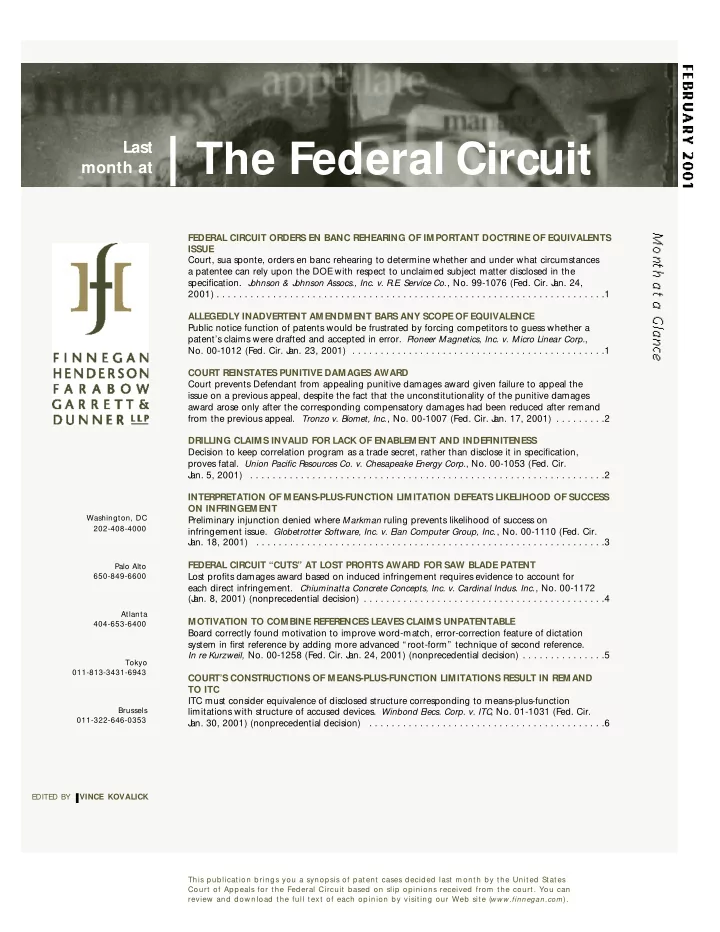
Last The Federal Circuit month at FEDERAL CIRCUIT ORDERS EN BANC REHEARING OF IMPORTANT DOCTRINE OF EQUIVALENTS ISSUE Court, sua sponte, orders en banc rehearing to determine whether and under what circumstances a patentee can rely upon the


slide-1
SLIDE 1

EDITED BY VINCE KOVALICK This publication brings you a synopsis of patent cases decided last m onth by the United States Court of Appeals for the Federal Circuit based on slip opinions received from the court. You can review and dow nload the full text of each opinion by visiting our Web site (www.finnegan.com). Washington, DC 202-408-4000 Palo Alto 650-849-6600 Atlanta 404-653-6400 Tokyo 011-813-3431-6943 Brussels 011-322-646-0353

FEDERAL CIRCUIT ORDERS EN BANC REHEARING OF IMPORTANT DOCTRINE OF EQUIVALENTS ISSUE Court, sua sponte, orders en banc rehearing to determine whether and under what circumstances a patentee can rely upon the DOE with respect to unclaimed subject matter disclosed in the

  • specification. J
  • hnson & J
  • hnson Assocs., Inc. v. R.E

. Service Co., No. 99-1076 (Fed. Cir. J

  • an. 24,

2001) . . . . . . . . . . . . . . . . . . . . . . . . . . . . . . . . . . . . . . . . . . . . . . . . . . . . . . . . . . . . . . . . . . . . .1 ALLEGEDLY INADVERTENT AMENDMENT BARS ANY SCOPE OF EQUIVALENCE Public notice function of patents would be frustrated by forcing competitors to guess whether a patent’s claims were drafted and accepted in error. Pioneer Magnetics, Inc. v. Micro Linear Corp.,

  • No. 00-1012 (Fed. Cir. J
  • an. 23, 2001) . . . . . . . . . . . . . . . . . . . . . . . . . . . . . . . . . . . . . . . . . . . . .1

COURT REINSTATES PUNITIVE DAMAGES AWARD Court prevents Defendant from appealing punitive damages award given failure to appeal the issue on a previous appeal, despite the fact that the unconstitutionality of the punitive damages award arose only after the corresponding compensatory damages had been reduced after remand from the previous appeal. Tronzo v. Biomet, Inc., No. 00-1007 (Fed. Cir. J

  • an. 17, 2001) . . . . . . . . .2

DRILLING CLAIMS INVALID FOR LACK OF ENABLEMENT AND INDEFINITENESS Decision to keep correlation program as a trade secret, rather than disclose it in specification, proves fatal. Union Pacific Resources Co. v. Chesapeake E

nergy Corp., No. 00-1053 (Fed. Cir. J

  • an. 5, 2001) . . . . . . . . . . . . . . . . . . . . . . . . . . . . . . . . . . . . . . . . . . . . . . . . . . . . . . . . . . . . . . .2

INTERPRETATION OF MEANS-PLUS-FUNCTION LIMITATION DEFEATS LIKELIHOOD OF SUCCESS ON INFRINGEMENT Preliminary injunction denied where Markman ruling prevents likelihood of success on infringement issue. Globetrotter Software, Inc. v. E

lan Computer Group, Inc., No. 00-1110 (Fed. Cir. J

  • an. 18, 2001) . . . . . . . . . . . . . . . . . . . . . . . . . . . . . . . . . . . . . . . . . . . . . . . . . . . . . . . . . . . . . .3

FEDERAL CIRCUIT “CUTS” AT LOST PROFITS AWARD FOR SAW BLADE PATENT Lost profits damages award based on induced infringement requires evidence to account for each direct infringement. Chiuminatta Concrete Concepts, Inc. v. Cardinal Indus. Inc., No. 00-1172 (J

  • an. 8, 2001) (nonprecedential decision) . . . . . . . . . . . . . . . . . . . . . . . . . . . . . . . . . . . . . . . . . . .4

MOTIVATION TO COMBINE REFERENCES LEAVES CLAIMS UNPATENTABLE Board correctly found motivation to improve word-match, error-correction feature of dictation system in first reference by adding more advanced “ root-form” technique of second reference.

In re Kurzweil, No. 00-1258 (Fed. Cir. J

  • an. 24, 2001) (nonprecedential decision) . . . . . . . . . . . . . . .5

COURT’S CONSTRUCTIONS OF MEANS-PLUS-FUNCTION LIMITATIONS RESULT IN REMAND TO ITC ITC must consider equivalence of disclosed structure corresponding to means-plus-function limitations with structure of accused devices. Winbond E

  • lecs. Corp. v. ITC

, No. 01-1031 (Fed. Cir. J

  • an. 30, 2001) (nonprecedential decision) . . . . . . . . . . . . . . . . . . . . . . . . . . . . . . . . . . . . . . . . . .6

The Federal Circuit

Last month at

slide-2
SLIDE 2

Federal Circuit Orders En Banc Rehearing of Important Doctrine

  • f Equivalents Issue

In J

  • hnson & J
  • hnson Associates v. R.E

. Service Co., No. 99-1076 (Fed. Cir. J

  • an. 24, 2001), the

Federal Circuit ordered, sua sponte, that the case be heard en banc to determine when and under what circumstances a patentee can rely upon the DOE with respect to unclaimed subject matter disclosed in the specification. The Court ordered the en banc hearing after initial arguments before a three-judge panel on December 7, 1999. The Court also ordered new briefs to be filed and permitted the filing of amicus briefs. The supplemental briefing also applies to the more narrow question of whether in this case the jury’s finding of infringement should be reversed because the patentee was foreclosed from assert- ing the DOE with respect to unclaimed subject matter disclosed in the specification.

Allegedly Inadvertent Amendment Bars Any Scope of Equivalence

J ason E . Gorden

[J udges: Mayer (author), Newman, and Lourie] In Pioneer Magnetics, Inc. v. Micro Linear

Corp., No. 00-1012 (Fed. Cir. J

  • an. 23, 2001), the

Federal Circuit affirmed a judgment of nonin- fringement based on prosecution history estop- pel, relying on its decision in F

esto Corp. v. Shoketsu Kinzoku Kogyo Kabushiki Co., 234 F.3d

558 (Fed. Cir. 2000) (en banc). Pioneer Magnetics, Inc. (“ Pioneer” ) owns U.S. Patent No. 4,677,366 (“ the ’366 patent” ) that is directed toward a switched power supply, in particular, electrical circuits for converting alternating current to a constant output voltage. Pioneer sued Micro Linear Corporation (“ Micro Linear” ) for patent infringement of the ‘366

  • patent. During a Markman briefing, the parties

requested the district court to identify what scope of equivalents of a “ switching multiplier” limitation, if any, was barred by prosecution his- tory estoppel. The district court interpreted the claims and ruled that a “ non-switching multipli- er” is outside the proper scope of equivalents, given the amendments made during prosecu-

  • tion. The parties then stipulated to SJ
  • f nonin-

fringement, and Pioneer appealed. During prosecution of the ‘366 patent, in response to a prior art rejection, Pioneer added two limitations to the independent claim, name- ly “ switching analog multiplier circuit,” and “ pulse-width modulator.” In the R emarks, Pioneer stated that the reference cited by the E xaminer did not disclose the combination as set forth in the amended claim, but Pioneer provid- ed no explanation for the addition of the “ switching “ limitation. At the district court level, Keith Beecher, the patent attorney who had prosecuted the ‘366 patent, submitted a Declaration stating that the “ switching” limitation was added inadvertently. Specifically, the independent claim was said to have been amended to include the limitations of a dependent claim, and that dependent claim did not include the “ switching” limitation. Thus, Pioneer argued that the inclusion of the “ switch- ing” limitation was obviously inadvertent. The Federal Circuit refused to consider the Beecher Declaration, concluding, based on F

esto,

that only the public record of a patent’s prosecu- tion may be used to establish a reason for an

  • amendment. The Court also concluded that

regardless of the Beecher Declaration, inadver- tence was not an acceptable reason to overcome the estoppel in this case. According to the Court, although the R emarks section of the Amendment at issue indicates that Pioneer had amended claim 1 to state dependent claim 6 in independent form, it is equally possible that Pioneer had intentionally added the “ switching” limitation, but inadvertently failed to update the R

  • emarks. Moreover, according to the Court’s

review of the prosecution history, Pioneer had voluntarily amended the claims to avoid prior art, which raises the estoppel issue. Under F

esto,

the Court concluded, it need not speculate as to the materiality of the amendment. Thus, the Federal Circuit affirmed the judgment of nonin- fringement.

page 01

L A ST M O N T H AT T H E F E D E R A L C I R C U I T

F I N N EG A N H EN D ERSO N FA RA B O W G A RRET T D U N N ER L L P

.

slide-3
SLIDE 3

2 0 0 1

FEB RU A RY 02

page F I N N EG A N H EN D ERSO N FA RA B O W G A RRET T D U N N ER LL P

.

Court Reinstates Punitive Damages Award

Gregory A. Chopskie

[J udges: Archer (author), Newman, and Lourie] In Tronzo v. Biomet, Inc., No. 00-1007 (Fed.

  • Cir. J
  • an. 17, 2001), the Federal Circuit affirmed a

district court’s reduction of compensatory dam- ages, but reversed the reduction of punitive damages.

  • Dr. R

aymond Tronzo charged Biomet, Inc. (“ Biomet” ) with infringement of U.S. Patent No. 4,743,262 (“ the ‘262 patent” ) and asserted state law claims of breach of confidential relationship, fraud, and unjust enrichment. Tronzo alleged that he had confidentially disclosed to Biomet his ideas relating to his hip implant technology and that Biomet had misappropriated those ideas and integrated them into Biomet’s implant tech- nology. A jury found in favor of Tronzo on all counts and Tronzo was awarded over $7 million in com - pensatory damages and $20 million in punitive

  • damages. On appeal (“Tronzo I” ), the Federal

Circuit affirmed the district court’s judgment on the state law counts, but reversed the district court’s finding of patent infringement, remand- ing to the district court for reconsideration of the damages calculation. On remand, the district court reduced Tronzo’s compensatory damages from $7,134,000 to $520, the amount that Tronzo had spent in patent prosecution costs. In light

  • f that reduction, the district court also reduced

the punitive damages to $52,000. Additionally, the district court denied Tronzo’s motion for a new trial on damages. On appeal, the Federal Circuit affirmed the district court’s reduction of Tronzo’s compensa- tory damages, finding that Tronzo had failed to establish his actual damages beyond the costs incurred from prosecution of his patent. Specifically, the Federal Circuit rejected Tronzo’s attempt to use either Biomet’s profits from its hip implant device or Biomet’s payments to the designers of that implant as a surrogate measure

  • f Tronzo’s actual damages. Furthermore, the

Federal Circuit rejected Tronzo’s argument that the district court’s reduction in the compensa- tory damages constituted a remittitur requiring a new trial. As to the district court’s reduction of Tronzo’s punitive damages award, the Federal Circuit reversed, holding that Biomet was barred from raising the issue before the district court on

  • remand. As an initial matter, the Federal Circuit

noted that Biomet had never specifically raised the issue of the punitive damages award in

Tronzo I despite the fact that the district court

had awarded punitive damages. According to the Federal Circuit, since the issue of compensa- tory damages was within the scope of the initial judgment of the district court, it was necessarily within the scope of the Tronzo I mandate and was, thus, barred from further review on

  • remand. R

ejecting Biomet’s arguments that the constitutionality of the punitive damages became an issue only after the compensatory damages had been reduced, the Federal Circuit asserted that Biomet could have raised the constitutionali- ty of the punitive damages in Tronzo I. Finally, the Federal Circuit held that this was not an exceptional case meriting the district court’s revisiting of the punitive damages award because there had been no substantial change in the evi- dence.

Drilling Claims Invalid for Lack of Enablement and Indefiniteness

Lawrence F . Galvin

[J udges: Rader (author), Michel, and Lourie] In Union Pacific Resources Co. v. Chesapeake

E nergy Corp., No. 00-1053 (Fed. Cir. J

  • an. 5,

2001), the Federal Circuit affirmed a district court’s decision holding a patent invalid for nonenablement and indefiniteness. The Court also refused to find inequitable conduct or to award attorney fees and found no error with the district court having admitted lay opinion testi- mony regarding enablement. Union Pacific R esources Company (“ UPR C” )

  • wns U.S. Patent No. 5,311,951 (“ the ’951

patent” ) covering a specific process of horizontal drilling for the exploration of oil and natural gas. The ’951 patent discloses a process for accurately locating a drill bit in three dimensions as it is steered through a horizontal, serpentine bore-

slide-4
SLIDE 4
  • hole. E

ssentially, the process correlates location data from an offset vertical borehole with loca- tion data from the horizontal borehole. This cor- relation process requires converting the horizon- tal location data into a format showing vertical location data. Importantly, this correlation process employs a computer program to rescale the converted location data. UPR C brought suit against a number of com - panies in the U.S. District Court for the Northern District of Texas, alleging infringement of the ’951 patent. These companies included, inter alia, Chesapeake E nergy Corporation; Chesapeake Operating, Inc.; and Chesapeake E xploration Limited Partnership (collectively “ Chesapeake” ). After a bench trial, the district court held the ’951 patent invalid for nonenablement and indefiniteness, found that UPR C did not commit inequitable conduct, refused to find the case exceptional or award attorney fees, and deter- mined that Chesapeake did not infringe the ’951

  • patent. In deciding definiteness, the district

court had found that the specification’s failure to define the term “ comparing” rendered all of the claims indefinite. As to enablement, UPR C had admittedly kept the details of a rescaling com - puter program as a trade secret, rather than include them in the specification. Although the district court had concluded that the inventors did not consider the program to be the best mode of practicing the invention, this lack of dis- closure led to the enablement problem. The dis- trict court had admitted the opinion testimony

  • f eight lay witnesses under Fed. R

. E

  • vid. 701
  • ver UPR

C’s objection that such enablement tes- timony constituted expert testimony admissible

  • nly under Fed. R

. E

  • vid. 702, despite the fact

that Chesapeake had not submitted expert reports or otherwise complied with this rule. On appeal, the Federal Circuit agreed with the district court’s claim construction, found that the specification did not enable one of ordinary skill in the art to employ the pivotal “ correlation” process, and held indefinite the “ comparing” steps in both independent claims of the ’951

  • patent. The Court agreed that the specification

did not explain the meaning of the term “ com - paring.” R ather, it appeared that the “ compar- ing” step referred to the complex “ correlation” process that was suggested but not explained in the specification. Because “ comparing” could have other meanings, however, the Court agreed that it rendered the claims indefinite. Moreover, UPR C’s decision to keep the details of this actual correlation process a trade secret supported the failure of the specification to enable the claimed invention. Also, the Federal Circuit found no abuse of discretion in the district court’s admission under

  • Fed. R

. E

  • vid. 701 of the enablement testimony,

because the lay witnesses testified based on their

  • wn extensive, personal experience in the oil-

drilling industry. Additionally, the Federal Circuit found that the district court had not abused its discretion in refusing to find inequitable conduct, to find the case exceptional, or to award attor- ney fees. Having affirmed that all claims of the ’951 patent were invalid, the Federal Circuit did not reach the infringement issue.

Interpretation of Means-Plus- Function Limitation Defeats Likelihood of Success on Infringement

Charlena L. Williams

[J udges: Dyk (author), Bryson, and Plager] In Globetrotter Software, Inc. v. E

lan Computer Group, Inc., No. 00-1110 (Fed. Cir. J

  • an. 18,

2001), the Federal Circuit affirmed a district court’s denial of the patent holder’s motion for preliminary injunction. As owner of U.S. Patent No. 5,390,297 (“ the ‘297 patent” ) directed to a license management system, Globetrotter Software, Inc. (“ Globetrotter” ) sued E lan Computer Group, Inc. (“ E lan” ) for infringement of the ‘297 patent and filed a motion for preliminary injunction and par- tial SJ

  • f infringement of claim 55. E

lan filed a cross-motion for partial SJ

  • f noninfringement of

claim 55. The license management system claimed in the ‘297 patent controls the number

  • f program copies in use on a computer network

based on the number of licenses purchased by a

  • licensee. In one embodiment, each license is

stored in a separate license file. When a comput- er user requests to use a program, the license management system determines whether the corresponding license files contain a license. If the license files do not contain a license, the license management system searches for an available license and transfers the license to the license file and grants the request. In the second

page 03

L A ST M O N T H AT T H E F E D E R A L C I R C U I T

F I N N EG A N H EN D ERSO N FA RA B O W G A RRET T D U N N ER L L P

.

slide-5
SLIDE 5

2 0 0 1

FEB RU A RY 04

page F I N N EG A N H EN D ERSO N FA RA B O W G A RRET T D U N N ER LL P

.

embodiment, several licenses are stored in a sin- gle license file. When a computer user requests to use a program, the license management sys- tem grants the request if the license file contains a license. E ach time a request is granted, the license management system decrements by one a counter indicating the number of remaining licenses. Claim 55 generally recites a “ license file means” for storing licenses. After conducting a

Markman hearing, the district court had ruled

that a “ license file means for storing” is defined as an area of memory capable of storing at least

  • ne license and containing at least a unique

identification (“ UID” ) assigned to the license file. The district court had further ruled that the UID is a necessary structure to perform the function

  • f storing licenses. Finding that Globetrotter had

failed to show that E lan’s license management system included a UID, the district court denied Globetrotter’s motion for preliminary injunction and partial SJ and granted E lan’s motion for par- tial SJ

  • f noninfringement of claim 55.

On appeal, asserting that a UID is not neces- sary to perform the function of storing a license, Globetrotter argued that the district court improperly interpreted the “ license file means” to include a UID. Globetrotter, relying on the doctrine of claim differentiation, also argued that claim 58, a dependent claim of claim 55, recites “ means for assigning a UID” and therefore, claim 55 should not be interpreted to include the UID. The Federal Circuit rejected Globetrotter’s argu- ments and affirmed the district court’s conclusion that the corresponding structure of the “ license file means” is a license file that includes a stored

  • UID. The Federal Circuit also concluded that the

holding that the “ license file means” includes a UID does not import into claim 55 the “ means for assigning a UID” limitation of claim 58.

Federal Circuit “Cuts” at Lost Profits Award for Saw Blade Patent

Malcolm T. Meeks

[J udges: Clevenger (author), Schall, and Dyk] In Chiuminatta Concrete Concepts, Inc. v.

Cardinal Industries, Inc., No. 00-1172 (J

  • an. 8,

2001) (nonprecedential decision), the Federal Circuit held that Defendant Green Machine

  • Corp. (“ GMC” ), which had been found liable as

inducing infringement, had raised material issues

  • f fact as to whether each sale of a GMC

accused product induced the purchaser to direct- ly infringe, rendering inappropriate a SJ

  • f lost

profits for each such sale. This decision is the fourth in a series of deci- sions during which Cardinal Industries, Inc. (“ Cardinal” ) and GMC had been found liable for inducement to infringe Chiuminatta’s U.S. Patent

  • No. 4,889,675 (“ the ‘675 patent” ). The ‘675

patent teaches a method for cutting concrete when the concrete is within a specific hardness

  • range. Specifically, the ‘675 patent teaches cut-

ting concrete while it is still soft, or “ green.” Cardinal and GMC manufactured a concrete-cut- ting saw dubbed the “ Green Machine” and advertised the Green Machine’s ability to cut concrete in various hardness ranges—including the range claimed in the ‘675 patent. Although the Green Machine saw alone does not infringe the claimed method in the ‘675 patent, a pur- chaser can infringe the patent when using the saw to cut concrete within the claimed range. Uses outside the claimed range of hardness, however, do not directly infringe. After the Federal Circuit affirmed the Defendant’s liability of inducing infringement, the case went back to the district court for a determination of damages. The Federal Circuit noted that in instances where “ not every sale lends to an instance of infringement, it logically follows that not every lost sale profit should be compensated by the party inducing infringe- ment.” Chiuminatta, slip op. at 6. Therefore, the Court continued, “ in cases in which there is a question whether every sale leads to an instance of direct infringement, a patentee must, in addition to establishing that the four factors of the [Panduit Corp. v. Stahlin Bros. F

ibre Works, 575

F.2d 1152 (6th Cir. 1978)] test are satisfied, establish the connection between sales and direct infringement. Chiuminatta, slip op. at 6. Since the lost profits damages were assessed against Cardinal and GMC on a SJ motion, the Federal Circuit looked to see whether Cardinal and GMC had raised any genuine issues of mate- rial fact. Cardinal and GMC had submitted evi- dence that they had sold blades of varying hard- ness for the Green Machine saw–the hardest being most appropriate for “ green” concrete. Their evidence also showed that most of the blades sold for the Green Machine saw were of the soft or medium hardness typically used to

slide-6
SLIDE 6

cut concrete outside the hardness range claimed in the ‘675 patent. This evidence raised genuine issues as to whether each sale of a Green Machine saw induced the purchaser to directly infringe the patent, the Court concluded. The Federal Circuit was careful to state that Chiuminatta was not “ required to demonstrate a

  • ne-to-one direct correspondence between units

sold and directly infringing customers.” Id. This record, however was insufficient to support SJ even by circumstantial evidence. Based on this, the Federal Circuit reversed the lower court’s lost profits damage award and remanded the case for further consideration consistent with its ruling.

Motivation to Combine References Leaves Claims Unpatentable

J

  • nathan A. Hack

[J udges: Michel (author), Newman, and Gajarsa] In In re Kurzweil, No. 00-1258 (Fed. Cir. J an. 24, 2001) (nonprecedential decision), the Federal Circuit affirmed a decision of the Board rejecting the appealed claims as being obvious under 35 U.S.C. § 103, given the motivation to combine the references found within the refer- ences themselves. R aymond C. Kurzweil and J

  • hn Armstrong III

(collectively “ Kurzweil” ) filed a patent application for a dictation device. Kurzweil argued that patentability turned on the dictation device’s ability to correct misrecognized speech when the user dictates two commands, a technique Kurzweil referred to as a “ double command arrangement.” The technique allows the user to speak a first command that informs the system it has misrecognized a previously spoken word. This command causes the system to display a list

  • f alternative words based on the root form of

the misrecognized word. The user then speaks a second command to select the desired word from the displayed list. For the section 103 rejection, the E xaminer combined U.S. Patent No. 5,231,670 (“ Goldhor” ) with U.S. Patent No. 4,868,750 (“ Kucera” ). Goldhor disclosed a dictation device for converting speech into text. When the user speaks into a microphone, the device converts the speech into text that is instantly displayed to the user. An important aspect of Goldhor’s invention is the user’s control of the device through spoken commands. Goldhor’s dictation device is capable of cor- recting misrecognitions, but Goldhor does not disclose the use of the misrecognized word’s root form as a basis for determining what other word may be intended by the user, as claimed by Kurzweil. Kucera discloses a device that uses a root- form analysis for correcting spelling and gram- mar errors in digitally encoded text. However, Kucera is not a dictation device; rather, it is a computer device for manipulating textual data to correct errors, or an improved spell checker. Kucera discloses the isolation and use of a mis- spelled word’s root in order to identify other can- didates for the desired word. For example, when confronted with the text “ walke,” Kucera’s device would drop the “ e” and find “ walk” in its data base of known word roots. The device would then choose alternative word-match can- didates from its dictionary of known words con- taining the root “ walk,” such as “ walks,” “ walk- ing,” or “ walker.” The Board stated that Goldhor and Kucera are both directed to an apparatus for identifying erroneous text and that it was not material from an artisan’s perspective whether the erroneous text resulted from erroneous textual input or improperly decoded speech input. The Board agreed with the E xaminer that one would have been motivated to search for alternative candi- dates in Goldhor using the candidates technique suggested by Kucera. On appeal, Kurzweil asserted that the Board employed hindsight in combining selected fea- tures from Goldhor and Kucera. Kurzweil argued that neither Goldhor nor Kucera teach the dou- ble-command arrangement for correcting dicta- tion as recited in Kurzweil’s claims, and that only through hindsight would a person of ordinary skill in the art be led to make the claimed inven- tion based on the art of record. The Court noted that Kurzweil had made no clear argument based on the double-command arrangement before either the E xaminer or the Board, and thus it was hardly surprising that nei- ther the E xaminer’s rejection nor the Board’s decision addressed such an argument. The Court considered the argument, however, and concluded it was not persuasive. The Court affirmed the Board’s finding that because both Goldhor and Kucera are directed to devices for identifying and correcting erro- neous text, there was substantial evidence to

page 05

L A ST M O N T H AT T H E F E D E R A L C I R C U I T

F I N N EG A N H EN D ERSO N FA RA B O W G A RRET T D U N N ER L L P

.

slide-7
SLIDE 7

2 0 0 1

FEB RU A RY 06

page F I N N EG A N H EN D ERSO N FA RA B O W G A RRET T D U N N ER LL P

.

support the Board’s finding that one of ordinary skill in the art would be motivated to combine Goldhor and Kucera. The Court pointed to Kucera’s statement that the claimed root-based text correction sys- tem “ includes a spelling checker of the type wherein each erroneously-spelled word is identi- fied and a list of possibly intended words is dis- played.” Kucera, col. 3, ll. 15-19. To this the Court coupled Goldhor’s statement that mis- recognitions, i.e., misspellings, are a problem with prior art dictation systems, and that one of the goals of its system is to provide for the cor- rection of misrecognitions identified to the sys- tem by the user. Goldhor, col. 2, ll. 9-26. When combined, the Court found the statements pro- vided substantial evidentiary support for the Board’s finding of fact that one of ordinary skill in the art would have been motivated to combine Kucera’s spell checker based upon root matching with Goldhor’s dictation system in order to pro- vide improved correction of misrecognized words, one of the goals stated in Goldhor. This constituted clear motivation to improve the word-match, error-correction feature of the dicta- tion system disclosed in Goldhor by adding the more advanced root-form technique taught in Kucera. The Court went on to say that the use of two commands is simply unavoidable when implementing Kurzweil’s claimed combination of Kucera’s root-matching process and the dictation system disclosed in Goldhor. Goldhor teaches a “ TR Y AGAIN” command that a user utters in

  • rder to cause Goldhor’s system to reattempt a

word match in the event of an initial mismatch. The selection of the correct word, of course, requires a second voice command. This consti- tutes a “ double command arrangement” with “ TR Y AGAIN” constituting the first command and selection of the desired word from the resulting list constituting the second command.

Court’s Constructions of Means- Plus-Function Limitations Result in Remand to ITC

Vince Kovalick

[J udges: Rader (author), Clevenger, and Dyk] In Winbond E

lectronics Corp. v. ITC, No. 01-

1031 (Fed. Cir. J

  • an. 30, 2001) (nonprecedential

decision), the Federal Circuit provided new claim constructions for several limitations of the assert- ed claims. As a result, the Court vacated a judg- ment of noninfringement with regard to Macronix International Co., Ltd. and Macronix America, Inc. (collectively “ Macronix” ) and remanded for further consideration of the infringement issue. The Court affirmed infringe- ment, however, by Winbond E lectronics Corporation and Winbond E lectronics North America Corporation (collectively “ Winbond” ). U.S. Patent No. 4,451,903 (“ the ‘903 patent” ) discloses a semiconductor chip with cir- cuitry that performs the primary function of the chip connected to memory cells that contain the device’s manufacturing and programming infor-

  • mation. The ITC initiated its investigation of

Macronix, Winbond, and others in March 1997. In its initial determination, the presiding ALJ con- cluded that none of the R espondents had violat- ed section 337 of the Tariff Act of 1930. The ITC, however, found the ‘903 patent to be unen- forceable for failure to name an inventor, and concluded that no remedy based on infringe- ment of the ‘903 patent could be issued unless and until inventorship had been corrected. In a supplemental opinion, Chairman Bragg, based

  • n her own claim construction, found that cer-

tain claims of the ‘903 patent were invalid for indefiniteness, found that Macronix did not infringe the ‘903 patent, and found that Winbond did infringe claims 1 and 9 of the ‘903 patent. The patentee, Atmel Corporation (“ Atmel” ), filed a petition with the PTO for a correction of inventorship, which the PTO granted. After Atmel had petitioned the ITC for a rehearing on the issue of inventorship, the ALJ found the ‘903 patent unenforceable because the Certificate of Correction named incorrect inventors and because Atmel had committed inequitable con- duct in obtaining the Certificate of Correction. Upon further review, however, the ITC held the ‘903 patent enforceable, and later adopted the supplemental opinions of Chairman Bragg. The infringement issues center on the claim constructions of the phrases “ primary circuit,” “ adjacent,” “ access means,” and “ output means.” As to the “ primary circuit” limitation, the Federal Circuit found no error with the ITC’s construction and rejected R espondents’ argu- ment that the primary circuit refers only to a memory array. The Court observed that depend- ent claim 2 had narrowed the meaning of “ pri- mary circuit” in claim 1 to a semiconductor memory providing a memory array and conclud-

slide-8
SLIDE 8

ed that the doctrine of claim differentiation dictat- ed that the primary circuit did not include the memory array. The Court also agreed that the “ primary circuit” would include decoders and buffers. As to the phrase “ adjacent,” the Federal Circuit rejected that part of the ITC’s interpretation that included “ not overlapping with the primary circuit.” Instead, the Federal Circuit applied the

  • rdinary dictionary definition of adjacent to simply

mean “ close to, next to, lying near, or adjoining.” As to the “ access means” limitation, the Federal Circuit concluded that this phrase was a means-plus-function element under 35 U.S.C. § 112, ¶ 6. E xamining the specification, the Court concluded that a high voltage detection circuit and a decoder corresponded to the claimed access means because these two structures performed all three recited functions of the access means. The Court again relied on the doctrine of claim differ- entiation to exclude an “ address pin,” as recited in dependent claim 3, from the “ access means” of claim 1. Finally, the Court concluded that the claimed “ output means,” another means-plus-function ele- ment, found corresponding structure in the dis- closed output buffer and pins. Against these claim constructions, the Federal Circuit affirmed the finding of infringement with regard to Winbond, but vacated the infringement finding against Macronix. The Court remanded the case to the ITC for further findings as to the equivalence between the disclosed structures and the accused Macronix devices.

page 07 F I N N EG A N H EN D ERSO N FA RA B O W G A RRET T D U N N ER L L P

. DISCLAIMER:

The case summaries reflect the understanding

  • f the authors only and are not meant to con-

vey legal opinions or advice of any kind. The firm disclaims any liability for any errors or

  • missions in these summaries. This promotion-

al newsletter does not establish any form of attorney-client relationship with our firm or with any of our attorneys.

In Last month at The Federal Circuit, certain terms, titles, and names of fed - eral agencies that are frequently referred to in text, appear in abbreviated forms or as acronyms. These abbreviated forms and acronyms are listed below. ALJ Administrative Law J udge APJ Administrative Patent J udge Board Board of Patent Appeals and Interferences Commissioner Commissioner of Patents and Trademarks CIP Continuation-in-Part DJ Declaratory J udgment DOE Doctrine of Equivalents ITC International Trade Commission J M OL J udgment as a Matter of Law MPEP Manual of Patent Examining Procedure PCT Patent Cooperation Treaty PTO United States Patent and Trademark Office SM Special M aster SJ Summary J udgment