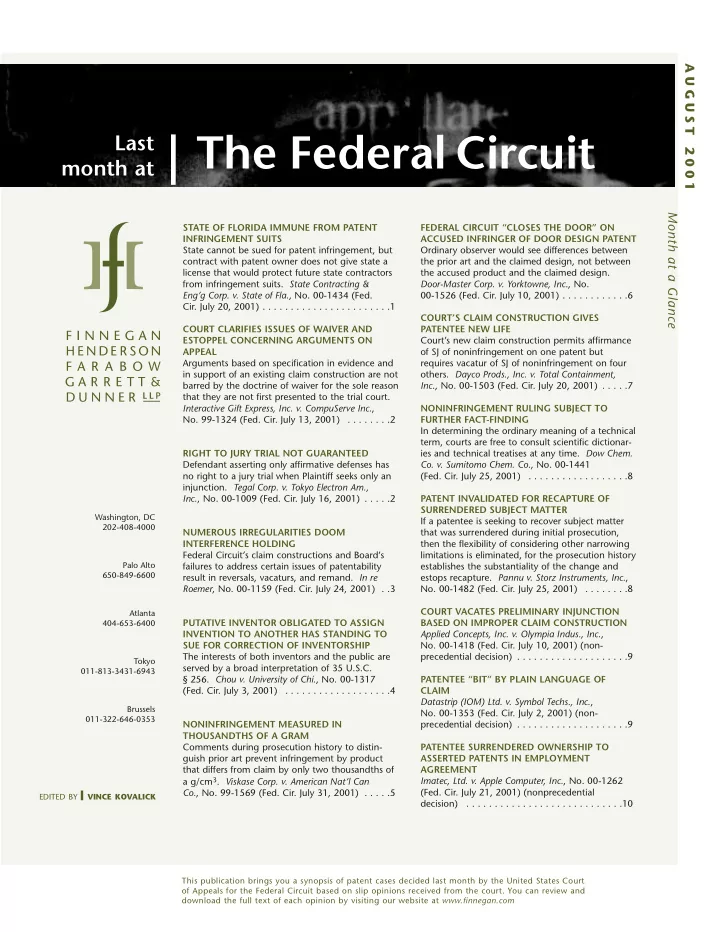
The Federal Circuit month at Month at a Glance STATE OF FLORIDA - - PDF document

the federal circuit
SMART_READER_LITE
LIVE PREVIEW

The Federal Circuit month at Month at a Glance STATE OF FLORIDA - - PDF document

A U G U S T 2 0 0 1 Last The Federal Circuit month at Month at a Glance STATE OF FLORIDA IMMUNE FROM PATENT FEDERAL CIRCUIT CLOSES THE DOOR ON INFRINGEMENT SUITS ACCUSED INFRINGER OF DOOR DESIGN PATENT State cannot be sued for patent


slide-1
SLIDE 1

EDITED BY VINCE KOVALICK This publication brings you a synopsis of patent cases decided last month by the United States Court

  • f Appeals for the Federal Circuit based on slip opinions received from the court. You can review and

download the full text of each opinion by visiting our website at www.finnegan.com Washington, DC 202-408-4000 Palo Alto 650-849-6600 Atlanta 404-653-6400 Tokyo 011-813-3431-6943 Brussels 011-322-646-0353

STATE OF FLORIDA IMMUNE FROM PATENT INFRINGEMENT SUITS State cannot be sued for patent infringement, but contract with patent owner does not give state a license that would protect future state contractors from infringement suits. State Contracting & Eng’g Corp. v. State of Fla., No. 00-1434 (Fed.

  • Cir. July 20, 2001) . . . . . . . . . . . . . . . . . . . . . . .1

COURT CLARIFIES ISSUES OF WAIVER AND ESTOPPEL CONCERNING ARGUMENTS ON APPEAL Arguments based on specification in evidence and in support of an existing claim construction are not barred by the doctrine of waiver for the sole reason that they are not first presented to the trial court. Interactive Gift Express, Inc. v. CompuServe Inc.,

  • No. 99-1324 (Fed. Cir. July 13, 2001) . . . . . . . .2

RIGHT TO JURY TRIAL NOT GUARANTEED Defendant asserting only affirmative defenses has no right to a jury trial when Plaintiff seeks only an

  • injunction. Tegal Corp. v. Tokyo Electron Am.,

Inc., No. 00-1009 (Fed. Cir. July 16, 2001) . . . . .2 NUMEROUS IRREGULARITIES DOOM INTERFERENCE HOLDING Federal Circuit’s claim constructions and Board’s failures to address certain issues of patentability result in reversals, vacaturs, and remand. In re Roemer, No. 00-1159 (Fed. Cir. July 24, 2001) . .3 PUTATIVE INVENTOR OBLIGATED TO ASSIGN INVENTION TO ANOTHER HAS STANDING TO SUE FOR CORRECTION OF INVENTORSHIP The interests of both inventors and the public are served by a broad interpretation of 35 U.S.C. § 256. Chou v. University of Chi., No. 00-1317 (Fed. Cir. July 3, 2001) . . . . . . . . . . . . . . . . . . .4 NONINFRINGEMENT MEASURED IN THOUSANDTHS OF A GRAM Comments during prosecution history to distin- guish prior art prevent infringement by product that differs from claim by only two thousandths of a g/cm3. Viskase Corp. v. American Nat’l Can Co., No. 99-1569 (Fed. Cir. July 31, 2001) . . . . .5 FEDERAL CIRCUIT “CLOSES THE DOOR” ON ACCUSED INFRINGER OF DOOR DESIGN PATENT Ordinary observer would see differences between the prior art and the claimed design, not between the accused product and the claimed design. Door-Master Corp. v. Yorktowne, Inc., No. 00-1526 (Fed. Cir. July 10, 2001) . . . . . . . . . . . .6 COURT’S CLAIM CONSTRUCTION GIVES PATENTEE NEW LIFE Court’s new claim construction permits affirmance

  • f SJ of noninfringement on one patent but

requires vacatur of SJ of noninfringement on four

  • thers. Dayco Prods., Inc. v. Total Containment,

Inc., No. 00-1503 (Fed. Cir. July 20, 2001) . . . . .7 NONINFRINGEMENT RULING SUBJECT TO FURTHER FACT-FINDING In determining the ordinary meaning of a technical term, courts are free to consult scientific dictionar- ies and technical treatises at any time. Dow Chem.

  • Co. v. Sumitomo Chem. Co., No. 00-1441

(Fed. Cir. July 25, 2001) . . . . . . . . . . . . . . . . . .8 PATENT INVALIDATED FOR RECAPTURE OF SURRENDERED SUBJECT MATTER If a patentee is seeking to recover subject matter that was surrendered during initial prosecution, then the flexibility of considering other narrowing limitations is eliminated, for the prosecution history establishes the substantiality of the change and estops recapture. Pannu v. Storz Instruments, Inc.,

  • No. 00-1482 (Fed. Cir. July 25, 2001) . . . . . . . .8

COURT VACATES PRELIMINARY INJUNCTION BASED ON IMPROPER CLAIM CONSTRUCTION Applied Concepts, Inc. v. Olympia Indus., Inc.,

  • No. 00-1418 (Fed. Cir. July 10, 2001) (non-

precedential decision) . . . . . . . . . . . . . . . . . . . .9 PATENTEE “BIT” BY PLAIN LANGUAGE OF CLAIM Datastrip (IOM) Ltd. v. Symbol Techs., Inc.,

  • No. 00-1353 (Fed. Cir. July 2, 2001) (non-

precedential decision) . . . . . . . . . . . . . . . . . . . .9 PATENTEE SURRENDERED OWNERSHIP TO ASSERTED PATENTS IN EMPLOYMENT AGREEMENT Imatec, Ltd. v. Apple Computer, Inc., No. 00-1262 (Fed. Cir. July 21, 2001) (nonprecedential decision) . . . . . . . . . . . . . . . . . . . . . . . . . . . .10

A U G U S T 2 0 0 1

The Federal Circuit

Last month at

Month at a Glance

slide-2
SLIDE 2

State of Florida Immune from Patent Infringement Suits

Christopher L. Crumbley [Judges: Dyk (author), Rader, and Gajarsa] In State Contracting & Engineering Corp. v. State

  • f Florida, No. 00-1434 (Fed. Cir. July 20, 2001), the

Federal Circuit affirmed-in-part, vacated-in-part, and remanded a district court’s decision granting SJ on issues of infringement, takings, and breach of con- tract concerning the State of Florida and several pri- vate contractors. In 1989, State Contracting & Engineering Corporation (“State Contracting”) and State Paving Corporation (“State Paving”) (collectively “Plaintiffs”) successfully bid on a Florida Department of Transportation (“FDOT”) project to construct sound-barrier walls. In July 1990, the State of Florida accepted State Paving’s Value Engineering Change Proposal (“VECP”) to use a new design for sound walls in the completion of the project. State Paving later filed for and

  • btained two patents covering the structure (U.S.

Patent No. 5,429,455) (“the ‘455 patent”) and method (U.S. Patent No. 5,234,288) (“the ‘288 patent”) described in the VECP. This suit resulted from FDOT’s use of data from Plaintiffs’ VECP in subsequent requests for bids. The Plaintiffs sued the State of Florida and seven private contractors (“Defendants”) in August 1997. The complaint as amended alleged seven causes of action: direct patent infringement of the ‘455 and ‘288 patents by the State of Florida (counts I and II); direct patent infringement of both patents by the private contractors (count III); violations of the Lanham Act by the State of Florida (count IV); unconstitutional taking by the State of Florida (count V); breach of contract by the State of Florida for failure to compensate Plaintiffs for use of their technology (count VI); and contributory patent infringement by Joelson Concrete Pipe Company based on its manufacture, use, and sale of posts specially made as a component of the patented apparatus and method (count VII). Defendants, in their answer, filed counterclaims seeking a DJ of noninfringement and invalidity of the ‘455 and ‘288 patents. Defendants also asked that the Lanham Act count be dismissed on grounds of sovereign immunity. Although the dis- trict court had denied the dismissal of the Lanham Act count, Defendants made an interlocutory appeal to the Federal Circuit, which remanded the case for further consideration in view of the Supreme Court’s rulings in Florida Prepaid Postsecondary Education Expense Board v. College Savings Bank, 527 U.S. 627 (1999), and College Savings Bank v. Florida Prepaid Postsecondary Education Expense Board, 527 U.S. 666 (1999). On remand, following cross motions for SJ, the district court had dismissed counts I, II, and IV on grounds of sovereign immunity. The district court had also granted SJ to the State of Florida on the takings claim, count V, and on the breach of con- tract claim, count VI. Finally, the district court had granted SJ on counts III and VII on the grounds that the contract with the State created a license to practice the patent. The district court did not address Defendants’ counterclaims for noninfringe- ment and invalidity. Because the district court had failed to rule on Defendants’ counterclaims, the Federal Circuit first addressed whether it had jurisdiction because the decision below was not a final judgment and, therefore, not appealable. In response to an order from the Federal Circuit, the parties had filed a Rule 54(b) Emergency Motion/Request for Certification

  • f Final Order in the district court. The district

court granted the motion and amended the Final Order to dismiss the pending claims as moot. The Federal Circuit ruled that a premature notice of appeal ripens upon entry of a proper Rule 54(b) certification and that it had jurisdiction to hear the appeal. As to the substantive issues, the Court affirmed the district court’s holding that the State of Florida enjoyed immunity from patent infringement suits under the patent statute and unfair competition suits under the Lanham Act based on the Florida Prepaid and College Savings cases. The Court ruled that the State of Florida had not waived its sover- eign immunity by filing a counterclaim in the case, because at the time of filing the State of Florida was reasonably unsure about the availability of an immunity defense. The Court also affirmed the district court’s SJ

  • n the takings issue. According to the Court, nei-

ther the language nor the history of 42 U.S.C. § 1983 shows a clear intent to abrogate state immunity and, therefore, the claim could not go forward. With respect to the breach of contract claim, the Court held that sovereign immunity did not protect the State of Florida. The Court further determined, however, that the contract did not cre- ate an obligation for the State of Florida to pay Plaintiffs if FDOT used their data on future con-

  • tracts. Therefore, the FDOT’s actions did not

breach the contract with Plaintiffs, and the Federal Circuit sustained the grant of SJ. Finally, having disposed of all claims against the State of Florida, the Federal Circuit addressed counts III and VII against the private contractors. The district court had granted SJ of noninfringe-

page 01 L A S T M O N T H A T T H E F E D E R A L C I R C U I T F I N N E G A N H E N D E R S O N F A R A B O W G A R R E T T D U N N E R L L P.

slide-3
SLIDE 3

2 0 0 1 A U G U S T

02 page F I N N E G A N H E N D E R S O N F A R A B O W G A R R E T T D U N N E R L L P.

ment on the theory that the claims were barred because Plaintiffs had agreed in the VECP to license the State of Florida under its patents. The Federal Circuit reversed, concluding that the licensing pro- vision only conveyed to FDOT the right to use “data” in future contracts. The contract, therefore, did not convey the right to manufacture the inven- tion, nor did it explicitly convey any patent rights. For this reason, the Federal Circuit remanded the case for further proceedings against the private con- tractors.

Court Clarifies Issues of Waiver and Estoppel Concerning Arguments on Appeal

Kimani P. Clark [Judges: Linn (author), Plager, and Schall] In Interactive Gift Express, Inc. v. CompuServe Inc., No. 99-1324 (Fed. Cir. July 13, 2001), the Federal Circuit replaced its earlier opinion, Interactive Gift Express, Inc. v. CompuServe Inc., 231 F.3d 859 (Fed. Cir. 2000), with a modified opinion to address issues of waiver and judicial estoppel after granting a petition for panel rehearing. The modification, however, did not affect the outcome

  • f the Court’s previous decisions on claim construc-

tion or the disposition of the case. In its original opinion, the Federal Circuit had reversed a district court’s claim construction of U.S. Patent No. 4,527,643 owned by Interactive Gift Express, Inc. (“IGE”) (now known as E-Data Corp.), which discloses methods and systems for reproduc- ing information in material objects at point of sale

  • locations. The Court rejected the district court’s

attempts to read into the claims features from detailed systems described in the patent specifica-

  • tion. The Federal Circuit disagreed with the district

court’s construction of five contested claim limita- tions, reversed the stipulated noninfringement find- ing, and remanded the case for further proceedings consistent with its claim construction. [The original

  • pinion is summarized in our December 2000 issue
  • f “Last Month at the Federal Circuit.”]

In its substitute opinion, the Federal Circuit considered whether IGE’s claim construction posi- tion on appeal was subject to waiver or judicial estoppel. With respect to claim construction, the doctrine

  • f waiver dictates that a party may not advocate a

new claim construction that changes the scope of the claims on appeal. The Federal Circuit held that the doctrine of waiver does not, however, prevent a party from clarifying or defending the original scope or supporting its existing claim construction position with new arguments based on the patent

  • specification. As applied to the facts of this appeal,

the Court ruled that IGE’s new arguments on appeal were based on the specification and did not modify the scope of its argued claim construction. As to judicial estoppel, the Federal Circuit pointed out that the petitioning Appellees did not contend that IGE had succeeded at trial and then reversed its

  • position. Accordingly, the Court found that IGE was

not judicially estopped from making any of its argu- ments regarding claim construction.

Right to Jury Trial Not Guaranteed

Anthony A. Dreux [Judges: Linn (author), Lourie, and Bryson] In Tegal Corp. v. Tokyo Electron America, Inc.,

  • No. 00-1009 (Fed. Cir. July 16, 2001), the Federal

Circuit affirmed a district court’s decision that Tokyo Electron America, Inc. (“TEA”) had no right to a jury trial because the Plaintiff, Tegal Corporation (“Tegal”), sought only injunctive relief and TEA had asserted no counterclaims, only affirmative defens-

  • es. The Court also affirmed that the asserted claims

were not obvious and were infringed by TEA and that Tegal had not engaged in inequitable conduct. In its ruling, the Court also vacated the district court’s grant of an injunction, its finding of willful- ness, and related award of attorney fees and remanded the case for further proceedings on antic- ipation. Tegal asserted reexamined U.S. Patent No. 4,464,223 (“the ‘223 patent”) against TEA. The ‘223 patent is directed to plasma reactors used in the fabrication of semiconductor devices. Tegal ini- tially sought both injunctive and monetary relief and requested a jury trial on the issues. Shortly before the trial’s commencement, however, Tegal dropped its claim for damages, requested only injunctive relief, and withdrew its jury trial request. The district court granted Tegal’s request and subse- quently denied TEA’s motion for reconsideration of the order. After the bench trial, the district court concluded that Tegal was entitled to a permanent injunction and attorney fees based on TEA’s willful infringement of the ‘223 patent. On appeal, TEA claimed that the district court had improperly denied it the right to a jury trial because (1) it had an independent right to a jury trial; (2) the district court had improperly focused

  • nly on the nature of the remedy—injunctive

relief—as opposed to the nature of the action; and (3) the district court had violated Fed. R. Civ. P. 38(d) and 39(a). TEA also challenged the district

slide-4
SLIDE 4

court’s finding that the asserted claims were valid and enforceable and that it had committed willful

  • infringement. TEA also took issue with the district

court’s grant of the injunction. The Federal Circuit noted that it was a matter

  • f first impression as to whether a defendant,

asserting only affirmative defenses and no counter- claims, had a right to a jury trial when the only remedy sought by the plaintiff-patentee was an

  • injunction. After considering both the Supreme

Court’s and its own precedent, the Federal Circuit concluded that since an injunction is a purely equi- table remedy, a jury trial, when requested, is required only in cases seeking damages and not in cases calling for only injunctive relief. Before turning to TEA’s affirmative invalidity defenses, the Court found that the district court’s construction of the term “electrode” had been too broad because it did not fully consider statements in the prosecution history that excluded the term “spiked electrode” from the scope of claims. The Court also construed “plasma” as a charged collec- tion of particles generated by the high and/or low frequency electric fields established between the electrodes and excluding arc or spike discharges, such as would emanate from a spiked electrode. Against these constructions, the Court conclud- ed that the district court had made an erroneous evaluation of TEA’s anticipatory reference, Itakura, but chose to remand the case for further construc- tion on the issue because the district court had made no findings regarding certain disputed limita- tions of claims 1 and 7. The Court also concluded that the district court had not committed reversible error when it determined that the ’223 patent was not invalid for obviousness over a Nippon Telegraph and Telephone Corporation (“NTT”) ref- erence, finding that TEA had failed to prove that it was obvious to make its suggested alterations and that secondary indicators of nonobviousness favored Tegal. The Federal Circuit also let stand the lower court’s ruling against inequitable conduct because even though Tegal had discovered the NTT refer- ence through the prosecution of a Japanese coun- terpart application and had failed to report it dur- ing the reexamination of the ‘223 patent, TEA had failed to establish the NTT reference as noncumula- tive and, therefore, material. The Federal Circuit also held that the district court had not erred in its determination that TEA had infringed claims 1 and 7 of the ‘223 patent. But, since it vacated the determination of anticipa- tion, the Court concluded that a willfulness ruling was premature. The Court also cautioned the lower court that an award of attorney fees is only appro- priate under 35 U.S.C. § 285 when damages are sought, not when equitable relief is requested. Finally, the Court vacated the injunction in view of its decision to vacate and remand the determina- tion that the ’223 patent is not invalid.

Numerous Irregularities Doom Interference Holding

Lawrence F. Galvin [Judges: Rader (author), Michel, and Lourie] In In re Roemer, No. 00-1159 (Fed. Cir. July 24, 2001), the Federal Circuit reversed-in-part, vacated- in-part, and remanded a decision of the Board that found the claims of a reissue patent application related to magnetic resonance imaging (“MRI”) unpatentable over a previously issued U.S. patent. An MRI apparatus typically includes a main magnet, an internal imaging volume, a radio- frequency-producing (“RF”) coil, and gradient coils. The main magnet produces a background magnetic field in the imaging volume. When the RF coil is turned on, protons in a patient positioned in the imaging volume absorb energy from RF coil electro- magnetic pulses. When the RF coil is turned off, these protons release this absorbed energy. The gradient coils produce a second magnetic field to provide a substantially linear magnetic field gradi- ent acting as a reference coordinate system for the imaging volume. This reference coordinate system allows the MRI apparatus to detect the exact loca- tions and measure the precise amounts of these energy releases, converting the results into an

  • image. Typically, an MRI apparatus manufacturer

locates the gradient coils between the imaging vol- ume and the surrounding main magnet. In 1988, U.S. Patent No. 4,737,716 (“the Roemer patent”) issued to Dr. Peter Roemer et al. The Roemer patent discloses a solution to a prob- lem where the gradient coil magnetic fields adversely affect the main magnet. The solution includes second coils located between the corre- sponding gradient coils and the main magnet. The magnetic fields of these second coils essentially can- cel that of the gradient coils outside of the second coils, thus eliminating these adverse effects. In 1989, Dr. Roemer filed a reissue application, copying claims to intentionally provoke an interfer- ence with U.S. Patent No. 4,733,189 (“the Punchard patent”). Later, the Administrative Patent Judge (“APJ”) added U.S. Patent No. 4,978,920 (“the Mansfield patent”) to the interference. Although a count in an interference should

  • nly read on patentable subject matter, the APJ

found the single count of the interference

page 03 L A S T M O N T H A T T H E F E D E R A L C I R C U I T F I N N E G A N H E N D E R S O N F A R A B O W G A R R E T T D U N N E R L L P.

slide-5
SLIDE 5

2 0 0 1 A U G U S T

04 page F I N N E G A N H E N D E R S O N F A R A B O W G A R R E T T D U N N E R L L P.

unpatentable over U.S. Patent No. 4,595,899 (“the Smith patent”). The Smith patent discloses an MRI apparatus that includes second coils to essentially cancel the main magnet’s magnetic field outside of the main magnet, a different purpose than the Roemer reissue application and the Punchard and Mansfield patents. In a departure from normal interference proce- dure, the parties conceded that any claims corre- sponding to the count were unpatentable over the Smith patent. Armed with this concession, the APJ had concluded that all claims of the Roemer reissue application, including all claims copied from the Punchard and Mansfield patents, corresponded to the count and were unpatentable over the Smith patent. Only Dr. Roemer appealed this determination. Despite the fact that interference rules limit deter- minations of patentability to claims, not counts, Dr. Roemer’s appeal accepted the APJ’s determination that the single count of the interference was unpatentable over the Smith patent. Instead, his appeal focused on whether sixteen specific claims

  • f the Roemer reissue application corresponded to

the count. The Federal Circuit read a portion of the pre- amble of an independent claim to require a sub- stantially linear magnetic field gradient. The Court also contrasted the Roemer reissue application’s complex canceling of the gradient coils’ magnetic field outside of the second coils with the Smith patent’s simpler canceling of the main magnet’s magnetic field outside of the main magnet. The Federal Circuit found that the Board had erred in its conclusion that six of the claims of the Roemer reis- sue application corresponded to the count and, thus, were unpatentable over the Smith patent and reversed that portion of the Board’s holding. Additionally, because the Board had failed to make any findings of fact regarding the remaining ten appealed claims of the Roemer reissue application, the Federal Circuit vacated and remanded the relat- ed portion of the Board’s holding.

Putative Inventor Obligated to Assign Invention to Another Has Standing to Sue for Correction of Inventorship

Gregory A. Chopskie [Judges: Lourie (author), Mayer, and Bryson] In Chou v. University of Chicago, No. 00-1317 (Fed. Cir. July 3, 2001), the Federal Circuit reversed a district court’s holding that a purported inventor

  • f an issued patent lacked standing to sue for cor-

rection of inventorship. The district court had held that the purported inventor lacked standing because she had no expectation of ownership of the patent, but rather, was obligated to assign all inventions to her employer. The Federal Circuit also reversed improper holdings on certain other state- law claims arising from the alleged failure to include the purported inventor on three patents. Joany Chou, Ph.D., sued for correction of inventorship under 35 U.S.C. § 256, seeking to be named as the sole inventor or a joint inventor on three patents relating to the herpes simplex virus. Specifically, Chou sued Bernard Roizman, Ph.D., her former academic advisor; the University of Chicago (“the University”), her former employer; ARCH Development Corporation (“ARCH”), a wholly

  • wned subsidiary of the University; and Aviron

Company (“Aviron”), the exclusive licensee of the disputed patents (collectively “the Defendants”), claiming that the Defendants refused to name her as an inventor on those patents. In addition, Chou charged the Defendants with fraudulent conceal- ment, breach of fiduciary duty, unjust enrichment, breach of contract, and academic theft and fraud arising out of that refusal to name her as an inven- tor. The district court had dismissed Chou’s suit for correction of inventorship, holding that she lacked standing to bring the claim. Specifically, the district court had concluded that because she was obligat- ed to assign all inventions to the University, Chou could not claim ownership of any of the patents and, thus, had no standing to seek relief under sec- tion 256. Although the Federal Circuit agreed that Chou was obligated to assign her inventions to the University, it concluded that Chou nevertheless had standing to seek correction of inventorship. The Federal Circuit ruled that section 256 con- tains no requirement for an expectation of owner- ship of a patent as a prerequisite for a putative inventor to have standing to sue to correct inven-

  • torship. As to the constitutional considerations for

standing, the Court ruled that Chou’s omission as an inventor on the disputed patents, if improper, would result in an injury-in-fact directly traceable to that omission, which could be remedied by correc- tion of inventorship. Moreover, the Court held that each of the Defendants was properly named in Chou’s claim under section 256 because each one had an economic stake in the disputed patents. Accordingly, it reversed and remanded that claim to the district court. The district court had also dismissed Chou’s state-law claims against the Defendants for failure to state a claim upon which relief could be granted.

slide-6
SLIDE 6

The district court had dismissed Chou’s fraudulent concealment claim against all of the Defendants, holding that none of the Defendants had a duty to inform Chou of the status of the patent applications. The Federal Circuit disagreed, holding that Roizman had failed in his duty to advise Chou of applications

  • n which she may have been an inventor. The

Court further concluded that Chou had stated a claim for fraudulent misrepresentation against the University and ARCH because Roizman was an agent for those parties, but had failed to state a claim against Aviron because Roizman was not an agent for it. Similarly, the Court reversed the district court’s dismissal of Chou’s claim for breach of fiduciary

  • duty. The Federal Circuit ruled that Chou had ade-

quately pled a claim for breach of fiduciary duty against her superior, Roizman, and the University under an agency theory. The Federal Circuit affirmed with respect to Aviron, however, holding that Chou had failed to allege its liability under an agency theory. The Federal Circuit reversed the district court’s dismissal of Chou’s claim of unjust enrichment against Roizman, holding that she had adequately alleged that Roizman had unjustly retained the ben- efit of Chou’s research. The Federal Circuit reversed regarding the other Defendants, however, because Chou was obligated to assign her inventions to the University and, thus, those parties would have been enriched by Chou’s inventions even if she had been a named inventor. The Federal Circuit reversed the district court’s dismissal of Chou’s breach of contract claim against the University, finding that Chou had adequately alleged that the University, in violation of its express policies, had failed to compensate her for her inven-

  • tion. Furthermore, the Court reversed the district

court’s dismissal of Chou’s claim against Roizman for the breach of an implied-in-law contract, holding that Chou’s adequate pleading of unjust enrichment satisfied the pleading requirements for the related breach of contract claim. Finally, the Federal Circuit affirmed the striking

  • f Chou’s claim of academic fraud and theft because

it was immaterial and redundant to her complaint.

Noninfringement Measured in Thousandths of a Gram

Elizabeth M. Burke [Judges: Newman (author), Lourie, and Rader] In Viskase Corp. v. American National Can Co.,

  • No. 99-1569 (Fed. Cir. July 31, 2001), the Federal

Circuit affirmed-in-part, reversed-in-part, and remanded a district court judgment, following a jury trial, of willful infringement. The issues on appeal involved the claim construction of density ranges and the term “linear,” the grant of SJ of infringe- ment under the DOE, and the grant of JMOL that all patents-in-suit are valid. Viskase Corporation (“Viskase”) charged American National Can Company (“ANC”) with infringement of six of its patents. The Viskase patents are directed to heat-shrinkable films used to make plastic bags for packaging food. The patents- in-suit were classified as “first family” and “second family” patents. The first family patents include U.S. Patent Nos. 4,863,769; 4,976,898; 5,059,481; and 5,256,351. These patents relate to outer-film layers

  • f very low density polyethylene copolymers

(“VLDPE”) and claim a density limited to “below about 0.91 g/cm3.” The second family patents include U.S. Patent Nos. 4,863,784 and 4,988,465. These patents also use VLDPE in the outer-film layers and the claims recite a density “not greater than about 0.915 g/cm3.” The ANC products accused of infringement are heat-shrinkable films having either a linear ethylene copolymer with a density of 0.912 g/cm3 ( “Attane” copolymer) or an ethylene copolymer having a den- sity of 0.908 g/cm3 ( “Affinity” copolymer) and a MA-saran core. The issue of infringement turned on the scope

  • f the densities of VLDPE encompassed in “below

about 0.91 g/cm3” for the first family patents and “not greater than about 0.915 g/cm3” for the sec-

  • nd family patents. Also at issue for the second

family patents was the degree of branching of the VLDPE. For the first family patents, the district court had construed the term “about 0.91 g/cm3” to include numbers that would be rounded to 0.91, i.e., between 0.905 g/cm3 and 0.914 g/cm3, despite arguments that the prosecution history limited the density term to “below about 0.910 g/cm3.” Based

  • n its construction, the district court had granted SJ

that ANC’s products containing the Attane copoly- mer literally infringed the first family patents. On appeal, the Federal Circuit found Viskase’s prosecution history to be highly relevant. Of partic- ular interest was a statement in which Viskase distin- guished its products from a prior art reference that taught densities of 0.910 to 0.940 g/cm3 by stating that the “A” copolymer was not pertinent to the present application in that it does not have a density “below about 0.910 g/cm3” as defined in all pend- ing claims. The Court therefore construed the den- sity term of the first family patents of “below about 0.91 g/cm3” to mean “below about 0.910 g/cm3.” Based on the Court’s corrected claim construction there could be no literal infringement by products containing the Attane copolymer, whose density is 0.912 g/cm3, and therefore, the Court reversed the judgment of literal infringement of first family

page 05 L A S T M O N T H A T T H E F E D E R A L C I R C U I T F I N N E G A N H E N D E R S O N F A R A B O W G A R R E T T D U N N E R L L P.

slide-7
SLIDE 7

2 0 0 1 A U G U S T

06 page F I N N E G A N H E N D E R S O N F A R A B O W G A R R E T T D U N N E R L L P.

patents by such products. In the second family patents, the VLDPE used has a density of “from about 0.850 to about 0.915 g/cm3.” As no arguments were presented by ANC, the Court, on the plain reading of the claims, affirmed the grant of SJ of infringement of the sec-

  • nd family patents by the ANC products containing

the Attane copolymer (density of 0.912 g/cm3). For the ANC products containing the Affinity copolymer (density of 0.908 g/cm3), the infringe- ment issue turned on whether the Affinity copoly- mer was “linear.” The parties agreed with the dis- trict court’s construction of the term “linear” as meaning “without significant long chain branch- ing,” but disagreed as to the meaning of “signifi- cant.” At trial, the jury had found literal infringe- ment of both families of patents by the products containing the Affinity copolymer. However, based

  • n subsequently discovered perjury of one of

Viskase’s expert witnesses, the district court had vacated the judgment of literal infringement and granted a new trial. The district court had then reversed itself, granting Viskase’s motion for SJ of infringement by Affinity copolymer products under the DOE and vacating the new trial order. On appeal, the Federal Circuit found that the district court’s grant of SJ was inappropriate. ANC had proffered evidence that the Affinity copolymer has significant long-chain branching in its molecular

  • structure. ANC had also proffered evidence of

advantages associated with its products and attrib- uted to the nonlinear nature of the Affinity copoly-

  • mer. ANC had argued, and the Court agreed, that

a reasonable jury could have found that these were not insubstantial differences. Thus, the issue requires a trial. The Court also considered the district court’s judgment of validity of the patents-in-suit. The dis- trict court had granted JMOL that the six patents- in-suit were valid. On appeal, ANC challenged the district court’s grant of JMOL and the merits of the judgment. On appeal, ANC cited references in addition to those that were before the district court. However, because ANC did not present any compelling rea- son to consider references that were available dur- ing the pretrial period, the Court declined to con- sider the new arguments. The Court also found that the record showed that the district court had received full argument on the issues of validity and that ANC provided no evidence of a suggestion, teaching, or motivation in the prior art cited by ANC to combine the references as suggested by

  • ANC. For these reasons, the Court affirmed the dis-

trict court’s grant of JMOL, upholding the validity of the patents-in-suit. After the district court’s finding of validity of the patents-in-suit, ANC filed a request for reexami- nation in the PTO patent from each family. During the reexamination process, Viskase petitioned the PTO to correct inventorship for the second family

  • patents. The PTO granted the petition.

Based on the inventorship change, ANC moved the district court to reopen the judgment and dis- miss the infringement counts as to the second fami- ly patents and filed a separate DJ action seeking to invalidate the second family patents based on alleged irregularities in the process of correcting

  • inventorship. The Federal Circuit found no flaws in

the district court’s dismissal of the declaratory counts as raising no new issues.

Federal Circuit “Closes the Door” on Accused Infringer of Door Design Patent

Brian M. Burn [Judges: Rader (author), Gajarsa, and Linn] In Door-Master Corp. v. Yorktowne, Inc., No. 00- 1526 (Fed. Cir. July 10, 2001), the Federal Circuit affirmed a district court’s ruling that Yorktowne, Inc. (“Yorktowne”) willfully infringed U.S. Patent No.

  • Des. 338,718 (“the ‘718 design patent”) and

denied Yorktowne’s motion for JMOL. The Federal Circuit also affirmed the district court’s denial of attorney fees to Door-Master Corporation (“Door- Master”). The ‘718 design patent claims the ornamental design of an integrated door and frame shown in four figures. Cabinet doors are generally mounted

  • n frames by either overlay mounting or inset
  • mounting. With overlay-mounted cabinet doors,

the door covers some or all of the frame’s surface. Inset-mounted cabinet doors are more difficult to align with the door frame, but have a more desir- able appearance. The claimed design appears as an inset door and frame combination, and has a desir- able look of an inset-mounted door without the dif- ficulty of inset mounting. At trial, Yorktowne asserted that the CRP-10 door, sold by Yorktowne, anticipated the ‘718 design patent. Cabinet dealers had inset mounted the CRP-10 door within a cabinet frame, so that when closed, it looked very similar to the integrated door and frame claimed in the ‘718 design patent. However, unlike the claimed design, hinges were visible on the CRP-10 door and frame. Furthermore, the rear view of the CRP-10 cabinet door did not correspond to the rear view claimed in the ‘718 design patent. The jury found that the ‘718 patent was not anticipated by the CRP-10 door and was willfully infringed by Yorktowne’s

slide-8
SLIDE 8

sales of a similar door, known as the “Richland” door. On appeal, Yorktowne urged the Federal Circuit to construe the claims of the ‘718 design patent so that the rear features of the cabinet doors, shown in two of the four figures, are not part of the protected design. The Court refused, noting that the patentee specifically included the rear features in the claimed design. The Court con- tinued its anticipation and infringement analysis by applying the “ordinary observer” test, in which a court must decide whether the accused product and a product covered by the design patent are so similar that an ordinary observer, paying as much attention as a purchaser typically does, would mis- takenly buy one product, thinking it was the other. Noting the visible hinges and the different rear design of the CRP-10 door, the Court ruled the claimed design was not anticipated. The Court also held that the Richland door infringed the claimed design because neither had visible hinges and both had very similar front and rear designs. Addressing the district court’s denial of attor- ney fees in view of the jury’s finding of willful infringement, the Court held that the district court had not abused its discretion. Yorktowne had made an effort to investigate the ‘718 design patent, and the district court’s findings on this issue were not clearly erroneous and did not conflict with the jury’s findings.

Court’s Claim Construction Gives Patentee New Life

Barry D. Biddle [Judges: Dyk (author), Linn, and Mayer] In Dayco Products, Inc. v. Total Containment, Inc., No. 00-1503 (Fed. Cir. July 20, 2001), the Federal Circuit affirmed the district court’s grant of SJ of noninfringement regarding Dayco Products, Inc.’s (“Dayco”) U.S. Patent No. 5,129,686 (“the ‘686 patent”). The Federal Circuit vacated, howev- er, the grant of SJ of noninfringement of Dayco’s U.S. Patent Nos. 5,199,752 (“the ‘752 patent”); 5,297,822 (“the ‘822 patent”); 5,380,050 (“the ‘050 patent”); and 5,486,023 (“the ‘023 patent”), and remanded based on a proper claim construc- tion. The five patents in dispute relate to a hose con- struction for use in underground gas containment

  • systems. Specifically, the patents disclose a cylindri-

cal hose having an inner hose with an inner surface consisting of inward projections and recesses, and an insert means having an exterior surface consist- ing of outward projections and recesses. In order to form a tight seal to prevent the escape of gas, the cylindrical hose is joined to the insert means by a hollow, cylindrical coupling. The insert means is placed within the hollow core of the inner hose so that the projections of the insert means receive the recesses of the inner hose and vice versa. The outer surface of the insert means presses against the inner hose to form the tight seal. Both Dayco and Total Containment, Inc. (“TCI”) moved for SJ on the issues of claim con- struction and infringement. Claim 1 of one patent defines an “insert means having an outer peripheral surface means defined by a plurality of outwardly directed projections with recesses therebetween, said projections of said insert means being respec- tively received in said recesses of said inner hose.” Claim 1 described the “projections of said insert means [as] . . . having a transverse cross-sectional configuration of a certain length different from the transverse cross-sectional length of said recesses of said inner hose.” The parties disputed the meaning

  • f the following limitations in the claim: (1) “com-

pletely received”; (2) “different than”; (3) “out- wardly directed projections”; and (4) “plurality.” With respect to the first limitation, the district court had construed the phrase “said projections of said insert means being respectively received in said recesses of said inner hose” to mean that three or more projections that extend outwardly from the peripheral surface must be completely received within the recesses of the inner hose. The Federal Circuit rejected this construction because the claim language did not explicitly or implicitly require complete reception. Similarly, the Federal Circuit rejected the dis- trict court’s interpretation of the “different than”

  • limitation. With regard to Dayco’s ‘050 and ‘023

patents, the district court had construed the “differ- ent than” limitation to mean that the length of the insert-means projections must be different than the length of the inner-hose recesses. The Federal Circuit, however, found that the “different than” limitation meant that the insert-means recesses must be “greater than” the length of the inner-hose

  • projections. The Federal Circuit held that the dis-

trict court had improperly construed the “different than” limitation for the ‘752 and ‘822 patents because the structure and wording of these patents is similar to the ‘050 and ‘023 patents. Thus, the Federal Circuit saw no reason to construe the claims

  • f the former two patents more narrowly than in

the latter two patents. The Federal Circuit also found that the district court had improperly construed the “outwardly directed projections” limitation. Dayco’s ‘686 patent requires “outwardly convex projections,” while the ‘050, ‘023, ‘752, and ‘822 patents merely

page 07 L A S T M O N T H A T T H E F E D E R A L C I R C U I T F I N N E G A N H E N D E R S O N F A R A B O W G A R R E T T D U N N E R L L P.

slide-9
SLIDE 9

2 0 0 1 A U G U S T

08 page F I N N E G A N H E N D E R S O N F A R A B O W G A R R E T T D U N N E R L L P.

require “outwardly directed projections.” Thus, the district court had concluded that TCI did not infringe because its products had a space between the recesses that consisted of a line segment. The Federal Circuit, reviewing the district court’s findings, affirmed the lower court’s holding

  • f noninfringement of the ‘686 patent because the

TCI product clearly did not have “outwardly convex projections.” The Federal Circuit reversed, however, the holding relating to noninfringement of the ‘050, ‘023, ‘752, and ‘822 patents, because the lower court had read a limitation into the claim lan-

  • guage. The Court ruled that the phrase “outwardly

directed” does not have any special meaning or require that the projections have a particular shape. Instead, the phrase “outwardly directed” was mere- ly used to modify the term “projections” to clarify that the insert-means projections point to the out- side of the hose construction. Finally, the Federal Circuit determined that the district court had improperly construed the mean- ing of the term “plurality.” The lower court had held that the term “plurality” meant that three or more projections of the insert means must be received in the recesses of the inner hose. It had reasoned that because the claim required “recesses” between the projections, there must be at least three projections to have at least two recesses. The Federal Circuit stated that “plurality,” when used in a claim, refers to two or more items unless the pat- entee gives some indication to the contrary.

Noninfringement Ruling Subject to Further Fact-Finding

Barry D. Biddle [Judges: Gajarsa (author), Clevenger, and Rader] In Dow Chemical Co. v. Sumitomo Chemical Co.,

  • No. 00-1441 (Fed. Cir. July 25, 2001), the Federal

Circuit vacated and remanded a district court’s grant of SJ, concluding that Sumitomo Chemical Company and Sumitomo Chemical America, Inc. (collectively “Sumitomo”) were not liable for infringement, either literally or under the DOE, of Dow Chemical Company’s (“Dow”) U.S. Patent No. 4,499,255 (“the ‘255 patent”). The ‘255 patent improves upon a well-known process for preparing high-purity epoxy resins. These specific resins are often utilized in electrical applications and are particularly useful in the encap- sulation of computer semiconductor chips. The high-purity epoxy resins are favored because they produce lower levels of hydrolyzable halide, which ultimately decreases the chances of computer chip

  • failure. Since 1983, Sumitomo has utilized two dif-

ferent processes, the “old DOX” and the “new DOX,” to produce an epoxidation reaction. Both the old and the new processes consist of two stages, in which orthocreol novolac reacts with epichlorohydrin in the presence of a solvent (diox- ane) to yield the desired result. In 1996, Dow asserted a patent infringement action against Sumitomo alleging that both of Sumitomo’s processes fell within the scope of claim 1 of the ‘255 patent. On June 20, 2000, the U.S. District Court for the Eastern District of Michigan found that limitations regarding “boiling point” and “continuous” distillation present in claim 1 of the ‘255 patent were not found, either literally or under the DOE, in Sumitomo’s products. On appeal, the Federal Circuit reexamined the determination of infringement by first analyzing the district court’s claim construction of independent claim 1. The Federal Circuit disagreed with the dis- trict court’s interpretation that the “boiling point” temperature is the temperature of the reaction mix-

  • ture. Instead, the Court concluded that one of
  • rdinary skill in the art would believe that the “boil-

ing point” is measured in the vapor phase. Furthermore, the Federal Circuit determined that there is no language in Dow’s specification to sub- stantiate any other unconventional meaning for this term, and Sumitomo cited no technical treatise to refute the proposition. The Federal Circuit further stated that any alternative construction, other than the ordinary meaning, would exclude many of the preferred embodiments in the specification. With regard to the construction of the terms “continuous” and “continuously,” the Federal Circuit ruled that the district court had improperly imported a limitation not supported by the claim language of the specification by requiring distilla- tion that commenced simultaneously with the addi- tion of alkali metal hydroxide. After construing the claims, the Federal Circuit considered the infringement issue and found that the district court had incorrectly compared two stages of the Sumitomo processes with the ‘255 patent process. As a result, the Federal Circuit remanded this case to the district court to deter- mine whether Sumitomo’s second stage alone may infringe.

Patent Invalidated for Recapture of Surrendered Subject Matter

Vince Kovalick [Judges: Mayer (author), Friedman, and Rader] In Pannu v. Storz Instruments, Inc., No. 00-1482 (Fed. Cir. July 25, 2001), the Federal Circuit affirmed a SJ invalidating U.S. Patent No. Re. 32,525 (“the ‘525 patent”) because it had improp-

slide-10
SLIDE 10

erly broadened claims in a manner directly perti- nent to subject matter surrendered during prosecu- tion. The ‘525 patent relates to an artificial intraocu- lar eye lens to replace a natural eye lens. During the prosecution of the ‘525 patent lineage of appli- cations, applicant canceled and amended claims to

  • vercome several prior art rejections. In particular,

applicant added limitations directed to snag- resistant discs on “haptics” that are attached to a round lens and contact internal tissue in the eye for the purpose of positioning and securing the lens. During reissue, the Examiner allowed the appli- cant to delete some of the claim limitations that defined the shape of the haptics but required the applicant to add other limitations. The resulting reissue claims define the “snag-resistant means” to have a specific width and snag-resistant elements being substantially coplanar with position and sup- porting elements. The Federal Circuit stated that reissue claims that are broader than the original patent’s claims in a manner directly pertinent to the subject matter surrendered during prosecution are improper. In the reissue oath, the applicant had admitted that he had unnecessarily narrowed the scope of the claim with respect to the shape of the haptics. He stated that the haptics may actually be of any shape as long as the elements terminate in a free end having snag-resistant means. The Court ruled that by such arguments, the applicant had specifi- cally limited the shape of the haptics to a “continu-

  • us, substantially circular arc.” On reissue, he was

estopped from attempting to recapture the precise limitation he added to overcome prior art rejec- tions. The Court rejected Pannu’s arguments that narrowing limitations to other claim elements should prevent application of the recapture rule. If a patentee is seeking to recover subject matter that was surrendered during the initial prosecution, the Court ruled, the flexibility of considering other nar- rowing limitations is eliminated, for the prosecution history establishes the substantiality of the change and estops its recapture.

Court Vacates Preliminary Injunction Based on Improper Claim Construction

Christopher H. Kirkman [Judges: Lourie (author), Schall, and Linn] In Applied Concepts, Inc. v. Olympia Industrial, Inc., No. 00-1418 (Fed. Cir. July 10, 2001) (non- precedential decision), the Federal Circuit vacated a preliminary injunction based on an error in a claim construction and remanded the case for further proceedings. Applied Concepts, Inc. (“ACI”), an exclusive licensee of U.S. Patent No. 4,651,598 (“the ‘598 patent”), had successfully obtained a preliminary injunction against Olympia Industrial, Inc. (“Olympia”) for alleged infringement of the ‘598

  • patent. The patent relates to self-adjusting utility

pliers having a “tooth and pawl” construction. Olympia appealed the injunction, arguing that the district court had erred in construing two limi- tations of the asserted claim. The Federal Circuit reviewed the limitations at issue and rejected Olympia’s argument with regard to one limitation, but agreed with Olympia as to the other. In partic- ular, the Court agreed that the district court had incorrectly identified the structure in the written description corresponding to a “slideable and piv-

  • table fastening means” limitation. The Federal

Circuit construed the limitation to include a “pawl” member, which it found to be an integral part of the claimed invention. ACI argued that under the doctrine of claim differentiation, the additional structure, which was recited in a dependent claim, should not be read into the independent claim being construed. The Court disagreed and held that the doctrine of claim differentiation does not override the statutory requirements of 35 U.S.C. § 112, ¶ 6. Accordingly, the Court vacated the preliminary injunction and remanded.

Patentee “Bit” by Plain Language of Claim

John A. Voisinet [Judges: Schall (author), Michel, and Dyk] In Datastrip (IOM) Ltd. v. Symbol Technologies, Inc., No. 00-1353 (Fed. Cir. July 2, 2001) (non- precedential decision), the Federal Circuit affirmed a district court’s decision denying Plaintiff’s motion for JMOL, affirming that the patent-in-suit was not infringed. Datastrip (IOM) Limited and Datastrip International Limited (collectively “Datastrip”) sued Symbol Technologies, Inc. (“Symbol”) and Tracker Corporation of America, alleging infringement of U.S. Patent No. 4,782,221 (“the ‘221 patent”). The ‘221 patent is directed toward a printed data strip that contains encoded information that can be decoded by an optical scanner. The claimed invention has “a series of contiguous and parallel ‘data lines’ that are preferably read in sequence and each of which is made up of a series of areas of pre-

page 09 L A S T M O N T H A T T H E F E D E R A L C I R C U I T F I N N E G A N H E N D E R S O N F A R A B O W G A R R E T T D U N N E R L L P.

slide-11
SLIDE 11

2 0 0 1 A U G U S T

10 page F I N N E G A N H E N D E R S O N F A R A B O W G A R R E T T D U N N E R L L P.

determined size and uniform height and width, called ‘bit areas.’” The claim at issue recites “[a] data strip containing a plurality of encoded data bits for scanning by an optical scanner, said strip including . . . a plurality of aligned, contiguous par- allel data lines, each said line being formed of con- tiguous bit areas, information being encoded [sic] in said bit areas by the presence or absence of printing thereon, . . . ” (emphasis added). The data strip of the preferred embodiment encodes information in “dibits” by using two adjacent bit areas. Symbol designed a code, known as the PDF417, that contains multiple contiguous and par- allel data lines. However, in the PDF417, in each data line information is encoded in the same man- ner information is encoded in a bar code, i.e., by variable-width encoding. The district court had construed the term “encoding” to not require dibit encoding, but it did not determine whether the claim was limited to presence/absence encoding. After a jury found that Symbol did not literally infringe Datastrip’s patent, the district court denied Datastrip’s motion for JMOL, concluding that there was substantial evi- dence that Symbol’s device did not have informa- tion “encoded in said bit areas by the presence or absence of printing thereon.” On appeal, Datastrip argued that this limita- tion, properly construed, only requires that the bit areas that are used to encode information be print- ed or not. Datastrip contended that the claim limi- tation also covers variable-width codes because they encode information by the presence or absence of printing at the bit area level. The Federal Circuit looked to the plain lan- guage of the claim and the specification. The Court observed that the specification contrasts the bar-code prior art with the claimed invention, indi- cating that the invention provides bits of informa- tion by the presence or absence of printing. As Symbol presented sufficient evidence to establish that PDF417 utilized variable-width encoding and that variable-width encoding was different than presence/absence encoding, the Federal Circuit upheld the district court’s denial of the JMOL finding that Symbol did not infringe the claim.

Patentee Surrendered Ownership to Asserted Patents in Employment Agreement

Timothy M. Hsieh [Judges: Gajarsa (author), Mayer, and Michel] In Imatec, Ltd. v. Apple Computer, Inc., No. 00- 1262 (Fed. Cir. July 21, 2001) (nonprecedential decision), the Federal Circuit affirmed a district court’s decision that Imatec, Ltd. (“Imatec”) and Dr. Hanoch Shalit lacked standing to bring suit for infringement of three U.S. patents (collectively the “Shalit patents”) because they did not own the patents. The Shalit patents are directed toward systems for matching an image displayed in one format to that same image displayed in another format. In particular, these patents address the problem of accurately matching an image displayed on a video monitor to a photograph of the image or to the image displayed on a second monitor.

  • Dr. Shalit, President and Chairman of Imatec,

was an employee of Fonar Corporation (“Fonar”) prior to founding Imatec. While at Fonar, Dr. Shalit developed a system to produce accurate hard-copy images of a magnetic resonance image (“MRI”) scan as viewed on a video monitor. Dr. Shalit left Fonar on February 14, 1988. Nine days later, Dr. Shalit filed an application for the first of the Shalit patents. Imatec sued Apple Computer, Inc. (“Apple”), alleging that Apple’s ColorSync software that matches the colors of images on various computer peripherals, such as printers, scanners, and moni- tors, infringed the Shalit patents. Apple filed a motion to dismiss for lack of standing and a motion for SJ of noninfringement. The district court had held that Imatec lacked standing to bring suit for infringement of the Shalit patents because the employee agreement (“the Agreement”) Dr. Shalit entered into while an employee of Fonar had cov- ered the Shalit patents. The Agreement, the district court determined, had assigned the rights to the inventions of the Shalit patents to Fonar. The dis- trict court further held that Apple’s ColorSync soft- ware did not infringe the claims of the Shalit patents. On appeal, Imatec argued the Agreement specifically exempted the Shalit patents from its scope by providing a designated space for employ- ees to exclude from its scope patents covering cer- tain inventions. In that space, Dr. Shalit listed “sin- gle step laser printing” and “photographic video recording for keeping records of video tape con- tent.” Imatec argued that Dr. Shalit intended the phrase “photographic video recording for keeping records of video tape content” to cover the Shalit patents because the invention of the Shalit patents involved printing of images displayed on video monitors that were generated from a video tape. The Federal Circuit, applying New York state law to construe the scope of the Agreement, reject- ed this argument. The Court determined that the focus of the Shalit patents is to ensure accurate reproduction of an image displayed on a video

  • monitor. The Court noted that the disputed exemp-

tion phrase not only failed to suggest processing an image to generate accurate reproductions, but

slide-12
SLIDE 12

failed to even mention the display of images or the use of a monitor. And, in contrast to the Shalit patents, the Court identified the use of “video tape” as the critical aspect of the invention Dr. Shalit had sought to exempt. While video tape was listed in the Shalit patents as one alternative for the source of an image, the Court recognized that the use of video tape was not critical to the operation

  • f the Shalit patents. The Court also noted that

Fonar had attempted to avoid this type of dispute by devoting an entire paragraph of the Agreement to instruct employees to clearly document the sub- ject matter the employee intended to exempt. The Court weighed the fact that Dr. Shalit had failed to do so against him. Thus, the Court concluded that the Agreement’s language was clear and unambigu-

  • us and that the exemptions did not accurately

describe the Shalit patents. Accordingly, the Court held that both Imatec and Dr. Shalit lacked stand- ing to bring suit for infringement of the Shalit patents and that the issue of infringement was therefore moot.

F I N N E G A N H E N D E R S O N F A R A B O W G A R R E T T D U N N E R L L P.

DISCLAIMER:

The case summaries reflect the understanding of the authors only and are not meant to convey legal opinions or advice of any kind. The firm dis- claims any liability for any errors or omissions in these summaries. This promotional newsletter does not establish any form of attorney-client relationship with our firm or with any of our attorneys.

page 11

In Last month at The Federal Circuit, certain terms, titles, and names of fed- eral agencies that are frequently referred to in text, appear in abbreviated forms or as acronyms. These abbreviated forms and acronyms are listed below. ALJ Administrative Law Judge APJ Administrative Patent Judge Board Board of Patent Appeals and Interferences Commissioner Commissioner of Patents and Trademarks CIP Continuation-in-Part DJ Declaratory Judgment DOE Doctrine of Equivalents IP Intellectual Property ITC International Trade Commission JMOL Judgment as a Matter of Law MPEP Manual of Patent Examining Procedure PCT Patent Cooperation Treaty PTO United States Patent and Trademark Office SEC Securities and Exchange Commission SM Special Master SJ Summary Judgment