Last Month at the Federal Circuit July 2008 Table of Contents - - PDF document

last month at the federal circuit
SMART_READER_LITE
LIVE PREVIEW

Last Month at the Federal Circuit July 2008 Table of Contents - - PDF document

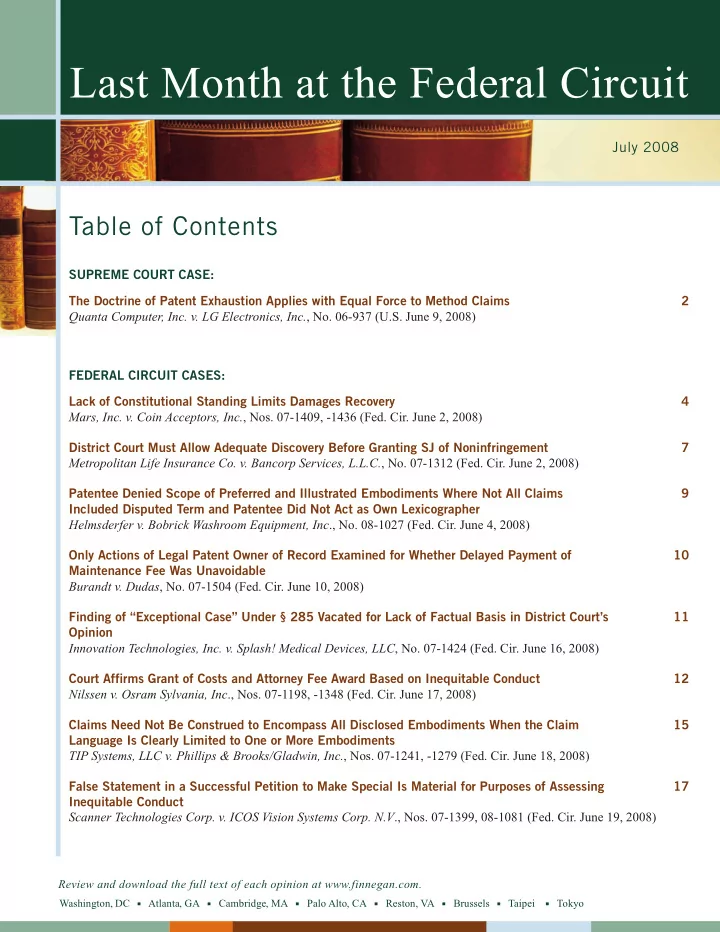
Last Month at the Federal Circuit July 2008 Table of Contents SUPREME COURT CASE: The Doctrine of Patent Exhaustion Applies with Equal Force to Method Claims 2 Quanta Computer, Inc. v. LG Electronics, Inc. , No. 06-937 (U.S. June 9, 2008)


slide-1
SLIDE 1

July 2008

Last Month at the Federal Circuit

Washington, DC

■ Atlanta, GA ■ Cambridge, MA ■ Palo Alto, CA ■ Reston, VA ■ Brussels ■ Taipei ■ Tokyo

Review and download the full text of each opinion at www.finnegan.com.

Table of Contents

SUPREME COURT CASE: The Doctrine of Patent Exhaustion Applies with Equal Force to Method Claims 2 Quanta Computer, Inc. v. LG Electronics, Inc., No. 06-937 (U.S. June 9, 2008) FEDERAL CIRCUIT CASES: Lack of Constitutional Standing Limits Damages Recovery 4 Mars, Inc. v. Coin Acceptors, Inc., Nos. 07-1409, -1436 (Fed. Cir. June 2, 2008) District Court Must Allow Adequate Discovery Before Granting SJ of Noninfringement 7 Metropolitan Life Insurance Co. v. Bancorp Services, L.L.C., No. 07-1312 (Fed. Cir. June 2, 2008) Patentee Denied Scope of Preferred and Illustrated Embodiments Where Not All Claims 9 Included Disputed Term and Patentee Did Not Act as Own Lexicographer Helmsderfer v. Bobrick Washroom Equipment, Inc., No. 08-1027 (Fed. Cir. June 4, 2008) Only Actions of Legal Patent Owner of Record Examined for Whether Delayed Payment of 10 Maintenance Fee Was Unavoidable Burandt v. Dudas, No. 07-1504 (Fed. Cir. June 10, 2008) Finding of “Exceptional Case” Under § 285 Vacated for Lack of Factual Basis in District Court’s 11 Opinion Innovation Technologies, Inc. v. Splash! Medical Devices, LLC, No. 07-1424 (Fed. Cir. June 16, 2008) Court Affirms Grant of Costs and Attorney Fee Award Based on Inequitable Conduct 12 Nilssen v. Osram Sylvania, Inc., Nos. 07-1198, -1348 (Fed. Cir. June 17, 2008) Claims Need Not Be Construed to Encompass All Disclosed Embodiments When the Claim 15 Language Is Clearly Limited to One or More Embodiments TIP Systems, LLC v. Phillips & Brooks/Gladwin, Inc., Nos. 07-1241, -1279 (Fed. Cir. June 18, 2008) False Statement in a Successful Petition to Make Special Is Material for Purposes of Assessing 17 Inequitable Conduct Scanner Technologies Corp. v. ICOS Vision Systems Corp. N.V., Nos. 07-1399, 08-1081 (Fed. Cir. June 19, 2008)

slide-2
SLIDE 2

The Doctrine of Patent Exhaustion Applies with Equal Force to Method Claims

Jessica R. Underwood Justices: Thomas (author), Roberts, Stevens, Scalia, Kennedy, Souter, Ginsburg, Breyer, Alito [Appealed from Fed. Cir., Judges Michel, Newman, Mayer] In Quanta Computer, Inc. v. LG Electronics, Inc., No. 06-937 (U.S. June 9, 2008), the Supreme Court held that the patent exhaustion doctrine applies to method claims and that LG Electronics, Inc.’s (“LGE”) authorized sale of components that substantially embodied the patents-in-suit exhausted the patents. Respondent LGE licensed a patent portfolio to Intel Corporation (“Intel”). The portfolio encompassed patents directed to components used in personal computers, such as microprocessors and chipsets, and patents directed to methods and systems for combining components into a computer system (“the LGE patents”). The LGE-Intel license agreement permitted Intel to manufacture and sell microprocessors and chipsets covered by the LGE patents. The license agreement prohibited Intel from granting a license to permit third parties to combine Intel products with non-Intel

  • products. In a separate agreement, Intel

agreed to give written notice to its customers that the license did not extend to any product made by combining an Intel product with any non-Intel product. Petitioners, including Quanta Computer, Inc. (collectively “Quanta”), are computer manufacturers that bought microprocessors and chipsets from Intel and received the notices required by the separate agreement. Quanta manufactured computers using Intel parts in combination with non-Intel memory and buses in ways that practiced the LGE

  • patents. LGE subsequently sued Quanta,

asserting that the combination of Intel products with non-Intel products infringed the LGE patents. The district court granted Quanta SJ, but on reconsideration, denied SJ as to the LGE patents that contained method claims because the patent exhaustion doctrine does not apply to method claims. The Federal Circuit affirmed-in-part and reversed-in-part. It agreed that patent exhaustion does not apply to method claims. In the alternative, the Federal Circuit concluded that exhaustion did not apply in this circumstance because LGE did not license Intel to sell the Intel products to Quanta for use in combination with non-Intel products. On appeal, the Supreme Court reversed. The Court first reviewed the history of the patent exhaustion doctrine and concluded that

2 July 2008

  • Last year, the Supreme Court granted a petition for a writ of certiorari in Quanta Computer, Inc. v.

LG Electronics, Inc., No. 06-937, to address the scope of the patent exhaustion doctrine and whether a patent holder can place any restrictions through a license on a patented product after a first sale has taken place. The Federal Circuit had held that patent exhaustion does not apply to method claims. The Supreme Court heard oral argument in January 2008 and issued its opinion last month. It reversed the Federal Circuit, holding that the patent exhaustion doctrine applies to method claims and that LG Electronics, Inc.’s authorized sale of components that substantially embodied the patents-in-suit exhausted the patents. See full summary below.

Spotlight Info

slide-3
SLIDE 3

precedent did not support LGE’s argument that the exhaustion doctrine is not applicable to method patents. In so doing, the Court noted that eliminating exhaustion for method patents “would seriously undermine the exhaustion doctrine” by encouraging patentees to shield a patented invention from exhaustion by drafting patent claims to a method rather than an apparatus. Slip op. at 10. Next, the Court considered the extent to which a product must embody a patent in order to trigger exhaustion. After determining that the products Intel sold to Quanta embodied the patents at issue, the Court applied its holding in United States v. Univis Lens Co., 316 U.S. 241 (1942), to decide whether exhaustion was triggered by Intel’s sale to Quanta under the license agreement. In Univis, the Court concluded that the traditional bar on patent restrictions following the sale of an item applies when the item sufficiently embodies the patent—even if it does not completely practice the patent—such that its only and intended use is to be finished under the terms

  • f the patent.

Here, the Court concluded that, because the

  • nly reasonable and intended use of the

microprocessors and chipsets was to practice the patents and they embodied essential features of the patented inventions, Intel’s sale to Quanta triggered exhaustion. The Court found that LGE suggested no reasonable use for the microprocessors or chipsets sold by Intel other than incorporating them into computer systems that practiced the LGE patents, and that LGE’s attempts to distinguish Univis were not persuasive. Indeed, the Court found that the microprocessors and chipsets embodied everything inventive about each patent and that the only missing step to practice the patents was the application of common processes or the addition of standard parts. The Court also rejected LGE’s argument that exhaustion does not apply across patents. The Court agreed with LGE that the sale of a device that practices patent A does not, by virtue of practicing patent A, exhaust patent B. The Court clarified, however, that if the device practices patent A while substantially embodying patent B, patent B could also be

  • exhausted. Here, the Court found that, while

the microprocessors and chipsets practiced thousands of patents, including the LGE patents not at issue, the fact that more than

  • ne patent is practiced by the same product

does not alter the exhaustion analysis. Rather, the Court explained that the only relevant consideration is whether the products Intel sold partially practiced a patent by embodying that patent’s essential features and would therefore exhaust that patent. Finally, the Court determined that Intel’s sale

  • f the microprocessors and chipsets to Quanta

exhausted LGE’s patent rights. According to the Court, nothing in the LGE-Intel license agreement restricted Intel’s right to sell the microprocessors and chipsets to purchasers who intended to combine them with non-Intel

  • parts. Intel provided notice to its customers

that LGE had not licensed those customers to practice LGE’s patents in compliance with the supplemental agreement. But the Court explained that the notice provision appeared

  • nly in the separate agreement and a breach of

that agreement would not constitute a breach

  • f the license agreement itself. Accordingly,

the Court held that Intel’s authority to sell the microprocessors and chipsets was not

3 Last Month at the Federal Circuit

“The authorized sale of an article that substantially embodies a patent exhausts the patent holder’s rights and prevents the patent holder from invoking patent law to control postsale use of the article.” Slip op. at 19.

slide-4
SLIDE 4

conditioned on this notice or on Quanta’s decision to abide by LGE’s directions in that notice. Furthermore, although the license agreement specifically disclaimed any license to third parties to practice the patents by combining licensed products with other components, the Court found that whether third parties received implied licenses was irrelevant because Quanta asserted its right to practice the patents under exhaustion, not implied license. Thus, the license agreement authorized Intel to sell products that practiced the LGE patents to Quanta, and the doctrine of patent exhaustion prevented LGE from further asserting its patents substantially embodied by those products. In its final footnote, the Supreme Court noted that, although the sale here exhausted LGE’s patent rights, the sale to Quanta did not limit LGE’s other contract rights. The Court, however, expressed no opinion on whether contract damages might be available.

Lack of Constitutional Standing Limits Damages Recovery

Bart A. Gerstenblith Judges: Linn (author), Clevenger, Prost [Appealed from D.N.J., Judge Lifland] In Mars, Inc. v. Coin Acceptors, Inc.,

  • Nos. 07-1409, -1436 (Fed. Cir. June 2, 2008),

the Federal Circuit affirmed the district court’s findings that Mars, Inc. (“Mars”) was not entitled to recover lost profit damages, and that Mars’s subsidiary, Mars Electronics International, Inc. (“MEI”), lacked standing before 1996. The Federal Circuit also affirmed the district court’s determination of the reasonable royalty rate. The Federal Circuit, however, reversed the finding that Mars had standing to recover damages between 1996 and 2003. The patents-in-suit relate to technology used in vending machines to authenticate coins. MEI manufactured and sold vending machine coin changers with the ability to recognize and authenticate coins

  • electronically. Mars is a candy company and

has never made vending machine coin

  • changers. Before 1996, MEI had an

agreement with Mars under which MEI made royalty payments to Mars based on the gross sales value of coin changers using Mars’s patented technology, even if MEI did not make a profit. In 1990, Mars brought this action against Coin Acceptors, Inc. (“Coinco”), alleging that certain Coinco products infringed U.S. Patent

  • Nos. 3,870,137 and 4,538,719 (“the ’137

patent” and “the ’719 patent,” respectively), which Mars owned at the time of suit. Coinco counterclaimed, alleging infringement of four

  • f its own patents, and added MEI as a

counterclaim defendant. The district court found that Coinco infringed both of Mars’s patents, but that Mars did not infringe Coinco’s patents and entered final judgment on liability. Coinco appealed, and the Federal Circuit affirmed on liability. The district court then considered appropriate damages. During the fifteen years that the infringement action was pending, however, several key events occurred that limited the damages available to Mars: (1) the ’137 patent expired

4 July 2008

“Title to a patent— even an expired patent—includes more than merely the right to recover damages for past infringement.” Slip op. at 20.

slide-5
SLIDE 5

in 1992; (2) in 1994, Coinco introduced noninfringing alternative technology and the parties agreed that Mars was not entitled to lost profits for any lost sales after that date; (3) Mars entered into the “1996 Agreements” with MEI and a Mars subsidiary in the United Kingdom (“MEI-UK”), in which, inter alia, Mars transferred its entire interest in the patents to MEI; and (4) the ’719 patent expired in 2003 and the parties agreed that Mars was not entitled to any damages thereafter. As compensation for Coinco’s infringement, Mars sought (1) lost profits, or, at minimum, a reasonable royalty for sales before 1994 (the period before Coinco’s introduction of alternative technology); and (2) a reasonable royalty on Coinco’s sales from 1994 until 2003 (the remaining life of the patents). Coinco acknowledged that Mars was entitled to a reasonable royalty before the effective date of the 1996 Agreements, but disputed Mars’s claim to lost profits and claim to any damages after 1996. Before the damages trial began, the district court granted Coinco’s SJ motion on Mars’s claim for lost profits and denied as futile Mars’s motion for leave to amend its complaint to join MEI as a coplaintiff because MEI lacked standing in the infringement

  • action. On reconsideration, the district court

modified its ruling on Mars’s motion, finding that the 1996 Agreements assigned all of Mars’s interest in the ’719 patent to MEI, and therefore MEI, not Mars, had standing from 1996 forward, but that Mars’s lack of standing could “be cured by the ‘imminent’ transfer back to Mars of the rights to the ’137 and ’719 patents before final judgment.” Slip op. at 5. Mars then entered into a purchase agreement to acquire certain assets of its subsidiaries’ (including MEI) businesses. The purchase agreement was not made part of the record, either before the district court or on appeal. Instead, Mars offered a document, titled “Confirmation Agreement,” between it and MEI, effective in 2006. Apparently treating the “Confirmation Agreement” as a transfer of all of MEI’s rights back to Mars, the district court found that while MEI lacked standing, Mars was entitled to recover damages during the period MEI owned the patents (i.e., from the 1996 Agreements until the ’719 patent expired in 2003) because Mars had cured its lack of standing before the entry of final judgment. Following a four-day bench trial, the district court issued a detailed oral opinion from the bench analyzing the fifteen Georgia-Pacific factors and concluding that a blended 7% royalty rate for the two patents was

  • reasonable. After resolving post-trial motions,

the district court applied the 7% royalty rate to Coinco sales up to 2003, resulting in damages

  • f $14,376,062. The district court awarded

prejudgment interest and entered final

  • judgment. Both parties appealed.

First, the Federal Circuit agreed with the district court that Mars was not entitled to lost profits and noted that because Mars had only asserted lost profit and reasonable royalty theories, the Court did not need to consider any other damages theories. Rejecting Mars’s assertion that all of MEI’s lost profits were inherently lost profits of Mars, the Court noted that the uncontradicted testimony indicated that MEI paid Mars a royalty based on the gross sales value of MEI’s products and that MEI was required to make those payments whether or not it made a profit. Thus, the Court did not need to determine whether a parent company could recover on a lost profits theory when profits of a subsidiary actually do flow inexorably to the parent because that was not the case here.

5 Last Month at the Federal Circuit

slide-6
SLIDE 6

Second, the Federal Circuit agreed that Mars’s attempt to amend its complaint by adding MEI as a coplaintiff for infringement that occurred before 1996 was futile because (1) it was undisputed that MEI did not own either of the patents before 1996, and (2) MEI was not an exclusive licensee in the United States because the 1996 Agreements allowed MEI-UK to continue to “exploit . . . [the patents at issue] in any country of the world in exchange for a royalty,” and “any country of the world” included the United States. Id. at 13. Third, the Federal Circuit considered the district court’s finding that Mars had standing to recover damages based on sales between 1996 and 2003 because Mars cured its lack of standing before final judgment. On appeal, Coinco argued that Mars failed to recover standing because (1) the Confirmation Agreement (the only agreement relied upon by Mars) transferred only the right to sue under— not title to—the ’719 patent; and (2) the transfer occurred after final judgment. Applying Delaware state law to interpret the 1996 Agreements, the Federal Circuit concluded that Mars had transferred its “entire interest” in the patents, which includes title. Applying New York state law to interpret the Confirmation Agreement, the Court concluded that it provided (1) a “recognition” of rights that the contracting parties (Mars and MEI) believed had already been transferred (which was also supported by the agreement’s title (i.e., Confirmation Agreement)); and (2) a transfer of “any rights in or to any past infringement of the . . . Patents or any recovery therefor.” Id. at 18-19. The Federal Circuit concluded that only the latter portion was in fact an assignment of rights, but that the only right assigned was the right to sue for past infringement. Additionally, the Court rejected Mars’s argument that an assignment

  • f the right to sue for past infringement is

equivalent to an assignment of title when pertaining to an expired patent: “Title to a patent—even an expired patent—includes more than merely the right to recover damages for past infringement.” Id. at 20. Thus, Mars lacked standing from 1996 to 2003 because it assigned title to MEI in the 1996 Agreements, and MEI never assigned it back. Based on its finding, the Court did not need to reach Coinco’s argument that the effective date of the Confirmation Agreement was after, not before, the entry of final judgment. Finally, the Federal Circuit rejected Coinco’s challenges to the royalty rate. Specifically, the Court rejected Coinco’s argument that a reasonable royalty rate could not exceed the cost of switching to an available noninfringing alternative because (1) as a matter of fact, the district court did not find that there were available, acceptable, noninfringing alternatives; (2) as a matter of law, royalty damages are not capped at the cost of implementing the cheapest available, acceptable, noninfringing alternative; and (3) the district court reduced the blended royalty rate from 11.5% to 7% because it found that Coinco probably could have designed an acceptable alternative. The Court also rejected Coinco’s argument that its royalties should be capped at the same rate used in a Mars intra-company agreement implemented to satisfy the UK taxing authorities because the circumstances and relationship between the parties were completely different, including that Coinco was a competitor. Finally, the Court rejected Coinco’s argument that the district court erred by using Mars’s incremental profit rather than its operating profit in the reasonable royalty analysis because the district court was well within its discretion to select the appropriate method of profit accounting. Thus, the Federal Circuit affirmed-in-part, reversed-in-part, and remanded for a recalculation of damages for the period before 1996.

6 July 2008

slide-7
SLIDE 7

District Court Must Allow Adequate Discovery Before Granting SJ of Noninfringement

Jason W. Melvin Judges: Mayer, Dyk (author), Moore [Appealed from E.D. Mo., Chief Judge Jackson] In Metropolitan Life Insurance Co. v. Bancorp Services, L.L.C., No. 07-1312 (Fed. Cir. June 2, 2008), the Federal Circuit affirmed the district court’s claim construction but vacated and remanded the district court’s grant of SJ

  • f noninfringement.

Metropolitan Life Insurance Company (“MetLife”) sued Bancorp Services, L.L.C. and Benefit Finance Partners, L.L.C. (collectively “Bancorp”), seeking a DJ of noninfringement and invalidity with respect to Bancorp’s U.S. Patent No. 5,926,792 (“the ’792 patent”). The ’792 patent claims a method of using a computer to track the book value and market value of Business Owned Life Insurance policies that are stable value protected (“SVP”) by an additional layer of insurance, and calculating the credits the SVP writer must guarantee and pay if the policy is paid out prematurely. The district court stayed MetLife’s DJ action pending appeal of another case involving the ’792 patent; after the Federal Circuit reversed an invalidity holding in that case, Bancorp filed an infringement action against MetLife. The district court consolidated the two cases involving MetLife and lifted the stay, at which point discovery had taken place in the DJ action but not in the infringement action. Shortly after the stay was lifted, MetLife moved for SJ of noninfringement, supporting its motion with affidavits stating that MetLife did not calculate SVP investment credits as required by the ’792 patent. Bancorp requested depositions and document discovery from MetLife. MetLife agreed to produce some of the requested documents, but denied Bancorp’s requested depositions. Bancorp filed a motion pursuant to Fed. R. Civ. P. 56(f) seeking additional discovery necessary to respond to the SJ motion; it also opposed the SJ motion. The district court denied Bancorp’s Rule 56(f) motion, rejecting Bancorp’s contention that the MetLife affiants committed perjury. The district court, however, allowed Bancorp to supplement its

  • pposition to SJ

based on late-produced source code for MetLife’s

  • system. Bancorp

submitted an affidavit from its expert stating that MetLife’s system did calculate SVP investment credits either directly or through external spreadsheets. The district court denied MetLife’s SJ motion after construing a disputed claim term based on the Federal Circuit’s opinion in a related case. After granting MetLife’s motion for reconsideration, the district court granted SJ of

  • noninfringement. The district court explained

that it had misunderstood Bancorp’s expert and rejected his statements regarding the accused product. The district court accepted as true MetLife’s expert’s declaration and

7 Last Month at the Federal Circuit

“When, as here, there has been no adequate initial opportunity for discovery, a strict showing of necessity and diligence that is

  • therwise required for

a Rule 56(f) request for additional discovery does not apply.” Slip op. at 12 (citation omitted).

slide-8
SLIDE 8

8 July 2008

concluded that Bancorp’s expert’s declaration did not show that MetLife’s product infringes. On appeal, the Federal Circuit first dismissed Bancorp’s first argument that the district court had applied an erroneous claim construction. The Court determined that its earlier decision resolved the issue and requires the construction adopted by the district court. Accordingly, the Court held the district court properly construed the term “SVP investment credits.” The Court then considered Bancorp’s other claim construction argument that the district court had erroneously imported a limitation requiring use of the SVP investment credit calculation in administering SVP policies. It noted that, while not expressly construing the claims as requiring such, the district court concluded that Bancorp could only show infringement if the MetLife system used an SVP investment credit calculation in administering policies. Because “administering” and “managing” appeared

  • nly in the preamble of certain claims, the

parties disputed their effect. The Federal Circuit declined to answer the question, instead remanding for the district court to determine whether the preamble should limit the claims. The Court, however, held that the district court erred in granting SJ of noninfringement even under MetLife’s more limited claim

  • construction. It first concluded that the district

court should have granted Bancorp’s Rule 56(f) motion for discovery, holding that the district court abused its discretion by not allowing Bancorp to conduct any discovery in its infringement action. The Federal Circuit cited Eighth Circuit and Federal Circuit case law supporting Bancorp’s position that, when given no adequate initial opportunity for discovery, the strict showing of necessity and diligence required for a Rule 56(f) request for additional discovery does not apply. The Court held that the district court should not have treated the MetLife declarations as

  • truthful. Instead, the district court should have

allowed Bancorp a reasonable opportunity for discovery. The Court further rejected MetLife’s alternative argument that Bancorp could have

  • btained the requested discovery in MetLife’s

DJ action before the stay was imposed. The Federal Circuit noted that MetLife’s system did not incorporate the accused aspects until two years after MetLife filed the DJ action, and that MetLife had not shown Bancorp was aware of those accused aspects before the close of discovery in the DJ action. Accordingly, the Federal Circuit remanded the case to the district court with instructions to allow reasonable discovery by Bancorp; it left the proper scope of that discovery up to the district court. The Federal Circuit next stated that the district court erred in granting MetLife’s SJ motion, even on the present record. According to the Court, there was a direct conflict in the parties’ declarations as to a material fact. The district court, however, dismissed the conflict by crediting MetLife’s declarations. The Court held that resolving such credibility disputes is not appropriate on SJ and that the conflict in declarations created a genuine issue

  • f material fact that made SJ inappropriate.

Accordingly, the Federal Circuit vacated the district court’s decision and remanded for further proceedings.

slide-9
SLIDE 9

9 Last Month at the Federal Circuit

Patentee Denied Scope of Preferred and Illustrated Embodiments Where Not All Claims Included Disputed Term and Patentee Did Not Act as Own Lexicographer

Gabriel K. Azar Judges: Mayer, Friedman, Moore (author) [Appealed from S.D. Ohio, Judge Barrett] In Helmsderfer v. Bobrick Washroom Equipment, Inc., No. 08-1027 (Fed. Cir. June 4, 2008), the Federal Circuit affirmed the district court’s judgment of noninfringement, holding that the district court did not err in construing the term “partially hidden from view” of U.S. Patent No. 6,049,928 (“the ’928 patent”) to mean “hidden from view to some extent but not totally hidden from view.” The ’928 patent is directed to baby diaper changing stations. John Helmsderfer and Brocar Products, Inc. (collectively “Brocar”) sued Bobrick Washroom Equipment, Inc., BWA South Company, Inc., Target Sales and Marketing, LLC, and Patterson Case Associates, Inc. (collectively “Bobrick”), alleging that Bobrick’s baby changing stations infringed the ’928 patent. After a Markman hearing, the district court construed the claim term “partially hidden from view” to mean “hidden from view to some extent but not totally hidden from view.” Based on this construction, the parties filed a stipulation asking the district court to enter final judgment

  • f noninfringement. The district court did so.

Brocar appealed. On appeal, Brocar argued that the district court erred when it construed the term “partially hidden from view” to exclude “totally hidden from view.” Brocar proposed that the term should instead mean “positioned so at least some of the top surface is blocked from being seen.” The Federal Circuit disagreed. First, the Court rejected Brocar’s assertion that the written description supported its proposed construction because it states that the top surface is “generally hidden from view.” The Court found no evidence to support Brocar’s contention and noted that the written description did not once mention the term “partially hidden.” It noted that the claims elsewhere recited the terms “generally” and “at least.” The Court reasoned that this language gave rise to a presumption that the claim terms have different meanings and declined to construe the term “partially hidden from view” to have the same meaning as “generally hidden from view” or “at least partially hidden from view.” The Federal Circuit also rejected Brocar’s argument that the district court accorded too much weight to extrinsic

  • evidence. It
  • bserved that here,

“partially” was not defined in the specification and that the phrase “partially hidden from view” did not even appear in the written description. The Court explained that “[w]hen the intrinsic evidence is silent as to the plain meaning of a term, it is entirely appropriate for the district court to look to dictionaries or other extrinsic sources for context—to aid in arriving at the plain meaning of a claim term.” Slip op. at 5. The Court noted that all three dictionaries cited by the district court supported its construction.

“As [the patentee] did not act as its own lexicographer and alter the ordinary meaning

  • f the term ‘partially,’

we cannot construe these particular claims to encompass the preferred embodiment

  • r other illustrated
  • embodiments. Courts

cannot rewrite claim language.” Slip op. at 7.

slide-10
SLIDE 10

Finally, the Court found no error in that the district court’s construction excluded the preferred and every illustrated embodiment. The Court explained that its case law generally counsels against interpreting a claim term in a way that excludes the preferred embodiment from the scope of the invention. The Court noted, however, that other claims of the ’928 patent, which were not at issue on appeal, did not recite the disputed term, which left

  • pen the possibility that such claims may

encompass the omitted embodiments. Accordingly, the Federal Circuit determined that the district court did not err by construing the term “partially hidden from view” to exclude “totally hidden from view” and affirmed the district court’s judgment of noninfringement.

Only Actions of Legal Patent Owner of Record Examined for Whether Delayed Payment of Maintenance Fee Was Unavoidable

Erin M. Sommers Judges: Newman, Lourie (author), Bryson [Appealed from E.D. Va., Senior Judge Hilton] In Burandt v. Dudas, No. 07-1504 (Fed. Cir. June 10, 2008), the Federal Circuit affirmed the district court’s grant of SJ for the Director, holding that the district court did not err in upholding the Director’s denial of Burandt’s request to reinstate his patent for failure to pay the maintenance fee. In 1980, Burandt designed internal combustion engines for Investment Rarities,

  • Inc. (“IRI”). In the following year, he entered

into an assignment agreement with IRI, which provided that IRI would fund Burandt’s research efforts in return for the IP rights to any patent applications or patents resulting from that research. In addition, Burandt was entitled to repurchase the patents from IRI in the event that IRI ceased funding his research. Under that agreement, Burandt filed a patent application that issued as U.S. Patent No. 4,961,406 (“the ’406 patent”) on October 9, 1990. IRI was the legal title holder

  • f the ’406

patent at the time of issuance. Burandt, however, claims he gained equitable title to the ’406 patent by trying to repurchase rights to the patent before it issued. As the legal title holder, IRI was responsible for paying the maintenance fees during the life of the ’406 patent. But because IRI failed to pay the first maintenance fee, the ’406 patent expired on October 9, 1994. Burandt alleged that he became mentally disabled two years before the ’406 patent

  • expired. Almost seven years after the

’406 patent expired, Burandt learned of the expiration from the PTO. Burandt then gained legal title of the ’406 patent from IRI and filed a petition in the PTO under 37 C.F.R. § 1.378(b) for acceptance of a delayed maintenance fee payment, asserting that the failure to pay the fee was unavoidable. In addition, Burandt argued that he should not be bound by IRI’s actions because he held equitable title in the ’406 patent. When the

10 July 2008

“The Director is entitled to rely on the record and does not have to conduct an equitable analysis in

  • rder to determine who

must pay the maintenance fee.” Slip op. at 8-9.

slide-11
SLIDE 11

11 Last Month at the Federal Circuit

PTO denied Burandt’s petition, Burandt brought an action in district court against the Director under the APA. Both parties moved for SJ, and the district court awarded SJ to the Director. On appeal, the Federal Circuit acknowledged that 35 U.S.C. § 41(c)(1) provides the Director with the discretion to accept a late maintenance fee after the six-month grace period if the delay is shown to the satisfaction

  • f the Director to have been unavoidable.

Relying on its decision in Ray v. Lehman, 55 F.3d 606 (Fed. Cir. 1995), the Court noted that in determining whether a delay in paying a maintenance fee was unavoidable, one looks to whether the party responsible for payment

  • f the maintenance fee exercised the due care
  • f a reasonably prudent person. Applying this

standard, the Court held that IRI, as the legal title holder of the ’406 patent, failed to exercise reasonable care in ensuring that the maintenance fee would be paid in a timely

  • manner. The record indicated that IRI

deliberately allowed the ’406 patent to expire. Accordingly, the Court found no clear error in the Director’s conclusion that unavoidable delay was not shown. The Court disagreed with Burandt’s argument that the district court erred by focusing on IRI’s actions, stating that the argument “flies in the face of our holding in Ray, where we expressly held that it is the actions of the party responsible for making payments of the maintenance fees, the legal title owner, that must be considered when evaluating [the] unavoidable delay . . . .” Slip op. at 8. In addition, the Court concluded that the Director is entitled to rely on the record and is not required to conduct an equitable analysis to determine who must pay the maintenance fees.

  • Id. at 8-9.

The Court then distinguished the district court cases Burandt cited as nonbinding precedent and factually distinguishable. Furthermore, the Court rejected Burandt’s assertion that the district court erred by giving deferential review to the PTO’s determination of unavoidable delay. The Court found no conflict with its ruling and Congressional intent to avoid the equitable loss of patent rights because Congress expressly gave the Director the responsibility to determine the circumstances under which a late payment may be waived. The Court agreed with the Director that unavoidable delay was not shown in this case. The Court also concluded that Burandt’s mental condition and financial status were irrelevant, given IRI’s status as the legal owner of the ’406 patent at the time the maintenance fee was due. Finally, the Court ruled that there was no error in denying Burandt’s request for waiver under 37 C.F.R. § 1.183 because § 183 is discretionary and the Court found no error in the Director’s

  • decision. Accordingly, the Court concluded

that the Director’s decision to deny Burandt’s request for reinstatement was neither arbitrary

  • r capricious, nor an abuse of discretion.

Finding of “Exceptional Case” Under § 285 Vacated for Lack

  • f Factual Basis in District

Court’s Opinion

Michael Skopets Judges: Mayer, Friedman (author), Moore [Appealed from N.D. Ga., Judge Thrash, Jr.] In Innovation Technologies, Inc. v. Splash! Medical Devices, LLC, No. 07-1424 (Fed. Cir. June 16, 2008), the Federal Circuit held that the district court failed to make adequate findings to support its “exceptional case” determination under 35 U.S.C. § 285, and

slide-12
SLIDE 12

vacated and remanded the district court’s order awarding attorneys’ fees. Innovation Technologies, Inc. (“Innovation”) sued Splash! Medical Devices, LLC (“Splash”) for infringement of U.S. Patent No. 5,830,197 (“the ’197 patent”), which covers a method for irrigating wounds. The parties conducted extensive discovery and filed claim construction briefs. But, over a year after filing suit and before the Markman hearing, Innovation executed a covenant not to sue Splash for infringement of the ’197 patent and moved to dismiss its suit with prejudice. After the district court granted the motion, Splash moved for attorneys’ fees under § 285. The district court granted the motion and awarded Splash attorneys’ fees and expenses. The substantive portion of the district court’s order consisted of a single paragraph with seven sentences. The only explanation the district court gave to support its finding that this was an “exceptional case” was that Innovation knew

  • r should have known that its claims of

infringement were baseless. The Federal Circuit found that “[t]he court gave no explanation of, or factual basis for, that conclusion.” Slip op. at 3. The Court stated that a district court’s finding of an “exceptional case” must include particular factual findings and reasoning for its determination for the Court to provide meaningful review. An exceptional case finding must not be based on “speculation or conjecture” but upon clear and convincing

  • evidence. Id. at 4.

The Court noted that the parties had raised before the district court five issues relevant to the “exceptional case” question, including the sufficiency of Innovation’s prefiling investigation, its reasons for filing suit, any litigation improprieties by Innovation, whether Innovation’s proposed claim construction was “sufficiently plausible” to justify filing suit, and whether Innovation’s covenant not to sue indicated that its infringement claims were

  • baseless. As the district court made no

findings on any of these issues, proper appellate review was impossible. The Court noted that although it could comb the record to answer the questions, the responsibility for making initial findings lies with the district court. The Court therefore vacated the district court’s order and ordered that, on remand, the district court make additional findings to justify its ultimate holding.

Court Affirms Grant of Costs and Attorney Fee Award Based

  • n Inequitable Conduct

Kenneth M. Motolenich-Salas Judges: Newman (dissenting), Mayer, Lourie (author) [Appealed from N.D. Ill., Judge Darrah] In Nilssen v. Osram Sylvania, Inc.,

  • Nos. 07-1198, -1348 (Fed. Cir. June 17, 2008),

12 July 2008

“Of course, the district court is not required definitively to determine the meaning of the claims in considering whether this is an exceptional case. It should, however, make a sufficient analysis of the claims’ probable meaning to enable it to determine whether [the plaintiff’s] proposed construction of the disputed language was sufficiently plausible to justify filing suit based upon that construction.” Slip op. at 4.

slide-13
SLIDE 13

the Court affirmed the district court’s decision to (1) grant approximately $6 million in costs and attorneys’ fees to Osram Sylvania, Inc. (“Osram”) pursuant to 35 U.S.C. § 285, and (2) deny Nilssen’s motion for expert witness fees pursuant to Fed. R. Civ. P. 26(b)(4)(C)(i). Nilssen is the owner and principal inventor of

  • ver 200 patents, many of which concern

fluorescent light bulbs and ballasts used in combination with those bulbs. In August 2000, Nilssen brought an action alleging that certain light bulbs and ballasts made and sold by Osram infringed twenty-six of Nilssen’s

  • patents. Osram denied the allegations and

filed a counterclaim alleging patent invalidity. Following a bench trial, the district court held the patents-in-suit unenforceable due to inequitable conduct committed by Nilssen based on misclaiming small entity status, improperly paying small entity maintenance fees, failing to disclose related litigation, misclaiming the priority of earlier filing dates, withholding material prior art, and submitting misleading affidavits to the PTO, which was affirmed on appeal. Nilssen v. Osram Sylvania, Inc., 440 F. Supp. 2d 884 (N.D. Ill. 2006), aff’d, 504 F.3d 1223 (Fed. Cir. 2007). After trial, Osram filed a motion for reimbursement of costs and attorneys’ fees, and Nilssen responded with a motion to recover expert deposition fees. The district court granted Osram’s costs and attorneys’ fees after finding that the case was exceptional under § 285. The district court noted three reasons for finding exceptionality: (i) Nilssen’s inequitable conduct, (ii) the frivolous nature of the lawsuit, and (iii) Nilssen’s litigation misconduct. With respect to frivolousness, the district court noted Nilssen “knew or should have known” that the suit was baseless. In support of the finding of litigation misconduct, the district court cited Nilssen’s (1) refusal to allow a deposition of Nilssen’s nephew and lone

  • fficer of assignee of the patents-in-suit in the

United States; (2) late withdrawal of fifteen of the patents-in-suit, just months before the start

  • f trial; (3) belatedly produced documents,

toward the end of trial, which Osram had requested earlier; (4) last-minute waiver of the attorney-client privilege during trial without providing notice to Osram, which forced Osram to conduct a new deposition of Nilssen’s attorney during trial; and (5) providing incorrect responses to interrogatories and never filing a formal correction, followed by an attempt to exclude them for impeachment purposes based on the fact that they were unsigned. Additionally, the district court denied Nilssen’s motion seeking recovery of expert deposition fees, holding that awarding those fees to Nilssen would result in “manifest injustice” due to Nilssen’s initial filing of the lawsuit based on twenty-six patents and subsequent withdrawal of fifteen

  • f the patents and Nilssen’s inequitable

conduct before the PTO. On appeal, Nilssen argued that the district court clearly erred in finding the case exceptional and abused its discretion in awarding attorneys’ fees. With respect to exceptionality, Nilssen argued that a finding of inequitable conduct is an insufficient ground for a finding

  • f exceptionality and that conduct must be

“egregious,” i.e., fraudulent and not benign, to qualify as exceptional. Nilssen claimed that his conduct did not rise to the level of egregiousness to justify attorneys’ fees. Furthermore, Nilssen argued that the district court’s findings of frivolousness and litigation misconduct were clearly erroneous. Finally, Nilssen disagreed with the district court’s

13 Last Month at the Federal Circuit

“[I]t is a contradiction to call inequitable conduct benign. If certain conduct has been held to be inequitable, . . . it is hence per se not benign.” Slip op. at 9.

slide-14
SLIDE 14

conclusion that the attorney fee award was necessary to prevent a “gross injustice,” which Nilssen reasoned was required for fee-shifting under § 285. In response, Osram noted that the district court’s exceptional case decision relied on three separate grounds listed above. Osram argued that there was overwhelming evidence supporting all three grounds such that the district court did not clearly err. Moreover, Osram argued that after finding the case exceptional, the district court was within its discretion to award Osram its fees as it would have been grossly unjust not to do so in light

  • f Nilssen’s conduct.

The Court agreed with Nilssen that there is no per se rule of exceptionality in cases involving inequitable conduct. However, the Court stressed that the lack of such a rule did not mean that inequitable conduct was insufficient to support a finding of exceptionality as inequitable conduct “may constitute a basis for an award of attorney fees under . . . § 285.” Slip op. at 9 (citing A.B. Chance Co. v. RTE Corp., 854 F.2d 1307, 1312 (Fed. Cir. 1988)). Moreover, the Court rejected Nilssen’s argument that exceptionality required a showing of fraud, concluding that there was no case law or statutory authority supporting Nilssen’s distinction between inequitable conduct that is somehow benign and inequitable conduct that is otherwise. In fact, the Court stated, “[I]t is a contradiction to call inequitable conduct benign.” Id. The Court noted that, even if it were to agree with Nilssen that his actions were less egregious than other actions more typical of inequitable conduct holdings, the Court was faced with more than inequitable conduct. Rejecting Nilssen’s contention that the acts the district court called litigation misconduct were no more than oversight of legal formalities or permissibly rough litigation tactics, the Court concluded that instances considered by the district court were context-specific, and that the district court found that, taken in context, they amounted to litigation misconduct. Noting that the district court dealt with this case and parties for nearly six years, the Court concluded that the district court did not clearly err in finding the case exceptional. With respect to Nilssen’s request for its expert fees, the Court noted that under Rule 26(b)(4)(C)(i), a court, unless “manifest injustice” would result, shall require that the party seeking discovery pay the expert a reasonable fee for the time spent in responding to discovery. On appeal of the district court’s decision to apply the “manifest injustice” exception, Nilssen argued that the district court misinterpreted the term “manifest injustice,” reasoning that the exception was limited to cases where a party was indigent or

  • therwise unable to pay the fee award. The

Court rejected this argument, agreeing with Osram that the term should be given its plain and ordinary meaning: “an outcome that is plainly and obviously unjust.” Id. at 13. In support, the Court looked to the 1983 Amendment Advisory Committee Notes where the committee found that the term was sufficiently familiar to be a useful guide for

  • courts. As such, since there was nothing in the

familiar understanding of the term to suggest that it applied only to indigent parties, the Court affirmed the district court’s denial of Nilssen’s request for expert fees. Judge Newman dissented, concluding that the majority departed from precedent in holding that the nature of the grounds on which inequitable conduct was found are not relevant to the attorney fee determination under § 285. Judge Newman stressed that it is always

14 July 2008

slide-15
SLIDE 15

appropriate and necessary to consider the nature of the conduct in reviewing an attorney fee award and to limit such award to major infractions, as statute and precedent require. Noting that the Court observed in its affirmance of the inequitable conduct case that Nilssen’s actions were not unreasonable as such and “may have been an oversight,” Judge Newman stated that it was now inappropriate to recharacterize Nilssen’s conduct as “litigation misconduct.” Newman Dissent at 7 (citing Nilssen, 501 F.3d at 1223). With no evidence or charge of bad faith or prejudice, Judge Newman stressed that the majority’s decision enlarged the scope of “exceptional case” to include less than egregious aspects of patent prosecution and litigation practice.

Claims Need Not Be Construed to Encompass All Disclosed Embodiments When the Claim Language Is Clearly Limited to One or More Embodiments

Judy W. Chung Judges: Michel, Prost (author), Pogue (U.S.

  • Ct. of Int’l Trade, sitting by designation)

[Appealed from S.D. Tex., Judge Gilmore] In TIP Systems, LLC v. Phillips & Brooks/Gladwin, Inc., Nos. 07-1241, -1279 (Fed. Cir. June 18, 2008), the Federal Circuit affirmed the district court’s claim construction and its holding that the accused devices of Independent Technologies, Inc. (“Independent Technologies”), and TZ Holdings, Inc., T-Netix Telecommunications Services, Inc., T-Netix, Inc., Evercom Holdings, Inc., Evercom Systems, Inc., and Evercom Inc. (collectively “Evercom”) do not infringe the patents-in-suit literally or under the DOE. TIP Systems, LLC (“TIP”) owns U.S. Patent Nos. 6,009,169 (“the ’169 patent”) and 6,512,828 (“the ’828 patent”), which are related patents directed to wall-mounted, cordless telephones designed for use in correctional facilities. The district court issued an order construing the terms of both patents and then granted Independent Technologies’ and Evercom’s motion for SJ of noninfringement. TIP appealed the construction of several claim terms in each patent, but the Federal Circuit affirmed all of the district court’s claim

  • constructions. First, TIP challenged the

district court’s construction of the claim term “handset” to mean “a handle with an earpiece at one end and a mouthpiece at the opposite end.” TIP argued the term should be construed to mean “an earpiece and mouthpiece and equivalents.” The district court principally relied on the claim language, which stated: “a telephone handset being a handle with an earpiece at one end and a mouthpiece at an opposite end.” The Court found that the district court did not err in relying heavily on the claim language to construe the claim, recognizing that “the claims themselves provide substantial guidance as to the meaning of particular claim terms.” Slip op. at 6 (quoting Phillips v. AWH Corp., 415 F.3d 1303, 1314 (Fed. Cir. 2005)). Moreover, the Court rejected TIP’s claim construction arguments, finding no support in the specification for a definition of “handset”

15 Last Month at the Federal Circuit

“Although the alternative embodiment does not support the court’s construction, . . . the claims need not be construed to encompass all disclosed embodiments when the claim language is clearly limited to one or more embodiments.” Slip op. at 16.

slide-16
SLIDE 16

16 July 2008

that is contrary to the express definition in the

  • claim. The Court also found no error in the

district court’s determination that a “handle” is a required structural component of the claim term “handset.” TIP also argued that the applicants’ amendment of the claims to replace “handset” with “earpiece and mouthpiece” during the prosecution of the ’828 patent application demonstrated how the applicants defined the term “handset.” Furthermore, TIP cited as support the examiner’s rejection of the ’828 patent application claims, which did not disclose or claim a handle, as obvious over the claims of the ’169 patent. The Federal Circuit noted that the prosecution history of related patent applications may inform construction of a claim term when the two applications are directed to the same subject matter and a clear disavowal or disclaimer is made during

  • prosecution. Here, however, the specification
  • f the ’169 patent and that of the ’828 patent

were distinct, and the applicants distinguished the inventions disclosed in the patents. Thus, the Court held that the fact that the examiner found the claims of the ’828 patent application

  • bvious over the claims of the ’169 patent has

no bearing on the construction of the term “handset” in the ’169 patent. Finally, in response to TIP’s complaint that the district court did not consider its extrinsic evidence, the Court held that the district court did not err in finding the clear intrinsic evidence

  • utweighed the extrinsic evidence of industry

practice. Next, TIP challenged the district court’s construction of the phrases “the earpiece positioned at top and the mouthpiece positioned at bottom will permanently extend

  • ut through the front wall of the housing,” and

“said mouthpiece and said earpiece extending

  • utward from said housing through said aural

apertures” to require that both the earpiece and the mouthpiece pass through apertures in the front wall such that they project out from the front wall. TIP argued that the district court’s construction impermissibly excluded an alternative embodiment disclosed in the ’828 patent. The Court found that the mere fact that there is an alternative embodiment that is not encompassed by the district court’s claim construction does not outweigh the language of the claim, especially when the district court’s construction is supported by the intrinsic evidence. Furthermore, the Court found that TIP had not successfully rebutted the presumption that § 112, ¶ 6 does not apply and could not see how applying § 112, ¶ 6 would affect claim construction. TIP also appealed the district court’s construction of “said earpiece and said mouthpiece presenting an external relief surface for positioning said ear and a mouth of said user” to mean “the earpiece and the mouthpiece present a raised surface on the

  • utside of the phone for positioning said ear

and mouth of said user.” Again, TIP argued that the district court’s construction impermissibly excluded an alternative embodiment in the ’828 patent. And again, the Federal Circuit concluded that the claims need not be construed to encompass all disclosed embodiments when the claim language is clearly limited to one or more embodiments. Finally, TIP challenged the district court’s construction of “said dial tone actuating switch electronically connected to said phone line and said electronic circuit” to mean “said dial tone actuating switch electronically connected to both the said phone line and said electronic circuit board, such that electricity can pass among these elements.” TIP contended that the actuating switch need not be between the phone line and the circuit board, provided that electricity can pass

slide-17
SLIDE 17

between the three components. In response, the Court noted the claim’s use of the conjunction “and,” together with the specification’s disclosure that the actuating switch was located between the phone line and the electronic circuit. In light of this support, the Federal Circuit affirmed the district court’s construction. Under the district court’s construction, TIP conceded that the accused devices did not literally infringe the claims of the ’169 patent. On appeal, TIP contended that the accused devices infringe under the DOE. The Federal Circuit, however, agreed with the district court that the accused devices do not infringe the “handset” limitation under the DOE because no structural equivalent to a handset is found in the accused devices. Accordingly, the Court affirmed the grant of SJ that neither accused device infringes the claims of the ’169 patent, literally or under the DOE. TIP also appealed the district court’s holding that one of the accused devices did not infringe the ’828 patent under the DOE. TIP argued that the difference between the single electrical connection in the accused device and the two electrical connections in the claims was insubstantial. The Federal Circuit disagreed, finding that the claim required an electrical connection between the phone line and the actuating switch. The Court found that there was no such connection, or an equivalent, present in the accused device. Finally, the Court found that TIP failed to show that the electronic circuit in the accused device functioned in substantially the same way to achieve substantially the same result. Accordingly, the Court held that the district court did not err in granting SJ of no literal infringement and no infringement under the DOE of the ’828 patent by either accused device.

False Statement in a Successful Petition to Make Special Is Material for Purposes of Assessing Inequitable Conduct

Joseph E. Palys Judges: Michel, Clevenger (author), Gajarsa [Appealed from S.D.N.Y., Judge Chin] In Scanner Technologies Corp. v. ICOS Vision Systems Corp. N.V., Nos. 07-1399, 08-1081 (Fed. Cir. June 19, 2008), the Federal Circuit reversed the district court on its inequitable conduct holding regarding U.S. Patent Nos. 6,064,756 (“the ’756 patent”) and 6,064,757 (“the ’757 patent”) (collectively “the patents-in-suit”); vacated the award of attorneys’ fees; affirmed the holding that claim 1 of the ’756 patent is obvious and that all claims of the patents-in-suit are invalid, given a stipulation between the parties that the case would be tried on representative claim 1; and affirmed the district court’s holding that ICOS Vision Systems Corporation N.V.’s (“ICOS”) product does not infringe the patents-in-suit. Scanner Technologies Corporation (“Scanner”) holds an exclusive license to the patents-in-suit, which are directed to a system and process for three-dimensional inspection of ball array devices positioned in a fixed optical

  • system. ICOS developed a ball array device

inspection product (“CyberSTEREO”) that implemented a two-camera system to measure coplanarity of solder balls on circuit boards. The CyberSTEREO replaced ICOS’s older inspection product, the ICOS Projector, which had been on the market before the effective filing date of the applications for the patents-in-suit.

17 Last Month at the Federal Circuit

slide-18
SLIDE 18

18 July 2008

While the applications for the patents-in-suit were pending, and upon learning that ICOS had launched the competing CyberSTEREO product, Scanner submitted a petition to make special to the PTO to seek accelerated examination because of actual infringement. The petition contained all the prerequisites that the PTO requires, including a statement that a “rigid comparison” of the alleged infringing method with the claims of the application had been made, that some claims are “unquestionably infringed,” and a description of the invention, Scanner’s interactions with ICOS, and ICOS’s competing system. The petition was granted and the PTO considered the applications patentable over the prior art ICOS Projector. Scanner then filed suit against ICOS for infringement of the patents-in-suit. ICOS counterclaimed, asking the district court to declare the patents-in-suit invalid, unenforceable, and not infringed by ICOS. The parties agreed that the case would rise and fall on claim 1 of the ’756 patent. The district court found that statements made in the petition were “intended to mislead the PTO into believing” that ICOS copied Scanner’s competing product, and thus held the patents-in-suit unenforceable due to Scanner’s inequitable conduct. The district court also found that the ICOS Projector rendered the claims of the patents-in-suit obvious and that the CyberSTEREO product did not infringe claim 1 of the ’756 patent. Scanner appealed the district court’s rulings. Scanner argued that a misrepresentation must be material to patentability to support a charge

  • f inequitable conduct. The Court rejected

Scanner’s argument and reaffirmed that when the setting involves a petition to make special, a false statement that succeeds in expediting the application is, as a matter of law, material for purposes of assessing the issue of inequitable conduct. The Court found, however, that the district court failed to draw all reasonable inferences on the factual findings relied upon to show

  • materiality. First,

the Court found that a physical inspection should not be an implied requirement to use the phrase “rigid comparison” in a petition to make special. The district court also did not credit the fact that the words “rigid comparison” are required by the PTO’s rules for the contents of a petition to make special. The Court also found that the district court erred when it inferred from Scanner’s statement that its product was

  • n “open display” at a trade show and that the

display revealed how calculations were

  • performed. Instead, the Court considered an

equally reasonable inference was that “open display” meant the product was accessible to people as opposed to a closed method of display where people could not get to them. Moreover, given that the memory of both witnesses was vague, the Court determined that the district court erred in favoring ICOS’s witness testimony over Scanner’s witness testimony regarding whether ICOS had visited Scanner’s booth. Finally, recognizing that what constitutes “copious” note-taking is a relative determination, the Court found that the district court erred in presuming an unfavorable inference in deciding whether Scanner falsely described the notes taken by ICOS at the trade show. Accordingly, the Court held that the district court erred in its finding of materiality and reversed the district court’s determination that the patents-in-suit are unenforceable for inequitable conduct. Further, because the district court based its

“When the setting involves a petition to make special, as is the case here, we reaffirm that a false statement that succeeds in expediting the application is, as a matter of law, material for purposes of assessing the issue of inequitable conduct.” Slip op. at 14 (footnote omitted).

slide-19
SLIDE 19

finding of an exceptional case on an erroneous finding of inequitable conduct, the Court found that the district court abused its discretion in awarding attorneys’ fees to ICOS. With respect to obviousness, the Court held that the district court did not err in finding the claims obvious where Scanner did not rebut ICOS’s expert testimony regarding the level of

  • rdinary skill in the art, and did not present

much evidence of secondary indicia of

  • bviousness. Further, the Court disagreed

with Scanner that the record contains no evidence that suggests implementing stereo triangulation calculations on related images in the prior art ICOS Projector system. Referencing KSR International Co. v. Teleflex Inc., 127 S. Ct. 1727 (2007), the Court concluded that the trial testimony showed that the relatively small logical gap between the prior art and asserted claim 1 is closed by a person of ordinary skill in the art pursuing known options within his or her technical grasp. The Court also found that the district court correctly construed the terms “triangulation calculation” and “pre-calculated calibration plane.” And the district court correctly determined that the accused product does not satisfy either limitation. As such, the Court affirmed the district court’s finding of noninfringement of claim 1. Finally, Scanner argued that the district court erred in ruling on the validity and infringement of unasserted claims of the patents-in-suit based on its analysis of only claim 1 of the ’756 patent. Scanner argued that the district court lacked jurisdiction because no case or controversy exists and that it erred in ruling on validity where ICOS presented no evidence. The Court rejected these arguments. The Court cited the parties’ stipulation that the “case stands and falls on Claim 1 of the ’756 patent,” noting that “parties can stipulate to almost anything but jurisdiction.” Slip op. at 28-29. The Court found no ambiguity in the parties’ representation of the stipulation and determined that “the case” constituted allegations of infringement of both patents and a DJ action seeking invalidity, noninfringement, and unenforceability of all the claims in the patents-in-suit. Thus, the Court affirmed the district court’s judgment invalidating the claims of both patents-in-suit. The Court also affirmed the district court’s judgment of noninfringement, given Scanner failed to provide facts to support a finding that ICOS infringed those claims.

19 Last Month at the Federal Circuit

slide-20
SLIDE 20
  • The PTO recently filed its opening brief in support of its appeal of Judge Cacheris’s April 1, 2008,

decision in which he struck down the highly controversial PTO rules that limited the number of claims and continuation applications that may be filed. Judge Cacheris found the rules to be substantive in nature and, thus, beyond the PTO’s rulemaking authority. See Tafas v. Dudas, No. 1:07cv846 (E.D. Va. 2007). The PTO appealed to the Federal Circuit and filed its opening brief on July 18, 2008. Briefing is expected to be completed by the end of this year and oral argument will likely be scheduled for early next year.

Abbreviations Acronyms Looking Ahead

Last Month at the Federal Circuit

DISCLAIMER:

The case summaries are intended to convey general information

  • nly and should not be construed as a legal opinion or as legal
  • advice. The firm disclaims liability for any errors or omissions and

readers should not take any action that relies upon the information contained in this newsletter. You should consult your own lawyer concerning your own situation and any specific legal questions. This promotional newsletter does not establish any form of attorney-client relationship with our firm or with any of our attorneys.

If you have any questions or need additional information, please contact:

Esther H. Lim

Editor-in-Chief 202.408.4121 esther.lim@finnegan.com

Edward J. Naidich

Assistant Editor 202.408.4365 ed.naidich@finnegan.com

Naveen Modi

Assistant Editor 202.408.4065 naveen.modi@finnegan.com

Finnegan, Henderson, Farabow, Garrett & Dunner, LLP www.finnegan.com ALJ Administrative Law Judge ANDA Abbreviated New Drug Application APA Administrative Procedures Act APJ Administrative Patent Judge Board Board of Patent Appeals and Interferences Commissioner Commissioner of Patents and Trademarks CIP Continuation-in-Part DJ Declaratory Judgment DOE Doctrine of Equivalents FDA Food & Drug Administration IDS Information Disclosure Statement IP Intellectual Property ITC International Trade Commission JMOL Judgment as a Matter of Law MPEP Manual of Patent Examining Procedure PCT Patent Cooperation Treaty PTO United States Patent and Trademark Office SEC Securities and Exchange Commission SJ Summary Judgment SM Special Master TTAB Trademark Trial and Appeal Board