Last Class: File System Abstraction Naming Protection - - PDF document

last class file system abstraction
SMART_READER_LITE
LIVE PREVIEW

Last Class: File System Abstraction Naming Protection - - PDF document

Last Class: File System Abstraction Naming Protection Persistence Fast access Computer Science Computer Science CS377: Operating Systems Lecture 17, page 1 Protection The OS must allow users to control sharing of their


slide-1
SLIDE 1

Computer Science

Lecture 17, page

Computer Science

CS377: Operating Systems

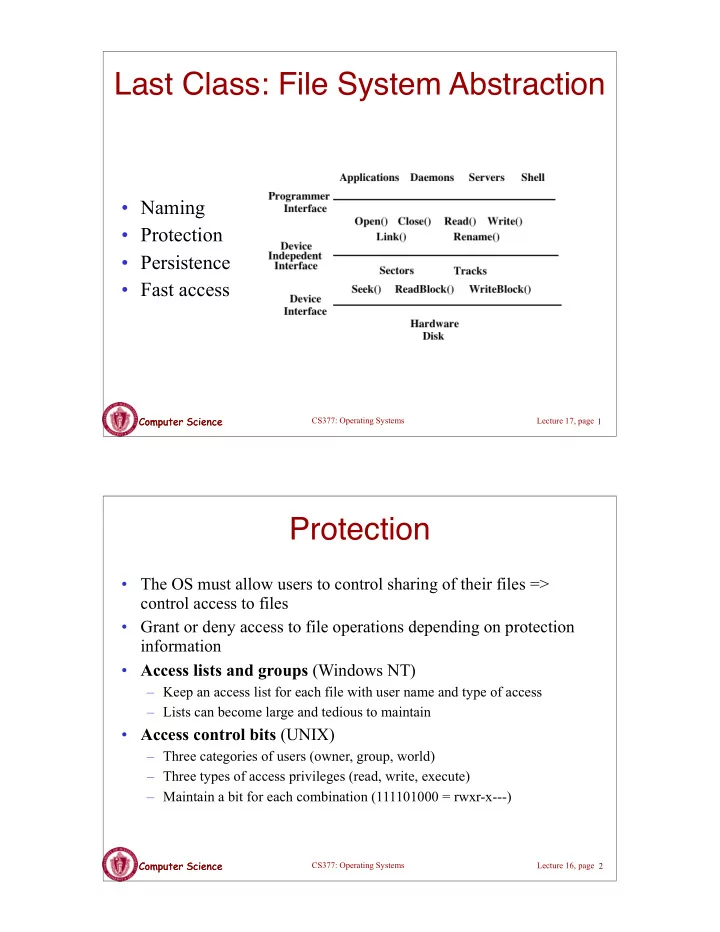
Last Class: File System Abstraction

1

  • Naming
  • Protection
  • Persistence
  • Fast access

Computer Science

Lecture 16, page

Computer Science

CS377: Operating Systems

Protection

  • The OS must allow users to control sharing of their files =>

control access to files

  • Grant or deny access to file operations depending on protection

information

  • Access lists and groups (Windows NT)

– Keep an access list for each file with user name and type of access – Lists can become large and tedious to maintain

  • Access control bits (UNIX)

– Three categories of users (owner, group, world) – Three types of access privileges (read, write, execute) – Maintain a bit for each combination (111101000 = rwxr-x---)

2

slide-2
SLIDE 2

Computer Science

Lecture 17, page

Computer Science

CS377: Operating Systems

Today: File System Implementation

Disk management

  • Brief review of how disks work.
  • How to organize data on disks.

3

Computer Science

Lecture 16, page

Computer Science

CS377: Operating Systems

How Disks Work

  • The disk surface is circular and is coated with a magnetic material.

The disk is always spinning (like a CD).

  • Tracks are concentric rings on disk with bits laid out serially on

tracks.

  • Each track is split into sectors or blocks, the minimum unit of

transfer from the disk.

4

slide-3
SLIDE 3

Computer Science

Lecture 17, page

Computer Science

CS377: Operating Systems

How Disks Work

  • CDs come individually, but disks come organized in disk pack

consisting of a stack of platters.

  • Disk packs use both sides of the platters, except on the ends.
  • Comb has 2 read/write head assemblies at the end of each arm.
  • Cylinders are matching sectors on each surface.
  • Disk operations are in terms of radial coordinates.

– Move arm to correct track, waiting for the disk to rotate under the head. – Select and transfer the correct sector as it spins by

5

Computer Science

Lecture 16, page

Computer Science

CS377: Operating Systems

Disk Overheads

  • Overhead: time the CPU takes to start a disk operation
  • Positioning time: the time to initiate a disk transfer of 1 byte to

memory.

– Seek time: time to position the head over the correct cylinder – Rotational time: the time for the correct sector to rotate under the head

  • Transfer rate: once a transfer is initiated, the rate of I/O transfer

(bandwidth)

6

slide-4
SLIDE 4

Computer Science

Lecture 17, page

Computer Science

CS377: Operating Systems

File Organization on Disk

The information we need: fileID 0, Block 0 → Platter 0, cylinder 0, sector 0 fileID 0, Block 1 → Platter 4, cylinder 3, sector 8 ... Key performance issues:

  • 1. We need to support sequential and random access.
  • 2. What is the right data structure in which to maintain file location

information?

  • 3. How do we lay out the files on the physical disk?

7

Computer Science

Lecture 17, page

Computer Science

CS377: Operating Systems

File Organization: On-Disk Data Structures

  • The structure used to describe where the file is on the disk and

the attributes of the file is the file descriptor (FileDesc). File descriptors have to be stored on disks just like files.

  • Most systems fit the following profile:

1. Most files are small. 2. Most disk space is taken up by large files. 3. I/O operations target both small and large files. => The per-file cost must be low, but large files must also have

good performance.

8

slide-5
SLIDE 5

Computer Science

Lecture 17, page

Computer Science

CS377: Operating Systems

Contiguous Allocation

  • OS maintains an ordered list of free disk blocks
  • OS allocates a contiguous chunk of free blocks when it creates a

file.

  • Need to store only the start location and size in the file descriptor
  • Advantages

– Simple – Access time? Number of seeks? (sequential and random access)

  • Disadvantages

– Changing file sizes – Fragmentation? Disk management?

  • Examples: IBM OS/360, write-once disks, early personal

computers

9

Computer Science

Lecture 17, page

Computer Science

CS377: Operating Systems

Linked files

  • Keep a list of all the free sectors/blocks.
  • In the file descriptor, keep a pointer to the first sector/block.
  • In each sector, keep a pointer to the next sector.

10

slide-6
SLIDE 6

Computer Science

Lecture 17, page

Computer Science

CS377: Operating Systems

Linked files

  • Advantages:

– Fragmentation? – File size changes? – Efficiently supports which type of access?

  • Disadvantages:

– Does not support which type of access? Why? – Number of seeks?

  • Examples: FAT, MS-DOS

11

Computer Science

Lecture 17, page

Computer Science

CS377: Operating Systems

Indexed files

  • OS keeps an array of block pointers for each file.
  • The user or OS must declare the maximum length of the file when

it is created.

  • OS allocates an array to hold the pointers to all the blocks when it

creates the file, but allocates the blocks only on demand.

  • OS fills in the pointers as it allocates blocks.

12

slide-7
SLIDE 7

Computer Science

Lecture 17, page

Computer Science

CS377: Operating Systems

Indexed files

  • Advantages

– Not much wasted space for files – Both sequential and random accesses are easy.

  • Disadvantages

– Wasted space in file descriptors – Sets a maximum file size – Lots of seeks because data is not contiguous.

13

Computer Science

Lecture 17, page

Computer Science

CS377: Operating Systems

Multilevel indexed files

  • Each file descriptor contains

(for example) 14 block pointers.

  • First 12 pointers point to data

blocks.

  • 13th pointer points to a block of

1024 pointers to 1024 more data blocks. (One indirection)

  • 14th pointer points to a block of

pointers to indirect blocks. (Two indirections)

14

slide-8
SLIDE 8

Computer Science

Lecture 17, page

Computer Science

CS377: Operating Systems

Multilevel indexed files

  • Advantages

– Supports incremental file growth – Small files?

  • Disadvantages

– Indirect access is inefficient for random access to very large files. – Lots of seeks because data is not contiguous.

  • What could the OS do to get more contiguous access and fewer

seeks?

  • Examples: BSD Unix 4.3

15

Computer Science

Lecture 17, page

Computer Science

CS377: Operating Systems

Free-Space Management

  • Need a free-space list to keep track of which disk blocks are free

(just as we need a free-space list for main memory)

  • Need to be able to find free space quickly and release space

quickly => use a bitmap

– The bitmap has one bit for each block on the disk. – If the bit is 1, the block is free. If the bit is 0, the block is allocated.

  • Can quickly determine if any page in the next 32 is free, by

comparing the word to 0. If it is 0, all the pages are in use. Otherwise, you can use bit operations to find an empty block. 110000100100011111110...

  • Marking a block as freed is simple since the block number can be

used to index into the bitmap to set a single bit.

16

slide-9
SLIDE 9

Computer Science

Lecture 17, page

Computer Science

CS377: Operating Systems

Free-Space Management

  • Problem: Bitmap might be too big to keep in memory for a large
  • disk. A 2 TB disk with 512 byte sectors requires a bitmap with

4,000,000,000 entries (500,000,000 bytes = 500 MB).

  • If most of the disk is in use, it will be expensive to find free blocks

with a bitmap.

  • An alternative implementation is to link together the free blocks.

– The head of the list is cached in kernel memory. Each block contains a pointer to the next free block. – How expensive is it to allocate a block? – How expensive is it to free a block? – How expensive is it to allocate consecutive blocks?

17

Computer Science

Lecture 17, page

Computer Science

CS377: Operating Systems

Summary

  • Many of the concerns and implementations of file system

implementations are similar to those of virtual memory implementations.

– Contiguous allocation is simple, but suffers from external fragmentation, the need for compaction, and the need to move files as they grow. – Indexed allocation is very similar to page tables. A table maps from logical file blocks to physical disk blocks. – Free space can be managed using a bitmap or a linked list.

18