Large Subalgebras and the Structure of Crossed Products, Lecture 3: - - PowerPoint PPT Presentation

large subalgebras and the structure of crossed products
SMART_READER_LITE
LIVE PREVIEW

Large Subalgebras and the Structure of Crossed Products, Lecture 3: - - PowerPoint PPT Presentation

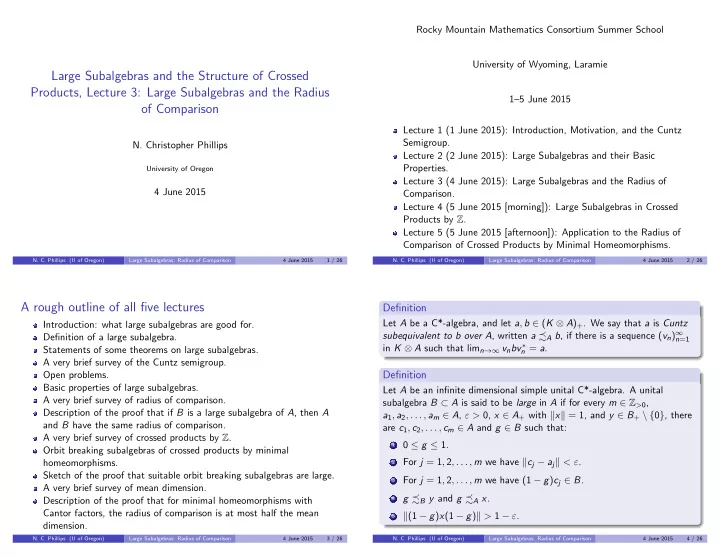
Rocky Mountain Mathematics Consortium Summer School University of Wyoming, Laramie Large Subalgebras and the Structure of Crossed Products, Lecture 3: Large Subalgebras and the Radius 15 June 2015 of Comparison Lecture 1 (1 June 2015):


slide-1
SLIDE 1

Large Subalgebras and the Structure of Crossed Products, Lecture 3: Large Subalgebras and the Radius

  • f Comparison
  • N. Christopher Phillips

University of Oregon

4 June 2015

  • N. C. Phillips (U of Oregon)

Large Subalgebras: Radius of Comparison 4 June 2015 1 / 26

Rocky Mountain Mathematics Consortium Summer School University of Wyoming, Laramie 1–5 June 2015 Lecture 1 (1 June 2015): Introduction, Motivation, and the Cuntz Semigroup. Lecture 2 (2 June 2015): Large Subalgebras and their Basic Properties. Lecture 3 (4 June 2015): Large Subalgebras and the Radius of Comparison. Lecture 4 (5 June 2015 [morning]): Large Subalgebras in Crossed Products by Z. Lecture 5 (5 June 2015 [afternoon]): Application to the Radius of Comparison of Crossed Products by Minimal Homeomorphisms.

  • N. C. Phillips (U of Oregon)

Large Subalgebras: Radius of Comparison 4 June 2015 2 / 26

A rough outline of all five lectures

Introduction: what large subalgebras are good for. Definition of a large subalgebra. Statements of some theorems on large subalgebras. A very brief survey of the Cuntz semigroup. Open problems. Basic properties of large subalgebras. A very brief survey of radius of comparison. Description of the proof that if B is a large subalgebra of A, then A and B have the same radius of comparison. A very brief survey of crossed products by Z. Orbit breaking subalgebras of crossed products by minimal homeomorphisms. Sketch of the proof that suitable orbit breaking subalgebras are large. A very brief survey of mean dimension. Description of the proof that for minimal homeomorphisms with Cantor factors, the radius of comparison is at most half the mean dimension.

  • N. C. Phillips (U of Oregon)

Large Subalgebras: Radius of Comparison 4 June 2015 3 / 26

Definition

Let A be a C*-algebra, and let a, b ∈ (K ⊗ A)+. We say that a is Cuntz subequivalent to b over A, written a A b, if there is a sequence (vn)∞

n=1

in K ⊗ A such that limn→∞ vnbv∗

n = a.

Definition

Let A be an infinite dimensional simple unital C*-algebra. A unital subalgebra B ⊂ A is said to be large in A if for every m ∈ Z>0, a1, a2, . . . , am ∈ A, ε > 0, x ∈ A+ with x = 1, and y ∈ B+ \ {0}, there are c1, c2, . . . , cm ∈ A and g ∈ B such that:

1 0 ≤ g ≤ 1. 2 For j = 1, 2, . . . , m we have cj − aj < ε. 3 For j = 1, 2, . . . , m we have (1 − g)cj ∈ B. 4 g B y and g A x. 5 (1 − g)x(1 − g) > 1 − ε.

  • N. C. Phillips (U of Oregon)

Large Subalgebras: Radius of Comparison 4 June 2015 4 / 26

slide-2
SLIDE 2

Reminder: The Cuntz semigroup

Definition

Let A be a C*-algebra, and let a, b ∈ (K ⊗ A)+.

1 We say that a is Cuntz subequivalent to b over A, written a A b, if

there is a sequence (vn)∞

n=1 in K ⊗ A such that limn→∞ vnbv∗ n = a.

2 We define a ∼A b if a A b and b A a.

Definition

Let A be a C*-algebra.

1 The Cuntz semigroup of A is Cu(A) = (K ⊗ A)+/ ∼A, together with

the commutative semigroup operation aA + bA = a ⊕ bA (using an isomorphism M2(K) → K; the result does not depend on which

  • ne) and the partial order aA ≤ bA if and only if a A b.

2 We also define the subsemigroup W (A) = M∞(A)+/ ∼A, with the

same operations and order.

  • N. C. Phillips (U of Oregon)

Large Subalgebras: Radius of Comparison 4 June 2015 5 / 26

Comparison

Let A be a stably finite simple unital C*-algebra. Recall that T(A) is the set of tracial states on A and that QT(A) is the set of normalized 2-quasitraces on A. We say that the order on projections over A is determined by traces if, as happens for type II1 factors, whenever p, q ∈ M∞(A) are projections such that for all τ ∈ T(A) we have τ(p) < τ(q), then p is Murray-von Neumann equivalent to a subprojection of q. Simple C*-algebras need not have very many projections, so a more definitive version of this condition is to ask for strict comparison of positive elements, that is, whenever a, b ∈ M∞(A) (or K ⊗ A) are positive elements such that for all τ ∈ QT(A) we have dτ(a) < dτ(b) (recall dτ(a) = limn→∞ τ(a1/n)), then a A b. (It turns out that it does not matter whether one uses M∞(A) or K ⊗ A, but this is not as easy to see as with projections.) (Note: We have also switched from traces to quasitraces. For exact C*-algebras, this makes no difference.)

  • N. C. Phillips (U of Oregon)

Large Subalgebras: Radius of Comparison 4 June 2015 6 / 26

Comparison (continued)

From the previous slide: A has strict comparison of positive elements if whenever a, b ∈ M∞(A)+ satisfy dτ(a) < dτ(b) for all τ ∈ QT(A), then a A b. Simple AH algebras with slow dimension growth have strict comparison, but other simple AH algebras need not. Strict comparison is necessary for any reasonable hope of classification in the sense of the Elliott program. According to the Toms-Winter Conjecture, when A is simple, separable, nuclear, unital, and stably finite, strict comparison should imply Z-stability, and this is known to hold in a number of cases. The radius of comparison rc(A) of A measures the failure of strict

  • comparison. For context, we point out that rc(C(X)) is roughly 1

2 dim(X)

(at least for reasonable spaces X, such as finite complexes).

  • N. C. Phillips (U of Oregon)

Large Subalgebras: Radius of Comparison 4 June 2015 7 / 26

Radius of comparison

Definition

Let A be a stably finite unital C*-algebra.

1 Let r ∈ [0, ∞). We say that A has r-comparison if whenever

a, b ∈ M∞(A)+ satisfy dτ(a) + r < dτ(b) for all τ ∈ QT(A), then a A b.

2 The radius of comparison of A, denoted rc(A), is

rc(A) = inf

  • r ∈ [0, ∞): A has r-comparison
  • .

(We take rc(A) = ∞ if there is no r such that A has r-comparison.) (It is equivalent to use K ⊗ A in place of M∞(A).) The following is a special case of a result stated in the first lecture.

Theorem

Let A be an infinite dimensional stably finite simple separable unital exact C*-algebra. Let B ⊂ A be a large subalgebra. Then rc(A) = rc(B).

  • N. C. Phillips (U of Oregon)

Large Subalgebras: Radius of Comparison 4 June 2015 8 / 26

slide-3
SLIDE 3

Special case of a theorem from the first lecture (on previous slide):

Theorem

Let A be an infinite dimensional stably finite simple separable unital exact C*-algebra. Let B ⊂ A be a large subalgebra. Then rc(A) = rc(B). The extra assumption is that A is exact, so that every quasitrace is a trace. We describe a proof directly from the definition of a large subalgebra. We give a heuristic argument first, using the following simplifications:

1 The algebra A, and therefore also B, has a unique tracial state τ. 2 We consider elements of A+ and B+ instead of elements of M∞(A)+

and M∞(B)+.

3 For a ∈ A+, when needed, instead of getting (1 − g)c(1 − g) ∈ B for

some c ∈ A+ which is close to a, we can actually get (1 − g)a(1 − g) ∈ B. Similarly, for a ∈ A we can get (1 − g)a ∈ B.

4 For a, b ∈ A+ with a A b, we can find v ∈ A such that v∗bv = a

(not just such that v∗bv − a is small).

5 None of the elements we encounter are Cuntz equivalent to

projections, that is, we never encounter anything for which 0 is an isolated point of, or not in, the spectrum.

  • N. C. Phillips (U of Oregon)

Large Subalgebras: Radius of Comparison 4 June 2015 9 / 26

The heuristic argument

Simplifications for the heuristic argument (on previous slide):

1 The algebra A, and therefore also B, has a unique tracial state τ. 2 We consider only elements of A+ and B+. 3 For a ∈ A+, we can actually get (1 − g)a(1 − g) ∈ B, and for a ∈ A

we can get (1 − g)a ∈ B.

4 For a, b ∈ A+ with a A b, we can find v ∈ A such that v∗bv = a. 5 We never encounter anything for which 0 is isolated in the spectrum.

The most drastic simplification is (3). In the actual proof, since we only get approximation, we will need to make systematic use of elements (a − ε)+ for carefully chosen, and varying, values of ε > 0. We first consider the inequality rc(A) ≤ rc(B). So let a, b ∈ A+ satisfy dτ(a) + rc(B) < dτ(b). The essential idea is to replace b by something slightly smaller which is in B+, say y, and replace a by something slightly larger which is in B+, say x, in such a way that we still have dτ(x) + rc(B) < dτ(y). Then use the definition of rc(B).

  • N. C. Phillips (U of Oregon)

Large Subalgebras: Radius of Comparison 4 June 2015 10 / 26

The heuristic argument (continued)

We want to show rc(A) ≤ rc(B). So let a, b ∈ A+ satisfy dτ(a) + rc(B) < dτ(b). Choose δ > 0 such that dτ(a) + rc(B) + δ ≤ dτ(b). Applying (3) of our simplification, find g ∈ B with 0 ≤ g ≤ 1, such that (1 − g)a(1 − g) ∈ B and (1 − g)b(1 − g) ∈ B, and so small in W (A) that dτ(g) < δ

  • 3. Using basic result (4) on Cuntz

comparison, we get (1 − g)b(1 − g) ∼A b1/2(1 − g)2b1/2 ≤ b. Similarly, (1 − g)a(1 − g) A a, and this relation implies dτ

  • (1 − g)a(1 − g)
  • ≤ dτ(a).

Also, b A (1 − g)b(1 − g) ⊕ g by the second lemma on the list of basic results on Cuntz equivalence, so dτ

  • (1 − g)b(1 − g)
  • + dτ(g) ≥ dτ(b).
  • N. C. Phillips (U of Oregon)

Large Subalgebras: Radius of Comparison 4 June 2015 11 / 26

The heuristic argument (continued)

We have a, b ∈ A+, we want to show a A b, and we got: dτ(a) + rc(B) + δ ≤ dτ(b). (1) dτ(g) < δ

3.

(2) (1 − g)b(1 − g) A b. (3) dτ

  • (1 − g)a(1 − g)
  • ≤ dτ(a).

(4) dτ

  • (1 − g)b(1 − g)
  • + dτ(g) ≥ dτ(b).

(5) Using, in order, (4), (1), (5), (2), we get dτ

  • (1 − g)a(1 − g) ⊕ g
  • + rc(B) + δ

3 ≤ dτ(a) + dτ(g) + rc(B) + δ 3

≤ dτ(b) + dτ(g) − 2δ

3 ≤ dτ

  • (1 − g)b(1 − g)
  • + 2dτ(g) − 2δ

3

≤ dτ

  • (1 − g)b(1 − g)
  • .

Use the definition of rc(B) in the middle, the second lemma on the list of basic results on Cuntz equivalence at the first step, and (3) at the end: a A (1 − g)a(1 − g) ⊕ g B (1 − g)b(1 − g) A b, that is, a A b, as desired.

  • N. C. Phillips (U of Oregon)

Large Subalgebras: Radius of Comparison 4 June 2015 12 / 26

slide-4
SLIDE 4

Heuristic for rc(B) ≤ rc(A)

Let a, b ∈ B+ satisfy dτ(a) + rc(A) < dτ(b). Choose δ > 0 such that dτ(a) + rc(B) + δ ≤ dτ(b). By lower semicontinuity of dτ, we always have dτ(b) = supε>0 dτ

  • (b − ε)+
  • . So there is ε > 0 such that

  • (b − ε)+
  • > dτ(a) + rc(A).

(6) Define f : [0, ∞) → [0, ∞) by f (λ) = max(0, ε−1λ(ε − λ)) for λ ∈ [0, ∞). Then f (b) and (b − ε)+ are orthogonal positive elements such that f (b) + (b − ε)+ ≤ b, and f (b) = 0 (since we assume 0 ∈ sp(b) is not isolated). We have a A (b − ε)+ by (6) and the definition of rc(A). We are assuming for simplification that we can find v ∈ A such that v∗(b − ε)+v = a. Similarly, we are assuming we can find g ∈ B with 0 ≤ g ≤ 1 such that (1 − g)v∗ ∈ B and g B f (b). Since v(1 − g) ∈ B and [v(1 − g)]∗(b − ε)+[v(1 − g)] = (1 − g)a(1 − g), we get (1 − g)a(1 − g) B (b − ε)+. Therefore, using the second lemma

  • n the list of basic results on Cuntz equivalence at the first step,

a B (1 − g)a(1 − g) ⊕ g B (b − ε)+ ⊕ g B (b − ε)+ ⊕ f (b) B b.

  • N. C. Phillips (U of Oregon)

Large Subalgebras: Radius of Comparison 4 June 2015 13 / 26

Proving rc(A) ≤ rc(B): Preliminary results

Theorem (For Cu(A): Blackadar-Robert-Tikuisis-Toms-Winter)

Let A be a stably finite simple unital C*-algebra. Then:

1 rc(A) is the least s ∈ [0, ∞] such that whenever m, n ∈ Z>0 satisfy

m/n > s, and a, b ∈ M∞(A)+ satisfy naA + m1A ≤ nbA in W (A), then a A b.

2 rc(A) is the least s ∈ [0, ∞] such that whenever m, n ∈ Z>0 satisfy

m/n > t, and a, b ∈ M∞(A)+ satisfy (n + 1)aA + m1A ≤ nbA in W (A), then a A b. The second part has n + 1 in one of the places the first part has n.

Lemma (Lemma on functional calculus)

Let M ∈ (0, ∞), let f : [0, ∞) → C be a continuous with f (0) = 0, and let ε > 0. Then there is δ > 0 such that whenever A is a C*-algebra and a, b ∈ Asa satisfy a ≤ M and a − b < δ, then f (a) − f (b) < ε.

  • N. C. Phillips (U of Oregon)

Large Subalgebras: Radius of Comparison 4 June 2015 14 / 26

Standing assumptions

Throughout, A is an infinite dimensional stably finite simple separable unital exact C*-algebra and B ⊂ A is a large subalgebra. We want to prove that rc(A) ≤ rc(B). Since A is stably finite, Mn(B) is large in Mn(A) for all n. Since A is exact, QT(A) = T(A) (all quasitraces are traces). Being a subalgebra of A, the algebra B is also exact, so QT(B) = T(B). We know from the previous lecture that (abusing notation) T(B) = T(A). Also, recall from the first lecture (the second lemma on the list of basic results on Cuntz equivalence):

Lemma (Cutdown comparison)

Let A be a C*-algebra, let a ∈ A+, let g ∈ A+ satisfy 0 ≤ g ≤ 1, and let ε ≥ 0. Then (a − ε)+ A

  • (1 − g)a(1 − g) − ε
  • + ⊕ g.
  • N. C. Phillips (U of Oregon)

Large Subalgebras: Radius of Comparison 4 June 2015 15 / 26

Proving rc(A) ≤ rc(B)

We use the first criterion in the theorem above. Thus, let m, n ∈ Z>0 satisfy m/n > rc(B), and let a, b ∈ M∞(A)+ satisfy naA + m1A ≤ nbA in W (A). We want to prove that a A b. Without loss of generality a, b ≤ 1. It suffices to prove that (a − ε)+ A b for every ε > 0. So let ε > 0. We may assume ε < 1. Let x ∈ M∞(A)+ be the direct sum

  • f n copies of a, let y ∈ M∞(A)+ be the direct sum of n copies of b, and

let q ∈ M∞(A)+ be the direct sum of m copies of the identity of A. The relation naA + m1A ≤ nbA means that x ⊕ q A y. By (11) on the Cuntz semigroup handout, there exists δ > 0 such that

  • (x ⊕ q) − 1

  • + A (y − δ)+.

Since ε < 3, this is equivalent to

  • x − 1

  • + ⊕ q A (y − δ)+.
  • N. C. Phillips (U of Oregon)

Large Subalgebras: Radius of Comparison 4 June 2015 16 / 26

slide-5
SLIDE 5

Proving rc(A) ≤ rc(B) (continued)

Choose l ∈ Z>0 so large that a, b ∈ Ml ⊗ A. Since m/n > rc(B), there is k ∈ Z>0 such that rc(B) < m n − 2 k . Set ε0 = min 1

3ε, 1 2δ

  • .

Using the functional calculus lemma above, choose ε1 > 0 with ε1 ≤ ε0 and so small whenever D is a C*-algebra and z ∈ D+ satsifies z ≤ 1, then z0 − z < ε1 implies (z0 − ε0)+ − (z − ε0)+ < ε0,

  • z0 − 1

  • + −
  • z − 1

  • +
  • < ε0,

and

  • z0 −
  • ε0 + 1

  • + −
  • z −
  • ε0 + 1

  • +
  • < ε0.
  • N. C. Phillips (U of Oregon)

Large Subalgebras: Radius of Comparison 4 June 2015 17 / 26

Proving rc(A) ≤ rc(B) (continued)

We have from above a, b ∈ Ml ⊗ A, naA = xA, nbA = yA, m1A = qA,

  • x − 1

  • + ⊕ q A (y − δ)+,

and rc(B) < m n − 2 k , and we want to prove that a A b. Since A is infinite dimensional and simple, the third lemma on the Cuntz semigroup handout provides z ∈ A+ \ {0} such that (k + 1)zA ≤ 1A. Since Ml(B) is large in Ml(A), there are g ∈ Ml(B)+ and a0, b0 ∈ Ml(A)+ satisfying 0 ≤ g, a0, b0 ≤ 1, a0 − a < ε1, b0 − b < ε1, g A z, and such that (1 − g)a0(1 − g), (1 − g)b0(1 − g) ∈ Ml ⊗ B. From g A z and (k + 1)xA ≤ 1A we get supτ∈T(A) dτ(g) < 1

k .

  • N. C. Phillips (U of Oregon)

Large Subalgebras: Radius of Comparison 4 June 2015 18 / 26

Proving rc(A) ≤ rc(B) (continued)

We have from above 0 ≤ g, a0, b0 ≤ 1, a0 − a < ε1, b0 − b < ε1, g A x, and (1 − g)a0(1 − g), (1 − g)b0(1 − g) ∈ Ml ⊗ B. Set a1 =

  • (1−g)a0(1−g)−
  • ε0+ 1

  • +

and b1 =

  • (1−g)b0(1−g)−ε0
  • +,

which are in Ml ⊗ B. We claim that a0, a1, b0, and b1 satisfy:

1 (a − ε)+ A

  • a0 −
  • ε0 + 1

  • +.

2

a0 −

  • ε0 + 1

  • + B a1 ⊕ g.

3 a1 A

  • a − 1

  • +.

4 (b − δ)+ A (b0 − ε0)+. 5 (b0 − ε0)+ B b1 ⊕ g. 6 b1 A b.

  • N. C. Phillips (U of Oregon)

Large Subalgebras: Radius of Comparison 4 June 2015 19 / 26

Proving rc(A) ≤ rc(B) (continued)

We will prove the first three claims (involving a, a0, and a1); the last three (involving b, b0, and b1) are similar but easier. Recall: a0 − a < ε1 and a1 =

  • (1 − g)a0(1 − g) −
  • ε0 + 1

  • +.

We prove claim 1: (a − ε)+ A

  • a0 −
  • ε0 + 1

  • +. The choice of ε1

implies

  • a0 −

1

3ε + ε0

  • + −
  • a −

1

3ε + ε0

  • +
  • < ε0 ≤ 1

3ε.

At the last step in the following computation use this and (10) on the Cuntz semigroup handout, at the first step use ε0 ≤ 1

3ε, and at the second

step use (8) on the Cuntz semigroup handout: (a − ε)+ ≤

  • a −

2

3ε + ε0

  • +

=

  • a −

1

3ε + ε0

  • + − 1

  • + A
  • a0 −

1

3ε + ε0

  • +.
  • N. C. Phillips (U of Oregon)

Large Subalgebras: Radius of Comparison 4 June 2015 20 / 26

slide-6
SLIDE 6

Proving rc(A) ≤ rc(B) (continued)

Recall: a1 =

  • (1 − g)a0(1 − g) −
  • ε0 + 1

  • +.

Claim 2 (

  • a0 −
  • ε0 + 1

  • + B a1 ⊕ g) is an instance of the second

lemma on the list of basic results on Cuntz equivalence:

Lemma (Cutdown comparison)

Let A be a C*-algebra, let a ∈ A+, let g ∈ A+ satisfy 0 ≤ g ≤ 1, and let ε ≥ 0. Then (a − ε)+ A

  • (1 − g)a(1 − g) − ε
  • + ⊕ g.
  • N. C. Phillips (U of Oregon)

Large Subalgebras: Radius of Comparison 4 June 2015 21 / 26

Proving rc(A) ≤ rc(B) (continued)

Recall: a0 − a < ε1 and a1 =

  • (1 − g)a0(1 − g) −
  • ε0 + 1

  • +.

For claim 3 (a1 A

  • a − 1

  • +), note a0 − a < ε1 implies

(1 − g)a0(1 − g) − (1 − g)a(1 − g) < ε1. Therefore

  • (1 − g)a0(1 − g) − 1

  • + −
  • (1 − g)a(1 − g) − 1

  • +
  • < ε0.

Using (8) on the Cuntz semigroup handout at the first step, this fact and (10) on the Cuntz semigroup handout at the second step, (6) on the Cuntz semigroup handout at the third step, and (17) on the Cuntz semigroup handout and a1/2(1 − g)2a1/2 ≤ a at the last step, we get a1 =

  • (1 − g)a0(1 − g) − 1

  • + − ε0
  • +

A

  • (1 − g)a(1 − g) − 1

  • + ∼A
  • a1/2(1 − g)2a1/2 − 1

  • + A
  • a − 1

  • +,

as desired.

  • N. C. Phillips (U of Oregon)

Large Subalgebras: Radius of Comparison 4 June 2015 22 / 26

Proving rc(A) ≤ rc(B): What we have so far

We have a, b ∈ Ml ⊗ A, naA = xA, nbA = yA, m1A = qA,

  • x − 1

  • + ⊕ q A (y − δ)+,

and rc(B) < m

n − 2 k ,

and we want to prove that a A b. We got g, a0, a1, b0, b1 such that (1 − g)a0(1 − g), (1 − g)b0(1 − g) ∈ Ml ⊗ B and sup

τ∈T(A)

dτ(g) < 1

k .

and the following hold:

1 (a − ε)+ A

  • a0 −
  • ε0 + 1

  • +.

2

a0 −

  • ε0 + 1

  • + B a1 ⊕ g.

3 a1 A

  • a − 1

  • +.

4 (b − δ)+ A (b0 − ε0)+. 5 (b0 − ε0)+ B b1 ⊕ g. 6 b1 A b.

  • N. C. Phillips (U of Oregon)

Large Subalgebras: Radius of Comparison 4 June 2015 23 / 26

Proving rc(A) ≤ rc(B) (continued)

Now let τ ∈ T(A). Since x and y are the direct sums of n copies of a and b, it follows that

  • x − 1

  • + is the direct sum of n copies of
  • a − 1

  • +

and (y − δ)+ is the direct sum of n copies of (b − δ)+. So the relation

  • x − 1

  • + ⊕ q A (y − δ)+

implies n · dτ

  • a − 1

  • +
  • + m ≤ n · dτ
  • (b − δ)+
  • .

(7) Using claim 4 and claim 5 at the first step and supτ∈T(A) dτ(g) < 1

k at the

third step, we get the estimate dτ

  • (b − δ)+
  • ≤ dτ(b1) + dτ(g) < dτ(b1) + k−1.

(8) Claim 3 implies dτ(a1) ≤ dτ

  • a − 1

  • +
  • .

(9)

  • N. C. Phillips (U of Oregon)

Large Subalgebras: Radius of Comparison 4 June 2015 24 / 26

slide-7
SLIDE 7

Proving rc(A) ≤ rc(B) (continued)

Using supτ∈T(A) dτ(g) < 1

k at the second step, (9) at the third step, (7) at

the fourth step, and (8) at the fifth step, we get n · dτ(a1 ⊕ g) + m = n · dτ(a1) + m + n · dτ(g) ≤ n · dτ(a1) + m + nk−1 ≤ n · dτ

  • a − 1

  • +
  • + m + nk−1

≤ n · dτ

  • (b − δ)+
  • + nk−1

≤ n · dτ(b1) + 2nk−1. It follows that dτ(a1 ⊕ g) + m n − 2 k ≤ dτ(b1). This holds for all τ ∈ T(A), and therefore, since A and B have the same traces, for all τ ∈ T(B).

  • N. C. Phillips (U of Oregon)

Large Subalgebras: Radius of Comparison 4 June 2015 25 / 26

Proving rc(A) ≤ rc(B) (continued)

Since QT(A) = T(A), since m n − 2 k > rc(B), and since a1, b1, g ∈ Ml ⊗ B, it follows that a1 ⊕ g B b1. Using this relation at the third step, claim 1 at the first step, claim 2 at the second step, and claim 6 at the last step, we then get (a − ε)+ A

  • a0 −
  • ε0 + 1

  • + A a1 ⊕ g B b1 A b.

This completes the proof that rc(A) ≤ rc(B).

  • N. C. Phillips (U of Oregon)

Large Subalgebras: Radius of Comparison 4 June 2015 26 / 26