SmartBatt Smart and Safe Integration of Batteries in Electric - - PowerPoint PPT Presentation

smartbatt
SMART_READER_LITE
LIVE PREVIEW

SmartBatt Smart and Safe Integration of Batteries in Electric - - PowerPoint PPT Presentation

SmartBatt Smart and Safe Integration of Batteries in Electric Vehicles An EU funded project SmartBatt Smart and Safe integration of batteries into electric vehicles SmartBatt EU funded under 7 th Framework Programme Objectives: -


slide-1
SLIDE 1

SmartBatt

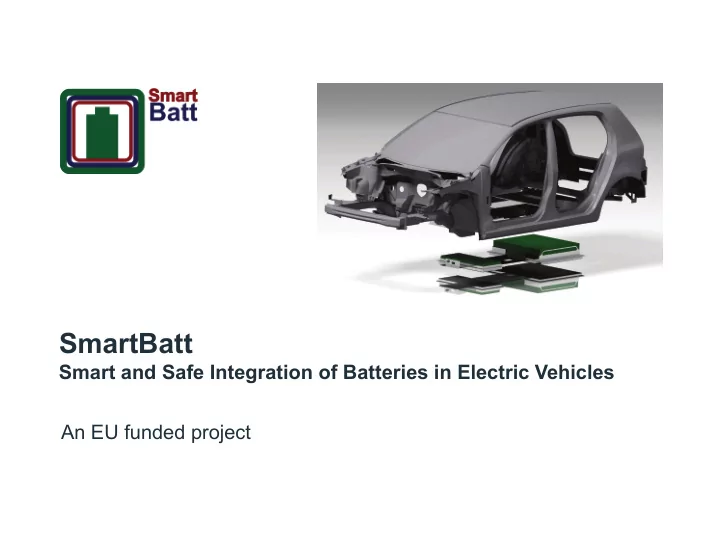
Smart and Safe Integration of Batteries in Electric Vehicles An EU funded project

slide-2
SLIDE 2

2

Objectives:

  • Development of an electric vehicle battery focusing on
  • Minimization of weight
  • Optimization of safety
  • Minimization of costs
  • Design capable for series production

Realisation:

  • Battery for an A-class BEV with 100km NEDC Range
  • 15% lighter than SotA (75% weight ratio between system and cell)
  • Crash safety based on reference SLC Body
  • Integrated BEV has same static and dynamic requirements as SLC

Budget: 3 million EUR overall budget / 2.25 million EUR funded budget Period: January 2011 until December 2012 Consortium: 9 Partners from 5 European countries: AIT Austrian Institute of Technology, LKR Ranshofen (AIT LKR), Axeon Technologies (part of the Johnson Matthey group), Fraunhofer Gesellschaft, Impact Design Europe, Ricardo UK, SP Sweden, Technical University Graz, Volkswagen AG

SmartBatt

EU funded under 7th Framework Programme

SmartBatt – “Smart and Safe integration of batteries into electric vehicles”

slide-3
SLIDE 3

WP 1: Project Management WP 2: Specification Analysis / Requirements WP 3: Concept & Feasibility Study WP 4: Risk Assessment WP 5: Design & Development WP 6: Hardware Build-Up & final Validation WP 7: Assessment WP 8: Exploitation

3

Work Package Structure

SmartBatt – “Smart and Safe integration of batteries into electric vehicles”

slide-4
SLIDE 4

WP 1: Project Management WP 2: Specification Analysis / Requirements WP 3: Concept & feasibility Study WP 4: Risk Assessment WP 5: Design & Development WP 6: Hardware Build-Up & final Validation WP 7: Assessment WP 8: Exploitation

4

SmartBatt – “Smart and Safe integration of batteries into electric vehicles”

slide-5
SLIDE 5

5

SmartBatt – “Smart and Safe integration of batteries into electric vehicles”

slide-6
SLIDE 6

WP 1: Project Management WP 2: Specification Analysis / Requirements WP 3: Concept & feasibility Study WP 4: Risk Assessment WP 5: Design & Development WP 6: Hardware Build-Up & final Validation WP 7: Assessment WP 8: Exploitation

6

SmartBatt – “Smart and Safe integration of batteries into electric vehicles”

slide-7
SLIDE 7
  • Definition / analysis of system constraints
  • platform of SLC car used
  • ~20 kWh energy content
  • 15 % lighter than comparable systems
  • Same crashworthiness as SLC
  • Identification of existing standards / regulation
  • IEC/ISO
  • FMVSS
  • SAE
  • ECE R100

7 Aluminium sheet Aluminium cast Aluminium extrusion Steel Hot-formed steel Magnesium sheet Magnesium diecasting Glasfibre thermoplastic Status 05/08: ∆m -101kg (35%) Materials

WP 2 - Specification Analysis and Requirements

SmartBatt – “Smart and Safe integration of batteries into electric vehicles”

slide-8
SLIDE 8

Example for a 20 kWh Battery ( ~200 kg): » Cells (60 – 70 %) = 120 kg – 140 kg » Components (10 - 15 %) = 20 kg – 30 kg » Housing (15 - 30 %) = 30 kg – 60 kg

  • “Reduction of pack weight by 10 % - 15 % due to housing components.”

Aimed weight target 170 – 180 kg » Cells (68 – 80 %) = 120 kg – 140 kg (unchanged) » Components (11,5 - 17 %) = 20 kg – 30 kg (almost unchanged) » Housing (5,7 – 11,5 %) = 10 kg – 20 kg (weight reduction of 66%)

Function integration of “Body in white - floor” and housing to achieve this target

Weight target calculation

8

SmartBatt – “Smart and Safe integration of batteries into electric vehicles”

slide-9
SLIDE 9

9

SLC – SmartBatt – Starting Point

SmartBatt – “Smart and Safe integration of batteries into electric vehicles”

slide-10
SLIDE 10

WP 1: Project Management WP 2: Specification Analysis / Requirements WP 3: Concept & Feasibility Study WP 4: Risk Assessment WP 5: Design & Development WP 6: Hardware Build-Up & final Validation WP 7: Assessment WP 8: Exploitation

10

SmartBatt – “Smart and Safe integration of batteries into electric vehicles”

slide-11
SLIDE 11
  • Definition of interfaces
  • Battery managment system
  • Cell selection
  • Package room/battery housing

11

WP 3 - Concept & Feasibility Study

SmartBatt – “Smart and Safe integration of batteries into electric vehicles”

VTBM’s Cells Only main components shown, fuse(s) etc omitted for clarity. High voltage to vehicle

slide-12
SLIDE 12
  • Combining accident statistics with SLC CAD
  • Possible structural solution of EV body

12

1

Given stiff front (conceptual block) we can justify similar design concept in the rear of vehicle. This gives us two stiff, crashworthy energy absorbing and anti- penetration limits of passengers cabin

2

Two additional sills (rocker panels) add additional stiffness (torsional stiffness in the first place). Like in current designs rocker panels work as important side impact energy

  • absorbers. Side impact load transferring mechanism (to the

non-stuck side) must be modified. This opens a way to flexible platform design (sedan/coupe – substantial bending stiffness of floor panel).

Source: Justen et. al

Searching for a safe Space that meets the Requirements

SmartBatt – “Smart and Safe integration of batteries into electric vehicles”

slide-13
SLIDE 13
  • Different investigated concepts (Metal Case vs. Pouch) within the

maximum package

13

P3 battery systems MC 1 battery system P1 battery system MC 2 Battery System

Concepts

SmartBatt – “Smart and Safe integration of batteries into electric vehicles”

slide-14
SLIDE 14

WP 1: Project Management WP 2: Specification Analysis / Requirements WP 3: Concept & feasibility Study WP 4: Risk Assessment WP 5: Design & Development WP 6: Hardware Build-Up & final Validation WP 7: Assessment WP 8: Exploitation

14

SmartBatt – “Smart and Safe integration of batteries into electric vehicles”

slide-15
SLIDE 15
  • Theoretical risk and failure analysis (e.g. FMEA)
  • Experimental analysis (e.g. safety tests)

15

WP 4 - Risk Assessment

SmartBatt – “Smart and Safe integration of batteries into electric vehicles”

slide-16
SLIDE 16

16

Sledge Tests

SmartBatt – “Smart and Safe integration of batteries into electric vehicles”

slide-17
SLIDE 17

17

Front ODB acceleration test

  • Data of acceleration out of SLC Model

Pole acceleration tests

  • Data of acceleration out of SLC Model

Acceleration pulses

SmartBatt – “Smart and Safe integration of batteries into electric vehicles”

slide-18
SLIDE 18

18

Module FrontODB Side Pole-Hard Side Pole-Standard P3 - 1 (2Cells) Same cells for all tests – Thermal-Shock-Cycling-Cells P3 - 2 (2Cells) Same cells for all tests – module checked after test 2 P3 - 3 (2Cells) 2 New Cells changed before the test MC 2 (6Cells) Same cells for all tests – 2Thermal-Shock-Cycling-Cells - 4 New Cells MC 2 (6Cells) 6 cells changed before the test

P1 - 2 P1 - 1 P1 - 3 MC 2

Front M. Rear M.

SmartBatt – “Smart and Safe integration of batteries into electric vehicles”

slide-19
SLIDE 19
  • No reaction because of acceleration
  • No damage of the module housing
  • No damage of the cells
  • Both cell types passed this test

19

Conclusion WP 4

SmartBatt – “Smart and Safe integration of batteries into electric vehicles”

slide-20
SLIDE 20

WP 1: Project Management WP 2: Specification Analysis / Requirements WP 3: Concept & feasibility Study WP 4: Risk Assessment WP 5: Design & Development WP 6: Hardware Build-Up & final Validation WP 7: Assessment WP 8: Exploitation

20

SmartBatt – “Smart and Safe integration of batteries into electric vehicles”

slide-21
SLIDE 21
  • Design of housing & mounting/simulation based optimization
  • Design of modules
  • Total weight of 160 kg achieved (goal was 169 kg)
  • General workflow and tool chain

for the design process

21

WP 5 - Design & Development

SmartBatt – “Smart and Safe integration of batteries into electric vehicles”

slide-22
SLIDE 22

22

Re-designed floor panel

Floor Panel: 50.1 [kg]

SmartBatt – “Smart and Safe integration of batteries into electric vehicles”

slide-23
SLIDE 23

Prismatic vs. Pouch Cell

23

SmartBatt – “Smart and Safe integration of batteries into electric vehicles”

Prismatic Pouch cell weight ratio: 13,3 % 18,1 %

  • grav. energy density:

158 Wh/kg 146 Wh/kg

slide-24
SLIDE 24

Prismatic vs. Pouch Cell

24

SmartBatt – “Smart and Safe integration of batteries into electric vehicles”

Prismatic Pouch cell weight ratio: 13,3 % 18,1 %

  • grav. energy density:

158 Wh/kg 146 Wh/kg

slide-25
SLIDE 25

top-cover connector (+) Prismatic Cell connector (-) bottom-cover

Assembling

25

SmartBatt – “Smart and Safe integration of batteries into electric vehicles”

slide-26
SLIDE 26

Al hybrid foam sandwich structure

  • Maximum stiffness
  • Lightweight design
  • Ground protection

Integrated „Plug balcony“

  • Easy to reach from inside
  • Fully integrated

Aluminium die-cast tunnel

  • High grade of geometrical flexibility
  • Integrates electrical components

Technical Details

26

SmartBatt – “Smart and Safe integration of batteries into electric vehicles”

slide-27
SLIDE 27
  • Not only a safe battery housing  also improvements on vehicle

level

  • Example: Intrusion depth (based on LS Dyna simulation)

~30%

Improvements for side pole test

27

SmartBatt – “Smart and Safe integration of batteries into electric vehicles”

slide-28
SLIDE 28
  • Interdisciplinary communication is necessary
  • No simple tool chain for such complex and interdisciplinary projects

Actually it is a matrix with a set of different tools for the different tasks

  • Not only highly sophisticated computer aided engineering tools, like

finite element (FE) and computer aided design (CAD) software important but also standard office software, e.g. spreadsheets

  • CAD was the “basic language” in the project

28

Tool Chain

SmartBatt – “Smart and Safe integration of batteries into electric vehicles”

slide-29
SLIDE 29

WP 1: Project Management WP 2: Specification Analysis / Requirements WP 3: Concept & feasibility Study WP 4: Risk Assessment WP 5: Design & Development WP 6: Hardware Build-Up & final Validation WP 7: Assessment WP 8: Exploitation

29

SmartBatt – “Smart and Safe integration of batteries into electric vehicles”

slide-30
SLIDE 30
  • Build-up of a fully equipped evaluation model
  • Build-up of an empty housing for test-reason
  • Testing on pack level
  • Overtemperature
  • Overcharge, -discharge

30

WP 6 - Hardware Build-Up & final Validation - AIT

SmartBatt – “Smart and Safe integration of batteries into electric vehicles”

slide-31
SLIDE 31

31

WP 6 - Hardware Build-Up & final Validation - Ricardo

SmartBatt – “Smart and Safe integration of batteries into electric vehicles”

  • Adoption of hard- and software to specific application
  • New generation of BMS hardware caused some implementing-

problems (hardware review, software updates)

  • Setting fully equipped pack into operation
  • Conducting operational tests
slide-32
SLIDE 32

32

WP 6 - Hardware Build-Up & final Validation - SP

SmartBatt – “Smart and Safe integration of batteries into electric vehicles”

  • Fire Test According to Future R100
  • Equipped with thermocouples, one battery module and bricks

simulating thermal capacity

  • Placed on a grating table above fuel pan
  • Exposed to flames for a total of 130 s
  • Validating simulations
slide-33
SLIDE 33

33

WP 6 - Hardware Build-Up & final Validation - SP

SmartBatt – “Smart and Safe integration of batteries into electric vehicles”

  • IP Evaluation Test
  • Classification of degree of protection according

to ISO 20653:2006, IP6K9K

  • Empty battery housing prototype
  • Exposed to test probe, dust and water
slide-34
SLIDE 34

34

WP 6 - Hardware Build-Up & final Validation - SP

SmartBatt – “Smart and Safe integration of batteries into electric vehicles”

  • EMC Test
  • Radiated emission and radiation immunity
  • System running in normal operation with no load on HV
  • utputs
  • Tested according to Functional Status Classification A
  • 20
  • 10

10 20 30 40 50 60 70 80 90 30M 50 60 80 100M 200 300 400 500 800 1G Level in dBµV/m

Frequency in Hz _E_radiated_2004-104-EC Annex VII

2004-104-EC ANNEX VII

slide-35
SLIDE 35

35

WP 6 - Hardware Build-Up & final Validation – TU Graz

SmartBatt – “Smart and Safe integration of batteries into electric vehicles”

  • Crash Test
  • Complete floor structure assembled
  • Use of battery cell dummies
  • Validating simulations
  • Real crash test was similar to

simulation after some improvements

slide-36
SLIDE 36

WP 1: Project Management WP 2: Specification Analysis / Requirements WP 3: Concept & feasibility Study WP 4: Risk Assessment WP 5: Design & Development WP 6: Hardware Build-Up & final Validation WP 7: Assessment WP 8: Exploitation

36

SmartBatt – “Smart and Safe integration of batteries into electric vehicles”

slide-37
SLIDE 37
  • Weight optimization
  • Performed analysis regarding energy consumption due to less weight of the battery system
  • Performed analysis on driving range improvements due to more battery capacity
  • Three different vehicle types were compared in standardized driving cycles and performance

tests (NEDC, FTP 72 and Artemis cycle)

  • Cost savings
  • The concept is suitable for the use in mass production
  • Cost outlook indicates potential in price reduction for cells
  • Components depending on volume sizes
  • Impact on standardization
  • Standardization concerning EVs is performed within ISO/TC 22/SC21 and IEC/TC 69
  • UNECE/REESS amendment to R100 Battery Electric vehicle safety for Lithium Ion batteries

developed and signed, interim from 1/3 2013, probably into force 1/3 2014

  • Impact on replaceable-energy-storage-system concepts
  • Reviewed standardization of cells, modules, battery management system, electrical connectors

and communications and battery enclosure

  • Imminently no standardization in sight

37

WP 7 - Assessment

SmartBatt – “Smart and Safe integration of batteries into electric vehicles”

slide-38
SLIDE 38

WP 1: Project Management WP 2: Specification Analysis / Requirements WP 3: Concept & feasibility Study WP 4: Risk Assessment WP 5: Design & Development WP 6: Hardware Build-Up & final Validation WP 7: Assessment WP 8: Exploitation

38

SmartBatt – “Smart and Safe integration of batteries into electric vehicles”

slide-39
SLIDE 39
  • Knowledge Transfer
  • To electric vehicle community and broader public
  • Papers / Conferences
  • Other EU projects
  • Promote Results
  • Website WP4/WP6
  • “Battery Integration Workshop” in May 2012 in Brussels
  • Fire fighter workshop in Austria
  • 5 papers in different conferences published
  • Exhibition of the demonstrator at the EEVC 2012 in Brussels
  • Input for Regulations and Standards
  • ISO TC22/SC21 and UNECE R100 amendment

39

WP 8 - Exploitation

SmartBatt – “Smart and Safe integration of batteries into electric vehicles”

slide-40
SLIDE 40

SmartBatt – “Smart and Safe integration of batteries into electric vehicles”

http://www.smartbatt.eu/

Project Coordination Hansjörg Kapeller AIT Austrian Institute of Technology GmbH Giefinggasse 2 | 1210 Vienna | Austria T +43(0) 50550-6606 | F +43(0) 50550-6595 hansjoerg.kapeller@ait.ac.at http://www.ait.ac.at