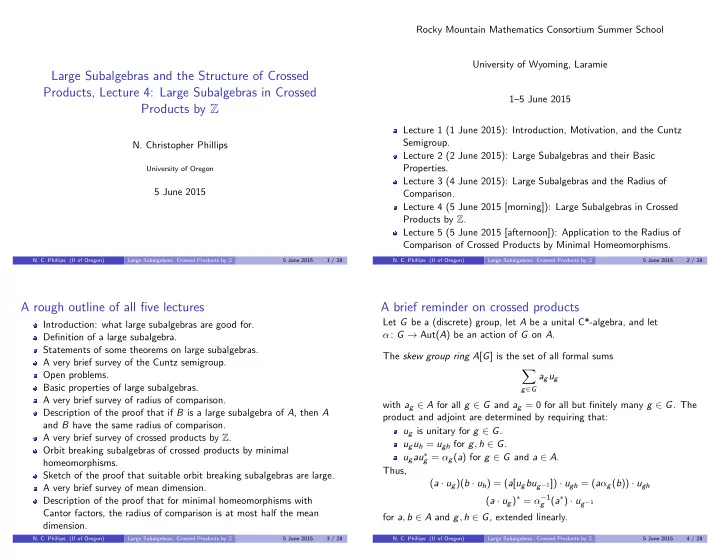

SLIDE 1
Large Subalgebras and the Structure of Crossed Products, Lecture 4: Large Subalgebras in Crossed Products by Z
- N. Christopher Phillips
University of Oregon
5 June 2015
- N. C. Phillips (U of Oregon)
Large Subalgebras: Crossed Products by Z 5 June 2015 1 / 28
Rocky Mountain Mathematics Consortium Summer School University of Wyoming, Laramie 1–5 June 2015 Lecture 1 (1 June 2015): Introduction, Motivation, and the Cuntz Semigroup. Lecture 2 (2 June 2015): Large Subalgebras and their Basic Properties. Lecture 3 (4 June 2015): Large Subalgebras and the Radius of Comparison. Lecture 4 (5 June 2015 [morning]): Large Subalgebras in Crossed Products by Z. Lecture 5 (5 June 2015 [afternoon]): Application to the Radius of Comparison of Crossed Products by Minimal Homeomorphisms.
- N. C. Phillips (U of Oregon)
Large Subalgebras: Crossed Products by Z 5 June 2015 2 / 28
A rough outline of all five lectures
Introduction: what large subalgebras are good for. Definition of a large subalgebra. Statements of some theorems on large subalgebras. A very brief survey of the Cuntz semigroup. Open problems. Basic properties of large subalgebras. A very brief survey of radius of comparison. Description of the proof that if B is a large subalgebra of A, then A and B have the same radius of comparison. A very brief survey of crossed products by Z. Orbit breaking subalgebras of crossed products by minimal homeomorphisms. Sketch of the proof that suitable orbit breaking subalgebras are large. A very brief survey of mean dimension. Description of the proof that for minimal homeomorphisms with Cantor factors, the radius of comparison is at most half the mean dimension.
- N. C. Phillips (U of Oregon)
Large Subalgebras: Crossed Products by Z 5 June 2015 3 / 28
A brief reminder on crossed products
Let G be a (discrete) group, let A be a unital C*-algebra, and let α: G → Aut(A) be an action of G on A. The skew group ring A[G] is the set of all formal sums
- g∈G
agug with ag ∈ A for all g ∈ G and ag = 0 for all but finitely many g ∈ G. The product and adjoint are determined by requiring that: ug is unitary for g ∈ G. uguh = ugh for g, h ∈ G. ugau∗
g = αg(a) for g ∈ G and a ∈ A.
Thus, (a · ug)(b · uh) = (a[ugbug−1]) · ugh = (aαg(b)) · ugh (a · ug)∗ = α−1
g (a∗) · ug−1
for a, b ∈ A and g, h ∈ G, extended linearly.
- N. C. Phillips (U of Oregon)
Large Subalgebras: Crossed Products by Z 5 June 2015 4 / 28