Lab 2 Group Communication Desired group communication Multicast - - PDF document

lab 2 group communication
SMART_READER_LITE
LIVE PREVIEW

Lab 2 Group Communication Desired group communication Multicast - - PDF document

Overview Introduction to group communication Lab 2 Group Communication Desired group communication Multicast communication Andreas Larsson Group membership service 2009-02-04 DSII: Group Comm. 2 A Distributed System in


slide-1
SLIDE 1

1

Lab 2 Group Communication

Andreas Larsson

2009-02-04

DSII: Group Comm. 2

Overview

  • Introduction to group communication
  • Desired group communication
  • Multicast communication
  • Group membership service

DSII: Group Comm. 3

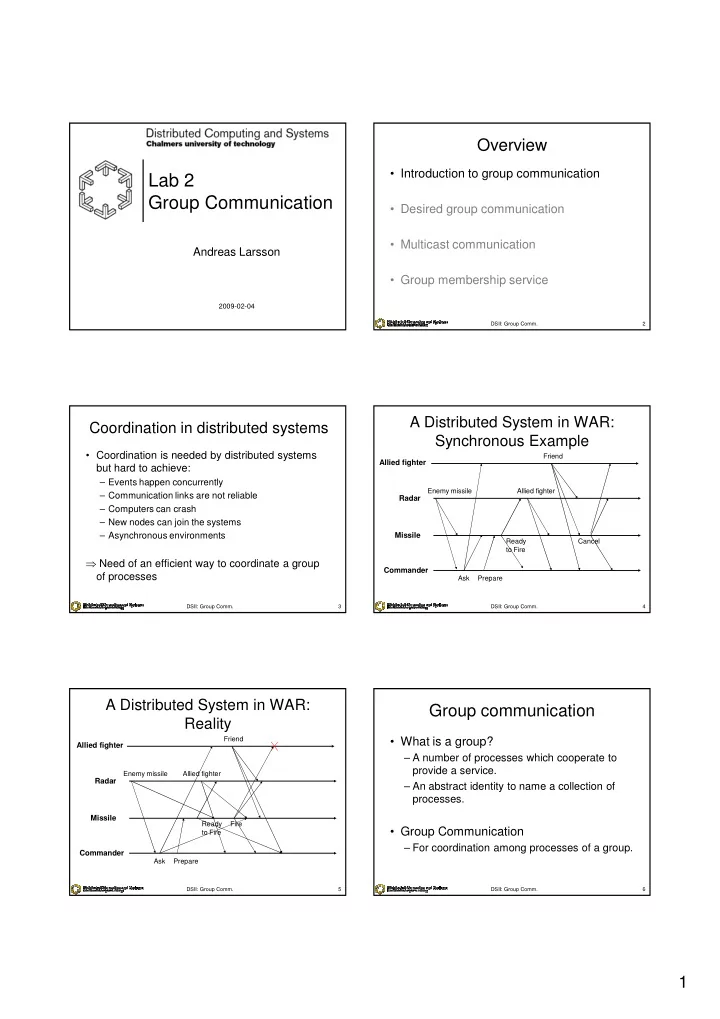
Coordination in distributed systems

  • Coordination is needed by distributed systems

but hard to achieve:

– Events happen concurrently – Communication links are not reliable – Computers can crash – New nodes can join the systems – Asynchronous environments

Need of an efficient way to coordinate a group

  • f processes

DSII: Group Comm. 4

A Distributed System in WAR: Synchronous Example

Allied fighter Radar Missile Commander

Enemy missile Friend Ready to Fire Cancel Ask Prepare Allied fighter

DSII: Group Comm. 5

A Distributed System in WAR: Reality

Allied fighter Radar Missile Commander

Enemy missile Friend Ready to Fire Fire Ask Prepare Allied fighter

DSII: Group Comm. 6

Group communication

  • What is a group?

– A number of processes which cooperate to provide a service. – An abstract identity to name a collection of processes.

  • Group Communication

– For coordination among processes of a group.

slide-2
SLIDE 2

2

DSII: Group Comm. 7

Who Needs Group Communication?

  • Highly available servers (client-server)
  • Database Replication
  • Multimedia Conferencing
  • Online Games
  • Cluster management

DSII: Group Comm. 8

Distributed Web Server

  • High availability

DSII: Group Comm. 9

Online Game

  • Fault-tolerance, Order

DSII: Group Comm. 10

Different Comm. Methods

  • Unicast

– Point-to-Point Communication – Multiple copies are sent.

  • Broadcast

– One-to-All Communication – Abuse of Network Bandwidth

  • Multicast

– One-to-multiple Communication

DSII: Group Comm. 11

Overview

  • Introduction to group communication
  • Desired group communication
  • Multicast communication
  • Group membership service

DSII: Group Comm. 12

Desired Group Communication

  • Name Abstraction
  • Efficiency
  • Delivery Guarantees
  • Dynamic Membership

Multicast Reliability, Ordering Group membership service

slide-3
SLIDE 3

3

DSII: Group Comm. 13

Properties of Communication

  • Ordering

– Total ordering, causal ordering

  • Failure behavior
  • Reliability

– Validity, integrity, agreement

DSII: Group Comm. 14

Properties of Group

  • Name of group
  • Addresses of group members
  • Dynamic group membership
  • Options:

– Peer group or client-server group – Closed or Open Group

DSII: Group Comm. 15

Peer Group

  • All the members are

equal.

  • All the members send

messages to the group.

  • All the members

receive all the messages.

DSII: Group Comm. 16

Client-Server Group

  • Replicated servers.
  • Clients do not care

which server answers.

DSII: Group Comm. 17

Overview

  • Introduction to group communication
  • Desired group communication
  • Multicast communication
  • Group membership service

DSII: Group Comm. 18

Multicast communication

  • Use network hardware support for

broadcast or multicast when it is available.

  • Send message over a distribution tree.
  • Minimize the time and bandwidth

utilization

slide-4
SLIDE 4

4

DSII: Group Comm. 19

Reliability

Correct processes: those that never fail.

  • Integrity

A correct process delivers a message at most once.

  • Validity

A message from a correct process will be delivered by the process eventually.

  • Agreement

A message delivered by a correct process will be delivered by all other correct processes in the group.

Validity + Agreement = Liveness

DSII: Group Comm. 20

Ordering

Assumptions: a process belongs to at most one group.

  • FIFO

– if mp→ m’p, all correct processes that deliver m’p will deliver mp (that is from the same sender) before m’p.

  • Causal

– if m→ m’, all correct processes that deliver m’ will deliver m before m’.

  • Total

– if a correct process delivers m before m’, all other correct processes that deliver m’ will deliver m before m’.

p1 p2 p3 p1 p2 p3 p1 p2 p3

DSII: Group Comm. 21

Examples

  • Assumption:

– Reliable one-to-one send operation (e.g. TCP)

  • Basic multicast

– Requirement:

  • All correct processes will eventually deliver the message

from a correct sender.

– Implementation:

  • B-multicast( g, m): ∀p ∈ g: send( p, m);
  • On receive( m) at p: B-deliver( m) at p.

Properties: integrity, validity.

DSII: Group Comm. 22

Basic multicast: Agreement?

4 crash 1 2 3 Agreement

X

DSII: Group Comm. 23

Examples (cont.)

  • Reliable multicast

– Requirements: integrity, validity, agreement – Implementation:

  • Received := {};
  • R-multicast( g, m) at process p: B-multicast( g, m);
  • On B-deliver( m) at process p from process q

if( m ∉ Received) Received := Received ∪ {m}; if( q ≠ p) B-multicast( g, m); R-deliver( m); end if Inefficient: each message is sent |g| times to each process

– You are encouraged to implement in more efficient ways

DSII: Group Comm. 24

Examples (cont.)

  • FIFO-ordered multicast:

– Assumption:

  • a process belongs to at most one group.

– Implementation:

  • Local variables at p: Sp = 1, Rp[ |g| ]={0};
  • FO-multicast( g, m) at p:

B-multicast( g, <m, Sp>); Sp++;

  • On B-deliver( <m, S>) at p from q:

if( S = Rp[q] + 1) FO-deliver( m); Rp[q] := S; else if( S > Rp[q] + 1) place <m, S> in the queue until S = Rp[q] + 1; FO-deliver( m); Rp[q] := S; end if

– Your task: totally ordered multicasts.

slide-5
SLIDE 5

5

DSII: Group Comm. 25

Overview

  • Introduction to group communication
  • Desired group communication
  • Multicast communication
  • Group membership service

DSII: Group Comm. 26

Group membership service

  • Four tasks:

– Interface for group membership changes – Failure detector – Membership change notification – Group address expansion

Group address expansion Multicast Communication Group membership management

  • Group partition:

– Primary-partition – one partition only – Partitionable – many partiations at once

DSII: Group Comm. 27

Group views

  • Group views:

– Lists of the current ordered group members – A new one is generated when processes join or leave/fail.

  • View delivery

– When a member is notified of a membership change – Requirements

  • Order

– if p delivers v(g)→ v’(g), no other process delivers v’(g)→ v(g).

  • Integrity

– if p delivers v(g), p ∈ v(g).

  • Non-triviality

– if q joins a group and becomes indefinitely reachable from p, eventually q is always in the view p delivers.

DSII: Group Comm. 28

View-synchronous group comm.

  • Extend the reliable multicast

semantics with group views.

– Agreement

  • Correct processes deliver the same

set of messages in any given view

– Validity (closed group)

  • Correct processes always deliver

the messages they send.

  • p ∈ v0(g) does not deliver m in v0(g)

p ∉ v1(g) for processes that deliver m.

– Integrity

p q r (p,q,r) (q,r) X crash

DSII: Group Comm. 29

Examples

  • Ensemble: reliable group communication

toolkit

– Previous talk

DSII: Group Comm. 30

IP-multicast

  • Multicast:

– Yes:

  • efficiency

– No:

  • Reliability
  • Ordering
  • Group membership

service:

– Yes:

  • Interface for group

membership change

  • Group address

expansion

– No:

  • Failure detector
  • Membership change

notification

  • IP: 224.0.0.1 - 239.255.255.255
slide-6
SLIDE 6

6

DSII: Group Comm. 31

References

  • Distributed Systems: Concepts and

Design by G. Coulouris et al., ISBN 0-201- 61918-0

– Section 4.5 Group Communication – Section 11.4 Multicast Communication – Section 14.2.2 Group Communication

DSII: Group Comm. 32

Lab 2: Construct a reliable and

  • rdered multicast
  • Reliable

– Integrity, Validity, Agreement

  • Ordered

– All machines should agree on the order of all received messages. – Total and causal order.

  • No membership service

– Processes can still crash though!

The GUI

DSII: Group Comm. 33

Message display Debug message display Time for stress test # of messages for stress test

The interface

  • Provide

– cast – setCallback

  • Use

– deliver – debug – enableSending

DSII: Group Comm. 34