
SLIDE 1
Leadership Using Effective Communication
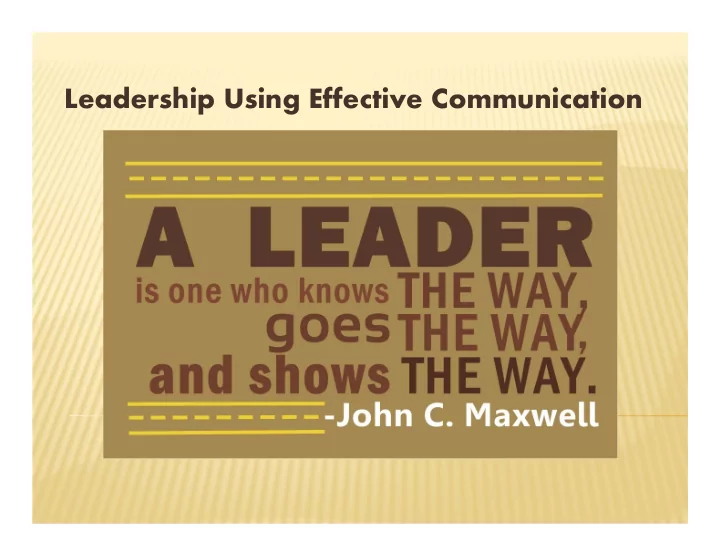
Leadership Using Effective Communication L eader eadership ship = - - PowerPoint PPT Presentation
Leadership Using Effective Communication L eader eadership ship = = Using communication t Using communication to achie achieve desired outco e desired outcomes. es. Wh Why is communication y is communication central t central to leader
Leadership Using Effective Communication
eadership ship = =
Using communication t Using communication to achie achieve desired outco e desired outcomes. es.
Wh Why is communication y is communication central t central to leader leadership? ship? Because ef Because effectiv ctive leader e leaders w s work with and thr with and through o ugh others. hers.
Communication is cir Communication is circular ular, no , not linear t linear. Inst . Instead... ead... Communication is a Communication is a transactional pr transactional process
thr through which messages are simultaneously ugh which messages are simultaneously sent and receiv sent and received. ed.
Communication has bo Communication has both th verbal and non-v rbal and non-verbal dimensions. rbal dimensions.
Communication style is tied t Communication style is tied to leader leadership type. ship type. Types of Leader pes of Leaders: s:
thoritarian
Democratic
Laissez-Faire ire
Which leader Which leadership style is best depends upon: ship style is best depends upon:
an organization’s purpose, purpose,
the conditions in which it operat which it operates, es,
the composition of its members.
Authoritarian Leadership T thoritarian Leadership Traits: aits:
Unilaterally sets goals, erally sets goals, policies, pr policies, procedures
p down communication wn communication
Controls discussion ls discussion
s obedience and punishes mistak punishes mistakes es
Democratic Leader Democratic Leadership T ship Traits aits:
:
llower ers in s involv lved in ed in setting goals, policies, and setting goals, policies, and pr procedures
cilitates discussion s discussion
s good work, resor rk, resorts t ts to punishment punishment as last resor as last resort t
Laissez-F Laissez-Faire Leader ire Leadership T ship Traits aits:
:
llowers enjo ers enjoy free rein y free rein
Noncommittal communication
sion
Offers f rs few if an w if any re y rewards or s or punishments punishments
Pr Pros and Cons of A
thoritarian Leader eadership hip
Pr Pros
High efficiency ciency
Quick and appropriat
e solutions if leader is kno if leader is knowledgeable ledgeable
Cons Cons
Creates conditions f s conditions for discont r discontent ent
Discourages inno ges innovation ation
Increases turnover and absent er and absenteeism eeism
sters cultur ers culture of dependency e of dependency
Pr Pros and Cons of Democratic Leader
ship
Cons Cons
Decision-making can be slow and cont and contentious entious
Majority ma ty may be wr y be wrong
Minority might feel possible resentment eel possible resentment
Pr Pros
Encourages ages inno innovati ation with
in accept accepted parame ed parameters rs
Decreases turnover and absent er and absenteeism eeism
Increases participation b icipation by f fost stering sense of buy ering sense of buy-in in
Pr Pros and Cons of Laissez-F
ire Leadership ship
Cons Cons
Diffused decision-making fused decision-making
Lack of clear direction
ntial chaos
Pr Pros
High innovation if org’l ation if org’l members are embers are kno knowledgeable and motiv ledgeable and motivated
Increases productivity and satisf
action for r highly motiv highly motivated e d exper perts s
versus Leadership
(e (exercise) ise)
Canno Cannot ha t have leader leaders without f s without follo llower ers. s. Leaders and f Leaders and follo llowers are relational par ers are relational partners who pla ners who play com complementar lementary r y roles in les in working t ing toward achie achieving goals. ing goals.
Treat p people a as i if t they w were w what t they o
to b be a and yo you ma may help y help them become what the them become what they are capable of being. are capable of being.
— Johan W Johan Wolfgang v lfgang von Goe n Goethe he
There are tw There are two primar
y forms of rms of communication be communication betw tween leader een leaders and f s and follo llowers:
Task (repor sk (report talk) t talk) Relational (rappor lational (rapport talk) talk)
A A word about the challenges t about the challenges to leaders posed b leaders posed by millennials. millennials. Three k Three key traits: y traits: Demanding politically correctness Demanding politically correctness Privileging of per Privileging of personal opinions
Cra Craving positiv ing positive f feedback eedback
Ethos
Logos
thos
Com Compliance gaining communication liance gaining communication
language