Missional Leadership: A Model for Governance and Ministry Church - - PDF document

missional leadership a model for governance and ministry
SMART_READER_LITE
LIVE PREVIEW

Missional Leadership: A Model for Governance and Ministry Church - - PDF document

Missional Leadership: A Model for Governance and Ministry Church Council Presentation by Pastor Austin March 25, 2019 VBCs Missional Priorities In March 2017, we adopted a bold vision for the future of our church. Our new mission statement,


slide-1
SLIDE 1

1 Missional Leadership: A Model for Governance and Ministry Church Council Presentation by Pastor Austin March 25, 2019 VBC’s Missional Priorities In March 2017, we adopted a bold vision for the future of our church. Our new mission statement, changing lives and transforming our community with the love of God, led us to prioritize growing disciples and local

  • missions. Since then, we have started or expanded many local mission

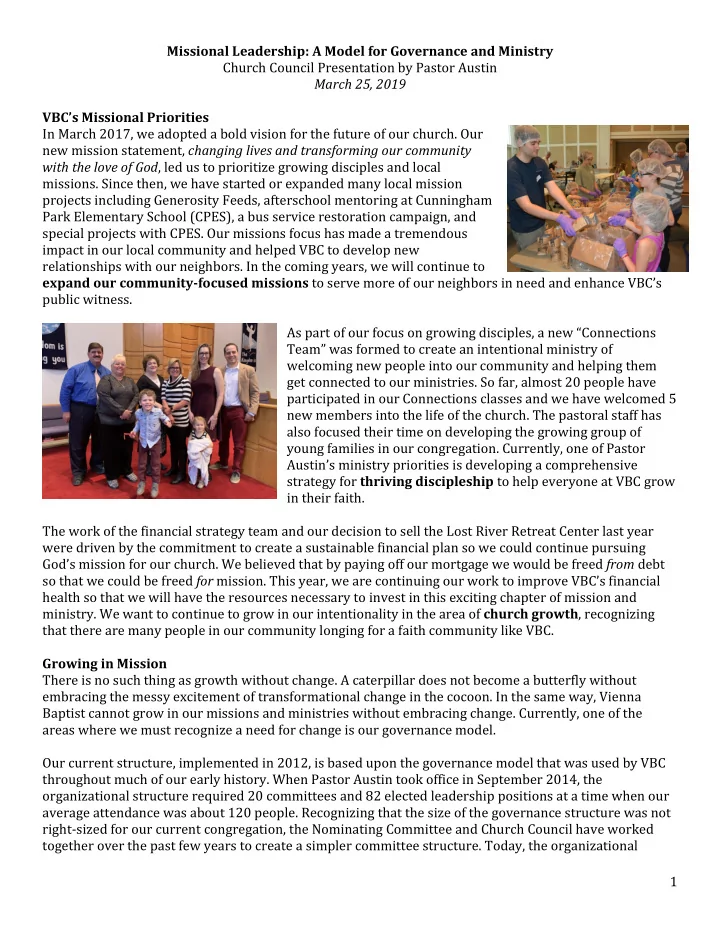
projects including Generosity Feeds, afterschool mentoring at Cunningham Park Elementary School (CPES), a bus service restoration campaign, and special projects with CPES. Our missions focus has made a tremendous impact in our local community and helped VBC to develop new relationships with our neighbors. In the coming years, we will continue to expand our community-focused missions to serve more of our neighbors in need and enhance VBC’s public witness. As part of our focus on growing disciples, a new “Connections Team” was formed to create an intentional ministry of welcoming new people into our community and helping them get connected to our ministries. So far, almost 20 people have participated in our Connections classes and we have welcomed 5 new members into the life of the church. The pastoral staff has also focused their time on developing the growing group of young families in our congregation. Currently, one of Pastor Austin’s ministry priorities is developing a comprehensive strategy for thriving discipleship to help everyone at VBC grow in their faith. The work of the financial strategy team and our decision to sell the Lost River Retreat Center last year were driven by the commitment to create a sustainable financial plan so we could continue pursuing God’s mission for our church. We believed that by paying off our mortgage we would be freed from debt so that we could be freed for mission. This year, we are continuing our work to improve VBC’s financial health so that we will have the resources necessary to invest in this exciting chapter of mission and

  • ministry. We want to continue to grow in our intentionality in the area of church growth, recognizing

that there are many people in our community longing for a faith community like VBC. Growing in Mission There is no such thing as growth without change. A caterpillar does not become a butterfly without embracing the messy excitement of transformational change in the cocoon. In the same way, Vienna Baptist cannot grow in our missions and ministries without embracing change. Currently, one of the areas where we must recognize a need for change is our governance model. Our current structure, implemented in 2012, is based upon the governance model that was used by VBC throughout much of our early history. When Pastor Austin took office in September 2014, the

  • rganizational structure required 20 committees and 82 elected leadership positions at a time when our

average attendance was about 120 people. Recognizing that the size of the governance structure was not right-sized for our current congregation, the Nominating Committee and Church Council have worked together over the past few years to create a simpler committee structure. Today, the organizational

slide-2
SLIDE 2

2 structure requires 11 standing committees/groups and 52 elected leadership positions at a time when average attendance is about 110 people. Although we have simplified the governance structure, it remains oversized and creates many burdens

  • n church leaders. Problems typically arise due to the complex decision-making process and large

number of people required to make management decisions. For instance, in the fall a chiller pump that served the Education wing’s HVAC system broke. The problem was identified by staff members who also discussed the current building needs and possible interim solutions. The Building & Grounds Committee was enlisted to retrieve three bids for a new chiller pump, the logistics of which required staff

  • participation. Once bids and timelines were coordinated, the group sent their recommendation to the

Financial Administration Committee for review. The committee needed a full briefing on the nature of the problem, solutions proposed, and bids reviewed in order to properly conduct their work. Since the price

  • f the repair required a special distribution of funds, a special Budget Council session was called to

approve repairs and funding. Then the staff, Building and Grounds chair, and a Church Trustee all had to coordinate with one another for scheduling the repair and signing contracts. As a result, in total 35 people, or one-third of a Sunday morning worship service, needed to be involved in the decision-making process to restore cool air to the Education wing.1 If you are exhausted after reading this paragraph, imagine how our staff and lay leaders felt! As a church leader, perhaps you have your own stories of navigating our large committee structure in order to accomplish your work. The complexity of decision-making and the administrative burden of our current model are taking time away from the Lead Pastor’s and church leaders’ ability to focus on VBC’s priorities of community- focused missions, thriving discipleship, and church growth. We must consider what is more important to us: our leaders spending time navigating bureaucracy or advancing our mission? If a change is not made in the near future, our church will not be able to devote the time and energy necessary to fulfill our bold strategic goals for our church. As a result, this proposal is not about a governance change for its own sake. It is about building a leadership structure that best serves the church and advances our mission. Simply put, our goal is to create a governance model “kept as simple as possible so that it can function efficiently, trying to allocate human resources wisely by forming committees that are not too large or numerous for the congregation but large enough to allow for a democratic process.”2 Organizing for Mission Before presenting a renewed model for governance and ministry, it is important to recognize the recent history of governance change at Vienna Baptist. Since 2002, Vienna Baptist has undergone two significant governance changes: The first, implemented in July 2002, led to the team-based model and the creation of the Leadership Team. While the change alleviated the burden of an oversized organizational chart (148 spots) and a complex committee structure (27 committees), it also produced unique challenges. Primary concerns were a lack of accountability at all levels, a lack of clarity in authority and decision-making, and a lack of transparent communication. The structure was also not able to provide effective leadership during times of congregational conflict and pastoral leadership transitions. As a result, in October 2013, the congregation approved the current organizational design, modeled after the 2001 Organizational Manual. While we recognize a need for organizational change in order to invest in the growth of our mission and ministry, our priorities for governance remain the same: clear and transparent leadership, mutual accountability, efficient decision making, effective oversight, and congregation-based authority. Any

1 4 staff members, 3 Building & Grounds members, 7 Financial Administration members, and 21 Church Council members 2 Maring, Norman H., and Winthrop S. Hudson. A Baptist Manual of Polity and Practice. Edited by David Gregg. 2nd ed. (Valley Forge, PA: Judson

Press, 2012), 141.

slide-3
SLIDE 3

3 proposal which does not meet these standards will not be approved by church leaders and the congregation. A Renewed Model for Governance and Ministry A fundamental law of leadership is that no group rises higher or moves beyond its leadership. There are many great resources devoted to helping churches and non-profits organize their leadership in ways that help the congregation climb higher and move closer to fulfilling God’s vision. The renewed model for governance and ministry outlined below relies heavily on two resources: Governance and Ministry: Rethinking Board Leadership (Second Edition) by Dan Hotchkiss and The Handbook of Nonprofit Governance published by BoardSource. Before examining the proposed model, it is important to establish a shared understanding of the key terms and concepts that serve as the foundation for subsequent recommendations. We will use the figure below as a guide to our discussion. The Mission Comes First – The highest authority in our church is God’s mission for Vienna Baptist. Everything we do, from daily operational decisions to strategic mission priorities, is rooted in our shared understanding of who God is calling us to be and what God is calling us to do. Our mission statement of changing lives and transforming our community is much more than a catchphrase; it is the standard by which we evaluate every decision in mission and ministry. Governance – Governance includes top-level tasks of articulating mission, selecting strategies for getting there, making sure the strategy is followed, and ensuring that people and property are protected against

  • harm. Governance produces mission statements, minutes, policies, strategic goals, and lists of core values.

Ministry – Ministry is the daily work of building a community, managing resources, and changing lives. Ministry brings into being worship services, study groups, mission trips, service projects, mowed lawns, happy children, and renewed hope. Although it borders on oversimplification, a helpful summary may be that governance produces words on paper and ministry produces action.

slide-4
SLIDE 4

4 Committees – Committees gather information, draft policy, or prepare in other ways to report back to the body that appointed them. A committee is responsible to the Council (or to the congregation) and its work product always goes back to its parent body. Teams – Teams exist to achieve practical results. They make important choices about how they will accomplish ministry goals. A team is responsible to the staff, and its work product flows outward to the congregation or to the world. Staff – For the purposes of our diagram, the staff includes ministers, administrative staff, program staff, and volunteer leadership positions. These are the leaders responsible for specific areas of ministry. Three Leadership Roles

  • 1. Oversight is the Church Council’s authority to hold the staff accountable. The Council is exercising
  • versight when it reviews a financial audit, evaluates VBC’s progress toward its annual goals, or

talks with the Lead Pastor about performance. In oversight, more than any other aspect of its work, the Council holds itself at a critical distance from the staff in order to give feedback from an independent standpoint.

  • 2. Management is the staff’s authority to lead the work of ministry. Because all or almost all of the

staff’s management authority is delegated by the Council, the scope of management depends on the extent of the authority the Council has delegated. Within its management authority, the Council expects the staff to make decisions and to take responsibility for them without asking for permission or approval.

  • 3. Planning is envisioning a future (discernment) and making the big choices about how to get there

(strategy). In contrast to oversight and management, planning is a “soft” kind of authority. To be effective, planning depends on wide support from the Council, Diaconate, staff, top leaders, lead givers, potential leaders, and active members. A planning effort might produce a mission statement, a five-year strategic plan, or annual goals. After a wide process of discernment, plans flow to the Council and possibly the congregation for approval. Implementing plans—and making many choices about how to implement them—becomes a staff responsibility. You will also notice that the Diaconate serves a special role in the life of Vienna Baptist. The Diaconate

  • perates both in the sphere of ministry—by providing pastoral care—and discernment—as spiritual

leaders considering God’s direction for VBC—placing them close to the center of the diagram. Through their constant contact with church members, the Diaconate is in a unique position to serve as discerners for the future of ministry. In a Baptist church, the congregation is the foundation for all of our work in governance and ministry. When elected to Church Council or participating in a business meeting, members of the congregation serve as overseers governing the life of the church. When church members participate in Town Hall discussions, prayer groups, or other activities that focus on the future of the church they are discerning

  • ur future together. When members join a ministry team, serve as a deacon, or lead a mission action

group they are serving as ministers of the church. Ultimately, all authority and power in the church comes from and returns to the congregation as a whole. Regardless of the size or structure of our governance model, it is important for congregational health that we always maintain clarity about the role and function of each leadership body. Clarity allows church leaders to focus on their own areas of responsibility and work together on shared goals for the sake of

  • ur mission and for the good of the congregation.
slide-5
SLIDE 5

5 The Job of a Mission-Focused Church Council A Mission-Focused Church Council makes its most important contributions to the mission of the church in three ways: by being a good partner to ministry leaders, by hosting ongoing conversation about the future, and by creating a sound structure of policy to regulate decision making. Creating and sustaining a strong partnership between itself and the Lead Pastor is one of the Council’s most crucial contributions. The Council has a unique opportunity to give support, feedback, advice, warnings, and encouragement to the Lead Pastor and to enhance his/her effectiveness as a result. Creating a good partnership is not a technical or legal project but a relational one. Ed Friedman famously taught, “when the chief lay person and the minister are together on things, that’s rooks back to back on the chess board, that’s an impregnable position.”3 Healthy congregations maintain strong relationships between the Church Council and the Lead Pastor. In the history of VBC, you might recall the powerful and effective partnership of Pastor Larry Matthews and Church Moderator Laurie Eek. When Church Council governs through conversation, they are intentional about creating better conversation between business meetings and before major decisions. By the time a budget is balanced and spreadsheeted, it’s too late to question its first principles. Once a slate of nominees has been presented, it’s too late to suggest criteria by which they might have been recruited in the first place. For church members to have an influence on congregational direction, they need to be brought into the conversation

  • sooner. Our Strategic Planning Team and Financial Strategy Team have both provided excellent models of

this type of leadership in recent years. Although each team was small (4-5 members including the Lead Pastor), they were responsible for setting the direction of the church. Both teams accomplished their tasks by leading a series of Town Hall meetings, maintaining ongoing conversation with church leaders, recruiting church members for special projects, and keeping the congregation updated on their progress. As a result, when the time came for significant votes everyone felt included, heard, and could see their fingerprints on the final decision. Effective church councils exercise their power by writing policies that define their own role, delegate authority, give guidance, and create accountability. Policies provide a framework for decisions to be made away from the Council meeting and allows for consistent, accountable decision-making. This way of leading saves the Council a lot of time and tedium. Policy also creates a boundary that protects the Council’s ability to focus on its most important work. If a council does not focus on creating policy, and instead waits for business to be brought to it, it gets caught in the trap of deciding each case one at a time and reacting to the agenda of others rather than moving forward with the mission of the church. Leading Mission and Ministry Together So what would it look like for Church Council to lead like this? How would a Mission-Focused Church use its time throughout the year? Below you will find a visual model for leadership and planning followed by an outlined calendar of events.

3 http://clinical-pastoral-education.blogspot.com/2005/01/edwin-friedman-thinking-systems.html

slide-6
SLIDE 6

6 January – The Diaconate meets for its annual “State of our Ministry” gathering. During this time of prayer and conversation, deacons share what they’re hearing from their families—the concerns and celebrations emerging from the congregation. In reflecting on these challenges and opportunities, the Diaconate and pastoral staff discuss possible goals for mission and ministry in the year ahead. February – The Church Council hosts the annual Planning Retreat. Ministerial staff, Deacon Officers, and Church Council members gather for a weekend at a retreat center to pray, discern, and plan for the next year of ministry. The group of leaders creates two major products: a set of open questions about the congregation’s future and an annual vision of ministry. Both lists are short, no longer than 3 items. The “open questions” serve as a guide to the learning goals of the congregation. These are questions that will guide the work of the Church Council in the next year or in multiple years. For instance, based upon the needs of the church the Council may choose to focus on questions like “what new or emerging needs do we see in the lives of our neighbors? How can we best serve them?” The Council may ask other questions like “what changes to our physical plant, staffing, and organizational structures will we make in order to make room for more people?” To answer these questions, the Council will plan a series of workshops, Town Hall meetings, study groups, and other opportunities for the congregation to learn and wrestle with important questions of mission and ministry. The next list is the annual vision of ministry. Instead of simply snatching these goals out of thin air each year, a group of church leaders that has been working on open questions sets its goals out of a deeper sense of God’s will, the congregation’s gifts, and changes in the wider community. The annual vision of ministry sets the 1-3 priorities for the work of the church in the coming year. It also articulates the

  • utcomes it is seeking so it can properly measure its progress and so leaders can hold one another

accountable to fulfilling our shared mission. While the planning retreat produces ministry priorities and desired outcomes, the staff accepts responsibility for implementing the vision of ministry in partnership with the congregation. March – Individual staff members set goals for their specific areas of ministry and develop action plans to accomplish the vision of ministry. These goals and plans are reviewed, refined, and approved by the Lead Pastor. April – A rule of good church leadership is that money follows mission. Now that the church leaders have articulated a vision and the staff has created a plan, the next step is to build a budget that supports the mission and ministry of the church in the next year. Rather than individual areas of ministry vying for a larger piece of the pie, church leaders are clear on budget decisions because they reflect a shared commitment to the vision and mission of the church. May – The Church Council hosts the Annual Vision & Mission Meeting for the congregation. At this meeting, church members share stories of life change and community transformation from the past year. The Diaconate shares what we’ve learned from open questions and the Church Council reports on the progress of our goals. The Lead Pastor shares the vision for the next year of ministry and opportunities for members to get involved. The Church Treasurer presents the mission and ministry budget for the next fiscal year highlighting the ways the budget reflects the annual vision of ministry. The Leadership Development Committee presents the slate of officers, committee members, and other leaders for the next year also taking time to highlight the ways these leaders were selected to help us fulfill the annual vision of ministry. The congregation reviews and approves the annual vision of ministry, the budget, and the nominations for church leadership.

slide-7
SLIDE 7

7 June – August – The work of planning and preparation for the next programming year begins as church leaders begin the process of implementing the annual vision of ministry. Summer is also a time for youth and children’s summer camps, mission trips, and special events. September – The new programming year begins. October – The annual Diaconate retreat occurs with a special focus on an open question for ministry or training to fulfill a ministry goal. November – December – The work of mission and ministry continues. Throughout the year, the Church Council will meet regularly to monitor and evaluate the progress of our

  • ministries. The Diaconate will also meet regularly for mutual support and coordinating ministry. The

Church Council will also hold quarterly business meetings, lead special gatherings, and provide other

  • pportunities for the congregation to discern new directions.

Designing a Church Council for Mission After establishing a shared understanding of the roles and responsibilities of our various layers of leadership, we turn our attention to the actual design for a new organizational structure. Best practices for both churches and nonprofits recommend a governing board, or Church Council, between 7-12 members (including the Lead Pastor or Executive Director). In addition, most experts recommend a seven-member board as the ideal size.4 If the Lead Pastor counts as one member, and we want even rotations of Council members, a council of either six elected members or nine elected members would keep us within best practices. Studies indicate that the larger the congregation, the more they feel a smaller council is more effective. To put these numbers in perspective, for the past few years VBC has averaged between 7-12 people regularly attending Church Council meetings. As a result, we do not think that formally reducing the size will reduce the ability to make informed decisions and provide responsible leadership. It is up to the congregation to decide whether a smaller council of seven members is preferable to a larger council of ten members. Terms In either case, following our current model Church Council members and committee members would be nominated by the Leadership Development Committee and approved by the congregation. These church leaders would be elected to serve staggered three-year terms and allowed to serve two consecutive

  • terms. After the second consecutive term, they would be required to take a defined sabbatical period

away from council and/or committee membership. Officers The Church Council must maintain at least three officers: Chair, Treasurer, and Clerk. If a smaller council

  • f seven members, a Vice Chair may not be deemed necessary. If a larger council of ten members, adding

the office of Vice Chair may be helpful to support their work. Officers are nominated by the Leadership Development committee and approved by the congregation. Church Officers’ terms would be limited to their council service (two consecutive three-year terms). The regular rotation of Church Officers helps to maintain accountability, leadership development, and is a best practice for preventing abuse of office.

4 http://www.thenonprofittimes.com/news-articles/smaller-boards-flexible-engage-all-members/

slide-8
SLIDE 8

8 Staff Evaluation & Representation As previously mentioned, best practices stipulate that the Lead Pastor is the only staff member who reports directly to the Council. The Lead Pastor is expected to serve as the head of staff, taking ultimate responsibility for managing the performance of ministers, administrative staff, program staff, and ministry leaders. The Church Council performs an annual review of the Lead Pastor’s performance and the Lead Pastor is responsible for performance reviews of other staff. While the Lead Pastor is the only designated staff representative, it does not mean that the Church Council will not regularly invite different ministers to attend part or all of a meeting to provide training

  • n their area of ministry, lead a special workshop, or offer other support to the work of the Council.

Given the size of our current staff, the Church Council would fulfill the role of our current Personnel

  • Committee. A smaller council of seven members could collectively fulfill this role while a council of ten

members could appoint a special “Executive Committee” composed of elected council members to fulfill this role. If the church staff grows larger than seven members, a separate Human Resources Committee may be formed to address the complexity and needs of a larger staff. Standing Committees Committees exist to create words on paper in the form of reports, draft policies, and recommendations. Applying this guideline to our current committee structure, a simplified organizational chart would include the following standing committees:

  • 1. Stewardship Committee – The Stewardship Committee is chaired by the Treasurer. The name is

chosen intentionally to highlight the focus of the committee not on managing money, but on helping the church be good stewards of our resources. The committee’s primary roles include reviewing and distributing monthly financial reports, preparing the annual budget, assisting with the annual pledge campaign, and gathering information for the Council on matters pertaining to

  • ur resource management. Members of this committee with be nominated by the Leadership

Development committee and approved by the congregation. Besides the Treasurer, committee members do not have to be Church Council members and are selected for their skills in the areas

  • f finance, fundraising, accounting, and stewardship. The ideal size for this committee is 3-5

members (including the chair).

  • 2. Leadership Development Committee – The Leadership Development Committee (formerly the

“Nominating Committee”) is composed of members of Church Council. In a larger board design, the committee is chaired by the Church Council Vice Chair. The Leadership Development Committee is responsible for nominating new members to Church Council, committee leadership, and ministry team leaders. The committee is responsible for organizing the annual vision of ministry retreat, trainings for new church leaders, and continuing education for veteran leaders. The committee will keep an updated roster of the members of all committees, teams, and mission action groups. Committee members must be passionate about developing leaders and bring skills

  • f mentorship, team building, teaching, and encouragement. The ideal size for this committee is 3-

4 members (including the chair).

  • 3. Endowment Committee – The Endowment Committee manages the investment funds for VBC’s
  • Endowment. The Church Treasurer is an ex officio committee member and committee members

do not have to be Church Council members. Committee members are required to have background

  • r experience in finance, investment, or accounting. The ideal size for this committee is 3-4

members (including the chair).

slide-9
SLIDE 9

9

  • 4. Audit Committee – The Audit Committee fulfills duties as outlined in the Financial Policies and

Procedures Manual. Members of the Stewardship Committee cannot serve on this committee and it is preferred if committee members are not current or recent Church Council members. The ideal size for this committee is 3-4 members (including the chair). Ministry Teams Teams exist to achieve practical results. They make important choices about how they will accomplish ministry goals. Each ministry team has a designated Team Leader appointed by the staff member responsible for the team in consultation with the Leadership Development Committee and approved by the congregation. A ministry team leader is responsible to the staff, and its work product flows outward to the congregation or to the world. Ministry teams can be formed and disbanded as needed without congregational votes. They serve for as long as they help the church advance our mission. Teams will annually submit their active roster to the Leadership Development Committee. Examples of VBC ministry teams are:

  • 1. Missions Team (reports to the Lead Pastor)
  • 2. VBCC Advisory Team (reports to VBCC Director)
  • 3. Worship Support Team (reports to Music Minister)
  • 4. Building & Grounds Team (reports to Office Administrator)
  • 5. Youth & Children Ministry Team (reports to Pastor for Youth and Children)
  • 6. Hospitality Team (reports to the Lead Pastor)
  • 7. Bereavement Team (reports to the Lead Pastor)

Congregationally Appointed Positions While these leaders do not create policy (committees), their role involves important fiduciary responsibilities requiring congregational approval for service. These leaders are nominated by Leadership Development Committee and approved by the congregation. Church Trustees are appointed without term limits and serve until they resign or can no longer fulfill the duties of the office. Tellers are appointed to serve three-year, staggered terms.

  • 1. Church Trustees
  • 2. Tellers

Characteristics of New Model Transparency and Communication – The Church Council and committees are required to post notices of upcoming meetings in advance. In addition, Church Council meeting minutes are required to be published in a timely manner for congregational review. If the Church Council creates a new policy or revises an existing policy, they are responsible for sharing this information with the congregation. The Church Council will also maintain an updated Book of Policy that is publicly accessible so church members and leaders can reference these policies for guidance and decision-making. Clear Boundaries of Authority – The Book of Policy will include clear boundaries of authority for our various layers of leadership. The decisions that can only be made by the congregation need to be specified along with the authority it has delegated to the Church Council. Similarly, the boundaries of authority for committees, staff, ministry teams, the Diaconate, and mission action groups should also be specified. Mutual Accountability – Quarterly business meetings, regular Town Hall meetings, and other events are expected so that the Church Council is constantly engaging the congregation in conversation and

slide-10
SLIDE 10

10 providing updates on the progress of VBC in our annual vision of ministry. These meetings not only assist in communicating with the congregation, but provide opportunities for the congregation to hold the Church Council accountable for properly monitoring and evaluating our shared ministry. The Church Council holds the staff accountable for accomplishing ministry goals and the staff holds the Church Council accountable for providing delegating the authority and creating the policies necessary for them to be effective. Flexibility in Design – This model is intentional kept small but provides the ability for the Church Council to form special task forces or advisory groups as needed for special projects. Ministry teams can also be added or removed as our needs change. Implementation Plan

  • 1. Conversation about research and recommendations by Church Council. Discussion, feedback, and

recommendation on whether or not to move forward with conversation.

  • 2. Presentation at regular church business meeting. Discussion, feedback, and recommendation on

whether or not to proceed with drafting policy.

  • 3. New organizational documents, Church Council Handbook, and appropriate policies are drafted.
  • 4. Draft materials presented to Church Council for review, revision, and approval.
  • 5. Revised organizational documents are distributed to the congregation and discussed at a Town

Hall meeting.

  • 6. Final revised materials are presented for congregational approval at a Business Meeting.
  • 7. The first slate of new Church Council members is nominated by the Nominating Committee with

staggered terms and approved by the congregation.

  • 8. A one-year trial run of the new organizational structure begins.
  • 9. A six-month review of the new organizational structure is conducted by the congregation either a

Town Hall meeting or a business meeting.

  • 10. A one-year review of the new organizational structure is conducted by the congregation either a

Town Hall meeting or a business meeting.

  • 11. Any adjustments, changes, or revisions are made to the organizational structure for approval. If

the congregation is not satisfied with the new structure, a vote is held to return to the current model. Next Steps As noted above, if the Church Council agrees that this model will help us better fulfill God’s mission for us (including any revisions or recommendations it may make) then the next step is to make a presentation to the church membership to determine whether or not to proceed with drafting policies.