Kyoto 2008 Cells as Power Source 50 years left - - PowerPoint PPT Presentation

kyoto 2008 cells as power source 50
SMART_READER_LITE
LIVE PREVIEW

Kyoto 2008 Cells as Power Source 50 years left - - PowerPoint PPT Presentation

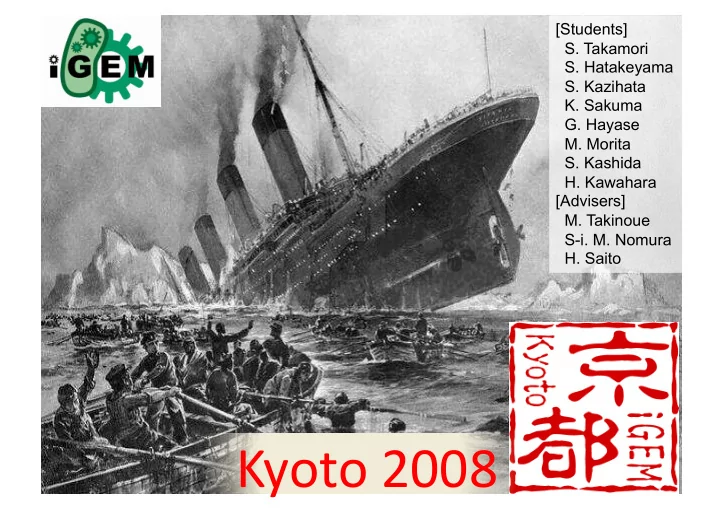
[Students] S. Takamori S. Hatakeyama S. Kazihata K. Sakuma G. Hayase M. Morita S. Kashida H. Kawahara [Advisers] M. Takinoue S-i. M. Nomura H. Saito Kyoto 2008 Cells as Power Source 50 years left http://commons.wikimedia.org/wiki/


slide-1
SLIDE 1

Kyoto 2008

[Students]

  • S. Takamori
  • S. Hatakeyama
  • S. Kazihata
  • K. Sakuma
  • G. Hayase
  • M. Morita
  • S. Kashida
  • H. Kawahara

[Advisers]

  • M. Takinoue

S-i. M. Nomura

  • H. Saito
slide-2
SLIDE 2

Cells as Power Source

slide-3
SLIDE 3
slide-4
SLIDE 4 http://commons.wikimedia.org/wiki/ Image:Titanic- bow_seen_from_MIR_I_submersible.jpeg

years left

50

slide-5
SLIDE 5

Cells as Power Source

slide-6
SLIDE 6

Cell as Power Source s

. et Together

  • ii. normous

GREAT

  • iii. achines

i G E M

s

i G E M

slide-7
SLIDE 7

Size & Weight

270m (880ft) 1µm (1×10⁻⁶m)

×270000000

×46000000000000000000000

46Gg (G = 109) 1pg

(p = 10-12)

slide-8
SLIDE 8

Official Website Q&A

Can the Titanic be raised? Sadly, even if the technology existed to raise it from the seabed, the wreck is far withstand liGing and transportaIon.

slide-9
SLIDE 9

Flagella 3 Binding 1 Gas Vesicle 2

Max of Total Power Max of Power/Cell Max of Cell Number Motility of Cells Others, if any… Growth Gathering swimming, swarming gliding twitching floating Flagella Gas Vesicles Thresholds Quorum Sensing Metabolic Engineering To Solids To Non-solids Binding Peptides Chemotaxis Lipids MotA, MotB Che proteins Proteorhodopsin Gvp series Different origins Positive FB +/- Lux proteins P Lux TBP PsBP Che series CheA CheZ GvpA Cyanobacteria Ohters Ohters LuxI LuxR

Scheme to Produce

  • 1. binding
  • 3. Flagella
  • 2. Gas Vesicle
slide-10
SLIDE 10

Flagella 3 Binding 1 Gas Vesicle 2

Outline

  • MoIvaIon and Target
  • Strategy: 3 STEPs
  • 1. Binding
  • 2. Gas
  • 3. Flagella
  • Mechanical EsImaIon
  • Results & Conclusion
slide-11
SLIDE 11

Flagella 3 Binding 1 Gas Vesicle 2

Outline Strategy: 3 STEPs

slide-12
SLIDE 12
  • 1. SIcking to the

Surface

slide-13
SLIDE 13
  • 2. Gas Vesicle Protein
slide-14
SLIDE 14
  • 3. Flagella RotaIon
slide-15
SLIDE 15

Flagella 3 Binding 1 Gas Vesicle 2

Pconst.

luxR

BP Pconst.

cheZ

PompR

cph8 pcyA ho1 luxI

Pconst. Pconst.

  • 1. Display of Material Binding Peptide
  • 3. Flagella Rotation
  • 2. Production of Gas Vesicle Protein (GVP)

Design of Parts

Terminator Promoter RBS Gene Plux

gvp
slide-16
SLIDE 16
  • 1. SIcking to the

Surface

slide-17
SLIDE 17

Flagella

3 2

Gas Vesicle Binding

1

Display of Material Binding PepIde

Binding PepDde MoDfs Polystyrene: FFSFFFPASAWGS Titanium: RKLPDAPGMHTW

Binding Peptide Lpp signal sequence + 1st 9 a.a. OmpA 46-159 a.a. 600 500 600 500

PS (542bp) Ti (524bp) PCR product

slide-18
SLIDE 18

Flagella

3 2

Gas Vesicle Binding

1

  • IPTG

+ IPTG

TiBP PsBP

Ti side PS side Ti side PS side

Fluorescence microscopic images

Binding Assay

slide-19
SLIDE 19
  • 2. Gas Vesicle Protein
slide-20
SLIDE 20

Binding

1

Gas Vesicle 2 Flagella

3

Gas Vesicle Protein(GVP)

Electro microgragh

Gas vesicle in Prosthecomicrobium peuma4cum Reference: ANTHONY E. WALSBY Gas vesicle

2 µm 0.5 µm

28 gas vesicles can float a single E.coli,

slide-21
SLIDE 21

Binding

1

Gas Vesicle 2 Flagella

3

Problem of Gas Vesicle

Too much expression of the Gvps leads to

  • death. So the expression of Gvps should

be controled. We use quorum sensing system!

slide-22
SLIDE 22

Binding

1

Gas Vesicle 2 Flagella

3

RegulaIon: Quorum Sensing

Small cell populaIon Large cell populaIon

Gas vesicles are produced

AHL (quorum sensing molecule)

slide-23
SLIDE 23

Binding

1

Gas Vesicle 2 Flagella

3

(1) Moving

Modeling

(2) Dividing (3) AHL producing (4) GVP expression

slide-24
SLIDE 24

Binding

1

Gas Vesicle 2 Flagella

3

Results

Quorum Sensing

slide-25
SLIDE 25

Binding

1

Gas Vesicle 2 Flagella

3

DifferenIaIon by AdaptaIon to Environment (DAE)

<surface> Low AHL Flagella dominant <inside> High AHL Quorum sensing GVP dominant

slide-26
SLIDE 26
  • 3. Flagella RotaIon
slide-27
SLIDE 27

Binding

1

Gas Vesicle

2

Flagella

3

Can
really
bacteria
move
objects?

YES YES


slide-28
SLIDE 28

Binding

1

Gas Vesicle

2

Flagella

3

Micro‐Bead

Bacterial Flagella‐Based Propulsion and On/Off Mo4on Control of Microscale Objects Bahareh Behkam and Me4n SiC
slide-29
SLIDE 29

Binding

1

Gas Vesicle

2

Flagella

3

Bacteria Can Move a Bead

Bacterial Flagella‐Based Propulsion and On/Off Mo4on Control of Microscale Objects Bahareh Behkam and Me4n SiC
slide-30
SLIDE 30

Binding

1

Gas Vesicle

2

Flagella

3

Two
Types
of
E.
Coli
Motion


Straight

Tumbling

slide-31
SLIDE 31

Binding

1

Gas Vesicle

2

Flagella

3

Z

Che‐Z Overexpressed Wild Type

Che-Z
Makes
E.coli
Go
Straight 


slide-32
SLIDE 32

Binding

1

Gas Vesicle

2

Flagella

3

Normal

Che-Z over-expressed

Our Idea

slide-33
SLIDE 33

Binding

1

Gas Vesicle

2

Flagella

3

cph8 pcyA ho1

Pconst.

Control of Che‐Z Expression

Che‐Z

OmpR-controlled promoter

slide-34
SLIDE 34

Binding

1

Gas Vesicle

2

Flagella

3

Che‐Z

OmpR-controlled promoter

Control of Che‐Z Expression

cph8 pcyA ho1

Pconst.

slide-35
SLIDE 35

Flagella 3 Binding 1 Gas Vesicle 2

Strategy: 3 STEPs

slide-36
SLIDE 36

Mechanical EsImaIon

Outline

  • MoIvaIon and Target
  • Strategy: 3 STEPs
  • 1. Binding
  • 2. Gas
  • 3. Flagella
  • Mechanical EsImaIon
  • Result & Conclusion
slide-37
SLIDE 37

Mechanical EsImaIon

Mechanical EsImaIon

Volume: 92,000 m3 Bottom Surface Area: 8,000 m2 0.5 µm3 0.25 m2

slide-38
SLIDE 38

Mechanical EsImaIon

Total: 40,000 t

Mechanical EsImaIon

slide-39
SLIDE 39

Mechanical EsImaIon

Total: 40,000 t

Mechanical EsImaIon

×(5.1×10¹⁶) Flagella

slide-40
SLIDE 40

Mechanical EsImaIon

Mechanical EsImaIon

×(5.1×10¹⁶) Flagella ×(1.8×10²³) Gas Vesicle Total: 40,000 t

slide-41
SLIDE 41

Mechanical EsImaIon

Mechanical EsImaIon

×(5.1×10¹⁶) = 1.5×10⁴ N Flagella Gas Vesicle ×(1.8×10²³) Total: 40,000 t

slide-42
SLIDE 42

Mechanical EsImaIon

Mechanical EsImaIon

×(5.1×10¹⁶) = 1.5×10⁴ N Flagella

×80

×(1.8×1023) = 4.0×10⁷ N

50%

Gas Vesicle Total: 40,000 t

slide-43
SLIDE 43

Mechanical EsImaIon

THE WIGHT OF THE TITANIC BECOME

ZERO!

slide-44
SLIDE 44

Mechanical EsImaIon

Mechanical EsImaIon

Gas Vesicle Flagella Gas Vesicle

slide-45
SLIDE 45

Mechanical EsImaIon

Flagella Gas Vesicle

Mechanical EsImaIon

Gas Vesicle

slide-46
SLIDE 46

Result & Conclusion

Outline

  • MoIvaIon and Target
  • Strategy: 3 STEPs
  • 1. Binding
  • 2. Gas
  • 3. Flagella
  • Mechanical EsImaIon
  • Results & Conclusion
slide-47
SLIDE 47

Result & Conclusion

Making of Ti‐coated Boat

Now coating…

slide-48
SLIDE 48

Result & Conclusion

Max of Total Power Max of Power/Cell Max of Cell Number Motility of Cells Others, if any… Growth Gathering swimming, swarming gliding twitching floating Flagella Gas Vesicles Thresholds Quorum Sensing Metabolic Engineering To Solids To Non-solids Binding Peptides Chemotaxis Lipids MotA, MotB Che proteins Proteorhodopsin Gvp series Different origins Positive FB +/- Lux proteins P Lux TBP PsBP Che series CheA CheZ GvpA Cyanobacteria Ohters Ohters LuxI LuxR

Achievement

slide-49
SLIDE 49

Result & Conclusion

Achievement

  • 1. binding
  • 3. Flagella
  • 2. Gas Vesicle

To Be Continued…

slide-50
SLIDE 50

Acknowledgments

  • Prof. Inoue, Dr. Siba, Prof. Shimamoto, Prof. Nakamura, and Prof.

Yoshikawa, Dr. Fujita

Personal Supporters: K. Siba, N. Shimamoto, Y. Nakamura, S. Kato, T. Nakaya, K. Fujita, N. Yoshinaga, S. Kidoaki, A. Yamada, K.

Tsumoto, H. Noguchi, Y. Yamasaki, S. Takagi, M. Ichikawa, D. Maezawa, Y. Kitahata, H. Mayama, T. Inoue, T. Hamada, T. Harada

Laboratory of Gene Biodynamics at Kyoto University iGEM Chiba Team, Ms. Yoshida(Inoue Lab.)

Technical Support Financial Support Special Thanks

slide-51
SLIDE 51

iGEM Kyoto

+Osaka