
SLIDE 1
By: Brooke Sheppard
By: Brooke Sheppard What is a Cell? Cells are the basic structure - - PowerPoint PPT Presentation
By: Brooke Sheppard What is a Cell? Cells are the basic structure of life for all organisms. Cells are microscopic, which means we can only view cells under a microscope. There are animal cells and plant cells that have similarities as well
By: Brooke Sheppard
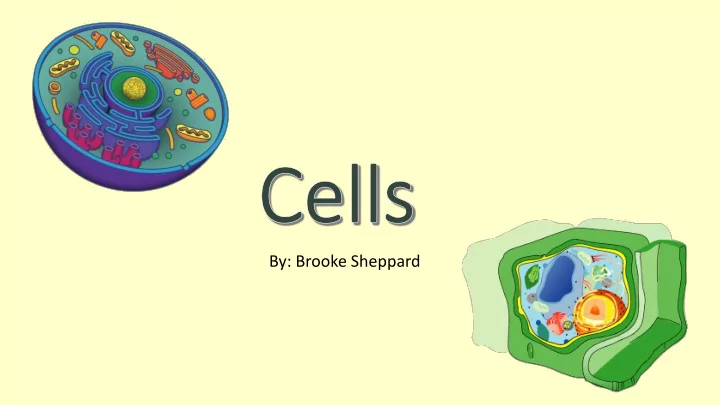
Cells are the basic structure of life for all organisms. Cells are microscopic, which means we can only view cells under a microscope. There are animal cells and plant cells that have similarities as well as differences. Try to spot the similarities and differences between animal and plant cells in the following pages.
The cell membrane helps keep all of the parts of a cell intact or inside of the cell. The cell membrane is mainly composed of proteins and
membrane is found in both animal and plant cells.
The Nucleus is commonly known as the “command center” of the
a nuclear envelop that protects the cell, a nucleolus, chromosomes, chromatin, and nuclear pores. The nucleus is found in both plant and animal cells.
The Nucleolus of a cell is made of protein and RNA. The Nucleolus can be found inside of the nucleus. The nucleolus is found in both plant and animal cells.
The vacuole stores needed food and nutrients for the cell to use in order to
products for the cell. The vacuoles are often known as “storage bubbles.” A plant cell has one large vacuole, while animal cells have one or more smaller vacuoles.
Lysosomes digests things for the cell, such as food,
They hold enzymes and proteins that the cell
found in the cytoplasm of animal cells and are not very evident in plant cells.
Within a cell, there is fluid that surrounds each part
the cytoplasm. Cytoplasm is present in both plant and animal cells.
The mitochondria is often known as the “powerhouse”
responsible for creating energy for the cell to use. Mitochondria are found in both plant and animal cells.
The Golgi Complex is also known as the Golgi Apparatus. The Golgi Complex rounds up simple molecules and then combines those molecules
animal and plant cells.
The Endoplasmic Reticulum is responsible for manufacturing and packaging materials in a cell. There are two types of Endoplasmic Reticulum known as Smooth Endoplasmic Reticulum and Rough Endoplasmic Reticulum. This part is found in both plant and animal cells.
Cell Walls are found in plant cells and are composed of
protects the actual plant cell itself.
The chloroplasts of a cell are in charge of producing food that is needed by the cell. Chloroplasts are found in plant cells and not in animal cells.
Ribosomes build proteins and can be found either floating free or attached to the Endoplasmic
proteins, Ribosomes connect amino acids together and link them as a chain. Ribosomes are found in both plant and animal cells.
http://www.diffen.com/difference/Animal_Cell_vs_Plant_Cell
August 02, 2016, from http://www.biology4kids.com/files/cell _main.html