KLB Higher Education Evening 2018 1 Reasons to apply to - - PDF document

klb higher education evening 2018
SMART_READER_LITE
LIVE PREVIEW

KLB Higher Education Evening 2018 1 Reasons to apply to - - PDF document

KLB Higher Education Evening 2018 1 Reasons to apply to university.. Could be essential for chosen profession Pursue a subject to your full academic potential and for the love of the subject For the life experience


slide-1
SLIDE 1

1

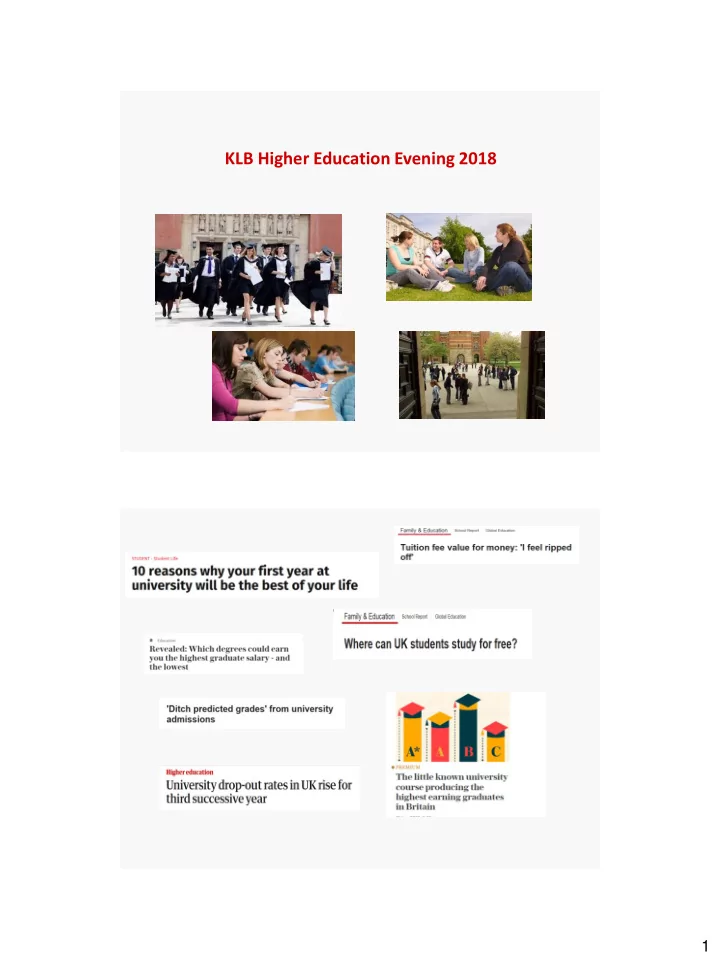
KLB Higher Education Evening 2018

slide-2
SLIDE 2

2

Reasons to apply to university…..

  • Could be essential for chosen profession
  • Pursue a subject to your full academic potential and for the love of the

subject

  • For the life experience
  • Provides qualifications and transferable skills sought by many employers

(independence/social skills/self confidence/prioritise/meet deadlines/team building skills/form lifelong friendships/awareness of

  • thers)
  • Head start/investment for the future in that it improves your chances of

getting a well-paid job

  • Starting salaries and salary progression benefits

Don’t apply if…..

  • Really no idea of course (career?)
  • Everyone else is applying
  • Financial – is this a valid reason?
  • Not utilising your strengths
  • Aspirations lie elsewhere
  • I just always thought I would
  • My friends are going and my brothers and sisters went to

university

  • I want to get away from home
  • Don’t know what else can I do??
  • Explore all options
slide-3
SLIDE 3

3

Reasons for dropping out 3 considerations…

1. Is university right for me? 2. Which course and where? 3. How do I make a successful application?

slide-4
SLIDE 4

4

Aims of the evening…..

  • Timeline
  • Key points about the applications process
  • How to choose courses and institutions
  • Advice, recommended research and support

HE Timeline

Y12 Term 3/4/5 Research, preparation and application planning UCAS Convention Y12 Term 6 Exam Week Other options Open days, research and application process Personal statement session – Bristol University advice Gap year talk Introduction to the application form HE Evening Campus open day (Birmingham) Summer Strengthen application Y13 Term 1 Shortlist Personal statement work On line application References written Early applicants completed (October 15th) Y13 Term 2 Finance presentation Interview practice School deadline Y13 Term 4 Deadlines for decisions from universities Y13 May Deadline for students’ decisions

slide-5
SLIDE 5

5

The application process

  • www.ucas.com
  • All online through school
  • UCAS Track
  • Costs about £23
  • Make up to 5 selections (exceptions) eventually
  • Invisibility of choices – no preference expressed during the

application

  • One personal statement
  • Conditional Firm and Conditional Insurance
  • Gap year or Art Foundation

HE provision in the UK

  • 325 Universities / Colleges
  • 40 000+ courses
slide-6
SLIDE 6

6

Things to consider when making your choices

  • Which course?
  • Where?

Choosing a course?

  • Type of course

– First degree Single Honours (e.g. BA, BSc) – First degree Joint Honours – First degree Combined Honours – Sponsored degree (http://www.thescholarshiphub.org.uk/blog/sponsored- degrees-uk) – Higher apprenticeship and degree apprenticeships – Masters degree (e.g. MEng, MA) – Foundation degree (Fdg) – First degree sandwich – First degree modular – B.Ed – Art degree

slide-7
SLIDE 7

7

Choosing a course?

  • Type of course
  • Content (what interests you now? Don’t just check Year 1.

Same name different course)

  • Assessments (exams vs. continual assessment)
  • Teaching styles (contact hours, tutorials, lectures)
  • Research/opportunity to specialise
  • Opportunity to go abroad
  • Aspects covered – BA or BSc
  • Fees, finance, bursaries and scholarships
  • Future prospects and demand for graduates in your chosen

field

  • Realistic entry requirements (decode the offer, cover a range
  • f offers)

Predicted grades

  • Look at Year 12 results – “overall subject grade”
  • We want to be realistic and positive
  • If B, predicted grade likely to be B; could be an A
  • If D, predicted grade likely to be D; could be a C
  • For 1+ grade higher, we need to be convinced…
  • “Over-predicting grades can be counter-productive because

many universities and colleges are likely to monitor the accuracy of schools’ and colleges’ predictions” (UCAS)

slide-8
SLIDE 8

8

Offers

  • Conditional

– A level grades

  • Sometimes, grades in particular subjects

– Total points scores for A level (new tariff 2016)

  • Unconditional

– For post-A level candidates – Occasionally, for candidates who have taken a separate entrance test – Occasionally, for outstanding candidates

Where to go?

  • City/rural/campus?
  • Near to home?
  • Halls of residence for first year students
  • Accommodation – cost and proximity to lecture
  • Transport needed
  • Other facilities
slide-9
SLIDE 9

9

Recommended research….

slide-10
SLIDE 10

10

slide-11
SLIDE 11

11

slide-12
SLIDE 12

12

Judging the courses and institutions

slide-13
SLIDE 13

13

slide-14
SLIDE 14

14

slide-15
SLIDE 15

15

And last but not least…

  • The Heaps Guide

Highly recommended….

  • Prospectuses on line
  • Books in study library – Heaps is a must!
  • www.prospects.ac.uk - where your subjects may take you
  • http://university.which.co.uk/
  • www.opendays.com
  • http://www.whatuni.com/
  • http://www.russellgroup.ac.uk/our-universities.aspx
  • http://www.telegraph.co.uk/education/universityeducation/
  • The Guardian also does subject tables
  • http://www.russellgroup.ac.uk/our-universities.aspx
  • www.prospects.ac.uk
  • http://www.highfliers.co.uk/ Look for the graduate market document

at the bottom of the home page

  • http://www.thecompleteuniversityguide.co.uk/careers/
slide-16
SLIDE 16

16

What are admissions tutors looking for?

  • Academic potential

– Predicted grades match course requirements – Supported by well-argued personal statement – Supported by school reference

  • Commitment to the subject

– Evident in personal statement – Supported by relevant experience and additional activities

  • Right attitude to be successful

– Hard-working and conscientious – Good school record

  • Well-rounded with evidence of extra-curricular and outside

interests

Elements in the selection process

  • Predicted A level grades
  • Subject choices
  • GCSE grades
  • Well-written personal statement
  • School reference
  • Entrance test results if taken
  • lnterview
slide-17
SLIDE 17

17

Opportunities that have been available to you since you started in the Sixth Form!

  • Access to Bristol/Pathways to Law
  • Primary school work
  • Pre-school work
  • Care home work
  • Charity shop
  • Sign Language
  • School Council
  • 6th Form committee
  • Rotary interview
  • Lesson help
  • Book group
  • Newsletter
  • Quiz team
  • Charity events
  • Prefect
  • First Aid
  • Stroud Council
  • Local youth forum
  • University subject days eg maths, law,

medicine, masterclass days

  • Community Sports Leaders’ Award
  • Sports
  • Duke of Edinburgh Award
  • Drive IQ
  • World Challenge
  • Helping at info/open evenings
  • Ambassadors showing visitors round

school

  • Film club
  • Drama
  • Music
  • EPQ
  • Summer schools (Headstart, Medsim)
  • STEM activities
  • Rotary Young Leaders Scheme
  • Department trips and visits
  • Work experience
  • Future Learn courses
  • TIC
  • TEFL

A good personal statement

  • “With so many applicants with top grades, the personal

statement is critical in the selection process.” Adele Ruston, Bristol University Admissions

  • Strongly argues understanding of and interest in chosen

subject – About two-thirds of statement, particularly for most competitive courses – Goes beyond mere content of A level courses

  • Gives strong sense of interesting and well-rounded person
slide-18
SLIDE 18

18

A good personal statement

  • Is written in the right style

– Persuasive writing: points made and supported by examples – Not a curriculum vitae or mere list of achievements

  • Is technically well written

– Points arranged and developed through helpful paragraphing – Sentences accurately demarcated and under control

  • Is original – content and expression are fresh and engaging
  • Sounds sincere and genuine, not contrived

– Avoid clichés – Avoid hyperbole

  • Presents applicant in best possible light

Help with personal statement

  • June: introduction to writing a good personal statement from

Bristol University tutor

  • July: personal statement seminar for early applicants
  • September: presentation to whole year group on personal

statements

  • September: personal statement seminars for all
  • September: further session for parents
  • One-to-one guidance
slide-19
SLIDE 19

19

The reference

  • Comments on performance in academic subjects
  • Particular emphasis on chosen subject
  • Predicted grades
  • Contributions to wider life of the school
  • Qualities of character and personality
  • Only comments on what reflects well on applicant

Sources of help

  • Head of 6th form; deputy head of 6th form; 6th form tutors
  • Higher Education Consultant

– Personal statements – References – Practice interviews – Based in 6th form office – Full-time until UCAS deadline, 15 January

slide-20
SLIDE 20

20

Next steps……

  • Students must do their own research
  • “Are you who they want?”
  • Personal statement
  • More detail about predicted grades
  • Finance
  • Shortlist
  • Online application
  • Chat about options

Thank you!