1 // special_course_features lu _ arc QUALITY (over quantity) + - - PDF document

1
SMART_READER_LITE
LIVE PREVIEW

1 // special_course_features lu _ arc QUALITY (over quantity) + - - PDF document

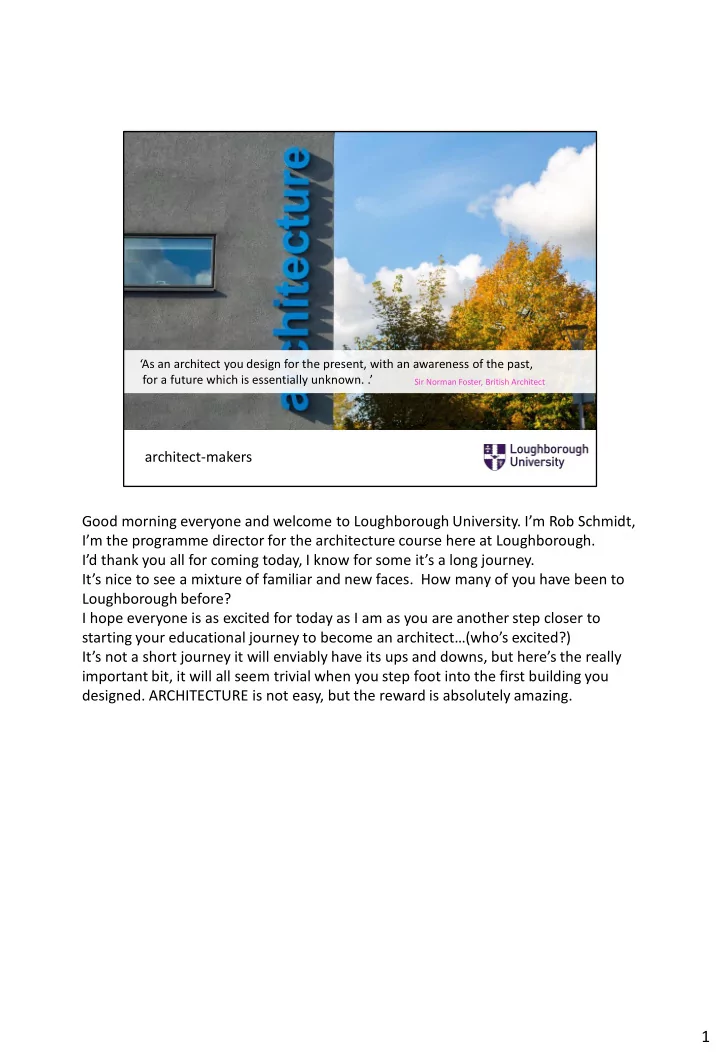
As an architect you design for the present, with an awareness of the past, for a future which is essentially unknown. . Sir Norman Foster, British Architect architect-makers Good morning everyone and welcome to Loughborough University.


slide-1
SLIDE 1

architect-makers

‘As an architect you design for the present, with an awareness of the past, for a future which is essentially unknown. .’

Sir Norman Foster, British Architect

Good morning everyone and welcome to Loughborough University. I’m Rob Schmidt, I’m the programme director for the architecture course here at Loughborough. I’d thank you all for coming today, I know for some it’s a long journey. It’s nice to see a mixture of familiar and new faces. How many of you have been to Loughborough before? I hope everyone is as excited for today as I am as you are another step closer to starting your educational journey to become an architect…(who’s excited?) It’s not a short journey it will enviably have its ups and downs, but here’s the really important bit, it will all seem trivial when you step foot into the first building you

  • designed. ARCHITECTURE is not easy, but the reward is absolutely amazing.

1

slide-2
SLIDE 2

// special_course_features lu_arc

QUALITY(over quantity) + LEADING EDGE

What I would like to do this morning, is to share with you a flavour of the journey we’ve crafted with this new course to allow our students to excel in their educational environment and be successful in their transition to practice. How many of you know this is a new course? This year is our first group of students, so you would be part of the second group? As a new course, one of the very first things we did was review all 51 UG courses of architecture in the UK; yes, 51 courses…so its a relatively saturated market, so understanding how we would fit into that market was crucial. We also ran a series of workshops with over 100 practitioners to discuss what they saw as the good and the bad from graduates. This diagram clusters a number of special features of the course around four themes…. I will expand on a number of the smaller bubbles this morning.

2

slide-3
SLIDE 3

// programme_structure lu_arc I will start with the overall programme structure. The top bar shows the conventional pathway to becoming an architect. Who knows how long it takes to become a registered architect? The lower bar shows the pathway that we’ve designed for this course which is slightly different. If we just focus on Part I for today, you can see that we’ve moved the first year of practice experience inside the undergraduate structure. Why do you think we’ve done this? Loughborough has a long history of sandwich courses, and in engineering we do it better than anywhere else in the UK…it emphasises our ethos of integrating theory and practice AND the benefit that we see from that.

3

slide-4
SLIDE 4

You benefit from the extra work we do… the network of practices we’ve established, you get full support…

4

slide-5
SLIDE 5

Year 3

Placement Year The School had an existing network of practitioners, but we held 6 practitioner workshops this summer – 4 in London, one in Loughborough for the East Midlands and one in Birmingham. This was two-fold: to get feedback on your proposed programme and to begin to establish a network of practitioners to engage with our students on placement. And these varied from major global practices such as Fosters+Partners, Zaha Hadid Architects and AHMM to well-established local practices in Franklin Ellis Architects, Watson Batty Architects and CPMG Architects. While the programme is new, we have already begun developing the relationships needed to support placement opportunities and sponsorships. We have organised 6 events with practitioners in the Midlands and London in which we will have met with

  • ver 80 practices including

We cannot guarantee placements for every student, we work hard to help provide those opportunities. RC Slide 11: really nice

5

slide-6
SLIDE 6

Degree award, does anyone know our degree award here? I’ll talk more about this perceived dichtomy through the curriculum, but I think the chosen degree award is much more than a symbolic gesture… I believe it represents the ethos we have for the course – that architecture can not be one without the other, that here you will be allowed to express your creativity but you will also be taught from our technical experts in structures and building science. You will learn how to harness both sides of your brain and allow for a technical creativity to flourish.

6

slide-7
SLIDE 7

Average intake for arch in UK? Our intake?

STUDENT to STAFF ratios

Year 1: 4 to 1 Year 4 (full capacity): 10 to 1

// small_cohorts lu_arc Small cohorts…this spend a moment on this. Here’s our group in the green, approximately 40 students; in the blue, we have 120 students which is the conventional size of an architecture cohort in the UK…… 40 to 120 (1 year) 200 to 600 (5 years – BArch + MArch) 200 to 900 (Nottingham) Ratio: Year 1: 8 staff + 2 design tutors for 40 students. 1:4 Year 2: 9 staff + 4 design tutors for 100 students. 1:7.5 Year 3: 10 staff + 5 design tutors for 160 students. 10.5 Year 4: 10 staff + 6 design tutors for 180 students. 1:11 The School is 1:13.5 Civils 80-100 Others 30-40 (AEDM, CMQS, CEM, Transport)

7

slide-8
SLIDE 8

lu_arc more opportunities superior resources better access to facilities materials better quality assurance

EVEN PLAYING FIELD FROM DAY 1

wacom tablet What does that allow for… Better access to facilities. Better resources More opportunities

8

slide-9
SLIDE 9

// assets lu_arc

SUSTAINABLE ENVIRONMENT

  • WALK. CYCLE. GREEN. SPORT. CONVENIENCE. SAFE

This is an aerial photograph of this side of campus. We’re here.

9

slide-10
SLIDE 10

// the studio

DEDICATED SPACE FROM DAY 1

lu_arc

10

slide-11
SLIDE 11

// staff offices

NOWHERE TO HIDE!

lu_arc

11

slide-12
SLIDE 12

MAKE & BREAK

// the factory lu_arc

12

slide-13
SLIDE 13

Film Night, National Women Day East Midlands Design Charrette Lego Workshop & Design Challenge

// active culture

Art, Migration and Cosmopolitanism Pizza Night LRSA Pub Quiz

Other activities:

Visionary Migration, Andreas Vogler

13

slide-14
SLIDE 14

w.jones-18@student.lboro.ac.uk Will Jones

14

slide-15
SLIDE 15

// international opportunities

15

slide-16
SLIDE 16

Design an apple store?

// international_projects

16

slide-17
SLIDE 17

ARCHITECT - MAKERS

/a’arkitekt-máykǝr/ n. collaborative design-leaders re-negotiating the construction process in/as communities

17

slide-18
SLIDE 18

// module_structure lu_arc

how many contact hours a week? how many design studio sessions?

I just want to touch on an aspect which makes architectural education different from

  • ther courses. And that is the 50/50 breakdown of traditional lecture modules and

50% of learning which occurs in the design studio environment. The lecture modules and the studio modules often work together to apply and integrate principles learned.

18

slide-19
SLIDE 19
  • Guest lectures
  • Workshops
  • Events
  • Evening seminars

25 WEEKS = 25 or 75 meetings?

Timetable + Active culture to engage with

19

slide-20
SLIDE 20

STUDIO A

IDENTITY

20

slide-21
SLIDE 21

OBJECT

LINKING DESIGN & MAKING

21

slide-22
SLIDE 22

INVESTIGATE A PROBLEM

‘To create, one must first question everything.’

Eileen Gray, Irish Architect

So where do we start….this might seem like a subtle difference to some of you, but it’s incredibly important…we don’t start with a fixed brief we start with a question and investigate a problem. The students were asked to first explore how they use their tablets, to examine scenarios and relationships between different variables – their body, the tablet and different uses.

22

slide-23
SLIDE 23

DOCUMENT YOUR PROCESS

Small blocks.

23

slide-24
SLIDE 24

24

slide-25
SLIDE 25

Phil Newsom

Dovetail detail Hidden cog; locking mechanism

25

slide-26
SLIDE 26

ELEMENT

LINKING DESIGN & MAKING

permeability shape weight scale

26

slide-27
SLIDE 27

Phil’s element was a cone along with a series of plugs that could be moved around to change the level of privacy and viewing tunnels. On the day of the review, we had 6 guest architects come in and they chose Phil’s design as the one that we would come together as a cohort and build.

27

slide-28
SLIDE 28

perspective

// live_projects

28

slide-29
SLIDE 29

seed bomb

// live_projects

29

slide-30
SLIDE 30

space: identity and speculation

30

slide-31
SLIDE 31

home: identity and architecture

31

slide-32
SLIDE 32

32

slide-33
SLIDE 33

STUDIO B

COMMUNITY

33

slide-34
SLIDE 34

extinction rebellion

// desertification // wildfires

34

slide-35
SLIDE 35

// disease // sea level rise

35

slide-36
SLIDE 36

animal shelters

// 24 hour design competition

36

slide-37
SLIDE 37

37

slide-38
SLIDE 38

38

slide-39
SLIDE 39

Orsi Kacso Vive la resistance!

a platform for public engagement

39

slide-40
SLIDE 40

40

slide-41
SLIDE 41

41

slide-42
SLIDE 42

Debatable lands

a visitor centre at the Anglo-Scottish border

42

slide-43
SLIDE 43

Inclusion / Exclusion in the city

a place to develop, store and trade knowledge

43

slide-44
SLIDE 44

44

slide-45
SLIDE 45

// live_projects

Discover Zone – Outdoor Classroom

45

slide-46
SLIDE 46

46

slide-47
SLIDE 47

at the end of your journey…

  • 1. Confident, creative, individual designers;
  • 2. Critical thinkers and culturally curious;
  • 3. Professional and prepared for practice.

PERSONALISED JOURNEY

At the end of this journey, I will feel like we will have done our job…if you have confidence in yourself and your design process, to be able to understand how you go about defining and responding to your generation’s local and global challenges.

47

slide-48
SLIDE 48

// offers

(UN)CONDITIONAL OFFERS

lu_arc Your A-level grades stick with you beyond just getting into University; It puts a lot of pressure unfairly on students to make decisions they don’t necessarily want to; Why do you think Universities do this? Numbers, poorer quality; That we want the best for you; that we want you to work hard and be successful;

48

slide-49
SLIDE 49

// accreditation lu_arc

design charrette mentorship programme monthly meetings social events RIBA President Prize End of Year prize

This is something that I can assure you that we’ve de-risked to the point that I can stand here in front of you and say this won’t be a problem. I met with ARB and RIBA on several occasions already to assure we will have a smooth process. The ARB and RIBA offer different forms of assurance that the course is providing you with the knowledge and skills that you will need to become an architect. ARB's validation is based on the curriculum of the course (paper work) and the RIBA's accreditation is based off of student work (primarily design projects). I have met with both organisations and presented our course to them both to assure we are on track to meet all of their requirements. In the next few months we will start the official ARB process and get approval prior to the start of the next academic year. The RIBA is slightly different in that they need to see student work from all levels, so we can't officially get their approval until just before the first group graduates - there is no way around this. I can assure you that we have done and will continue to do everything in line so that this is not ever a problem - all courses have to go through this cycle, this just happens to be our first (the RIBA's accreditation cycle is every 3-5 years).

49

slide-50
SLIDE 50

// exploratory visit

50

slide-51
SLIDE 51

The Complete University Guide

3rd in the Sunday Times

51

slide-52
SLIDE 52

52