? "@ Kim Reynolds, UT Southwestern, Sept. 2014 Why is this - - PowerPoint PPT Presentation

quot kim reynolds ut southwestern sept 2014 why is this
SMART_READER_LITE
LIVE PREVIEW

? "@ Kim Reynolds, UT Southwestern, Sept. 2014 Why is this - - PowerPoint PPT Presentation

Understanding Cellular Systems Using Genome Data ? "@ Kim Reynolds, UT Southwestern, Sept. 2014 Why is this problem hard? Detailed knowledge of the molecular players an apparently dense, interconnected network. Why is


slide-1
SLIDE 1

?

"@

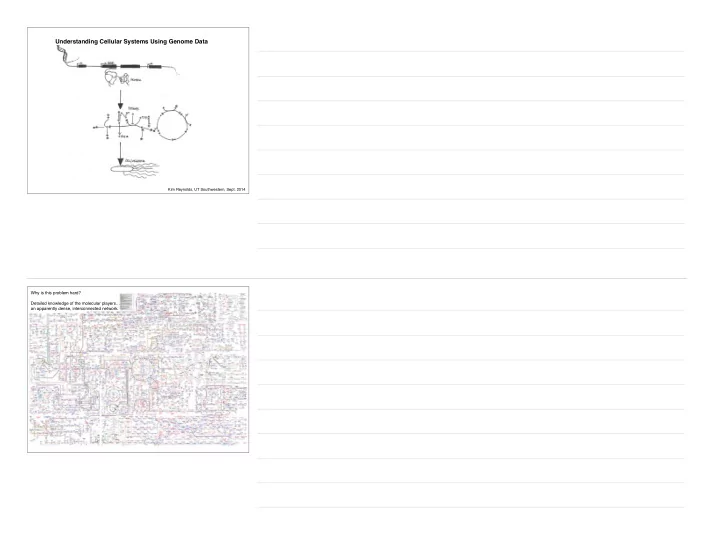
Understanding Cellular Systems Using Genome Data

Kim Reynolds, UT Southwestern, Sept. 2014 Why is this problem hard?

  • Detailed knowledge of the molecular players…

an apparently dense, interconnected network.

slide-2
SLIDE 2

Why is this problem hard?

  • Detailed knowledge of the molecular players…

an apparently dense, interconnected network.

  • A complex biological system.

what do we mean by complex?

Hillenmeyer, ME et al. (2008) Science 320, p 5874

gene essentiality in yeast for ~5000 homozygous gene deletion strains.

First of all, not all genes are equally important.

slide-3
SLIDE 3

Secondly, the effect of multiple genes can’t be predicted from the effect of genes taken individually (things don’t add)

An example - synthetic lethality: Why is this problem hard?

  • Detailed knowledge of the molecular players…

an apparently dense, interconnected network.

  • A complex biological system.

These two features: (1) heterogeneity in functional importance (some things more important than others) (2) non-additive (cooperative) interactions between components

  • Make it difficult to predict systems-level behavior from the individual parts.
  • We need a way to systematically and quantitatively measure these two properties!
slide-4
SLIDE 4

Fujii, T et al. (2009) Structure 17, p. 1425 Berg, HC (2003) Ann Rev Biochem 72, p 19

  • Chilcott et al. (2000) Micro and Mol Bio Reviews 64 p.694

As an example, let’s consider the bacterial flagellum.

motAB fliAZY fliBAE fliE fliFGHIJK fliLMNOPQR flgBCDEFGHIJKL

Proteins Cellular System

  • S. enterica,

typhimurium Fujii, T et al. (2009) Structure 17, p. 1425 Berg, HC (2003) Ann Rev Biochem 72, p 19

  • Chilcott et al. (2000) Micro and Mol Bio Reviews 64 p.694

Genes As an example, let’s consider the bacterial flagellum. A multi-protein complex often described by analogy to man-made machines with words like “motor”, “stator”, “rotor”, etc...

  • this suggests a precise arrangement of

components necessary for function.

  • A challenge to understand how such

systems are encoded by the genome, work and evolve.
slide-5
SLIDE 5

Evolution has arrived at a degeneracy of solutions to the problem of bacterial motility!

  • Visually comparing these, we see that a “core” motor element is conserved, and the

peripheral elements are more variable. This hints that a simpler representation of such systems may be possible.

Chen et al. (2011) EMBO J 30 p. 2972

The central idea: Comparison of genomes across many species can be used to make a statistical model for the design of biological systems.

  • 1) Invariance over genomes as a measure of relevance - conservation
  • 2) Correlation over genomes as a measure of cooperative function - coevolution

What do I mean here? Let’s look at an example….

slide-6
SLIDE 6

Here is one protein: N-GEEDIPREPRRIVIHRGSTGLGFNIVGGEDGEGIFISFILAG-GPADLSGELRKGDQILSVNGVDLRNASHEQAAIALKNAGQTVTIIAQYKPEE-C

Amino acid sequence (primary structure): Secondary structure: Three dimensional structure:

We can collect many amino acid sequences that encode this protein in different species, and align them to each other - a multiple sequence alignment

DIHAICACCKVRGIGNKGVL FLHAVVAVCPPQGIGKGGSL IISMIAAMADNRVIGKDNQM MISMIAAMAHDRVIGLDNQM LISLIAALAHNNLIGKDNLI IISMIAAMAKQRIIGKDNQM —MIAAMANNRVIGLDNKMPW VLNAIVAVCPDLGIGRNGDL

. . . . . . . . .

1 12 18

. . . . . . . . . . . . . . . . . . . . . . . .

VIYKRK EVYEKI TILEKQ ETWQRR VTLSRQ VILERV VTLYKY VYES— 156 1 2 418 4 3 417 416 5

Now we’d like to analyze this alignment to measure two things:

  • (1) which amino acid positions are most important
  • (2) and which interact/are cooperatively coupled
slide-7
SLIDE 7

k Conservation as a measure of functional importance

Lockless and Ranganathan, Science 286, p.295

  • O. Rivoire, S. Leibler, and Ranganathan, in preparation.

k i

What we want to measure: Are the amino acid frequencies at a particular position in the alignment more conserved than random?

  • N. Halabi, O.Rivoire, S. Leibler, and R. Ranganathan,

Cell (2009) 138: 774-86.

j k

mean

k i j

random 0.6 H 0.4 V 0.7 F 0.3 L H H H H H H V V V V L I V Q W V M S A E F F F F F F F L L L

k Conservation as a measure of functional importance

Lockless and Ranganathan, Science 286, p.295

  • O. Rivoire, S. Leibler, and Ranganathan, in preparation.

k i

What we want to measure: Are the amino acid frequencies at a particular position in the alignment more conserved than random?

  • N. Halabi, O.Rivoire, S. Leibler, and R. Ranganathan,

Cell (2009) 138: 774-86.

How we calculate this:

j k

mean

k i j

random 0.6 H 0.4 V 0.7 F 0.3 L H H H H H H V V V V L I V Q W V M S A E F F F F F F F L L L

slide-8
SLIDE 8

kk j i Coevolution as a measure of interaction between two positions.

The basic premise: Functional Coupling of two amino acid positions will result in co-evolution... provided that the interaction contributes to the fitness of the protein.

Lockless and Ranganathan, Science 286, p.295

  • O. Rivoire, S. Leibler, and Ranganathan, in preparation.
  • N. Halabi, O.Rivoire, S. Leibler, and R. Ranganathan,

Cell (2009) 138: 774-86.

k

mean

k i j

random 0.6 H 0.4 V 0.7 F 0.3 L H H H H H H V V V V L I V Q W V M S A E F F F F F F F L L L

kk j i

An example: Coevolution as a measure of interaction between two positions.

k

mean

k i j

random 0.6 H 0.4 V 0.7 F 0.3 L H H H H H H V V V V L I V Q W V M S A E F F F F F F F L L L

  • i

+

j i

+

j

  • i

+

j

+

slide-9
SLIDE 9

kk j i What we want to measure: How independent are the amino acid frequencies at sites i and j? Coevolution as a measure of interaction between two positions. k

mean

k i j

random 0.6 H 0.4 V 0.7 F 0.3 L H H H H H H V V V V L I V Q W V M S A E F F F F F F F L L L

kk j i

[ ]

What we want to measure: How independent are the amino acid frequencies at sites i and j? How we calculate this: Coevolution as a measure of interaction between two positions.

k

mean

k i j

random 0.6 H 0.4 V 0.7 F 0.3 L H H H H H H V V V V L I V Q W V M S A E F F F F F F F L L L

slide-10
SLIDE 10
  • The result of these two calculations (conservation and co-evolution): Statistical Coupling Matrix

322 372 A global view of coupling between amino acids, based on evolution.

  • Each pixel is the coupling between

a pair of amino acids.

  • The matrix is symmetric.

From initial inspection we can see that the matrix is: (1) sparse (2) shows no obvious arrangement in primary structure.

  • The result of these two calculations (conservation and co-evolution): Statistical Coupling Matrix
slide-11
SLIDE 11

Lockless and Ranganathan (1999) Science 286, p.295

What does the pattern of couplings look like on the structure? Let’s take one position to start...

H372 Lockless and Ranganathan (1999) Science 286, p.295

For a single position, we can examine all other coupled residues... The global architecture of correlations... A map of interactions between H372 and the remainder of the PDZ domain.

H372

slide-12
SLIDE 12
  • N. Halabi, O.Rivoire, S. Leibler, and R. Ranganathan,

Cell (2009) 138: 774-86.

Mapping all the coupled positions to the structure, we see that they form a physically contiguous network… the protein sector. So this is for one protein… what about multiple proteins?

active site ( j ) allosteric site ( i )

B β α γ δ δ B C D E B

i j

B

i j

C D E

i j

B C D E B C D E

slide-13
SLIDE 13

These co-evolving units seem to be “wired up” in larger cellular systems: fliG fliM fliN Flagellar Motor:

Neal Sharma

Torque-generation ring:

Minamino et al. (2008). Curr. Op. Struct Biol., 18, 693-701 Vartanian et al. (2012). JBC, 287, 35779-35783

Sector mapping:

  • So now….
slide-14
SLIDE 14
  • Prior results at the level of single proteins and the

current availability of complete genome data now motivate the application of this strategy genome wide.

  • The outcome (if successful):
  • A global decomposition of the genome into new cooperative units
  • A basis for:
  • Rational strategy for control and design of cellular behavior
  • Context for interpreting disease-causing mutations and drug interactions
  • Better understanding of the design of cellular systems and how they might

evolve.

Acknowledgements Olivier Rivoire (CNRS, Grenoble) Ivan Junier (CRG, Barcelona) Collaborators http://systems.swmed.edu/krlab/Reynolds_Lab.html UT Southwestern Green Center for Systems Biology Chris Ingle Neal Sharma Andrew Schober Funds