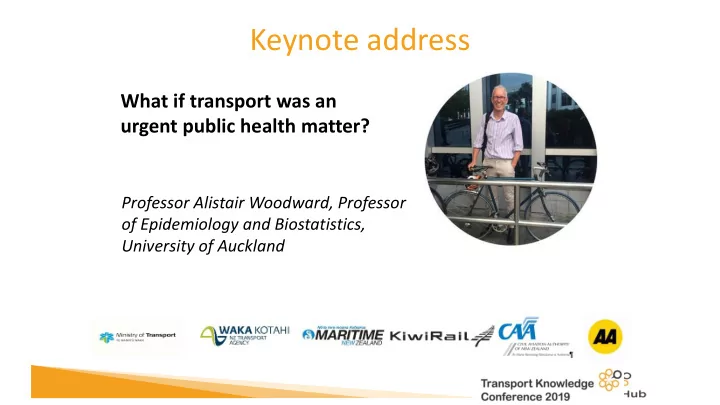
SLIDE 1 What if transport was an urgent public health matter?
Professor Alistair Woodward, Professor
- f Epidemiology and Biostatistics,
University of Auckland
Keynote address
SLIDE 2
With acknowledgements to Kirsty Wild Michael Hale Caroline Shaw Murray King
SLIDE 3
- People should not be killed or seriously injured while using the transport network
for everyday activities
- Reversing New Zealand’s current trauma trends requires a transport system that is
designed for people, and one that considers their safety as the top priority. GPS 2018-2022
- We aim to put people and place, rather than vehicles and networks, at the centre of
- ur decision-making
- Our position is that it is unacceptable for anyone to be killed or seriously injured
while travelling or working on the land transport system
- We will embed the Safe System approach in our decision-making and in our
standards NZTA Statement of Intent
SLIDE 4
- People should not be killed or seriously injured while using the transport network
for everyday activities
- Reversing New Zealand’s current trauma trends requires a transport system that is
designed for people, and one that considers their safety as the top priority. GPS 2018-2022
- We aim to put people and place, rather than vehicles and networks, at the centre of
- ur decision-making
- Our position is that it is unacceptable for anyone to be killed or seriously injured
while travelling or working on the land transport system
- We will embed the Safe System approach in our decision-making and in our
standards NZTA Statement of Intent
SLIDE 5
But is transport treated as an urgent public health matter?
SLIDE 6 But is transport treated as an urgent public health matter?
St Heliers
SLIDE 7
But is transport treated as an urgent public health matter?
SLIDE 8
SLIDE 9
But is transport treated as an urgent public health matter?
SLIDE 10
SLIDE 11
SLIDE 12
The Smoke-Free Environments Act was not poll-driven
SLIDE 13
Health and safety on the road – parallels with health and safety in the workplace?
Those who make the risk own the risk; those who own the risk pay for failure Risk management must be proportionate But if the outcomes are severe, unlikely that cost would justify failing to implement available and suitable control measures Hierarchy of control measures: eliminate/substitute/isolate/behavior change Health and safety – not safety alone
SLIDE 14
Workplace deaths About 60 per year from injuries 600-900 from work-related illness
SLIDE 15 Workplace deaths About 60 per year from injuries 600-900 from work-related illness
Road transport deaths About 350 per year from injuries ? from road-related illness
SLIDE 16 Hydrofluorosilicic Acid HFA
SLIDE 17
Similar but different
SLIDE 18
Land transport is indeed an urgent public health matter but frequently it is not treated this way
SLIDE 19 When we board an aeroplane, we expect that those responsible, the airline and the aviation authorities, have taken responsibility for our journeys, and that the system is safe and works for
- everyone. When we go to work, our health and safety laws places
clear expectations and responsibilities on our employers to ensure that everyone who goes to work comes home healthy and safe. In the same way, we should expect our road system to be designed for people, travelling in different ways, instead of blaming people for failing to survive in the system we have designed.
Road to Zero Consultation Document 2019 p.22
SLIDE 20
What if transport was an urgent public health matter?
Alistair Woodward University of Auckland