Keynote Presentation Venerable members of the Sa gha, upsakas and - - PowerPoint PPT Presentation

keynote presentation
SMART_READER_LITE
LIVE PREVIEW

Keynote Presentation Venerable members of the Sa gha, upsakas and - - PowerPoint PPT Presentation

Keynote Presentation Venerable members of the Sa gha, upsakas and upsiks , I am delighted to deliver this keynote address on a subject that is close to my heart. More than 10 years ago, 24 27 November 2006 to be precise, SBS initiated


slide-1
SLIDE 1

Founder and Spiritual Patron of Sāsanārakkha Buddhist Sanctuary (SBS)

Āyasmā Aggacitua

Keynote Presentation

Venerable members of the Saïgha, upāsakas and upāsikās, I am delighted to deliver this keynote address on a subject that is close to my heart. More than 10 years ago, 24 – 27 November 2006 to be precise, SBS initiated the Closer-to-Reality Dhamma-Vinaya Seminar with objectives very similar to those of today’s conference, i.e. going back to the roots to discover the essential teachings of the Buddha. I cannot measure the impact, on the participants, of that event and that of two others in the next two successive years. But since then, throughout my talks, workshops and meditation retreats I have been emphasising the same theme of going back to the roots. Perhaps the seeds have been sown on fertile ground and now saplings are swaying in the gentle refreshing breeze

  • f Awakening. So when Bro. Siang Chye informed me of the proposal to

hold WACANA 2017, it was an invitation that I could not refuse.

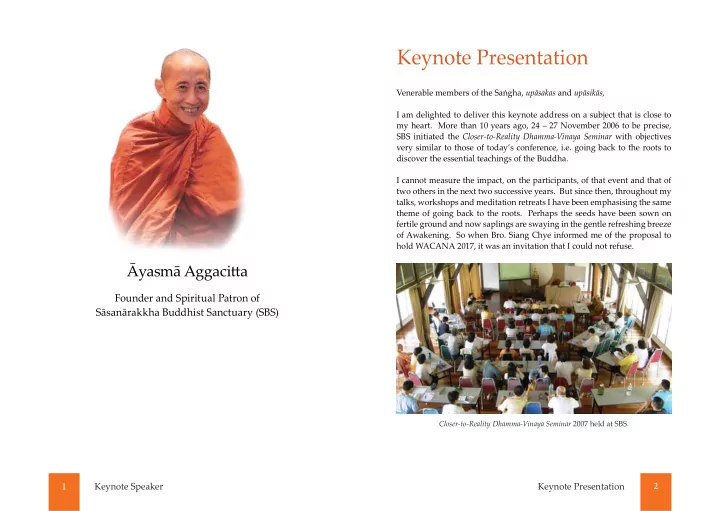
Closer-to-Reality Dhamma-Vinaya Seminar 2007 held at SBS.

Keynote Speaker Keynote Presentation

1 2

slide-2
SLIDE 2

The crux of today’s conference lies in trying to determine what we mean by ‘essential’. The Buddha gave a wide range of discourses for monastics and the laity. Most of the discourses were addressed to monks and oriented towards spiritual cultivation for liberation from saÿsāra, ideally in this very

  • life. There are signifjcantly fewer discourses that are relevant to the laity.

These pertain to ethics, relationships, communal harmony, growth and prosperity here and hereafter and spiritual development for lay disciples. There are hardly any on liturgy, rites and rituals for both the Saïgha and the laity. From such a disproportionate range of subject matuer, how do we extract the ‘essence’ and the ‘essential’ so that it can be relevant and useful to Buddhists today? This is the challenge. Most Buddhists would agree that the essence of the Buddha’s teachings can be found in this succinct verse from the Dhammapada : Not doing all evil, cultivation of the skilful, purifjcation of one’s own mind : this is the Teaching of the Buddhas. While this must certainly be what all Buddhists should ultimately aspire to accomplish, it is just a general ideal for most of them, not something they can apply practically in their daily lives. So, the primary task of this conference is to dig deeper into the Pāëi canon for details of the Buddha’s Teachings that are more relevant to aspiring practitioners. This is what Forum 1, “Awakening Buddhists to the Dhamma”, hopes to

  • accomplish. In a world where cultural and religious borders are becoming

increasingly blurred, Buddhists everywhere have to sieve through multiple layers of cultural accretions that veil and distort the original, essential teachings of the Buddha. No doubt, the strength of the Buddha-Dhamma lies in its ability to adapt to the culture of the society where it can take root; yet from another perspective, that strength becomes its weakness because eventually the cultural accretions tend to overwhelm and replace the original teachings. To give you an idea of how this can happen, let me share a recent development in SBS. More than 5 years ago the growing numbers of Myanmar devotees frequenting SBS expressed their desire to build a stupa in SBS. Initially I declined for two reasons: (1) because I had no interest in stupas and such objects of worship, and (2) because I could not envisage a suitable location for it. However, after repeated requests I relented, but delegated the task of managing the project to a long-time fellow monk whom I have known intimately for over 30 years. The Sayadaw has an innate interest in social welfare activities and had himself built a stupa in his

  • wn monastery in Myanmar. He happily accepted the task and dedicated

much of his personal time and efgort to all the minute details necessary to make the project a grand success. The stupa now stands as a small-scale replica of the world-famous Shwedagon Pagoda in Yangon, Myanmar.

The stupa looks like a small-scale replica of the world-famous Shwedagon Pagoda.

Keynote Presentation Āyasmā Aggacitua

3 4

slide-3
SLIDE 3

Although I had approved the project 5 years ago, the selection of a suitable location was only fjnalised last year. The site is a newly purchased two- acre-plus durian orchard adjoining the memorial park at the foothill, and is separated from SBS by another disused durian orchard roughly 10 acres in size. Now we refer to those additional premises as “Lower SBS” and the

  • riginal area as “Upper SBS”.

I was back in SBS when construction started in late October last year. After I left SBS, new additional plans, some of which I was totally unaware of, were drawn up and implemented to develop the area around the stupa. When I returned to SBS in early April to conduct a series of meditation retreats, I noticed that the development in Lower SBS was very Myanmar in

  • character. This ’Myanmarisation’ of Lower SBS boldly manifested itself in

a grand ceremony on Sunday 16 April 2017 to place the Golden Pinnacle on the stupa. I noted three glaring manifestations. (1) Part of the ceremony involved enshrining in the stupa items believed to be relics of the Buddha and various arahants, as well as gold, silver, jewellery, valuables, and any items cherished by the donor. Now this is strictly a Burmese custom. Let me explain. According to the Pāëi canon, stupas are supposed to enshrine the remains of a Cakkavati (Universal Monarch), Paccekabuddha (Solitary Buddha), Sammāsambuddha (Perfectly Self-Awakened Buddha) or his monk disciples. The Pāëi Commentaries extrapolated that to include personal items used by the Buddha and inscriptions of his Dhamma teachings. But Burmese custom further extrapolated that to include the items mentioned above. (2) A low octagonal wall had been constructed to encircle a bodhi tree planted on a terrace below the stupa. The top of the wall was widened to sit eight Buddha images, one on each of its eight sides, with eight accompanying water taps. I myself was totally ignorant of the signifjcance of this structure. When I asked one of the Myanmar monks, I was told that it was an astronomical superstition of Burmese culture to bathe the Buddha image corresponding to the day of the week of one’s birth, with Wednesday having two sides, one each for the morning and evening child. Needless to say, there is no mention of Buddha images in the Pāëi canon. Even in the commentaries where they are fjrst mentioned together with (Buddhist) shrines (cetiya) and stupas (thūpa), the practice of bathing them is absent.

Ongoing construction of the stupa at “Lower SBS”. Part of the low octogonal wall.

Keynote Presentation Āyasmā Aggacitua

5 6

slide-4
SLIDE 4

(3) The majority of the 2,000-plus atuendees were Burmese, and anyone there would surely have the impression that this was a typical Burmese pagoda temple festival. Most of the decorative signage and banners were in Burmese script; the dances, music and songs were Burmese; the free food-stalls served Burmese cuisine; some SBS commituee members were dressed in traditional Burmese costume. Apart from 4 local monks, all the rest of the 30-plus monks were Burmese. The whole setuing and ceremonial procedure was so typically Burmese that I was brought to my senses. I never imagined that my seemingly innocuous approval of a request to construct a stupa could have resulted in being overwhelmed by Myanmar culture in such alarming proportions. In truth, my approval was made out of gratitude for the continual support

  • f Myanmar devotees during my early monkhood years in Myanmar and

since the founding of SBS more than 17 years ago. In my speech at the opening ceremony, I admitued that all these were contrary to the original spirit and intent of SBS — Sāsanārakkha Buddhist Sanctuary — which was meant to be a place safe from the adulterations

  • f any national cultural elements and thus a Guardian of the Buddha’s
  • riginal teachings. I immediately drew a clear-cut distinction that setuings

Myanmar devotees celebrating the completion of the stupa.

and programmes with such obvious cultural infmuence shall in future be avoided in Upper SBS; and if indeed they have to be held, they should

  • nly be held in Lower SBS. A bit late, but at least I could still implement a

damage-control policy. Hopefully Forum 1 will be able to distinguish the extras from the essential before it is too late. As I mentioned at the outset, in the Pāëi canon there is hardly any mention

  • f liturgy, rites and rituals for the Saïgha and laity. Stripped of all cultural

accretions (most, if not all, of which comprise these very elements), what is essential may well turn out to be dry and insipid compared to the pomp and ceremony of elaborate protocols and observances. Therefore, in Forum 2, “Aturacting People to the Temple”, participants will need to brainstorm and tap their ingenuity for ideas and strategies to aturact people to the ‘temple’ where bare-bones Buddhism is the menu. Ironically, the concept of ‘temple’ as a place of worship for lay Buddhists is alien to the Pāëi canon. There is not a single mention of anything that resembles a Buddhist temple as understood today. Lay Buddhists would congregate to observe the Eight Precepts and listen to Dhamma talks in places where the monks stayed — and these were mostly called āvāsa (monks’ residence, dwelling place) or ārāma (park, monastery). Now that we have uncovered the ‘essentials’ of the Buddha-Dhamma, how do we go about re-educating Buddhists who have long believed and practised various adulterated forms of Buddhism? We certainly need to go back to the drawing board to deconstruct myths and requirements for superfmuous rites and rituals and create a revised syllabus of Buddhist education based on the essential teachings. We also need to revise the pedagogy of teaching the Dhamma in the light of the radical changes in modern-day life. For example, the widespread use of social media apps in the ubiquitous mobile device has resulted in the shortening of atuention span and the habit of craving for fast-changing visual and auditory

  • stimulation. This is the task awaiting the participants of Forum 3, “Good

Educators and Great Education”.

Keynote Presentation Āyasmā Aggacitua

7 8
slide-5
SLIDE 5

Reconstructing a new syllabus and pedagogy of education must also efgectively address a special target group — Buddhist youths — so that this new syllabus can resonate with them and receive their whole-hearted

  • engagement. A keen understanding of the mindsets and social milieu of

modern-day youths is required to design efgective strategies to reach out to them. The best people to know how youths think and feel are probably youths themselves, so hopefully youth leaders and activists will participate in Forum 4, “Empowering the Next Generation”, and contribute their ‘insider’ and insightful ideas. Sieving through the wide range of teachings found in the Pāëi canon to extract relevant details for modern lay Buddhist practitioners can be rather tedious and daunting. But to get a glimpse of the Dhamma may not be so diffjcult if one gets proper guidance. After all, the essence of the Dhamma, to complement that already summarised in the Dhammapada verse above, is to experientially understand the Four Noble Truths. And since all of us encounter the fjrst Truth of Sufgering daily in varying degrees, we are already at the gateway of awakening because the Buddha proclaimed that sufgering must be understood completely. Forum 5, “Meditation – Seeing the Dhamma”, will discuss how to walk through the gateway and proceed along the Noble Eightfold Path. In conclusion, I think the theme of WACANA 2017, The Buddha Word — Discovering the Essential, is very relevant to present-day Buddhists who have grown beyond the superfjcial rites and rituals inherited from the

  • lder generation and the confusing cultural elements that veil the original

teachings of the Buddha recorded in the Pāëi canon. The specifjc areas of concern addressed by the fjve Forums have been thoughtfully selected and

  • utlined by the organisers so that the conference can be well moderated

within congruent parameters. I sincerely hope that this will not turn out to be yet another N.A.T.O. conference (No Action, Talk Only conference), but

  • ne that can eventually produce a MAP — Master Action Plan — based on

the constructive conclusions of the fjve synergetic forums.

Keynote Presentation

9