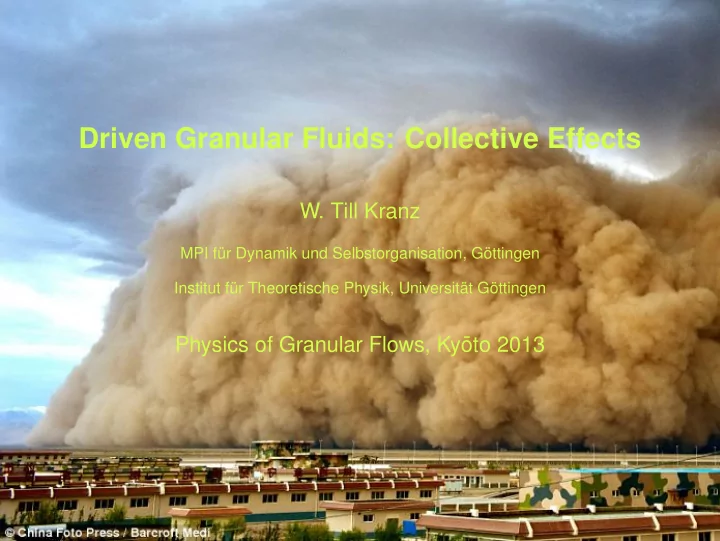
Driven Granular Fluids: Collective Effects W. Till Kranz MPI fr - - PowerPoint PPT Presentation

driven granular fluids collective effects
SMART_READER_LITE
LIVE PREVIEW

Driven Granular Fluids: Collective Effects W. Till Kranz MPI fr - - PowerPoint PPT Presentation

Driven Granular Fluids: Collective Effects W. Till Kranz MPI fr Dynamik und Selbstorganisation, Gttingen Institut fr Theoretische Physik, Universitt Gttingen Physics of Granular Flows, Ky oto 2013 Acknowledgment Annette Zippelius


slide-1
SLIDE 1

Driven Granular Fluids: Collective Effects

  • W. Till Kranz

MPI für Dynamik und Selbstorganisation, Göttingen Institut für Theoretische Physik, Universität Göttingen

Physics of Granular Flows, Ky¯

  • to 2013
slide-2
SLIDE 2

Acknowledgment

Annette Zippelius

Andrea Fiege

Timo Aspelmeier

Matthias Sperl

Iraj Gholami

W T Kranz Göttingen Driven Granular Fluids: Collective Effects

slide-3
SLIDE 3

A Sandstorm for Experimental Physicists

Abate & Durian, PRE 74 2006

◮ Steel balls (∼ 7 mm ∅) on a sieve ◮ Driven by air flow ◮ Measurement of mean square displacement

δr 2(t) =

  • [r(t) − r(0)]2

W T Kranz Göttingen Driven Granular Fluids: Collective Effects

slide-4
SLIDE 4

Inelastic, Smooth, Hard Spheres: A Model for Granular Particles

Hard Spheres completely characterized by

◮ Mass m ◮ Radius a ◮ Coefficient of restitution ǫ ∈ [0, 1]

Collision law v′

n = −ǫ vn,

v′

t = vt

Energy Loss on average per collision ∆E ∝ 1 − ǫ2

v12 vn vt

W T Kranz Göttingen Driven Granular Fluids: Collective Effects

slide-5
SLIDE 5

A Sandstorm for Theoretical Physicists

Random Force ξi(t), gaussian distributed

◮ Average ξi = 0 ◮ Driving power PD =

  • ξ2

i

  • Stationary State as a balance

between driving & dissipation Event Driven Simulations 10 000 particles Bidisperse to avoid crystallization Coefficient of Restitution ǫ = 0.9 Area Fraction η = 0.1–0.81

  • I. Gholami et al. PRE 84 2011

W T Kranz Göttingen Driven Granular Fluids: Collective Effects

slide-6
SLIDE 6

A Sandstorm for Theoretical Physicists

Random Force ξi(t), gaussian distributed

◮ Average ξi = 0 ◮ Driving power PD =

  • ξ2

i

  • Stationary State as a balance

between driving & dissipation Event Driven Simulations 10 000 particles Bidisperse to avoid crystallization Coefficient of Restitution ǫ = 0.9 Area Fraction η = 0.1–0.81

  • I. Gholami et al. PRE 84 2011

W T Kranz Göttingen Driven Granular Fluids: Collective Effects

slide-7
SLIDE 7

Outline

1

Static Structure & Momentum Conservation

2

Long-Time Tails

3

The Granular Glass Transition1

1See also the Lecture on Friday

W T Kranz Göttingen Driven Granular Fluids: Collective Effects

slide-8
SLIDE 8

Static Structure: A Surprise2

◮ Strong increase for k → 0 ◮ Highly Correlated on large

Length Scales

◮ Implies so called

Giant Number Fluctuations

0.0 0.5 1.0 1.5 2.0 2.5 3.0 0.0π 0.5π 1.0π 1.5π 2.0π 2.5π structure factor Sq wave number qd ε = 1.0 ε = 0.7, single ◮ Volume Fraction ϕ = 0.2 ◮ N = 50 × 400 000

2Kranz, Fiege, Zippelius, in preparation

W T Kranz Göttingen Driven Granular Fluids: Collective Effects

slide-9
SLIDE 9

A Toy Model

∂th(r, t) = η∇2h(r, t) + ξ(r, t) Correlation Function C(k) =

  • ˆ

h(−k)ˆ h(k)

  • ≃ ˆ

ξ(−k)ˆ ξ(k) ηk2

Grinstein et al., PRL 64 1990

Random Force ξ(r)ξ(r ′) ∝ δ(r − r ′) ⇒

  • ˆ

ξ(−k)ˆ ξ(k)

  • = 1.

Equilibrium

  • ˆ

ξ(−k)ˆ ξ(k)

  • ∝ ηk2 due to FDT

Local Pairs ξ(r)ξ(r ′) ∝ Θ(r − r ′ − ℓ) ⇒

  • ˆ

ξ(−k)ˆ ξ(k)

  • ∝ ℓ2k2.

W T Kranz Göttingen Driven Granular Fluids: Collective Effects

slide-10
SLIDE 10

A Toy Model

∂th(r, t) = η∇2h(r, t) + ξ(r, t) Correlation Function C(k) =

  • ˆ

h(−k)ˆ h(k)

  • ≃ ˆ

ξ(−k)ˆ ξ(k) ηk2

Grinstein et al., PRL 64 1990

Random Force ξ(r)ξ(r ′) ∝ δ(r − r ′) ⇒

  • ˆ

ξ(−k)ˆ ξ(k)

  • = 1.

Equilibrium

  • ˆ

ξ(−k)ˆ ξ(k)

  • ∝ ηk2 due to FDT

Local Pairs ξ(r)ξ(r ′) ∝ Θ(r − r ′ − ℓ) ⇒

  • ˆ

ξ(−k)ˆ ξ(k)

  • ∝ ℓ2k2.

W T Kranz Göttingen Driven Granular Fluids: Collective Effects

slide-11
SLIDE 11

A Toy Model

∂th(r, t) = η∇2h(r, t) + ξ(r, t) Correlation Function C(k) =

  • ˆ

h(−k)ˆ h(k)

  • ≃ ˆ

ξ(−k)ˆ ξ(k) ηk2

Grinstein et al., PRL 64 1990

Random Force ξ(r)ξ(r ′) ∝ δ(r − r ′) ⇒

  • ˆ

ξ(−k)ˆ ξ(k)

  • = 1.

Equilibrium

  • ˆ

ξ(−k)ˆ ξ(k)

  • ∝ ηk2 due to FDT

Local Pairs ξ(r)ξ(r ′) ∝ Θ(r − r ′ − ℓ) ⇒

  • ˆ

ξ(−k)ˆ ξ(k)

  • ∝ ℓ2k2.

W T Kranz Göttingen Driven Granular Fluids: Collective Effects

slide-12
SLIDE 12

A Toy Model

∂th(r, t) = η∇2h(r, t) + ξ(r, t) Correlation Function C(k) =

  • ˆ

h(−k)ˆ h(k)

  • ≃ ˆ

ξ(−k)ˆ ξ(k) ηk2

Grinstein et al., PRL 64 1990

Random Force ξ(r)ξ(r ′) ∝ δ(r − r ′) ⇒

  • ˆ

ξ(−k)ˆ ξ(k)

  • = 1.

Equilibrium

  • ˆ

ξ(−k)ˆ ξ(k)

  • ∝ ηk2 due to FDT

Local Pairs ξ(r)ξ(r ′) ∝ Θ(r − r ′ − ℓ) ⇒

  • ˆ

ξ(−k)ˆ ξ(k)

  • ∝ ℓ2k2.

W T Kranz Göttingen Driven Granular Fluids: Collective Effects

slide-13
SLIDE 13

Divergence under Control

0.0 0.5 1.0 1.5 2.0 2.5 3.0 0.0π 0.5π 1.0π 1.5π 2.0π 2.5π structure factor Sq wave number qd ε = 1.0 ε = 0.7, single ε = 0.7, paired ◮ Volume Fraction ϕ = 0.2 0.0 0.5 1.0 1.5 2.0 0.0π 0.5π 1.0π 1.5π 2.0π 2.5π 3.0π structure factor Sq wave number qd ε = 1.0 ε = 0.9 ε = 0.8 ε = 0.7 ◮ Volume Fraction ϕ = 0.4

W T Kranz Göttingen Driven Granular Fluids: Collective Effects

slide-14
SLIDE 14

Insight can be used for Measurements

1 10 0.1 0.2 0.3 0.4 shear viscosity η volume fraction ϕ ε=0.9 ε=0.8 ε=0.7 0.88 0.90 0.92 0.94 0.96 0.98 1.00 0.1 0.2 0.3 0.4 ratio ηint/η volume fraction ϕ ε=0.9 ε=0.8 ε=0.7

W T Kranz Göttingen Driven Granular Fluids: Collective Effects

slide-15
SLIDE 15

Long-Time Tails

W T Kranz Göttingen Driven Granular Fluids: Collective Effects

slide-16
SLIDE 16

The Velocity Autocorrelation Function

◮ ψ(t) = vs(0)|vs(t)

Long-Time Tails ψ(t) ∝ t−α (instead of exponential decay)

◮ In 3D elastic & inelastic hard spheres

have α = 3/2

10-3 10-2 10-1 100 10-2 10-1 100 101 |ψ(t)| t t-3/2

W T Kranz Göttingen Driven Granular Fluids: Collective Effects

slide-17
SLIDE 17

Equation of Motion

∂tψ(t) + ωEψ(t) + t dτM(t − τ)ψ(τ) = 0 Collision Frequency ωE Memory Kernel M(t) Incoherent Scattering Function φs(k, t) contains more information about the tagged particle

W T Kranz Göttingen Driven Granular Fluids: Collective Effects

slide-18
SLIDE 18

Mode-Coupling Approximation3

◮ Consider coupling of tagged particle to

Collective Density Modes φ(k, t) Longitudinal Current Modes φL(k, t) Transverse Current Modes φT(k, t)

◮ Transverse Mode yields slowest decay (in 3D)

M(t → ∞) = MT(t → ∞) ∝ (1 + ε)2 ∞ dkj′′

2(k)φT(k, t)φs(k, t)

and indeed ψ(t → ∞) ∝ t−3/2

◮ Situation in 2D is very subtle

3Kranz, Zippelius, in preparation

W T Kranz Göttingen Driven Granular Fluids: Collective Effects

slide-19
SLIDE 19

Mode-Coupling Approximation3

◮ Consider coupling of tagged particle to

Collective Density Modes φ(k, t) Longitudinal Current Modes φL(k, t) Transverse Current Modes φT(k, t)

◮ Transverse Mode yields slowest decay (in 3D)

M(t → ∞) = MT(t → ∞) ∝ (1 + ε)2 ∞ dkj′′

2(k)φT(k, t)φs(k, t)

and indeed ψ(t → ∞) ∝ t−3/2

◮ Situation in 2D is very subtle

3Kranz, Zippelius, in preparation

W T Kranz Göttingen Driven Granular Fluids: Collective Effects

slide-20
SLIDE 20

The Glass Transition

W T Kranz Göttingen Driven Granular Fluids: Collective Effects

slide-21
SLIDE 21

The Glass Transition

Amorphous Solid from either

1

Supercooled Melt

2

Supersaturated Suspension

3

Dense Granular Fluid?

◮ No Static Order Parameter

Debenedetti & Stillinger, Nature 2001 W T Kranz Göttingen Driven Granular Fluids: Collective Effects

slide-22
SLIDE 22

Order Parameter: Plateau of the Scattering Function

Scattering Function φ(q, t) =

  • ρ∗

q(τ)ρq(τ + t)

  • independent of τ

Density ρ(r, t) =

i δ(ri(t) − r)

Order Parameter fq = φ(q, t → ∞)

◮ Fluid: fq = 0 ◮ Glass: fq > 0

log t φq(t)

η ≥ ηc

log t φq(t)

η ηc

log t φq(t)

η ≪ ηc

W T Kranz Göttingen Driven Granular Fluids: Collective Effects

slide-23
SLIDE 23

Equation of Motion4

(∂2

t + q2v2 q)φ(q, t) +

t dτM(q, t − τ)∂τφ(q, τ) = 0 Speed of Sound vq Memory Kernel M(q, t)

4Kranz,Sperl,Zippelius, PRL 104, 225701 (2010); PRE 87, 022207 (2013)

W T Kranz Göttingen Driven Granular Fluids: Collective Effects

slide-24
SLIDE 24

Mode-Coupling Approximation

(∂2

t + q2v2 q)φ(q, t) +

t dτM(q, t − τ)∂τφ(q, τ) = 0

◮ Interpretation as interacting undamped sound waves

M(q, t) ≈

  • q=k+p

VqkpWqkpφ(k, t)φ(p, t) Loss of Detailed Balance implies

◮ Rate of creation Vqkp = rate of annihilation Wqkp ◮ Can still be calculated explicitly

W T Kranz Göttingen Driven Granular Fluids: Collective Effects

slide-25
SLIDE 25

The Granular MCT Glass Transition

◮ Percus-Yevick static structure factor ◮ Iterative Numerical Solution ◮ Standard Discretization Parameters

0.51 0.53 0.55 0.57 0.59 0.2 0.4 0.6 0.8 1

Volumenbruch ηc Restitution ε Glas Fluid

W T Kranz Göttingen Driven Granular Fluids: Collective Effects

slide-26
SLIDE 26

Nonuniversal Dynamics

0.0 0.2 0.4 0.6 0.8 1.0 10-2 100 102 104 106 108

Streufunktion φ(2qa=4.2,t) Zeit t ε = 0.5 ◮ Critcial exponents a, b depend on ε.

W T Kranz Göttingen Driven Granular Fluids: Collective Effects

slide-27
SLIDE 27

Nonuniversal Dynamics

0.0 0.2 0.4 0.6 0.8 1.0 10-2 100 102 104 106 108

Streufunktion φ(2qa=4.2,t) Zeit t ε = 1.0 ε = 0.5 ε = 0.0 ◮ Critcial exponents a, b depend on ε.

W T Kranz Göttingen Driven Granular Fluids: Collective Effects

slide-28
SLIDE 28

The Mean Square Displacement5

10-3 10-2 10-1 100 10-2 100 102 104 106 108 MSD <δr2>(t) time t ε = 0.0 ε = 0.5 ε = 1.0

5Sperl,Kranz,Zippelius, EPL 98, 28001 (2012)

W T Kranz Göttingen Driven Granular Fluids: Collective Effects

slide-29
SLIDE 29

Work in Progress

◮ Understand & Use Integration Through Transients (with Matthias

Fuchs/Sperl)

◮ Simulation Results for the Granular Glass Transition (with Stefan

Luding, Vitaliy Ogarko)

◮ Active Particles/Mobile Cells

W T Kranz Göttingen Driven Granular Fluids: Collective Effects

slide-30
SLIDE 30

Summary

◮ Momentum Conservation matters ◮ Violations of FDT may be useful ◮ Long-Time Tails are the same as in Equilibrium ◮ There is a Granular Glass Transition ◮ It has nontrivial Properties

W T Kranz Göttingen Driven Granular Fluids: Collective Effects

slide-31
SLIDE 31

Thank you for your attention

◮ Momentum Conservation matters ◮ Violations of FDT may be useful ◮ Long-Time Tails are the same as in Equilibrium ◮ There is a Granular Glass Transition ◮ It has nontrivial Properties

W T Kranz Göttingen Driven Granular Fluids: Collective Effects