
Slide 1 / 246
This material is made freely available at www.njctl.org and is intended for the non-commercial use of students and teachers. These materials may not be used for any commercial purpose without the written permission of the owners. NJCTL maintains its website for the convenience of teachers who wish to make their work available to other teachers, participate in a virtual professional learning community, and/or provide access to course materials to parents, students and others.
Click to go to website: www.njctl.org New Jersey Center for Teaching and Learning Progressive Science Initiative
Slide 2 / 246
www.njctl.org
Kinematics in Two Dimensions Slide 3 / 246
Kinematics in One Dimension (Review)
Table of Contents: Kinematics in 2D
Click on the topic to go to that section
Adding Vectors in Two Dimensions Vector Components Projectile Motion General Problems Basic Vector Operations
Slide 4 / 246
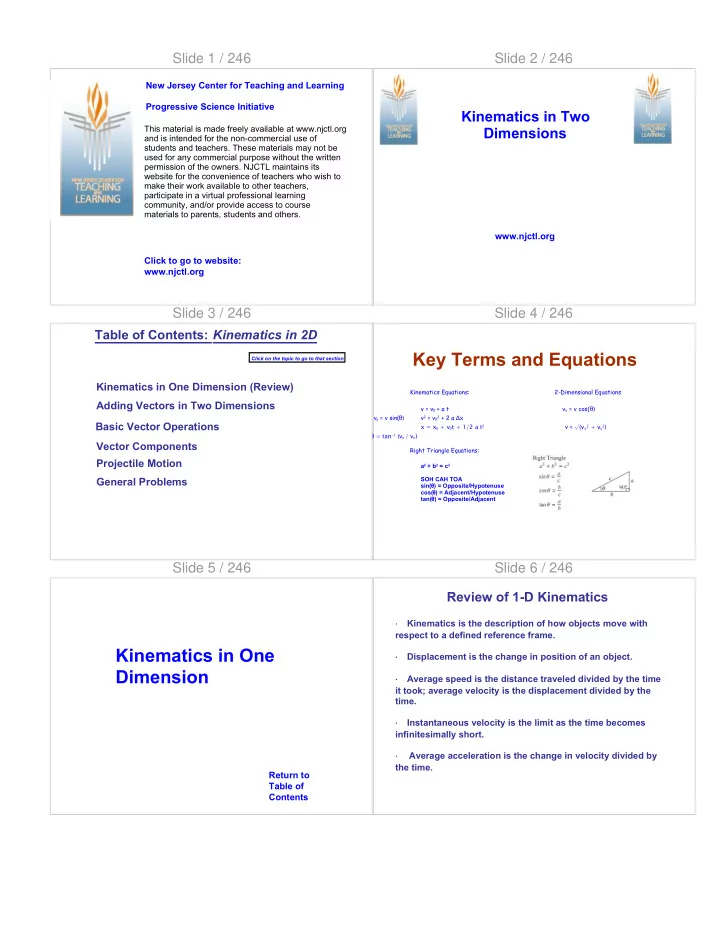
Key Terms and Equations
Kinematics Equations: 2-Dimensional Equations v = v0 + a t vx = v cos(θ) v2 = v02 + 2 a Δx vy = v sin(θ) x = x
0 + v0t + 1/2 a t2
v = √(vx2 + vy2) θ = tan-1 (vy / vx) Right Triangle Equations: a2 + b2 = c2 SOH CAH TOA sin(θ) = Opposite/Hypotenuse cos(θ) = Adjacent/Hypotenuse tan(θ) = Opposite/Adjacent
Slide 5 / 246
Return to Table of Contents
Kinematics in One Dimension
Slide 6 / 246
Review of 1-D Kinematics
· Kinematics is the description of how objects move with respect to a defined reference frame. · Displacement is the change in position of an object. · Average speed is the distance traveled divided by the time it took; average velocity is the displacement divided by the time. · Instantaneous velocity is the limit as the time becomes infinitesimally short. · Average acceleration is the change in velocity divided by the time.