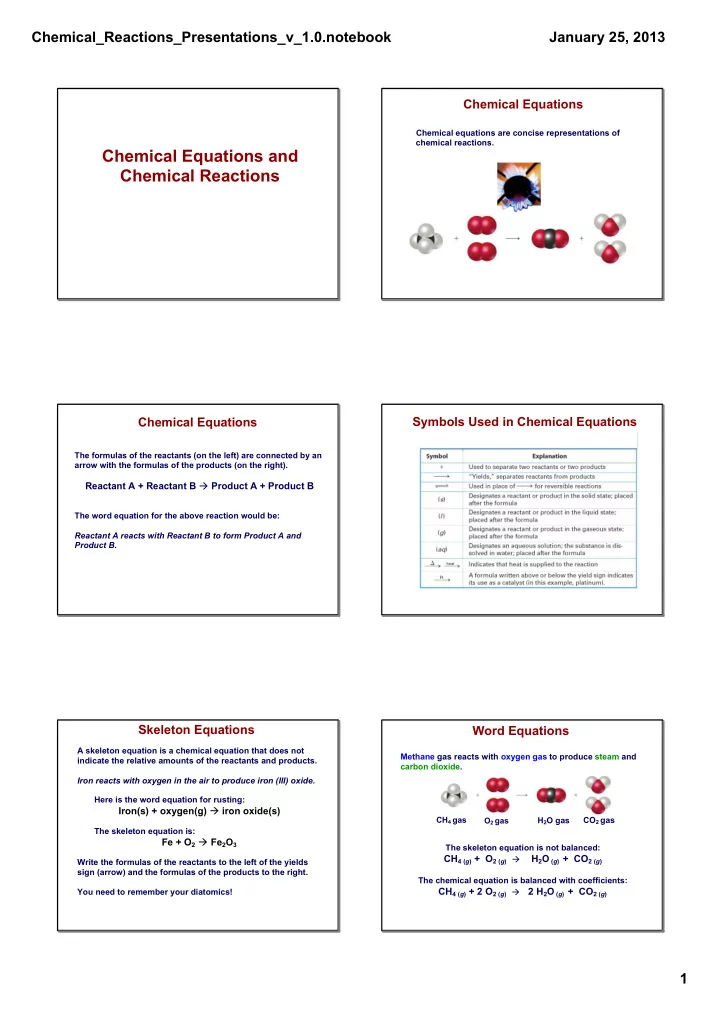
Chemical Equations and Chemical Reactions Symbols Used in Chemical - - PDF document

chemical equations and
SMART_READER_LITE
LIVE PREVIEW

Chemical Equations and Chemical Reactions Symbols Used in Chemical - - PDF document

Chemical_Reactions_Presentations_v_1.0.notebook January 25, 2013 Chemical Equations Chemical equations are concise representations of chemical reactions. Chemical Equations and Chemical Reactions Symbols Used in Chemical Equations Chemical


slide-1
SLIDE 1

Chemical_Reactions_Presentations_v_1.0.notebook 1 January 25, 2013

Chemical Equations and Chemical Reactions

Chemical Equations

Chemical equations are concise representations of chemical reactions. The formulas of the reactants (on the left) are connected by an arrow with the formulas of the products (on the right).

Reactant A + Reactant B Product A + Product B

The word equation for the above reaction would be: Reactant A reacts with Reactant B to form Product A and Product B.

Chemical Equations Symbols Used in Chemical Equations Skeleton Equations

A skeleton equation is a chemical equation that does not indicate the relative amounts of the reactants and products. Iron reacts with oxygen in the air to produce iron (III) oxide. Here is the word equation for rusting:

Iron(s) + oxygen(g) iron oxide(s)

The skeleton equation is:

Fe + O2 Fe2O3

Write the formulas of the reactants to the left of the yields sign (arrow) and the formulas of the products to the right. You need to remember your diatomics!

Word Equations

Methane gas reacts with oxygen gas to produce steam and carbon dioxide. CH4 gas O2 gas H2O gas CO2 gas The skeleton equation is not balanced:

CH4 (g) + O2 (g) H2O (g) + CO2 (g)

The chemical equation is balanced with coefficients:

CH4 (g) + 2 O2 (g) 2 H2O (g) + CO2 (g)

slide-2
SLIDE 2

Chemical_Reactions_Presentations_v_1.0.notebook 2 January 25, 2013

1 In the reaction

CH4 (g) + O2 (g) H2O (g) + CO2 (g)

the products are:

A

  • xygen and water

B

carbon dioxide and water

C

  • xygen and methane

D

methane and carbon dioxide

2 In the reaction

CH4 (g) + O2 (g) H2O (g) + CO2 (g)

the products are:

A

solids

B

liquids

C

gases D

dissolved in water (aqueous)

E

cannot be determined

Word Equations to Chemical Equations

Solid potasium chlorate decomposes in air to produce solid potassium chloride and oxygen gas. The "word" equation is: potasium chlorate (s) potassium chloride (s) + oxygen (g) The unbalanced "skeleton" equation is: KClO3(s) KCl(s) + O2(g) Write the word equation, then the skeleton equation for this reaction: Aluminum sulfate reacts with calcium chloride to produce calcium sulfate and aluminum chloride

Word Equations to Chemical Equations Law of Conservation of Mass

“We may lay it down as an incontestable axiom that, in all the operations of art and nature, nothing is created; an equal amount of matter exists both before and after the

  • experiment. Upon this principle, the whole art of

performing chemical experiments depends.” ­­Antoine Lavoisier, 1789 To write a balanced chemical equation, first write the skeleton equation. Then use coefficients to balance the equation so that it obeys the law of conservation of mass. This is a balanced equation for making a bicycle. The numbers are called coefficients—small whole numbers that are placed in front of the formulas in an equation in order to balance it.

Balancing Chemical Equations

slide-3
SLIDE 3

Chemical_Reactions_Presentations_v_1.0.notebook 3 January 25, 2013

CH4 (g) + 2 O2 (g) CO2 (g) + 2 H2O (g) Reactants appear on the left side of the equation. Products appear on the right side of the equation. The states of the reactants and products are written in parentheses to the right of each compound.

Balancing Chemical Equations

Coefficients are inserted to balance the equation. 1's typically are not written.

CH4 (g) + 2 O2 (g) CO2 (g) + 2 H2O (g)

Balancing Chemical Equations Subscripts and Coefficients

Subscripts tell the number of atoms of each element in a molecule. Coefficients tell the number of representative particles (atoms, molecules, or formula units).

3 How many oxygen atoms are in

  • ne formula unit of calcium

nitrate? (First, write the formula for calcium nitrate.) 4 How many nitrogen atoms are in one formula unit of ammonium sulfate?

2 2 1 1 2 2 2 2

H2 + Cl2 HCl H2 + Cl2 2HCl

Balancing Chemical Equations

unbalanced balanced

slide-4
SLIDE 4

Chemical_Reactions_Presentations_v_1.0.notebook 4 January 25, 2013

chlorine + sodium bromide bromine + sodium chloride

Balancing Chemical Equations

Write a balanced chemical equation for this reaction. (First write a skeleton equation, then balance it) Na + O2 Na2O

5 When the following equation is balanced, the coefficients are

Enter ### on your responder (112, etc) HgO Hg + O2

6 When the following equation is balanced, the coefficients are

Al + ZnCl2 Zn + AlCl3

7 When the following equation is balanced, the coefficients are 8 When the following equation is balanced, the coefficients are

NaCl + CaI2 NaI + CaCl2 NH3 + O2 NO2 + H2O

9 When the following equation is balanced, the coefficients are

slide-5
SLIDE 5

Chemical_Reactions_Presentations_v_1.0.notebook 5 January 25, 2013

10 When the following equation is balanced, the coefficients are

Al(NO3)3 + Na2S Al2S3 + NaNO3

Reaction Types

There are 5 major types of chemical reactions that we will study this year.

  • Combination
  • Decomposition
  • Combustion
  • Single replacement
  • Double replacement

Combination Reactions

Examples:

  • 2 Mg(s) + O2(g) 2 MgO(s)
  • N2(g) + 3 H2(g) 2 NH3(g)
  • C3H6(g) + Br2(l) C3H6Br2(l)

Two or more substances react to form

  • ne product.

11 Which of the following is a combination reaction?

A

H2O H2 +O2

B

Na + Cl2 NaCl

C

AgNO3 + BaSO4 Ag2SO4 + Ba(NO3)2

D

C3H8 + O2 H2O + CO2

One substance breaks down into two or more substances.

Decomposition Reactions

Examples:

  • CaCO3 (s)

CaO (s) + CO2 (g)

  • 2 KClO3 (s) 2 KCl (s) + 3 O2 (g)
  • 2 NaN3 (s)

2 Na (s) + 3 N2 (g)

12 Which of the following is a decomposition reaction?

A

H2O H2 +O2

B

Na + Cl2 NaCl

C

AgNO3 + BaSO4 Ag2SO4 + Ba(NO3)2

D

C3H8 + O2 H2O + CO2

slide-6
SLIDE 6

Chemical_Reactions_Presentations_v_1.0.notebook 6 January 25, 2013

Combustion Reactions

Examples:

  • CH4 (g) + 2 O2 (g) CO2 (g) + 2 H2O (g)
  • C3H8 (g) + 5 O2 (g) 3 CO2 (g) + 4 H2O (g)

These are generally rapid reactions that produce a flame. Most often involve hydrocarbons reacting with oxygen in the air. O2 is always one of the reactants.

Combustion Reactions

Oxygen is always a reactant in combustion reactions. Examples:

  • CH4 (g) + 2 O2 (g) CO2 (g) + 2 H2O (g)
  • C3H8 (g) + 5 O2 (g) 3 CO2 (g) + 4 H2O (g)

However, other elements may also undergo combustion: Mg (s) + O2 (g) MgO (s) N2 (g) + 2 O2 (g) 2 NO2 (g) These last two may also be classified as combination reactions.

13 Which of the following is a combustion reaction?

A

H2O H2 +O2

B

Na + Cl2 NaCl

C

AgNO3 + BaSO4 Ag2SO4 + Ba(NO3)2

D

C3H8 + O2 H2O + CO2

Combustion Reactions

Combustion reactions are easily identified by

  • xygen as a reactant. However, the products of a

combustion reaction may vary depending on how much oxygen is available.

  • Complete combustion

products are carbon dioxide and water

  • Incomplete combustion

products are carbon monoxide and water

Single Replacement Reactions

Single replacement reactions occur between an element and a compound. Usually, a pure metal will displace the metal from the compound.

M + XY X + MY

Single Replacement Reactions

Single replacement reactions can also involve nonmetals, specifically, halogens. In these reactions, one halogen will displace the halogen from the compound. F2 + NaCl Cl2 + NaF

slide-7
SLIDE 7

Chemical_Reactions_Presentations_v_1.0.notebook 7 January 25, 2013

14 Which of the following is a single replacement reaction?

A

H2O H2 +O2

B

Na + Cl2 NaCl

C

AgNO3 + Ba Ag + Ba(NO3)2

D

C3H8 + O2 H2O + CO2

In this reaction, copper metal displaces silver ions in the compound. The reverse reaction, however, does not occur.

Cu (s) + 2 AgNO3 (aq) Cu(NO3))2 (aq) + 2 Ag (s)

Single Replacement Reactions

Single replacement reactions only occur if the pure metal has a higher reactivity than the metal in the compound. The reactivity/activity of the metals is provided in a table, with the more reactive metals higher on the list. If a pure metal is higher on the list than the metal compound it's to react with, the reaction will takes place. If the pure metal is below the metal compound, the reaction will not occur.

Activity Series Activity Series

Note that hydrogen appears on this list. Hydrogen can be displaced from water and from some acids by metals that are above it on the Activity

  • Series. Such reactions

yield hydrogen gas as a product. Lithium metal will replace calcium metal from its compound such as CaCl2 since Li is more reactive than Ca. Li + CaCl2 Ca + 2 LiCl yes! But the reverse reaction will not occur. Ca + LiCl NO! Ca is less active than Li so it cannot displace Li.

Activity Series Activity Series

You have a copy of the activity series on the back of your periodic table. Remember, Lithium (Li) is the most reactive and will replace all other metals. Gold (Au) is the least reactive and will not replace any other metals (on the list).

slide-8
SLIDE 8

Chemical_Reactions_Presentations_v_1.0.notebook 8 January 25, 2013

15 Which of these reactions will NOT occur?

A

Ag + NaCl

B

AgCl + Na

C

PbF2 + Fe

D

Al + FeCl2

Activity Series

There is an Activity Series for the halogens, (Group 17) F fluorine, most reactive Cl chlorine Br bromine I iodine, least reactive Note that this series matches the placement of the elements on the Periodic Table.

http://www.chem.iastate.edu/group/Greenbowe/sections/projectfolder/flashfiles/ redox/home.html

Activity Series

Let's practice finding which reactions will occur and which will not. Use your reactivity list as a guide.

Double Replacement Reactions

Double replacement reactions usually occur between two ionic

  • compounds. They also
  • ccur between acids and

bases, which will be discussed later.

Double Replacement Reactions

Generally, the cations switch places as shown below: AB + CD AD + CB Recall that the cation is written first in an ionic compound. 16 Which of the following is a double replacement reaction?

A

H2O H2 +O2

B

Na + Cl2 NaCl

C

AgNO3 + BaCl2 AgCl + Ba(NO3)2

D

C3H8 + O2 H2O + CO2

slide-9
SLIDE 9

Chemical_Reactions_Presentations_v_1.0.notebook 9 January 25, 2013

The positive ions (metal ions) change their partners. AgNO3 + KCl AgCl + KNO3(( PP Pb(NO)3 + KI PbI2 + KNO3

Double Replacement Reaction Double Replacement Reactions

Double replacement reactions will NOT occur if both products are water­soluble. AB + CD AD + CB So, if AD and CB are both aqueous, then there is no reaction.

Double Replacement Reactions

Double replacement reactions occur ONLY if

  • ne of the products is

either:

  • a solid precipitate
  • a gas
  • water

Most of the double replacement reactions we will discuss form a solid precipitate.

In double replacement reaction, two ionic compounds in an aqueous solution (water) react together. The driving force in this reaction is that one of the product is either a gas or a pure soild (insoluble). The insoluble solid will precipitate out and settle inside the reaction vessel.

Double Replacement Reaction

Both of these reactions occur because one of the products is a solid precipitate.

AgNO3(aq) + KCl(aq) AgCl(s) + KNO3(aq) PP Pb(NO)3(aq) + KI(aq) PbI2(s) + KNO3(aq)

Double Replacement Reaction Double Replacement Reactions

An insoluble (solid) product is called a precipitate. AB + CD AD + CB A reference table called a Solubility Chart is used to determine whether a compound is soluble or not.

slide-10
SLIDE 10

Chemical_Reactions_Presentations_v_1.0.notebook 10 January 25, 2013

Solubility Chart

This reference table gives solubilities for many ionic compounds. In general, all compounds containing alkali metals and the ammonium ion are always soluble.

Solubility Chart

Note that S on this chart means that the compound is

  • soluble. When you

write a chemical equation, it will be (aq) aqueous. Insoluble compounds are shown with the letter I. When you write a chemical equation, it will be (s) solid.

Predict the products of this reaction: calcium fluoride + sodium sulfate CaF2 (aq) + Na2SO4 (aq)

Double Replacement Reactions

Now, put in the phases of the products and balance the equation.

Predict the products of this reaction: potassium phosphate + magnesium chloride

K3PO4 (aq) + MgCl2 (aq)

Double Replacement Reactions

Now, put in the phases of the products and balance the equation.

17 One of the products of a reaction between silver nitrate and potassium carbonate will be:

A silver potassium B potassium carbonate C nitrate carbonate D potassium nitrate

Writing Net Ionic Equations

  • So far, the single replacement and double replacement

reactions we have examined show all ions reacting.

  • In truth, only some of the ions actually take part in the

reaction.

  • To more accurately show what species are actually

reacting, we write (1) a complete ionic equation and (2) a net ionic equation.

slide-11
SLIDE 11

Chemical_Reactions_Presentations_v_1.0.notebook 11 January 25, 2013

  • The complete ionic equation shows all aqueous

substances (i.e. strong acids, strong bases, and soluble ionic compounds) dissociated into their ions.

  • For example:

NaCl (aq) would be written as Na+ (aq) + Cl­ (aq)

Writing Net Ionic Equations

However, when all the aqueous species are dissociated into their respective ions, it becomes:

Ag+ (aq) + NO3

­ (aq) + K+ (aq) + Cl­ (aq) →AgCl (s) + K+ (aq) + NO3 ­ (aq)

This is called the complete ionic equation. Note that the insoluble product does not dissociate.

Writing Net Ionic Equations

The equation between silver nitrate and potassium chloride would normally be shown as AgNO3

(aq) + KCl(aq) →AgCl (s) + KNO3 (aq)

Writing Net Ionic Equations

Ag (aq) + NO3

­(aq) + K+(aq) + Cl­(aq) →AgCl (s) + K+(aq) + NO3 ­ (aq)

As this example shows, certain ions are present both before and after the reaction. Because they play no significant role in the reaction, they are known as "spectator ions." A spectator ion is an ion that appears on both sides of an equation and is not directly involved in the reaction.

Ag+(aq) + NO3

­

(aq) + K+(aq) + Cl­ (aq) →

AgCl (s) + K+(aq) + NO3

­

(aq)

  • The net ionic equation is an equation for a reaction in

solution that shows only those particles that are directly involved in the chemical change.

  • To form the net ionic equation, cross out anything that

does not change from the left side of the equation to the

  • right. In other words, cancel out the spectator ions.

Writing Net Ionic Equations

After cancelling out the spectator ions, the only things left in the equation are those things that change, or react, during the course of the reaction.

Ag+(aq) + Cl­

(aq) → AgCl (s)

Writing Net Ionic Equations

Ag+(aq) + NO3

­

(aq) + K+(aq) + Cl­ (aq) →

AgCl (s) + K+(aq) + NO3

­

(aq)

This is called the net ionic equation.

  • Write a balanced molecular equation.
  • Dissociate any reactants or products that are
  • aqueous. All solids, liquids, and gases stay intact

and do not dissociate.

  • Cross out anything that remains unchanged from

the left side to the right side of the equation.

  • Write the net ionic equation with the species that

remain.

Writing Net Ionic Equations

slide-12
SLIDE 12

Chemical_Reactions_Presentations_v_1.0.notebook 12 January 25, 2013

  • Write a balanced molecular equation.

Pb(NO3)2 (aq)+ 2 KI (aq) PbI2 (s)+ 2 KNO3 (aq)

  • Dissociate any reactants or products that are aqueous.

Pb2+

(aq) + 2NO3 ­ (aq)+ 2K+ (aq)+ 2I­ (aq) PbI2 (s)+ 2K+ (aq)+ 2NO3 ­ (aq)

  • Cross out anything that remains unchanged from the left

side to the right side of the equation. Pb2+

(aq) + 2NO3 ­ (aq)+ 2K+ (aq)+ 2I­ (aq) PbI2 (s)+ 2K+ (aq)+ 2NO3 ­ (aq)

  • Write the net ionic equation with the species that

remain.

Pb2+

(aq) + 2 I­ (aq) ­­> PbI2 (s)

Writing Net Ionic Equations

Practice writing the balanced equation, complete ionic equation and net ionic equation for these reactions.

  • 1. calcium nitrate (aq) and potassium carbonate (aq)
  • 2. silver nitrate (aq) and sodium phosphate (aq)

Writing Net Ionic Equations