Key Findings from the Questionnaire on Country Participation in - - PowerPoint PPT Presentation

key findings from the questionnaire on country
SMART_READER_LITE
LIVE PREVIEW

Key Findings from the Questionnaire on Country Participation in - - PowerPoint PPT Presentation

Global Alliance to Monitor Learning: Key Findings from the Questionnaire on Country Participation in Cross-National Assessments (CNA) Silvia Montoya, UIS Director GAML4 November 2017 Madrid, Spain Global Alliance to Monitor Learning: Update


slide-1
SLIDE 1

Global Alliance to Monitor Learning:

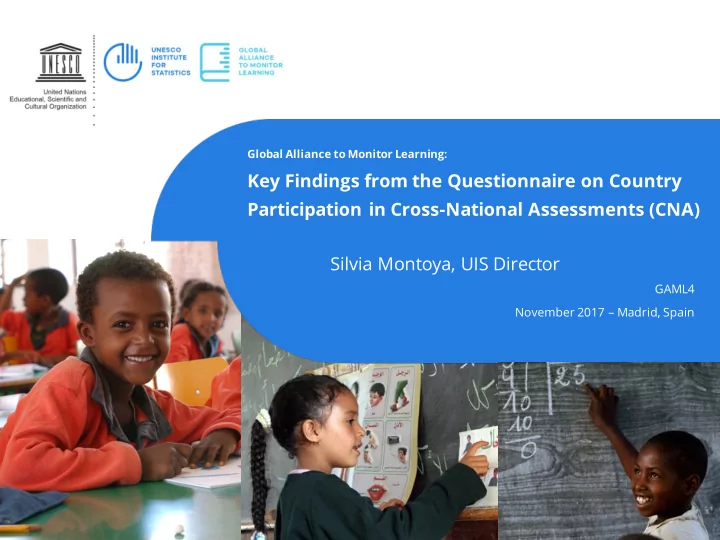
Key Findings from the Questionnaire on Country Participation in Cross-National Assessments (CNA) Silvia Montoya, UIS Director

GAML4 November 2017 – Madrid, Spain
slide-2
SLIDE 2
  • CNAs are key to inform SDG 4.1.1
  • Next round of CNAs is approaching

quickly:

  • PISA 2018
  • PISA for Development
  • PILNA 2018
  • SEA-PLM 2018/19
  • TIMSS 2019
  • LLECE 2019
  • PASEC 2019
  • PIRLS 2021
  • LANA
  • SACMEQ V

Introduction

Global Alliance to Monitor Learning: Update on Progress

slide-3
SLIDE 3
  • Questionnaires sent to 210 countries and

territories asking

  • If they are planning to participate in the next round of CNA
  • If their participation is formally confirmed
  • If they going to test the SDG4.1.1 target grades and subject

areas

  • Their financial situation to participate in CNAs
  • If they have a permanent institution or unit to implement a CNA
  • If they need technical assistance to participate in CNAs
  • So far, 80/210 (38%) countries have returned their

questionnaires

  • Highest return rate from high income countries (56%); lowest

return rate from low income countries (16%)

  • Highest return rates from North America and Western Europe

(64%); lowest return rates from Sub-Saharan Africa (21%)

CNA Questionnaire

Global Alliance to Monitor Learning: Update on Progress

slide-4
SLIDE 4

Key findings

Global Alliance to Monitor Learning: Update on Progress

slide-5
SLIDE 5

5

Participation in CNAs

Global Alliance to Monitor Learning: Update on Progress

  • 60/80 (75%) countries are participating or

planning to participate in the next round of CNAs

  • 22 countries in just one CNA
  • 20 countries in 2 CNAs
  • 23 countries in 3 CNAs

CNA Number of CNA/Countries PISA 2018 46 PISA-D 3 PILNA 2018 2 SEA-PLM 2018 2 TIMSS 2019 36 LLECE (ERCE) 2019 7 PASEC 2019 5 PIRLS 2021 29 LANA SACMEQ V 1 TOTAL 131

131 CNA/countries

slide-6
SLIDE 6

6

Participation in CNAs

Global Alliance to Monitor Learning: Update on Progress

  • Countries are participating or planning to

participate in 131 CNAs

  • Participation status
  • 89/131 (68%) CNAs have been formally

confirmed.

  • 18/131 (14%) Participation is in the process of

confirmation.

  • 11/131 (8%) Participation is still under

discussion.

  • 13/131 (10%) no response provided (missing)
  • 110/131 (84%) cases there is a national

institution or unit to implement the CNA.

slide-7
SLIDE 7

7

Participation in CNAs

Global Alliance to Monitor Learning: Update on Progress

  • For the countries that are NOT participating in

CNAs, the main reasons are

  • Lack of financing: Aruba, Armenia, Georgia,

Kyrgyz, Sao Tome, Grenada, Namibia

  • Uncertainty about which CNA to join
  • A national assessment will be administered

instead

slide-8
SLIDE 8

8

Adequacy to inform SDG 4.1.1

Global Alliance to Monitor Learning: Update on Progress

  • All 131 cases will measure math or reading
  • 120/131 (92%) cases will use a sample that is

representative of the entire country

  • Cases where a sub-national sampling will be used
  • Azerbaijan: Baku city will only participate in PISA

2018

  • Georgia: Has not secured funding to test

language minority schools in PIRLS 2021; these schools will be excluded from TIMSS 2019.

  • Other cases: Do not know or missing
  • 11/131 (8%) cases will test grades 2 or 3
  • LLECE 2019 at grade 3 (7 cases)
  • PASEC 2019 at grade 2 (3 cases)
  • PIRLS 2021 at grade 3 (1 case)
  • 35/131 (27%) cases will test at the end of primary

education

  • 51/131 (39%) cases will test at the end of lower

secondary education.

slide-9
SLIDE 9

9

Technical Assistance

Global Alliance to Monitor Learning: Update on Progress

  • Only 35/131 (27%) cases reported needing

technical assistance

  • Data come mainly from high income countries
  • Demand for technical assistance increases

among lower income countries

  • Areas where countries need technical assistance

the most

  • Sampling
  • Administration
  • Data processing and analysis
  • Data reporting, communication, and uses
slide-10
SLIDE 10

10

Costs and financial situations

Global Alliance to Monitor Learning: Update on Progress

  • Costs of participating in a CNA
  • Participation fees, overheads: ~USD$200,000
  • In-country implementation: ~USD$1,500,000
  • Total costs: ~USD$1,700,000
  • Main sources of funding
  • Government: 110/131 (84%) cases
  • Local or international donations: 16/131 (12%)

cases

  • Financial situation
  • 86/131 (66%) cases full financing is secure
  • 28/131 (21%) cases full financing is not secure
slide-11
SLIDE 11

11

Costs and financial situations

Global Alliance to Monitor Learning: Update on Progress

  • 16/131 (12%) cases (from 10 countries) are looking for

financial assistance:

  • Albania: PISA 2018, TIMSS 2019
  • Burundi: PASEC 2019
  • Bosnia and Herzegovina: PISA 2018, TIMSS 2019
  • Georgia: PISA 2018, TIMSS 2019, PIRLS 2021
  • Honduras: LLECE 2019, PISA-D
  • Jordan: PISA 2018
  • Latvia: PISA 2018, PIRLS 2021
  • Montenegro: PISA 2018, TIMSS 2019
  • Namibia: SACMEQ V
  • El Salvador: LLECE 2019
  • Financial assistance will be mainly used to fund
  • International participation fees
  • Assessment implementation
  • Training for the national project team
slide-12
SLIDE 12

12

Conclusions and next steps

Global Alliance to Monitor Learning: Update on Progress

  • Need to increase participation of countries in CNAs by
  • Identifying reasons for non participation
  • Addressing those reason case by case
  • Securing funding and technical assistance
  • Very few countries will have data to inform SDG 4.1.1.

at grades 2/3

  • Measuring grades 2/3 should be a priority
  • Next steps
  • Finalize analyses of CNA questionnaires
  • Add new countries
  • Recompute with a special focus on lower income

countries

  • Include data from (a) CNA agencies Questionnaire, and

(b) Donors Questionnaires.

  • Background paper with final results will be ready in January

2018

slide-13
SLIDE 13

Learn more: http://uis.unesco.org/ @UNESCOstat

Thank you!

Silvia Montoya, Director, UNESCO Institute for Statistics @Montoya_sil