International Labour Office Department of Statistics Methodological - - PDF document

international labour office department of statistics
SMART_READER_LITE
LIVE PREVIEW

International Labour Office Department of Statistics Methodological - - PDF document

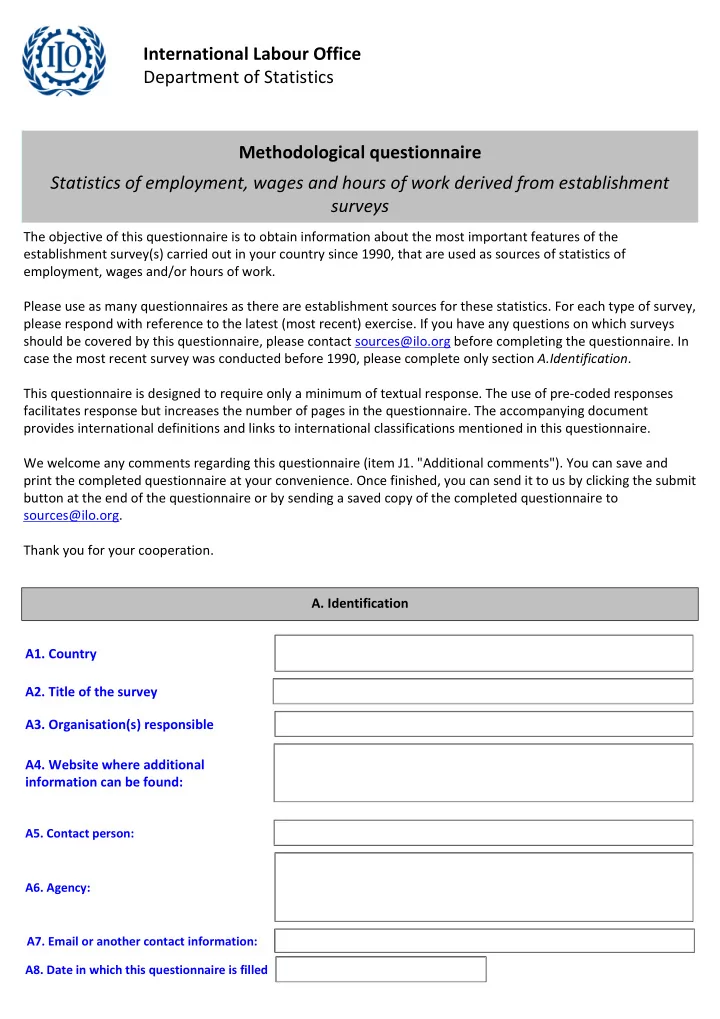
International Labour Office Department of Statistics Methodological questionnaire Statistics of employment, wages and hours of work derived from establishment surveys The objective of this questionnaire is to obtain information about the most


slide-1
SLIDE 1

Methodological questionnaire Statistics of employment, wages and hours of work derived from establishment surveys

  • A. Identification
  • A1. Country
  • A2. Title of the survey
  • A3. Organisation(s) responsible
  • A4. Website where additional

information can be found:

  • A5. Contact person:
  • A6. Agency:
  • A7. Email or another contact information:
  • A8. Date in which this questionnaire is filled

International Labour Office Department of Statistics

The objective of this questionnaire is to obtain information about the most important features of the establishment survey(s) carried out in your country since 1990, that are used as sources of statistics of employment, wages and/or hours of work. Please use as many questionnaires as there are establishment sources for these statistics. For each type of survey, please respond with reference to the latest (most recent) exercise. If you have any questions on which surveys should be covered by this questionnaire, please contact sources@ilo.org before completing the questionnaire. In case the most recent survey was conducted before 1990, please complete only section A.Identification. This questionnaire is designed to require only a minimum of textual response. The use of pre-coded responses facilitates response but increases the number of pages in the questionnaire. The accompanying document provides international definitions and links to international classifications mentioned in this questionnaire. We welcome any comments regarding this questionnaire (item J1. "Additional comments"). You can save and print the completed questionnaire at your convenience. Once finished, you can send it to us by clicking the submit button at the end of the questionnaire or by sending a saved copy of the completed questionnaire to sources@ilo.org. Thank you for your cooperation.

slide-2
SLIDE 2
  • B. Periodicity and coverage
  • B1. Periodicity: The survey is carried out ...

Once a year, continue to B2 Two times a year/half yearly, continue to B2 Every quarter, continue to B2 Every month, go to B3 Every Every Ad hoc survey, continue to B2 months, continue to B2 years, go to B3 Further comments

  • r explanations (if

needed): January February March April May June July August September October November December

  • B3. Year the survey started:
  • B4. Industry coverage: The survey includes establishments in the following ISIC rev. 4 groups
  • A. Agriculture, forestry and fishing

Yes No Yes No

  • C. Manufacturing

Yes No

  • D. Electricity, gas, steam and air

conditioning supply

Yes No

  • E. Water supply, sewerage, wast

management and remediation act.

Yes No

  • F. Construction

Yes No

  • G. Wholesale and retail trade; repair of

motor vehicles

Yes No

  • H. Transportation and storage

Yes No

  • I. Accomodation and food service

activities

Yes No

  • J. Information and communication

Yes No

  • K. Financial and insurance activities

Yes No

  • L. Real estate activities

Yes No

  • M. Professional, scientific and technical

activities

Yes No

  • N. Administrative and support support service

activities

Yes No

  • O. Public administration; compulsory social

security

Yes No

  • O. Defense

Yes No

  • P. Education

Yes No

  • Q. Human health and social work activities

Yes No

  • R. Arts, entertainment and recreation

Yes No

  • S. Other service activities

Yes No

  • T. Activities of household as employers

Yes No

  • U. Activities of extraterritorial organizations

and bodies

Yes No

Further comments

  • r explanations (if

needed):

  • B. Mining and quarrying
  • B2. Months of the survey: the survey is carried out in the following months ...
slide-3
SLIDE 3
  • B7. Worker coverage: The survey covers the following status in employment categories ...

(b) Only Paid employees Non-adults/workers below a certain age Managers Supervisors Casual and temporary employees Seconded employees Part time employees Pieceworkers

Yes No Yes No Yes No Yes No Yes No Yes No Yes No Yes No Yes No Yes No Yes No Yes No Yes No Yes No Yes No Yes No Yes No Yes No Yes No Yes No Yes No Yes No Yes No

Employees on probation Foreign employees Subcontracted workers Homeworkers Workers paid on commission (d) Only Non-manual /white collar/administrative workers (c) Only Manual / blue collar workers/wage earners/ production workers/ operatives, etc. Employees absent from work the entire reference period without pay Workers from temporary work agencies Apprentices Trainees (e) Paid employees and working proprietors (i.e., own account workers or employers) Volunteer workers Other workers not mentioned above: Further comments or explanations (if needed): The following groups are included: (a) All persons in the payroll (f) All persons engaged (Paid employees, working proprietors and unpaid family workers)

  • B6. Geographical coverage: The survey covers the ...

Whole country Whole country, excluding the following remote/marginal areas: Capital city (can include surrounding areas) The following main cities: Only urban areas Other geographical coverage:

  • B5. Size coverage: The survey covers ...

All establishments of any size All establishments with at least Other size coverage: workers/employees

slide-4
SLIDE 4

Yes No Yes No Yes No Yes No Yes No Yes No Yes No

  • B9. Other coverage: The survey includes or excludes other types of establishments not already mentioned above
  • C1a. The survey measures EMPLOYMENT
  • C1b. Operational definition: EMPLOYMENT relates to …

Yes, continue to C1b No, go to C2 The total number of workers, on: The average number of workers during: Other:

  • C1. EMPLOYMENT

A specific day: The month of the survey The quarter of the survey The whole year Other: A specific pay period The month of the survey The quarter of the survey The whole year Other: The same as the survey coverage (c.f. B7.) A different coverage:

  • C1c. The worker coverage is ...
  • C1d. Further comments
  • r explanations (if

needed):

  • C. Concepts and operational definitions
  • B8. Institutional sector coverage: The survey covers ...

Establishments in the the private sector Establishments in the the public sector Unincorporated establishments Non-profit institutions Foreign establishments located within the country Establishments which did not operate part of the reference period National establishments located abroad

slide-5
SLIDE 5
  • C2e. Earnings includes:

(f) Overtime payments (g) End of year bonuses (i) Other regular bonuses paid every pay period (a) Payments in kind (d) Other allowances in cash (b) Cost of living allowances (e) Payments for time not worked (j) Bonuses paid irregularly (k) Payments for periods outside the reference period (m) Tips and gratuities distributed by the employer (n) Severance and termination pay (o) Employers' contributions to workers' social security schemes (l) Payments for items required by the job Yes, continue to C2b No, go to C3a GROSS earnings NET earnings -> Deductions are made for: Yes No Yes No Yes No Yes No Yes No Yes No Other: The same as the survey coverage A different coverage:

  • C2c. The worker coverage is ...

The same reference period as employment A specific week A specific month Another reference period: Yes No Yes No Yes No Yes No Yes No Yes No Yes No Yes No Yes No Yes No Yes No Yes No Yes No Yes No Yes No (p) Other components not mentioned above Further comments or explanations (if needed): (c) Family allowance allowances (h) Profit sharing bonuses

  • C2. Earnings
  • C2a. The survey measures EARNINGS
  • C2d. and the reference period is ...

(before any deductions are made by the employer in respect of taxes, contributions of employees to social security and pension schemes, union dues, life insurance premiums, etc.)

  • C2b. EARNINGS relates to:

Workers' contributions to compulsory social security schemes

  • Health related
  • Pension
  • Unemployment

Union dues Advanced contributions to income tax

slide-6
SLIDE 6

Yes, continue to C3b No, go to C4 per hour per day per week per month

  • ther time unit:

Minimum or standard wage rates, fixed by or in pursuance of ... Wage rates actually paid Yes No Yes No Yes No Yes No The same as the survey coverage A different coverage: The same reference period as employment A specific week A specific month Another reference period:

  • C3. Wage rates
  • C3b. Time unit: WAGE RATES are requested ...
  • C3d. The worker coverage is ...
  • C3e. and the reference period is ...

Yes No Yes No Yes No Yes No Yes No Yes No (g) Other components not mentioned above Further comments or explanations (if needed):

  • C3f. Wage rates includes:

(a) Payments in kind (c) Family allowances (b) Cost of living allowances (f) Overtime payments (d) Other allowances in cash (e) Payments for time not worked

  • C4a. The survey measures COMPENSATION OF EMPLOYEES or

LABOUR COST Yes, continue to C4b No, go to C5

  • C4. Compensation of employees or Labour Cost
  • C4b. The worker coverage is ...
  • C4c. and the reference period is ...

The same as the survey coverage A different coverage: The same reference period as employment A specific week A specific month A different reference period:

  • C3a. The survey measures WAGE RATES
  • C3c. Concept:

... laws ... regulations ... collective agreements ... arbitral awards

slide-7
SLIDE 7
  • C5. Contractual/Normal hours of work
  • C5a. The survey measures CONTRACTUAL/NORMAL HOURS OF WORK

Yes No Yes No Yes No Yes No Yes No Yes No Yes No Yes No Yes No Yes No Yes No Yes No Yes No Yes No Yes No Yes No Yes No Yes No Yes No Yes No (u) Other components not mentioned above Further comments or explanations (if needed): Yes, continue to C5b No, go to C6 Yes No Yes No Yes No Other

  • C5b. CONTRACTUAL/NORMAL HOURS OF WORK relates to hours fixed by:

per day per week per pay period per month

  • ther:

Days Half days Hours Minutes Other time unit:

  • C5d. Information is requested in ….

The same reference period as for wages Another reference period:

  • C5e. The reference period is ...

The same as for wages Another coverage:

  • C5f. And the worker coverage is ...

Laws or regulations Collective agreements Establishments' internal regulations

  • C5c. Information is requested about normal hours ….
  • C4d. Compensation of employees or Labour cost includes:

(f) Overtime payments (g) End of year bonuses (i) Other regular bonuses paid every year (a) Payments in kind (d) Other allowances in cash (b) Cost of living allowances (e) Payments for time not worked (j) Bonuses paid irregularly (k) Payments for periods outside the reference period (m) Tips and gratuities distributed by the employer (n) Severance and termination pay (o) Employers' contributions to workers' social security schemes (l) Payments for items required by the job (c) Family allowance allowances (h) Profit sharing bonuses (p) Workers' social benefits provided by the employer (q) Employers' cost of training (r) Employers' expenses for welfare services (s) Taxes paid by the employer on employment payrolls,etc. (t) Employment related subsidies received by the employer

slide-8
SLIDE 8
  • C7a. The survey measures HOURS ACTUALLY WORKED
  • C7b. Information is requested in ….
  • C7c. The reference period is ...
  • C7d. And the worker coverage is ...
  • C7. Hours actually worked

Yes, continue to C6b No, go to C7 Days Half days Hours Minutes Other time unit:

  • C6b. Information is requested in ….
  • C6c. The reference period is ...
  • C6d. And the worker coverage is ...

The same reference period as for wages Another reference period: The same workers as for wages Another coverage: No Yes No Yes No Yes Yes No Yes No Yes No Yes No Yes No Yes No Yes No Yes No Yes No Yes No Yes No Yes No Yes No Yes No Further comments or explanations (if needed): Yes No Yes No Yes, continue to C7b No, go to C8 Days Half days Hours Minutes Other time unit: The same reference period as for wages Another reference period: The same workers as for wages Another coverage:

(b) Work at home (c) Travelling time required by the job (d) Meal breaks (e) Commuting time

  • Compensated with time off

(a) Overtime

  • Paid at special rates
  • Paid at normal rates
  • C6e. Hours paid for includes time paid due to ….

(h) Down time (including stand by time) (j) Other: (i) Time not worked (absence from work)

  • Vacation time
  • Sick leave
  • Occupational injuries
  • Labour disputes
  • Other time not worked

(f) Time for preparation (g) Training time

  • C6g. The survey measures OVERTIME separately
  • C6f. The survey measures ABSENCE FROM WORK separately
  • C6. Hours paid for
  • C6a. The survey measures HOURS PAID FOR
slide-9
SLIDE 9
  • C9a. The survey measures VACANCIES

No Yes No Yes No Yes Yes No Yes No Yes No Yes No Yes No Yes No Yes No Yes No Yes No Yes No Yes No Yes No Yes No Yes No Yes No Further comments

  • r explanations (if

needed): Yes No

  • C8a. The survey measures LABOUR TURNOVER

Yes No Yes, continue to C8b No, go to C9a Workers who were hired Workers who were fired Workers who resigned Workers who retired Yes No Yes No Yes No Yes No Other The same reference period as hours paid/hours actually worked Another reference period: The same workers as hours paid/hours actually worked Another coverage: Yes, continue to C11b No, go to C10

  • C9b. VACANCIES

are defined as:

  • C8c. The reference period is ...
  • C8d. and the worker coverage is ...
  • C10. Other topics: The survey measures other topics not mentioned above, namely ...
  • C7g. The survey measures OVERTIME separately
  • C8. Other topics
  • C8b. LABOUR TURNOVER includes the following components
  • C7f. The survey measures ABSENCE FROM WORK separately
  • C7e. Hours actually worked includes time paid due to ….

(b) Work at home (c) Travelling time required by the job (d) Meal breaks (e) Commuting time

  • Compensated with time off

(a) Overtime

  • Paid at special rates
  • Paid at normal rates

(f) Time for preparation (g) Training time

  • Unpaid and not compensated with time off

(h) Down time (including stand by time) (j) Other: (i) Time not worked (absence from work)

  • Vacation time
  • Sick leave
  • Occupational injuries
  • Labour disputes
  • Other time not worked
slide-10
SLIDE 10
  • D1. Establishment size: The establishment size categories used to group establishments are ...
  • D. Classifications

ISIC rev 2 ISIC rev 3, 3.1 ISIC rev 4 NACE, NAICS National classification: Other:

  • D2a. Industry (branch of economic activity): The classification used to code industry is (based on) ...
  • D2b. Number of groups distinguished at the most detailed level when coding industry

groups

  • D2d. If not using ISIC, it is convertible to ISIC:

Yes No ISIC, rev. 2 ISIC, rev. 3 ISIC, rev. 4 No

Yes, to

  • D2c. Computer assisted/automatic coding is used
  • D2e. The most important deviations between the classification used and the international

classification (at the Section - one digit - level) are: ISCO-68 ISCO-88 ISCO-08 National classification: Other:

  • D3a. Occupation: If information by occupation is collected, the classification used to code occupation is (based on):
  • D3d. If not using ISCO, it is convertible to ISCO

groups Yes No ISCO-68 ISCO-88 ISCO-08 No

Yes, to

  • D3e. The most important deviations between the classification used and the international

classification (at the Major Group - one digit - level) are:

  • D3c. Computer assisted/automatic coding is used
  • D3b. Number of groups distinguished at the most detailed level when coding occupation
slide-11
SLIDE 11
  • E. Questionnaire design
  • E1. Number of questionnaires: the survey uses ...
  • D4a. Labour cost components: If measuring labour cost, the classification of labour cost components is the International

Standard Classification of Labour Cost

Yes No

Payments in kind (group IV) include Cost of workers' housing borne by employers (group V) and Cost of welfare services (group VIII) Direct wages and salaries (group I) and Remuneration for time not worked (group II) are merged Other differences:

  • D4b. If no, the most important differences between the national classification and the international

classification are: Geographical regions Legal status of the establishment (i.e., institutional sector, type of ownership, etc.). Others: Yes No

  • D5. The survey uses other classifications, as follows:
  • D6. Further comments or

explanations (if needed): Cooperatives are separetely identified

  • E2. The unit(s) of observation: Information is obtained ...

One questionnaire Different types of questionnaires for different types of economic units: One questionnaire for the economic unit as a whole, one for workers individually Other: Yes No For the establishment as a whole (go to E3) For a sample of workers in the establishment (go to E4) For each individual worker in the establishment (go to E4) For (groups of) occupations within the establishment (go to E3) Yes No Yes No Yes No

slide-12
SLIDE 12
  • E5. Wage components: the survey obtains information separately for ...

Disaggregations Employment Wages concept (earnings, wage rates, etc Working time concepts Sex Age group Education level categories Occupation Manual/non-manual Full-time/part-time Skilled/semi-skilled/unskilled Casual/permanent worker Apprentices Adults/young workers Other disaggregation:

  • E4. When information is obtained for individual workers, the survey collects information about their:
  • E3. The survey collects information separately by ....

Sex Age (adults/young) Education level Occupation Full time/part time schedule Casual/permanent status Apprentices Other information: Wage rates Earnings Compensation of employees or labour cost Payments in kind Cost of living allowances Family allowances Overtime payment Employers' social security contributions Workers' social security contributions Other deductions of workers (e.g., for income tax) Other: go to E5

slide-13
SLIDE 13

Enterprise Establishment Employee Other: Business register Employee or population register Area frame Economic, Industrial, Establishment census Agricultural census Registers kept by the government Industrial/bussines directories Licence records Sales tax records Income tax records Unemployment insurance records Pension coverage records Other, namely: Records of workers or employers' associations Field operations Other, namely: % of all employees, and/or % of all economic units Every Every Continually Not updated with a specific frequency Never updated months years

  • F5. Updating frequency: The sample frame is updated ...
  • F4. Frame coverage: The percentage of all paid employees and/or economic units covered by the sample frame ...

Complete enumeration, go to F10 Random sample, go to F7 Purposive sample, go to F10 Other, go to F10:

  • F6. Type of sample
  • F3. The sources of information used to construct the register are ... (all relevant options are indicated)
  • F2. The sample frame is ... (all relevant options are indicated)
  • F. Sample design
  • F1. The sampling unit(s) is/are ... (all relevant options are indicated)
slide-14
SLIDE 14

Yes: No By region/location By industry By public and private sectors By size (or number of workers) -- the strata are the same as those indicated in D1 above: Yes: No Establishments above this size are included with certainty in the sample Other strata:

  • F8. Sample error - relative standard error for each concept ... (may be percentages or ranges of percentages)

economic units (establishments/enterprises) % of economic units workers % of all workers

  • F10. Further comments or

explanations (if needed): Personal interview Telephone interview Mail Online/web based questionnaire Other, namely: Yes No Yes, in case of non-response Yes, in other cases: No % of all units days or months

  • G6. Further

comments or explanations (if needed):

  • G3. Substitution of units
  • G1. Method(s) of data collection: Data are collected through ... (more than one option may be selected)
  • G. Data collection
  • G2. If personal or telephone interview,

computer assisted interview is used

  • G4. Non response rate: Percentage of all units in the final sample that are not inteviewed
  • G5. Timeliness: Number of days or months between the reference period and the release of the results
  • F9. Sample size: The number of economic untis and/or workers in the final sample (or an estimate of the relative size) ...
  • F7. The sample is stratified
slide-15
SLIDE 15
  • H3. Types of indicators produced ... (more than one option can be selected)

(a) Average earnings (per worker) Take into account estimates from a previous reference period Use benchmark data For employment For wages For working time Adjust for seasonality Other adjustments, please specify

  • H2. If benchmark data are used,

the type of benchmark data used is: per year per month per week per day per hour (actual or paid) (b) Median earnings (per worker) per year per month per week per day per hour (actual or paid) (c) Real earnings (per worker) per year per month per week per day per hour (actual or paid) (d) Labour cost (per worker) per year per month per week per day per hour (actual or paid) (e) Hours actually worked (per worker) per year per month per week per day (f) Hours paid for (per worker) per year per month per week per day (g) Overtime hours (per worker) per year per month per week per day (h) Absence from work hours (per worker) per year per month per week per day (i) Workers by levels of earnings Number of workers Percentage of workers (j) Earnings ... Deciles Quartiles (k) Earnings in each decile/ quartile Average earnings Median earnings (l) Workers by levels of hours (paid or actual) Number of workers Percentage workers (m) Wage indexes Simple unweighted index of growth Laspeyres index with fixed occupational employment weights Laspeyres index with industrial employment weights Other wage index: (n) Other indicators produced: Yes No, to a subset:

  • H4. The above indicators are calculated for all workers covered
  • H1. Estimation procedures ... (more than one option may be selected)
  • H. Estimates
slide-16
SLIDE 16

THANK YOU FOR COMPLETING THIS QUESTIONNAIRE

2E - Paid employment by economic activity 2F - Paid employment in manufacturing 4A - Hours of work by economic activity 4B - Hours of work in manufacturing 5A - Wages by economic activity 5B - Wages in manufacturing 6A - Labour cost in manufacturing OI - Hours of work and wages in detailed occupations (October Inquiry) Yes No If no, the main differences are as follows:

  • H6. The statistics published in LABORSTA have the same coverage and follow the same definitions

described above

  • I1. Main changes in this survey since 1990 that have led to breaks in the series
  • I. Historical information
  • I2. Additional comments on the survey

Additional comments regarding the questionnaire

  • H5. Links to Laborsta series: Statistics from this survey are presented in the following LABORSTA series ...

Submit by Email