Keeping the Conversation Going Cambridge University Press Remote - - PowerPoint PPT Presentation

keeping the conversation going
SMART_READER_LITE
LIVE PREVIEW

Keeping the Conversation Going Cambridge University Press Remote - - PowerPoint PPT Presentation

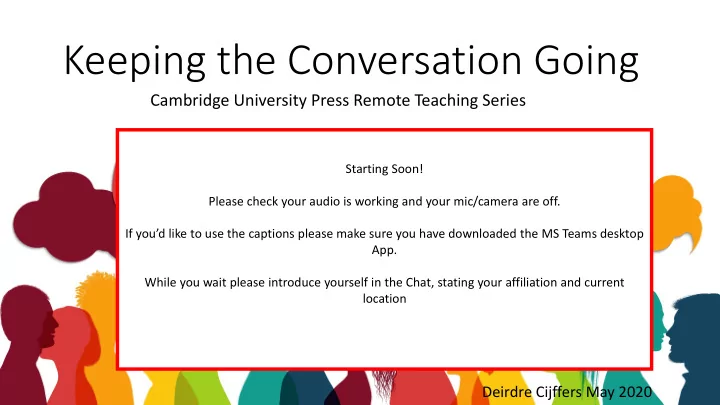
Keeping the Conversation Going Cambridge University Press Remote Teaching Series Starting Soon! Please check your audio is working and your mic/camera are off. If youd like to use the captions please make sure you have downloaded the MS Teams


slide-1
SLIDE 1

Keeping the Conversation Going

Cambridge University Press Remote Teaching Series

Deirdre Cijffers May 2020

Starting Soon! Please check your audio is working and your mic/camera are off. If you’d like to use the captions please make sure you have downloaded the MS Teams desktop App. While you wait please introduce yourself in the Chat, stating your affiliation and current location

slide-2
SLIDE 2

Keeping the Conversation Going

Cambridge University Press Remote Teaching Series

Deirdre Cijffers May 2020

slide-3
SLIDE 3

Quick Recap

Content

Seminar Lecture

Assignment Experience Content Activity Discursive review and extension Feedback

slide-4
SLIDE 4

Aims

Managing a single whole group discussion Breakouts and polls (or chat) Input Feedback

slide-5
SLIDE 5

20 minutes (lots of questions)

slide-6
SLIDE 6

Managing a centralised conversation

Heavy handed chair All muted if not speaking Questions on slides Chat – use for (dis)agreement, raising hand, brief commentary Polls Use chat and polls for ‘warmer’ questions Ask specific people to unmute

slide-7
SLIDE 7

Interaction Pattern

Teacher centricity Teacher talk time (TTT)

slide-8
SLIDE 8

Obstacles

‘Whole Audience’ effect Student Talk Time (STT) Reason for Listening

slide-9
SLIDE 9

Break out

What if I only have 2 students?

  • 1. Step back (and say so)
  • 2. Give a time limit
  • 3. Monitor (listen and take

notes)

  • 4. Feedback by questioning
slide-10
SLIDE 10

Then what?

Review the work done Name and fame Task feedback Target knowledge feedback Build on this to conclude

slide-11
SLIDE 11

Discuss

Higher numbers

Check mind change

Poll Poll Discuss Discuss

Breakouts T draws together interesting themes, provides feedback, builds on related ideas T monitors and makes notes

Input

T/someone presents or summarises

Evolution

Check temperature

slide-12
SLIDE 12

Staged Activities

Instructions on Screen Interdependent Clear outcome Reason for listening

Whole Group Pair 1 Pair 2 Input

Poll

slide-13
SLIDE 13

Example: Problem - Public Health

Prepare elements of a solution

Whole Group Pair 1 Pair 2

Present ideas Create a plan of action

Reason for Listening: to hear arguments I need to evaluate Outcome: Solve Covid 19!

Input

Poll

slide-14
SLIDE 14

Advanced

Prepare sides of a dialogue Debate Outcome: win negotiation/find solution

Pair 1 Pair 2 Pair A Pair B Whole Group

Report resolutions

Input

Poll Poll

S1 S2

slide-15
SLIDE 15

Short talk Resource/ different resources Ss submit work: essay/maths model/translation/ present their ideas T monitors T monitors Peer review T draws on submissions and reviews to create rich extended discussion

Input

Synchronous/ Asynchronous?

Short talk Resource/ different resources Ss submit work: essay/maths model/translation/ present their ideas T monitors T monitors Peer review T draws on submissions and reviews to create rich extended discussion 1. 2. 4. 3. 6. 5. 7.

slide-16
SLIDE 16

Feedback

‘The teaching of experts is characterized by high rates of both positive and negative feedback.’

Robert Duke

slide-17
SLIDE 17

Peer Feedback

Lead by example: Give and ask for feedback in the same format

slide-18
SLIDE 18

Implications for planning

1. Identify highest aim of session. Thinks about skills as well as knowledge. 2. Provide material and potentially activities in advance to make more room for connection. 3. Plan:

  • a mini-talk with carefully planned questions
  • a 2 stage discussion task
  • how to feedback on the task

4. Get Feedback from your students

slide-19
SLIDE 19

Thank you!

Next time:

Planning your course

Thursday 21st May 2pm BST highereducation@Cambridge.org dcijffers@cambridge.org @CamTELP

slide-20
SLIDE 20

Breakout!

Task: Come up with a plan of action to solve Climate Change Step 1: In groups discuss your assigned option – why should we do this? Step 2: Together, we’ll decide which options to take forward and in what order