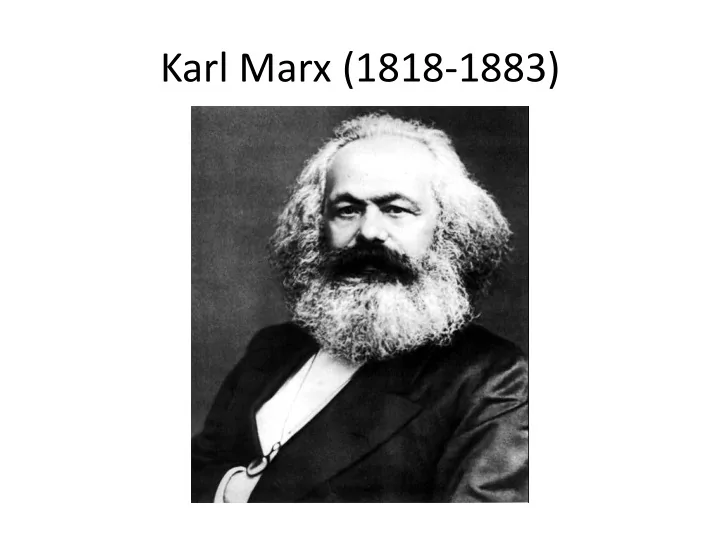
Karl Marx (1818-1883) Karl Marx Marx (1818-1883) German economist, - - PowerPoint PPT Presentation

karl marx 1818 1883 karl marx
SMART_READER_LITE
LIVE PREVIEW

Karl Marx (1818-1883) Karl Marx Marx (1818-1883) German economist, - - PowerPoint PPT Presentation

Karl Marx (1818-1883) Karl Marx Marx (1818-1883) German economist, philosopher, sociologist and revolutionist. Enormous impact on arrangement of economies in the 20th century The strongest critic of capitalism and classical


slide-1
SLIDE 1

Karl Marx (1818-1883)

slide-2
SLIDE 2

Karl Marx

  • Marx (1818-1883) – German economist, philosopher,

sociologist and revolutionist.

  • Enormous impact on arrangement of economies in the

20th century

  • The strongest critic of capitalism and classical

economics in history

  • Major economic work – Capital: Critique of Political

Economy

– first volume – 1867 – 2nd and 3rd vol. published by F. Engels in 1885 and 1894. – 4th volume published by K. Kautsky in 1905-1910.

slide-3
SLIDE 3

Karl Marx’s thought

  • Marx’s economics is in a large part the

application of his general theory of history to capitalism.

  • Marx’s theory of history is called historical

materialism (HM).

  • HM asks how to explain the different ways in

which societies have been organized in the past and how to use it to predict future forms of

  • rganization of society.
slide-4
SLIDE 4

Marx’s economics

  • 1. Historical materialism as applied to

capitalism

  • 2. Labour theory of value
  • 3. Marx’s exploitation of workers theory
  • 4. ‘Laws’ of motion of capitalism
slide-5
SLIDE 5

Life of Karl Marx

  • Born in 1818 in Trier, into wealthy Jewish family.
  • Studied law and philosophy,
  • In 1842 became an editor of radical newspaper in Cologne.
  • In 1843 ordered to leave Prussia, moved to France and there

he began to work with Friedrich Engels (1844).

  • Engels (1820-1895) was a German philosopher, social scientist, Marx’s

friend and collaborator. He worked in his father’s factory in Manchester and helped Marx financially.

  • Engels authored a book „The condition of the working class in

England” (1845) based on his observations from Manchester.

  • Marx was expelled from Paris in 1845, moved to Belgium and

later in 1850 to London, where he spent the rest of his life working on his criticism of capitalism and classical political economy (died in 1883).

slide-6
SLIDE 6

Historical context for Marx’s thought

  • Engels (1844), The Condition of the Working Class in England:

the Industrial Revolution made factory workers worse off

– Incomes are lower than before the revolution – Mortality from diseases is four times higher than in the countryside – Housing conditions are poor, longevity is shorter, workers are

  • verworked (up to 18 hours per day, 6 days a weak), children are

forced to work (first „factory act” passed in Britain in 1802 stipulated that children under 9 are not allowed to wokr, while aged 9-13 are allowed to work only 8 hours per day, aged 14-18 – max. 12h/day), etc.

  • In 1848 we had „Spring of Nations” – series of democratic

revolutions aiming at abolishing absolute monarchies in Europe; in general they were unsuccessful

slide-7
SLIDE 7

Historical materialism

  • The theory aims at explaining what are the causes of historical changes

in the modes of production (hunter-gatherers, agricultural slavery- based ancient systems, feudalism, capitalism… and in the future socialism, and finally communism)

  • Predicts that history inevitably leads to the collapse of capitalism and

the coming of socialism and ultimately communism

  • History is neither governed by some ideal power (God, Reason, fate),

nor it is a series of accidents

  • All societies can be analytically divided into three parts:

– FP: forces of production (technology, labour skills, scientific knowledge, tools, capital goods etc.) – RP: relations of production (social relations and relations between people and things, for example work relations and property rights) – SS: social superstructure (culture, the art, philosophy, science, religion, legal system etc.)

slide-8
SLIDE 8

Historical materialism, cont.

  • FP are inherently dynamic – they are the main source
  • f changes in the history of societies.
  • FP determine RP
  • RP are static, they are always from the past, never

fully adjusted to the continuously changing FP.

  • RP determine SS, but SS has a feedback effect on RP
  • SS reinforces the static nature of RP. Its purpose is to

keep RP intact, to maintain the status quo.

slide-9
SLIDE 9

Historical materialism, cont.

  • After the initial harmony between FP and RP,

continuously developing FP bring about contradictions in the system, which manifest themselves in the class struggle (in capitalism struggle between capitalists and labourers).

  • Finally, when those contradictions are too intense, there

is a period of social revolution in the social system.

  • In communism there are no social classes, so

communism will be the end of social history (no other forms of social organization in the future).

slide-10
SLIDE 10

Historical materialism

Social superstructre Relations of production Factors of production Initial harmony (between FP and RP) → growth of FP → contradictions → new RP emerge (new state of harmony) → new contradictions... etc.

slide-11
SLIDE 11

Is historical materialism a good theory of history?

  • If understood in a strict way (technology is the only

factor determining RP and SS) then it is absurd.

  • If treated loosely (technology is one among many

factors determining RP and SS) then it is obvious and trivial.

slide-12
SLIDE 12

Marx’s economic theory

  • Advancement in labour theory of value (LTV).
  • LTV states that relative values of commodities

equal to the relative amount of labour needed to produce those commodities

  • Marx followed many Ricardo suggestions in

labour theory of value:

– treated capital as accumulated, stored-up labour; – agreed that land rent does not influence values (prices)

slide-13
SLIDE 13

Marx on LTV

  • Dealt better than Ricardo with the problem of

quantifying the amount of labour needed to produce a unit of a good.

  • According to Marx the amount of labour needed to

produce a unit of a good is the so-called socially necessary labour time – the time taken by a worker with the average skills and with the help of the average available techniques

slide-14
SLIDE 14

Marx on LTV

  • For Marx, value of a commodity can be divided into 3 parts:

Value = c + v + s, where: c – expenses on constant capital, v– expenses on variable capital, s – surplus value

  • Marx’s assumptions:
  • Expenses on c are not productive
  • Expenses on v are productive; they give in return amount of

v+s

  • s is created by labour only, but it is owned by capitalists. So it

is unpaid labour and labourers are exploited under capitalism

slide-15
SLIDE 15

Marx on LTV – transformation problem

  • Can Marx’s LTV explain prices in capitalist economies? Can

Marxian values (c+v+s) be transformed into market prices?

  • Marx offered numerical examples supporting his arguments
  • All variables are measured in hours of labour time
  • Two industries exist, each of which advances the same capital of

100, but proportions of c and v differ

  • Rate of profit is equal to s/(c+v)
  • Rate of surplus value (s/v) is uniform and equal to 100%

Industry c v k=c+v s (s=v) Value =k+s Profits Market prices 1 70 30 100 30 130 20 120 2 90 10 100 10 110 20 120 Total economy 160 40 200 40 240 40 240

slide-16
SLIDE 16

Marx and the transformation problem

  • Notice that if prices would be proportional to values profit rates

would have to differ accross industries – that would violate competitive tendency to equalize rates of profits (which Marx accepted)

  • So, market prices deviate from values as predicted by LTV
  • But: 1) sum of values = sum of prices
  • 2) sum of surplus values = sum of profits
  • So profits are a form of surplus value (unpaid labour) and the gross

product of the economy ∑(c+v+s) is determined by labour values

Industry c v k=c+v s (s=v) Value =k+s Profits Market prices 1 70 30 100 30 130 20 120 2 90 10 100 10 110 20 120 Total economy 160 40 200 40 240 40 240

slide-17
SLIDE 17

Marx and the transformation problem

  • So, LTV cannot explain market prices of particular commodities
  • But according to Marx it can explain the aggregate size of the

economy (gross national product) and the sum of profits

  • In this sense only labour creates aggregate wealth of the society

and the incomes of capitalists

  • But, the type of computation illustrated in Marx’s example is not

satisfactory because the initial evaluations of c and v are not modified despite the fact that prices have changed

  • If market prices deviate from values, then c has to be bought at

market prices and v may be not enough to buy all the commodities workers need

  • So, in general sum of market prices will deviate from the sum of

values or the sum of profits is not equal to the sum of surplus values

slide-18
SLIDE 18

Marx on LTV and profits

  • Therefore pure LTV is incorrect
  • Marx was aware of this problem but could not solve

it, so his attempt at solving the problem of transforming values into prices failed

  • Later, many econmists (Marxian and non-Marxian)

tried to solve this problem

  • Mainstream economists hold that it cannot be solved

in a rigorous and general enough way, but some modern Marxian economists argue otherwise

slide-19
SLIDE 19

Marx on LTV and exploitation

  • But LTV was also used by Marx for other purpose, not for

explaining prices (positive aim), but for showing that workers are exploited under capitalism (normative, ethical aim)

  • Value of commodities (c+v+s) is greater than the value of

cost of production (c+v), so capitalists is left with a surplus. This arises because capitalists buys labour at its market value (v – covering subsistence wages), not at its social value (v+s).

  • Marx used surplus value in explaining exploitation due to

the necessity of unpaid labour

  • Labourers are exploited by capitalist because they do not

receive all value of their work (they get only v, while producing value v+s).

slide-20
SLIDE 20

Marx on exploitation, cont.

  • Notice, that workers are forced to produce s in Marx’s system
  • Example:
  • it takes 8 hours of labour to produce v
  • capitalists demands that workers worked for 12 hours a day
  • so workers are forced to produce surplus value equivalent to

4 hours of labour a day

  • rate of exploitation (s/v) is equal to 4/8 = 0.5 (or 50%)
  • Workers are deprived of part of value they create
  • Workers do not have freedom to choose the length of the

working day

  • Exploitation is necessary in capitalism.
  • Exploitation is ethically wrong, unjust. LTV is used by Marx for

ethical criticism of capitalism.

slide-21
SLIDE 21

Marx on other evils of capitalism

  • Alienation
  • Commodity fetishism
slide-22
SLIDE 22

Marx on alienation

  • Alienation – feeling of being separated, being apart
  • alienation of the worker from his or her humanity (being a machine

rather than a human being)

  • alienation between workers, since capitalism reduces labour to a

commodity to be traded on the market, rather than a social relationship;

  • alienation of the worker from the product, since this is appropriated

by the capitalist class, and so escapes the worker's control;

  • alienation from the act of production itself, such that work comes

to be a meaningless activity, offering little or no intrinsic satisfactions.

  • It is a systematic result of capitalism
slide-23
SLIDE 23

Commodity fetishism according to Marx

  • In capitalism lives are organized through the medium of

commodities

  • People trade their labour power (a commodity itself) for

another commodity (money) and then exchange it for other commodities

  • People start to perceive commodities as having lives and

movements of their own to which humans and their behaviuor merely adapt

  • Commodities become fetishes that rule actions of humans
  • People desire more and more commodities and social

relations (including family ones) become ruined

  • Production and consumption grows without limits while basic

community goals (like alleviation of poverty) are not realized

slide-24
SLIDE 24

Marx’s ‘Laws of motion’ of capitalism

  • These are the contradictions between FP and RP

described in Marx’s historical materialism.

  • Five ‘laws of motion’:

– law of a reserve army of the unemployed – law of a falling rate of profit – law of increasing concentration and centralization of capital – law of business cycles – law of increasing misery within of proletariat.

  • Not scientific laws, rather rough predictions,
  • ften based on analytical errors, rarely falsifiable.
slide-25
SLIDE 25

Marx’s ‘laws of motion’ of capitalism: (1)

  • 1. law of a reserve army of the unemployed
  • There is always excess supply of labour in the

markets in order to keep wages low.

  • Recruited from several sources:

– workers displaced by new machines – young people entering labour markets, housewives etc.

  • Reserve army will increase in number over

time in capitalism.

slide-26
SLIDE 26

Unemployment rate in the US

slide-27
SLIDE 27

Law of the falling rate of profit

slide-28
SLIDE 28

Law of increasing concentration and centralization of capital

  • Capitalists accumulate more and more capital,

the size of firms is increasing and the degree

  • f competition in the markets tends to be

diminished – there is growing concentration of capital.

slide-29
SLIDE 29

Law of growing concentration and centralization of capital Figure shows the Number and Percentage of U.S. Manufacturing Industries in which Largest Four Companies Accounted for at Least 50 Percent of Shipment Value in Their Industries, 1947-2007

slide-30
SLIDE 30

But in the meantime industry has declined

slide-31
SLIDE 31

Law of business cycles Business cycles will develop in capitalism and would become increasingly severe. Reasons: 1) Uneven introduction of technological change in industries 2) Spread of a depression in one industry throughout the economy 3) Falling rate of profit

slide-32
SLIDE 32

Law of business cycles

slide-33
SLIDE 33

Marx’s ‘laws of motion’ of capitalism: (5)

  • 5. Law of increasing misery (poverty) within of

proletariat.

  • Three interpretations:

– Increasing absolute poverty (real income of labourers decreases over time) – Increasing relative poverty (working class’ share of national income declines over time) – Quality of life of proletariat decreases over time

slide-34
SLIDE 34

Increasing misery of proletariat