
SLIDE 1
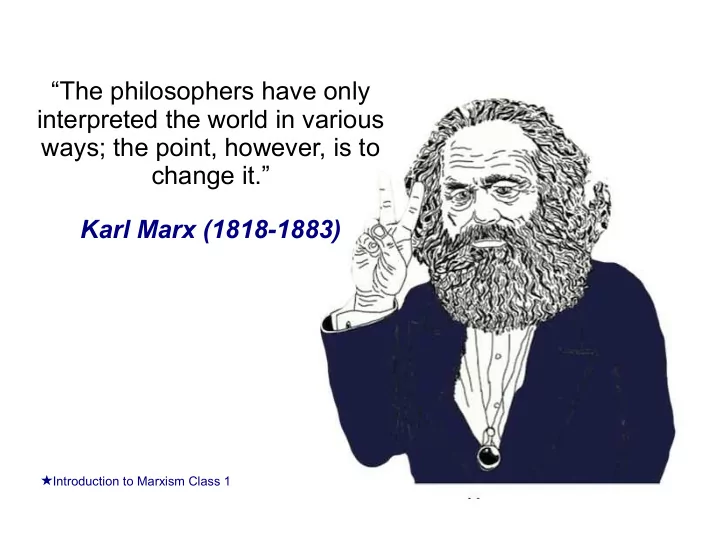
“The philosophers have only interpreted the world in various ways; the point, however, is to change it.” Karl Marx (1818-1883)
Introduction to Marxism Class 1
The philosophers have only interpreted the world in various ways; - - PowerPoint PPT Presentation
The philosophers have only interpreted the world in various ways; the point, however, is to change it. Karl Marx (1818-1883) Introduction to Marxism Class 1 The dominant ideology in any class society is the ideology of the ruling class .
“The philosophers have only interpreted the world in various ways; the point, however, is to change it.” Karl Marx (1818-1883)
Introduction to Marxism Class 1
The dominant ideology in any class society is the ideology of the ruling class. Every ruling class has insisted that their right to rule is natural or pre-ordained by some deity and that it is unchangeable. But class conflict generates challenges to the dominant ideology and in a revolutionary crisis the dominant ideology is submitted to a dramatic reality check.
Australia should never be defined by class or envy, but rather a nation united by mateship and achievement
the same as the 3.8 billion people who make up the poorest half of humanity, down from 43 people the year before
billionaires increased by 12% (almost $3.5 billion a day) last year. At the same time the poorest half of humanity saw their wealth shrink by 11%.
bottom 70% of all other Australians combined.
Class divide a reality not an 'ideology'
Reality should be understood not as a “complex of ready- made things, but as a complex of processes, in which the things apparently stable ... go through an uninterrupted change of coming into being and passing away”
Hegel argued: “contradiction is at the root of all movement and life, and it is
contradiction that anything moves and has impulse and activity”. However, he thought these contradictions unfolded in the sphere of ideas, which were then transmitted into the real world. Marx turned Hegel’s dialectical approach on its head. The contradictions in the sphere of ideas that Hegel identified, he argued, were ideological reflections of material processes and material contradictions that drove the development of nature and history.
Georg Wilhelm Friedrich Hegel, German philosopher (1770- 1831)
Marx's philosophical materialism: Developments in the sphere of ideas do impact powerfully on the material world. However, ultimately, “It is not the consciousness of men that determines their existence, but their social existence that determines their consciousness”.
Marx: Reality should be understood not as a “complex of ready-made things, but as a complex of processes” and that we understand these processes by engaging with reality as well as reflecting on what we perceive.
Engels postulated three laws of dialectics in his Dialectics of Nature:
quantitative changes into qualitative changes
negation (development as a spiral rather than a straight line)
4,000BC 1,900BC 3,500BC 3,500BC 1,800BC 3,300BC
Classless society 'Primitive communism'
For millennia, human societies were classless. Private property, states, kings, standing armies and police forces did not exist. Since class-divided societies emerged 6,000 to 7,000 years ago, once 'all-powerful' ruling classes have come and gone.