
SLIDE 1
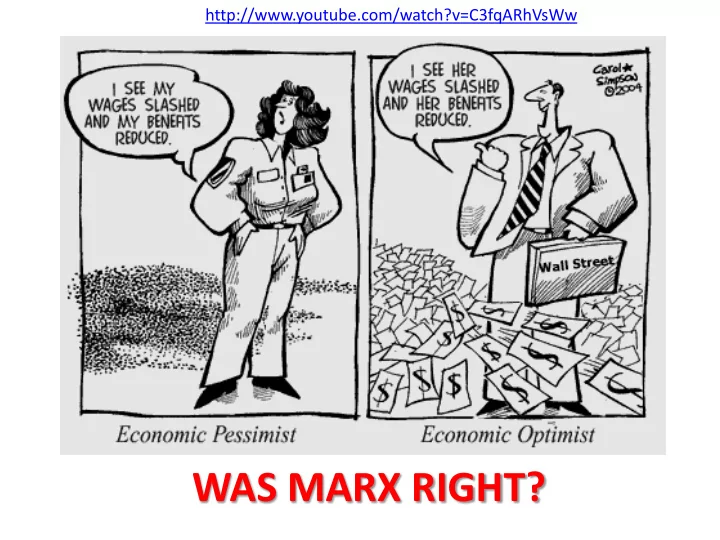
WAS MARX RIGHT?
http://www.youtube.com/watch?v=C3fqARhVsWw
WAS MARX RIGHT? Todays Menu I. The Three Laws of Capitalism A. - - PowerPoint PPT Presentation
http://www.youtube.com/watch?v=C3fqARhVsWw WAS MARX RIGHT? Todays Menu I. The Three Laws of Capitalism A. Exploit Others B. Expand or Die 1. Commodification is not sustainable 2. Surplus Value (profit) will always decline 3. Capitalists
http://www.youtube.com/watch?v=C3fqARhVsWw
I. The Three Laws of Capitalism
– Private property – Labor becomes a commodity – Extraction of surplus value
– Commodification of labor is not sustainable
– Surplus value will always decline – Capitalists will respond with both market and non-market strategies
– Deepening cycles of recession and depression – Class warfare and revolution
the human individual be most fully alive. Any forced activity means a loss of what is most vital about human
from a self-created life as it is possible to get. Millions of men, women, and children were little better than slaves, working at mind-numbing mechanical jobs in factories for a subsistence salary under hazardous working conditions which drastically shortened their lives. The system of private property leads to a total denial of the possibilities for a human life beyond mere animal existence. In a very real sense, the workers not only had no control over their lives; they did not own their lives, for they lived most of the time as extensions of machines which someone else owned, producing material goods which were not theirs. Nothing of themselves went into their work except their muscle power, for which they received a small hourly wage. Hence, their humanity was
was all the more acute because of his view of human nature. Marx sees human life as defined by its material
world around them. Everything about them, including their consciousness of themselves and their understanding
the human identity and the human being's consciousness of that identity are determined by work, by the material conditions which the individual has to face in order to cope with life.
capitalist system of exchange altogether. And this means that while we inhabit the capitalist world we can never be truly ourselves; If people in their daily activities have to deal with oppressive and dehumanizing material conditions, then they are not fully human, no matter what anyone can say about their spiritual or ideal identity. Thus, for Marx alienation is a physical and psychological condition which arises out of the conditions of modern
hates what he does, then the worker does not own his own life, he is in a basic sense simply a human machine. He exists to himself as an alien object; he is conscious of himself as something he despises, rather than loves or enjoys or even recognizes as his own.
chases the bourgeoisie over the entire surface of the globe. It must nestle everywhere, settle everywhere, establish connexions everywhere."
regulated by means of an authoritative economic plan that supposedly embodies the interests of the community as a whole.
production, but the individual citizen's equal rights of access to consumer goods would be completely unaffected by his/her own individual contribution to production -- hence Karl Marx's famous slogan "From each according to his ability; to each according to his need."
elimination of all other major social problems such as class conflict, political oppression, racial discrimination, the inequality of the sexes, religious bigotry, and cultural backwardness -- as well as put an end to such more "psychological" forms of suffering as alienation, anomie, and feelings of powerlessness.
Whereas in communist society, where nobody has one exclusive sphere of activity but each can become accomplished in any branch he wishes, society regulates the general production and thus makes it possible for me to do one thing today and another tomorrow, to hunt in the morning, fish in the afternoon, rear cattle in the evening, criticise after dinner,
– Outsourcing production to low-wage regions and… – Importing goods from low wage regions, which… – Reduces demand for American labor, which in turn….. » Weakens trade unions – The weaker the wage earners, the more power for those at the top to increase their own incomes
Symbolic Analyst Routine Production worker Routine Personal Services