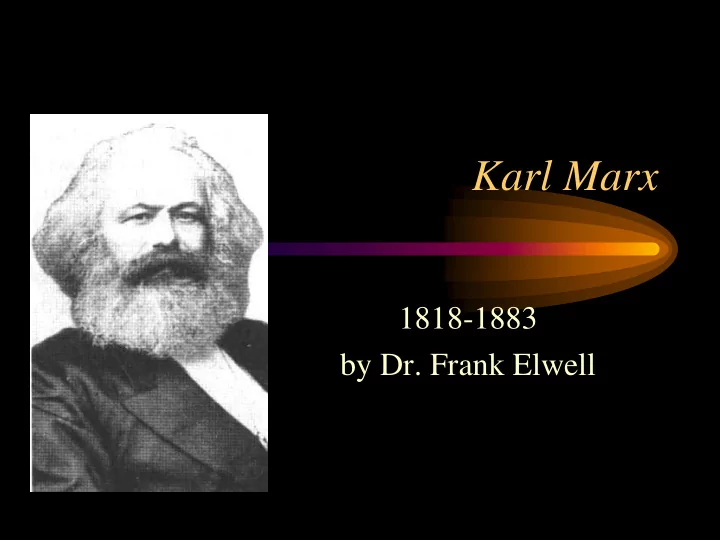
SLIDE 1
Karl Marx
1818-1883 by Dr. Frank Elwell
SLIDE 2 Note:
This presentation is based on the theories of Karl Marx as presented in his books listed in the
- bibliography. A more complete summary of Marx’s
theories (as well as the theories of other macro- theorists) can be found in Macrosociology: The Study of Sociocultural Systems, by Frank W. Elwell. If you would like to receive a .pdf file of the chapter
- n Marx please write me at felwell@rsu.edu and put
Marx.pdf in the subject line.
SLIDE 3
FRIEDRICH ENGELS
SLIDE 4
KARL MARX
Karl Marx (1818-1883) was a socialist theoretician and organizer, a major figure in the history of economic and philosophical thought, and a great social prophet.
SLIDE 5
KARL MARX
Personally, I like to call him the last of the old Testament prophets. He basically prophesized that man would someday create a paradise on earth. That we would all someday live in brotherhood, sharing our talents and our wealth.
SLIDE 6
KARL MARX
But in this presentation we will focus on his role as a sociological theorist. His writings have had an enormous impact on all of the social sciences, but particularly upon sociology.
SLIDE 7 Major Intellectual Contributions:
- 1. Elaboration of the conflict model of
society, specifically the theory of social change based upon antagonisms between social classes;
- 2. The insight that power originates
primarily in economic production; and
- 3. His concern with the social origins of
alienation.
SLIDE 8 Social Evolution
Marx’s vision was based on an evolutionary point of departure. Society was comprised
- f a moving balance of antithetical forces
that generate social change by their tension and struggle.
SLIDE 9 Social Evolution
Struggle, rather than peaceful growth, was the engine of progress; strife was the father of all things, and social conflict was the core
- f the historical process.
SLIDE 10 Forces of Production
Marx believed that the basis of the social
- rder in every society is the production of
economic goods. What is produced, how it is produced, and how it is exchanged determine the differences in people’s wealth, power, and social status.
SLIDE 11
Relations of Production
For Marx, the entire social system is based on the manner in which men and women relate to one another in their continuous struggle to wrest their livelihood form nature.
SLIDE 12
Relations of Production
"The first historical act is…the production of material life itself.” Marx goes on to say that “this is indeed an historical act, a fundamental condition of history.”
SLIDE 13
Relations of Production
In other words, unless this act is fulfilled (the production of material life), there would be no other, All social life is dependent upon the quest for a sufficiency of eating and drinking, for habitation and for clothing.
SLIDE 14
Relations of Production
This quest to meet basic needs is central to understanding social life—and is as true today as it was in prehistory.
SLIDE 15
Relations of Production
The quest to meet basic needs were man’s primary goals at the dawn of the race and are still central when attempts are made to analyze the complexities of modern life.
SLIDE 16
Secondary Needs
When basic needs have been met, this leads to the creation of new needs. Man (and woman) is a perpetually dissatisfied animal. Man’s struggle against nature does not cease when basic needs are gratified.
SLIDE 17 Secondary Needs
The production of new needs evolve when means are found to allow the satisfaction of
- lder ones. Humans engage in antagonistic
cooperation as soon as they leave the communal stage of development in order to satisfy their primary and secondary needs.
SLIDE 18 Antagonistic Cooperation
Marx argued that because human beings must
- rganize their activities in order to clothe,
feed, and house themselves, every society is build on an economic base. The exact form social organization takes varies from society to society and from era to era.
SLIDE 19
Division of Labor
The organization of economic activities leads to the division of labor which causes the formation of classes; over time, these classes develop different material interests, they become “antagonistic.” Thus antagonistic classes become the primary actors in the historical drama.
SLIDE 20 Economic Organization Determines:
- Polity
- Family
- Education
- Religion
SLIDE 21
Economic Organization
Economic organization to meet our material needs eventually comes to determine virtually everything in the social structure. All social institutions are dependent upon the economic base, and an analysis of society will always reveal its underlying economic arrangements.
SLIDE 22
Economic Organization
"Legal relations as well as the form of the state are to be grasped neither form themselves nor from the so-called general development of the human mind, but have their roots in the material conditions of life…”
SLIDE 23 Economic Organization
Marx’s thinking contrasted sharply with Comte for whom the evolution of mankind resulted from the evolution of ideas. Marx took as his point of departure the evolution in man’s material conditions, the varying ways in which men combined together in
- rder to gain a livelihood.
SLIDE 24
Economic Organization
"...The anatomy of civil society is to be sought in political economy.”
SLIDE 25
Social Evolution
According to Marx, the qualitative change of social systems through time could not be explained by extra-social factors such as geography or climate.
SLIDE 26 Social Evolution
Nor can such evolutionary changes be due to the emergence of novel ideas. Ideas, according to Marx, are not prime movers but are the reflections, direct or sublimated,
- f the material interests that impel men in
their dealings with others. Therefore, the widespread acceptance of ideas depend on something that is not an idea—depend upon material interests.
SLIDE 27
Social Evolution
"It is not the consciousness of men that determines their existence, but on the contrary, it is their social existence that determines their consciousness.”
SLIDE 28
Social Structure
Marx’s unique contribution lay in identifying the forces of production as the most powerful variable influencing the rest of the social system.
SLIDE 29
Social Structure
Marx regarded society as a structurally integrated whole. Consequently for Marx, any aspect of that whole—be it legal codes, systems of education, art, or religion— could not be understood by itself.
SLIDE 30 Social Structure
Like all of the founders of sociology, he believed that we must examine the parts in relation to one another and in relation to the
- whole. Although historical phenomena were
the result of the interplay of many factors, all but one of them were in the final analysis dependent variables—that is, dependent upon the economic base
SLIDE 31
Social Structure
"Political, legal, philosophical, and artistic development all depend on the economic. But they all react upon one another and upon the economic base.”
SLIDE 32 Social Structure
Marx is not the vulgar materialist that he is
- ften depicted as being, but he did believe
that the forces of production [which determine the relations of production, or roughly, the economy] was the most important factor in understanding the social system.
SLIDE 33
Social Structure
"It is not the case that the economic situation is the sole active cause and that everything else is merely a passive effect…There is, rather, a reciprocity within a field of economic necessity which in the last instance always asserts itself.”
SLIDE 34
Forces of Production
The forces of production are, strictly speaking, the technology and work patterns that men and women use to exploit their environment to meet their needs.
SLIDE 35
Forces of Production
These forces of production are expressed in relationships between men, which are independent of any particular individual and not subject to individual wills and purposes.
SLIDE 36
Forces of Production
While industrialism would be a particular force of production, capitalism would be the relations of production. By relations of production, Marx means the social relationships people enter into by participation in economic life.
SLIDE 37
Relations of Production
The relations of production are the relations men establish with each other when they utilize existing raw materials and technologies in the pursuit of their productive goals.
SLIDE 38
Relations of Production
While Marx begins with the forces of production, he quickly moves to the relations of production that are based on these forces. For Marx, the relations of production are the key to understanding the whole cultural superstructure of society.
SLIDE 39 Relations of Production
The relations of production (economic
- rganization) constitute the foundation upon
which the whole cultural superstructure of society comes to be erected.
SLIDE 40 Relations of Production
Marx gives the relations of production the primary focus in his analysis of social
- evolution. The forces of production
basically set the stage for these relations, and other than this are given little independent treatment by Marx.
SLIDE 41
Relations of Production
Problems of modern society are therefore all ascribed to capitalism by Marx and his followers, rather than ascribing some of them to industrialism—a problem we will return to shortly.
SLIDE 42
Social Class
According to Marx, men and women are born into societies in which property relations have already been determined. These property relations, in turn, give rise to different social classes. Just as men cannot choose who is to be his father, so he has not choice as to his class. [Social mobility, though recognized by Marx, plays no role in his analysis.]
SLIDE 43 Social Class
Once a man is ascribed to a specific class by virtue of his birth, once he has become a feudal lord or a serf, an industrial worker or a capitalist, his behavior is proscribed for
- him. His attitudes, beliefs, and behaviors are
all “determined.”
SLIDE 44
Social Class
The class role largely defines the man. In the preface to Capital Marx writes: “Here individuals are dealt with only as fact as they are personifications of economic categories, embodiments of particular class- relations and class interests.”
SLIDE 45
Social Class
Different locations in the class structure lead to different class interests. Such differing interests flow from objective positions in relation to the forces of production.
SLIDE 46 Social Class
In saying this Marx does not deny the
- peration of other variables in human
behavior; but he concentrates on class roles as primary determinants of that behavior. These class roles influence men whether they are conscious of their class interests or
- not. Men may well be unaware of their class
interests and yet be moved by them, as it were, behind their backs.
SLIDE 47 Social Class
The division of labor gives rise to different classes, which leads to differing interests and gives rise to different:
- Political Views
- Ethical Views
- Philosophical Views
- Religious Views
- Ideological Views
SLIDE 48
Social Class
These differing views express existing class relations and tend either to consolidate or undermine the power and authority of the dominant class.
SLIDE 49
Ruling Class
"The ideas of the ruling class are, in every age, the ruling ideas; the class which is the dominant material force in society is at the same time its dominant intellectual force.”
SLIDE 50 Ruling Class
For example, the business of America is
- business. We think naturally in these
- categories. The goal of the economic system
is to grow; our goal is to make more money to buy nice things. The point of the educational system is to provide education and training so that young adults can eventually assume their role in the workforce.
SLIDE 51 Ruling Class
"The class which has the means of material production at its disposal has control at the same time over the means of metal production.” This is done through control
- ver the media, educational curricula, grants
and such. This is not the result of a conspiracy, rather, it is a dominant viewpoint that pervades the culture.
SLIDE 52
Ruling Class
Because it owns and controls the forces of production, the social class in power uses the non-economic institutions to uphold its authority and position.
SLIDE 53
Ruling Class
Marx believed that religion, the government, educational systems, and even sports are used by the powerful to maintain the status quo.
SLIDE 54 The Oppressed
Although they are hampered by the ideological dominance of the elite, the
- ppressed classes can, under certain
conditions, generate counter ideologies to combat the ruling classes.
SLIDE 55
The Oppressed
These conditions are moments when the existing mode of production is played out; Marx terms these moments “revolutionary.”
SLIDE 56
Revolution
The social order is often marked by continuous change in the forces of production, that is, technology. Marx argued that every economic system except socialism produces forces that eventually lead to a new economic form.
SLIDE 57 Revolution
The process begins with the forces of
- production. At times, the change in
technology is so great that it is able to harness “new” forces of nature to satisfy man’s needs. New classes (and interests) based on control of these new forces of production begin to rise.
SLIDE 58 Revolution
At a certain point, this new class comes into conflict with the old ownership class based
- n the old forces of production.
SLIDE 59
Revolution
As a consequence, it sometimes happens that “…the social relations of production are altered, transformed, with the change and development…of the forces of production.”
SLIDE 60
The Capitalist Revolution
In the feudal system, for example, the market and factory emerged but were incompatible with the feudal way of life. The market created a professional merchant class, and the factory created a new proletariat (or class of workers).
SLIDE 61 The Capitalist Revolution
Thus, new inventions and the harnessing of new technologies created tensions within the old institutional arrangements, and new social classes threatened to displace old
- nes based on manorial farming. Conflict
resulted, and eventually revolution that established a new ruling class based on the new forces of production.
SLIDE 62 The Capitalist Revolution
A new class structure emerged and an alteration in the division of wealth and power based on new economic forms. Feudalism was replaced by capitalism; land
- wnership was replaced by factories and the
- wnership of capital.
SLIDE 63
The Capitalist Revolution
Those classes that expect to gain the ascendancy by a change in property relations become revolutionary. When this is the case, representatives of the ascending classes come to perceive existing property relations as a “fetter” upon further development.
SLIDE 64
The Capitalist Revolution
New social relationships (based upon the new mode of production) begin to develop within older social structures, exacerbating tensions within that structure.
SLIDE 65 The Capitalist Revolution
New forces of production—based on manufacture and trade—emerged within late European feudal society and allowed the bourgeoisie, which controlled this new mode of production, to challenge the hold
- f the classes that had dominated the feudal
- rder.
SLIDE 66 The Capitalist Revolution
As this new force of production gained sufficient weight (through technological development and the resulting accumulation
- f wealth of the ownership class), the
bourgeoisie “burst asunder the feudal relations of production” in which this new mode of production first made its appearance.
SLIDE 67
The Capitalist Revolution
"The economic structure of capitalist society has grown out of the economic structure of feudal society. The dissolution of the latter sets free elements of the former.”
SLIDE 68
The Capitalist Revolution
Like feudalism, Marx maintained, capitalism also carries the seeds of its own destruction. It brings into being a class of workers (the proletariat) who have a fundamental antagonism to the capitalist class, and who will eventually band together to overthrow the regime to which they owe their existence.
SLIDE 69
Class Theory:
"The history of all hitherto existing societies is the history of class struggles.” According to this view, ever since human society emerged from its primitive and relatively undifferentiated state it has remained fundamentally divided between classes who clash in the pursuit of their class interests.
SLIDE 70
Class Theory:
Under capitalism, there is an antagonistic division between the buyers and sellers of labor power, between the exploiters and the exploited—rather than a functional collaboration between them.
SLIDE 71
Class Theory:
Marx’s analysis continually centers upon how the relationships between men are shaped by their position in regard to the forces of production, that is, by their access to scarce resources and power.
SLIDE 72
Class Theory:
Conflicting class interests are the central determinant of social processes, they are the engine of history. The potential for class conflict is inherent in every society that has a division of labor.
SLIDE 73
Class Theory:
It is when class consciousness is attained that revolution becomes possible. Self conscious classes, as distinct from aggregates of people sharing a common fate, need for their emergence a number of conditions.
SLIDE 74
Class Theory:
The emergence of Class consciousness depends on: – A network of communication – Critical mass – Common enemy – Organization – Ideology
SLIDE 75
Class Theory:
In revolutionary periods it even happens that some representatives of the dominant class shift allegiance, thus “Some of the bourgeois ideologists, who have raised themselves to the level of comprehending theoretically the historical movement as a whole, will go over to the proletariat.”
SLIDE 76
Alienation
For Marx, the history of mankind has a double aspect: it was the history of increasing control of man over nature and at the same time, it was the history of the increasing alienation of man.
SLIDE 77 Alienation
Alienation may be described as a condition in which men are dominated by forces of their
- wn creation, which then confront them as
an alien power. It occurs when people lose the recognition that society and social institutions are constructed by human beings and can be changed by human beings.
SLIDE 78
Alienation
When people are alienated they feel powerless, isolated, and feel the social world is meaningless. They look at social institutions as beyond their control, and consider them oppressive.
SLIDE 79
Alienation
For Marx, all major spheres of capitalist society—religion, state, economy—were marked by a condition of alienation. Alienation thus confronts man in the whole world of institutions in which she is enmeshed.
SLIDE 80 Alienation
But alienation in the workplace is of
- verriding importance because it is work
that defines us as human beings; we are above all homo faber. Marx insisted that labor was man’s essence. This assertion caused him to describe the division of labor as something wrong with that essence.
SLIDE 81 Alienation
Marx believed that the capacity for labor is
- ne of the most distinctive human
- characteristics. All other species are objects
in the world; people alone are subjects, because they consciously act on and create the world, thus shaping their lives, cultures, and the self in the process.
SLIDE 82 Alienation
Economic alienation under capitalism means that man is alienated in daily activities—in the very work by which he/she fashions a
- living. There are four aspects to economic
- alienation. Man is alienated from :
– The object of labor – The process of production – Himself/Herself – Fellow human beings
SLIDE 83 Alienation
"Work is external to the worker…it is not part
- f his nature; consequently he does not
fulfill himself in his work but denies himself…"In work, the worker does not belong to himself, but to another person.”
SLIDE 84 Alienation
"This is the relationship of the worker to his
- wn activity as something alien, not
belonging to him, activity as suffering…as an activity which is directed against himself, independent of him and not belonging to him.”
SLIDE 85
Alienation
Alienated man is also alienated from the human community. “Each man is alienated from others…Each of the others is likewise alienated from human life.”
SLIDE 86
Alienation
The social world thus confronts people as an uncontrollable, hostile thing, leaving them alien in the very environment that they have created.
SLIDE 87
Alienation
Marx’s analysis of capitalism was thus the analysis of the alienation of individuals and classes (both workers and capitalists) losing control over their own existence in a system subject to economic laws over which they had no control.
SLIDE 88 Capitalism
Under capitalism, the worker has diminished responsibilities over the work process. The worker does not own the tools with which the work is done, does not control the process or the pace, does not own the final
- product. The worker does not set the
- rganizational goals, does not have the right
to make decisions.
SLIDE 89
Capitalism
The worker is therefore reduced to a minute part of a process, a mere cog in a machine. Work becomes an enforced activity, not a creative or satisfying one. It becomes the means for maintaining existence, it is no longer an expression of the individual, it is a means to an end.
SLIDE 90
Capitalism
For Marx the source of this alienation is in the “relations of production,” that is, capitalism, the fact that workers are laboring for someone else.
SLIDE 91 Capitalism
Others have since argued that it is not capitalism per se, but the detailed division
- f labor that is responsible for the condition.
Alienation, others say, is the psychic price we pay as we play our specialized roles in modern industrial society. But even these critics concede that capitalism is a powerful force in promoting this detailed division of labor.
SLIDE 92 Capitalism
But for Marx, alienation was a philosophical and moral critique of the situation imposed
- n man by capitalism (relations of
production), not industrialism (forces of production).
SLIDE 93
Capitalism
Capitalist societies are dehumanizing because the social relations of production prohibit men form achieving the freedom of self- determination that the advance of technology has made possible. If not for capitalism, the new technology could be used to free men of rote, repetitive labor rather than enslaving men.
SLIDE 94
Capitalism
According to Marx, when men realize how capitalism robs them of this self- determination and freedom (economic and social) the revolution will come.
SLIDE 95
Social Change
Marx’s focus on the process of social change is central to his thinking. He believed that the development of productive forces was the root of social change. In the process of transforming nature, however, man transform themselves. Human history is the process by which men change themselves even as they devise more powerful ways to exploit their environment.
SLIDE 96
Social Change
"Men begin to distinguish themselves from animals as soon as they begin to produce their means of subsistence.”
SLIDE 97
Social Change
In contrast to all other animals who can only passively adjust to nature’s requirements by finding a niche in the ecological order that allows them to subsist, man is active in relation to his surroundings. People alone fashion tools with which to transform the natural environment.
SLIDE 98
Social Change
Men “who every day remake their own life in the process of production can do so only in association with others.” These associations—these relations of production—are critical in understanding social life.
SLIDE 99 Social Change
In their struggle against nature to gain their livelihood, men create specific social
- rganizations that are very much in tune
with the forces of production.
SLIDE 100
Social Change
All of these social organizations, with the exception of those prevailing in the original state of primitive communism, are characterized by social inequality.
SLIDE 101
Social Change
As societies emerge from primitive communism, the division of labor leads to the emergence of stratified classes of men. These strata are distinguished by their differential access to the forces of production and thus their differential access to power.
SLIDE 102
Social Change
Given relative scarcity, whatever economic surplus has been accumulated will be taken by those who have attained dominance through their ownership or control over the forces of production.
SLIDE 103 Social Change
The exploited and the exploiters have confronted one another from the beginnings
- f recorded time. The dominance of the
exploiters is often challenged.
SLIDE 104 Social Change
Classes through history:
- Free men and slaves
- Patrician and plebian
- Baron and serf
- Nobility and bourgeoisie
- Bourgeoisie and proletariat
- Exploiters and exploited
SLIDE 105
Social Change
“The history of all hitherto existing society is the history of class struggles.”
SLIDE 106
Social Change
Successive Relations of Production: – Primitive communism – Asiatic – Ancient – Feudal – Bourgeois
SLIDE 107 Social Change
The Asiatic has never appeared in the West. It is the subordination of all workers to the
- state. Ancient society was based on slavery.
Feudal society on serfdom. Bourgeois society on the sweat of the wage earner. Each of these came into existence through antagonisms that had developed in the previous social order.
SLIDE 108 Social Change
Marx is clearly an evolutionist: "No social
- rder ever disappears before all of the
productive forces for which there is room in it have been developed; and new higher relations of production never appear before the material conditions of their existence have matured in the womb of the old society.”
SLIDE 109 Social Change
Many ask where Marx went wrong in his
- predictions. They confuse the theorist with
the activist revolutionary.
SLIDE 110 Social Change
As an historian, he must have been aware that capitalist or bourgeois society was in its
- infancy. Centuries would have to pass
before its full productive potential could be developed.
SLIDE 111 Social Change
Class antagonisms specific to each particular societal type led to the emergence of classes whose interests could no longer be asserted within the framework of the old social
- rder. The continued growth of new
productive forces reach the limits imposed by the existing relations of production.
SLIDE 112 Social Change
In the case of capitalism, the prediction is that the existing relations of production (private
- wnership) will prevent the further
development of industrial production— there will be no profit in their further expansion—though social need will remain.
SLIDE 113
Social Change
The masses will be impoverished amid exorbitant wealth for the few—and the unfulfilled potential to supply the many. When this happens, the new class, which represents a novel productive principle, will break down the old order, and the new productive forces will be unleashed to create the material conditions for further material advance.
SLIDE 114
Social Change
In other words, the proletariat will rise to take control of the forces of production away from private owners and employ them to meet the needs of all.
SLIDE 115
The Socialist Revolution
Marx predicted that capitalism would ultimately be transformed by the actions of the proletariat into socialism. The bourgeoisie is constantly creating more powerful forces of production. Wealth is becoming more concentrated. Labor is viewed as just another cost to be reduced in industry.
SLIDE 116 The Socialist Revolution
In attempts to maximize profits, capitalists automate factories or send jobs to third world countries to be done by cheaper labor without the costs of government regulation
- r the interference from labor unions.
SLIDE 117
The Socialist Revolution
The proletariat are forced to accept lower wages or, worse, to become unemployed. In Marx’s terms, they become “pauperized.”
SLIDE 118 The Socialist Revolution
The bourgeoisie is attached to private
- wnership of the forces of production and
therefore to a grossly unequal distribution
- f income and wealth. Poverty becomes the
lot of many as capitalists move to maximize profits.
SLIDE 119
The Socialist Revolution
At the same time, capitalist competition eliminates competitors, thus enabling the formation of oligopolies and monopolies that manipulate the market place in terms of price and quality.
SLIDE 120 The Socialist Revolution
With sufficient development, capitalism will have then produced a large class of
- ppressed people (the proletariat or the
workers) with sufficient class consciousness who are bent on destroying the system. Capitalism, like all of the economic systems before it, carries the seeds of its own destruction.
SLIDE 121 The Four Contradictions of Capitalism
- 1) The inevitability of monopolies, which
eliminate competition and gouge consumers and workers;
- 2) A lack of centralized planning, which
results in overproduction of some goods, and underproduction of others. This encourages economic crises such as inflation, slumps, and depressions,
SLIDE 122 The Four Contradictions of Capitalism
- 3) Automation and ever lower wages which
forces the pauperization of the proletariat; and
- 4) Control of the state by the bourgeoisie,
the effect of which is the passage of laws favoring their class interests and incurring the wrath of the proletariat.
SLIDE 123
The Socialist Revolution
These four contradictions of capitalism increase the probability of the workers becoming conscious of their objective interests, of their becoming class conscious.
SLIDE 124 The Socialist Revolution
The middle class will be eliminated through the moves of monopoly capitalism. The state will be blocked from providing real structural change by the dominance of the
- bourgeoisie. The proletariat will comprise
the vast majority and become more
- progressive. Eventually these contradictions
will produce a revolutionary crisis.
SLIDE 125
The Socialist Revolution
Then, Marx says, the proletariat will revolt for the benefit of all—this revolt will mark the end of classes; the antagonistic character of capitalist society will be at an end.
SLIDE 126
The Socialist Revolution
When this happens, Marx says, “the prehistory of human society will have come to an end,” and harmony will replace social conflict in the affairs of men.
SLIDE 127 The Socialist Society
Marx’s vision of life after the socialist revolution is sketchy. It appears that the division of labor would not be eliminated,
- nly limited. Man will work in the morning,
fish in the afternoon, and read Plato at
- night. Industrial forces will be harnessed to
provide for human needs rather than profit.
SLIDE 128
The Socialist Society
It is here where the state withers away, here where “from each according to his abilities, to each according to his needs” applies. It could be described as a sort of second coming without Christ. Clearly, Marx’s hopes, dreams, and values have unduly affected his analysis and his vision.
SLIDE 129 Note:
For a more extensive discussion of Marx’s theory, as well as a fuller discussion of its implications for understanding human behavior, refer to Macrosociology: the Study
- f Sociocultural Systems. For an even deeper
understanding of Marx’s thought, read from the bibliography that follows.
SLIDE 130 Bibliography
- Elwell, F. 2009. Macrosociology: The Study of
Sociocultural Systems. Lewiston: Mellen Press.
- Marx, K. 1847/1999. The Poverty of Philosophy.
Retrieved March 19, 2008, from Marx/Engels Archives http://www.marxists.org/archive/marx/works/1847/poverty
- philosophy/index.htm
- Marx, K. and Engels, F. 1848. The Communist Manifesto.
(F. Engels, Trans. and Ed.) Public Domain Books, Kindle Edition, (2005).
SLIDE 131 Bibliography
- Marx, K. 1867/1887. Das Kapital Volume I (Capital). (S.
Moore and E. Aveling, Trans.) Public Domain Books, Kindle Edition (2008-11-19).
- Marx, K. 1894/1991. Capital: Volume III. (D. Fernbach,
Trans.) New York: Penguin Books.
- Marx, K., and Engels, F. 1962. Selected Works, 2 Vols.
Moscow: Foreign Language Publishing House.
- Marx, K. 1964. Selected Writings in Sociology and Social
- Philosophy. (T. Bottomore, Trans. and Ed.) London:
McGraw-Hill.
SLIDE 132 Bibliography
- Marx, K. 1964b. Early Writings. (T. B. Bottomore, Trans.
and Ed.) New York: McGraw-Hill.