What is a Utopia? Dr Mark Featherstone Senior Lecturer Sociology - - PowerPoint PPT Presentation

what is a utopia dr mark featherstone senior lecturer
SMART_READER_LITE
LIVE PREVIEW

What is a Utopia? Dr Mark Featherstone Senior Lecturer Sociology - - PowerPoint PPT Presentation

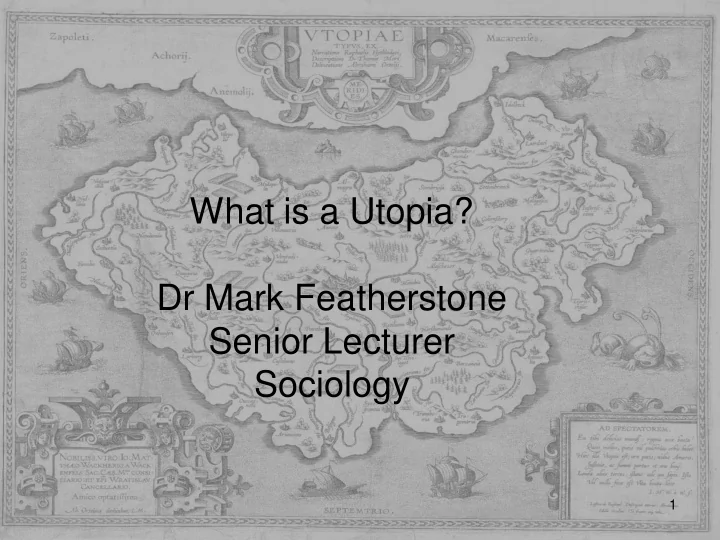
What is a Utopia? Dr Mark Featherstone Senior Lecturer Sociology 1 Part 1 What is Utopia? Sociology and Utopias What is the point of sociology? The aim of sociology is to think creatively about social problems and to try to solve


slide-1
SLIDE 1

What is a Utopia? Dr Mark Featherstone Senior Lecturer Sociology

1
slide-2
SLIDE 2

Part 1

What is Utopia?

slide-3
SLIDE 3

Sociology and Utopias

  • What is the point of sociology?
  • The aim of sociology is to think creatively about

social problems and to try to solve them.

  • In

this way there is a ‘utopian’ dimension to sociology.

  • As a discipline, sociology is concerned with thinking

about how we could make a good society.

3

slide-4
SLIDE 4

What is Utopia?

  • In 1516 Thomas More wrote about a

perfect society that was everything the real world was not.

  • There was no money or inequality in

More’s society and there was little or no crime.

  • More called his society Utopia.

4

slide-5
SLIDE 5

Ever since More wrote about utopia, and perhaps long before he put pen to paper, people have tried to design perfect worlds….

5

slide-6
SLIDE 6

Real and Imagined

These perfects world have been both real and imagined and some have been much more realistic than others.

6

slide-7
SLIDE 7

Part 2

Utopian Themes

slide-8
SLIDE 8

Utopias

  • Let’s think about four utopias:

– Plato’s Republic (Ancient Greece) – Marquis De Sade’s Society of Crime (French Revolutionary France) – Karl Marx’s Communist Society (19th Century Britain) – Steve Jobs’ Hi-Tech World (Today).

8

slide-9
SLIDE 9

Plato’s Republic

  • The first utopia was Plato’s Republic.
  • Plato

wrote his Republic sometime around 380BC.

  • He imagined a perfectly ordered society of

reason and discussion.

  • The Republic is a utopia of education, where the

best (his Philosopher Kings) people make the rules.

9

slide-10
SLIDE 10

10

The Myth of the Cave

slide-11
SLIDE 11

Other Key Themes

  • Plato also thought that the family was a bad

idea, so he abolished family childcare.

  • In

his utopia children would be raised by nurseries run by people who are skilled at producing good people.

  • In Plato’s view all that matters is the well

structured society.

11

slide-12
SLIDE 12

The Marquis De Sade

2000 years after Plato wrote his Republic the infamous French writer and libertine of the 18th century the Marquis de Sade invented a utopia of sorts, a utopia of total freedom.

12

slide-13
SLIDE 13

13

slide-14
SLIDE 14

Crime

  • De Sade’s utopia was a utopia of complete

freedom and consequently crime.

  • There are no rules in Sade’s utopia.
  • Apart from the rule to do exactly what you want

with whom you want!

  • This was a utopia of complete individualism.

14

slide-15
SLIDE 15

Marx’s Communism

Soon after De Sade, the 19th century German writer Karl Marx began to write about communism.

15

slide-16
SLIDE 16

16

slide-17
SLIDE 17

Cog in a Machine

  • For

Marx the problem with work was boredom.

  • He wanted to create a society where people

could be creative and find work that would allow them to express themselves.

  • In Marx’s society nobody would be turned

into a mindless workhorse, a cog in a machine.

17

slide-18
SLIDE 18

Apple’s Utopia

150 years after Marx the American company, Apple, and particularly its boss, Steve Jobs, imagined a world where technology would make the world a better place (a media communication utopia).

18

slide-19
SLIDE 19

19

slide-20
SLIDE 20

Jobs’ Hi-Tech World

  • After communism failed in the 1980s we entered a

period academics talk about in terms

  • f

globalisation.

  • In a globalised world we are all connected through

new media technologies, such as the iPhone.

  • Steve Jobs’ company, Apple, imagines a world

where everybody in better off and more creative because they are connected by new technologies. Is this true?

20

slide-21
SLIDE 21

So what is the purpose of utopia?

What does utopia do and why is it important?

21

slide-22
SLIDE 22

What is Utopia For?

The purpose of utopia is to challenge the way the world currently works. Utopian writers and thinkers have always imagined what the world would look like if it is was set up differently.

22

slide-23
SLIDE 23

Imaginations

In this way utopias encourage us to use critical skills to think about the problems

  • f

today and use

  • ur

imaginations to think about how we might solve these problems.

23

slide-24
SLIDE 24

Social Problems

  • Utopian writers try to solve problems of:

– Disorder – Insecurity – Regulation – Unhappiness – Inequality – Boredom – (Mis-)Communication

24

slide-25
SLIDE 25

Utopian Ideals

  • Core Themes:

– Law, Order, Socialisation of good people – End of the Family – Education – Desire, Freedom, Enjoyment, Pleasure – End of Money – Equality – Creativity – Communication

25

slide-26
SLIDE 26

Part 3

Design Your Own Utopia

slide-27
SLIDE 27

Design Your Own Utopia

  • Now

you take

  • n

the role

  • f

the utopian designer.

  • In

small groups produce a spider chart explaining what principles you want to underpin your perfect world.

  • What are the problems with today’s world and

what would you do to solve them?

  • Remember, the sky is the limit. Utopia is about

imagination.

27

slide-28
SLIDE 28

Feed Back

  • Now feedback about your perfect society.
  • What problems have you tried to solve?
  • What have you made central to your new

world?

  • Finally, what problems do you think your

new world might suffer from?

28

slide-29
SLIDE 29

Part 5

Why Utopia?

slide-30
SLIDE 30

Utopia and Sociology

  • The idea of society, and the question of the way society

should be organised, are key to the discipline of sociology.

  • The

idea

  • f

utopia is all about addressing these fundamental questions:

– What is wrong with society? – How could society be better? – What would the best possible society look like?

  • For this reason the study of utopias and dystopias is

arguably fundamental to the study of sociology.

30