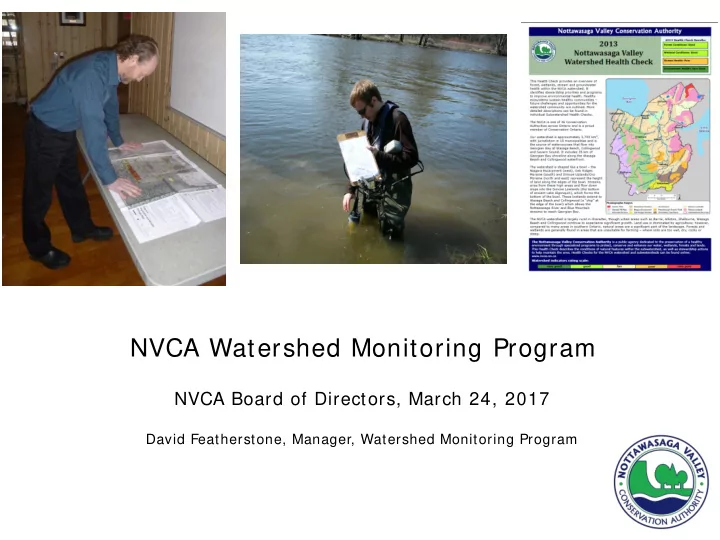
NVCA Watershed Monitoring Program NVCA Board of Directors, March 24, - - PowerPoint PPT Presentation

nvca watershed monitoring program
SMART_READER_LITE
LIVE PREVIEW

NVCA Watershed Monitoring Program NVCA Board of Directors, March 24, - - PowerPoint PPT Presentation

NVCA Watershed Monitoring Program NVCA Board of Directors, March 24, 2017 David Featherstone, Manager, Watershed Monitoring Program Pr esen t a t i o n Ou t l i n e Staffing/ Program Support Natural Heritage Plan Input and Review


slide-1
SLIDE 1

NVCA Watershed Monitoring Program

NVCA Board of Directors, March 24, 2017

David Featherstone, Manager, Watershed Monitoring Program

slide-2
SLIDE 2

Pr esen t a t i o n Ou t l i n e

  • Staffing/ Program Support
  • Natural Heritage Plan Input and Review
  • Regulation Input and Review
  • Aquatic and Terrestrial Monitoring
  • Communications

2

slide-3
SLIDE 3

Wa t er sh ed Mo n i t o r i n g Pr o g r a m

Staffing and NVCA Program Support

  • Manager (full time) – David Featherstone
  • Watershed Monitoring Specialist (full time) – Ian

Ockenden

  • 6 Month Contract
  • Summer/ Co-op Staff (non-levy

funding/ volunteer)

  • Program provides support (science) for all non-

administrative NVCA program areas

3

slide-4
SLIDE 4

Na t u r a l He r i t a g e Pl a n I n p u t a n d Re v i e w

(Technical Advisory Role)

  • Provincial planning input (Wetland Discussion Paper)
  • Broader scale municipal planning input (Official Plan,

Secondary Plan)

  • Finer scale municipal planning input (Draft Plans, Consents,

Severances)

  • Environmental Assessment input (Transportation and Servicing

EAs)

  • Review of stormwater planting, mitigation planting plans
  • Often working with proponents/ municipalities to identify/ scope

Environmental Impact Study requirements, provision of EIS review

  • Municipal support (upon request) for planning applications at

the Ontario Municipal Board and similar venues

  • Municipal natural heritage system development – Collingwood

(2011), Wasaga Beach (2005), Essa (2004) and New Tecumseth (2004)

4

slide-5
SLIDE 5

Reg u l a t i o n I n p u t a n d Rev i ew

(Permit/ Regulatory Role under Section 28 of the Conservation Authorities Act (Ontario Regulation 172/ 06))

  • review of wetland, watercourse and dynamic beach

aspects of permit applications

  • can include wetland boundary delineation
  • Review and resolution of violations associated with

above features including preparation/ review of restoration plans and assistance with charges/ court cases

  • Ongoing wetland boundary refinement based on site

inspections, consultant reports and broader efforts (Collingwood, Mono, Innisfil) – best science

5

slide-6
SLIDE 6

6

slide-7
SLIDE 7

NVCA Aq u a t i c Mo n i t o r i n g Pr o g r a m

  • Provincial Water Quality Monitoring Network

(MOECC partnership – surface water)

  • E. coli monitoring
  • Benthic monitoring
  • Instream flow monitoring
  • Fish community monitoring
  • Provincial Groundwater Monitoring Network

(MOECC partnership – Ryan Post)

7

slide-8
SLIDE 8

Pr o v i n ci a l Wa t e r Qu a l i t y Mo n i t o r i n g Ne t w o r k ( PW QMN)

  • 18 stations sampled six to ten times/ year

(8 stations X 10, 10 stations X 6)

  • Targeted to seasonal baseflow (low flow) and

storm events

  • All stations sampled for nutrients and standard

chemistry (i.e. pH, conductivity, dissolved

  • xygen)
  • Six stations sampled for metals (intensive urban

and agricultural land use areas)

8

slide-9
SLIDE 9

9

PWQMN Map

slide-10
SLIDE 10

Ben t h i c Mo n i t o r i n g

  • Benthic invertebrates are the animals that live in the sediments and

among the plants and rocks on the bottom of a stream or lake

  • Aquatic insects, leeches, crayfish, snails, clams
  • Cornerstone of NVCA aquatic monitoring program since 1996
  • We sample stream benthos (bugs) to assess stream health
  • Abundant, widespread
  • Easily, inexpensively sampled
  • Limited mobility – (unlike fish)
  • Relatively long lived (months to years)
  • Have different tolerances to stressors
  • Respond to both water and sediment chemistry
  • “What are long term stream health trends?”
  • “Is development impacting our streams?”
  • “Are our stewardship activities effective?”

10

slide-11
SLIDE 11

11

Benthic Map

slide-12
SLIDE 12

Ot h e r Aq u a t i c Mo n i t o r i n g Co m p o n e n t s

  • Instream temperature monitoring – to identify

cold, cool and warmwater habitats; identify impacts/ benefits of development and stewardship

  • Flow monitoring – to assist NVCA Engineering

with flow rating curves, identify significant areas

  • f groundwater discharge (and recharge)
  • Fish community monitoring – to assess impacts
  • f development and stewardship; to identify

shifts in species populations (i.e. brook trout)

12

slide-13
SLIDE 13

Pr o v i n ci a l Gr o u n d w a t e r Mo n i t o r i n g Ne t w o r k

  • MOECC partnership led by Ryan Post
  • Tracking water levels in ambient wells over time

(potential climate change indicator)

  • Tracking water quality in wells and informing

landowners/ municipalities of exceedances including interpretation of exceedance results

13

slide-14
SLIDE 14

14

PWQMN Map

slide-15
SLIDE 15

Ter r est r i a l Mo n i t o r i n g

  • Small component of program focused on NVCA

properties as capacity allows

  • Breeding bird monitoring (Tiffin and Minesing)

assists with property management and feeds into established provincial monitoring

  • Assistance with NVCA Lands acquisition process

and property management (Minesing Wetlands, Notttawasaga Bluffs, Tiffin)

  • Invasive species monitoring/ management

15

slide-16
SLIDE 16

Co m m u n i ca t i o n s

  • Watershed Report Cards/ Health Checks
  • Initiated in 2007 with update in 2013 and planned update

for 2018

  • Reporting to public – aimed at reporting on watershed

forest, wetland, stream and groundwater health; also a vehicle for promoting watershed stewardship activities

16

slide-17
SLIDE 17

17

Wa t e r sh e d Mo n i t o r i n g Pr o g r a m Su m m a r y W atershed Science supporting:

  • Planning/ Regs – natural heritage input and review, contribution to

natural heritage system development, monitoring potential impacts associated with land use change

  • Engineering – flow rating curve development, flow measurement, water

chemistry input to modeling

  • Stewardship – identification of “best bet” projects, monitoring success
  • f stewardship projects (lessons learned)
  • Lands – input to property acquisition and property management
  • Communications – reporting on watershed health and stewardship

action OUR VISION:

  • Innovative watershed management supporting a healthy environment,

communities and lifestyles. OUR MISSION:

  • Working together to lead, promote, support and inspire innovative

watershed management.

slide-18
SLIDE 18

Thank You!