Judbarra - Gregory karst & Caves. NB change of name (& - - PDF document

judbarra gregory karst caves nb change of name spelling
SMART_READER_LITE
LIVE PREVIEW

Judbarra - Gregory karst & Caves. NB change of name (& - - PDF document

Judbarra - Gregory karst & Caves. NB change of name (& spelling) Pronounced "jute-bra" Talk to ASF Conference, Chillagoe, April 2011 The Judbarra-Gregory Karst & Caves Northern Australia Ken Grimes & Jacques


slide-1
SLIDE 1

The Judbarra-Gregory Karst & Caves

Northern Australia

Ken Grimes & Jacques Martini 2011

Judbarra - Gregory karst & Caves. NB change of name (& spelling) Pronounced "jute-bra" Talk to ASF Conference, Chillagoe, April 2011

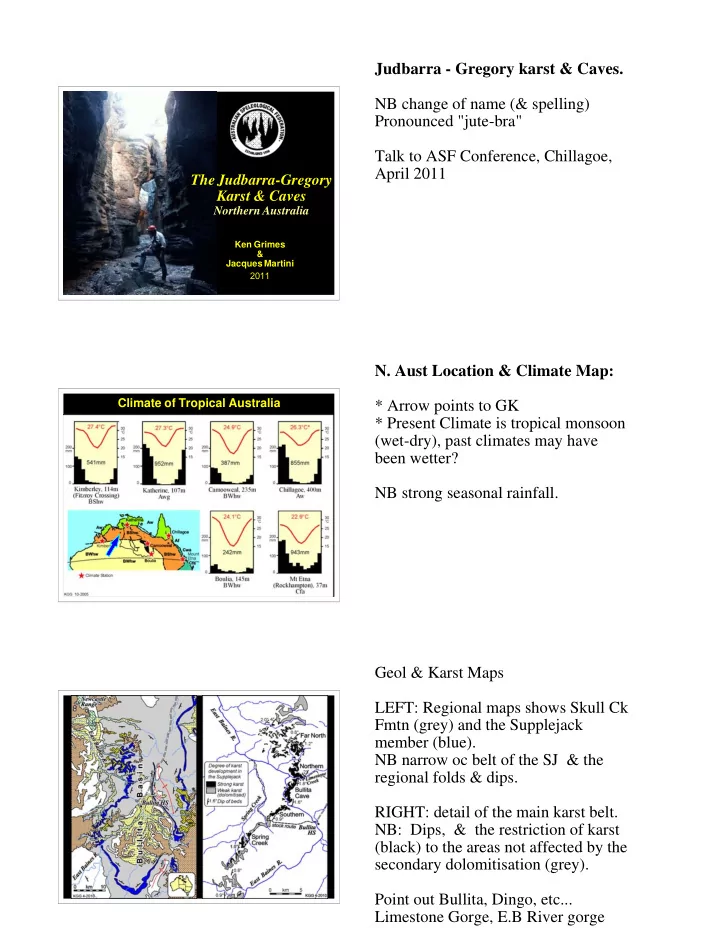
Climate of Tropical Australia

  • N. Aust Location & Climate Map:

* Arrow points to GK * Present Climate is tropical monsoon (wet-dry), past climates may have been wetter? NB strong seasonal rainfall. Geol & Karst Maps LEFT: Regional maps shows Skull Ck Fmtn (grey) and the Supplejack member (blue). NB narrow oc belt of the SJ & the regional folds & dips. RIGHT: detail of the main karst belt. NB: Dips, & the restriction of karst (black) to the areas not affected by the secondary dolomitisation (grey). Point out Bullita, Dingo, etc... Limestone Gorge, E.B River gorge

slide-2
SLIDE 2

Geology

  • Upper Skull Ck

(Microkarren)

  • Supplejack member

(Main karrenfield & caves)

  • Shale bed

(Main cave development)

  • Lower Skull Ck

(Lower levels of cave)

[ KG ]

GEOLOGY Diagram shows the geol units. Describe lithol & also karst features also point out karren zones & mention slope retreat. Photo (Lstn Gorge) shows SJ cliffs & karren\ USC soft shale with resistant lst beds

Upper Skull Ck: Microkarren

mm

mm

Upper Skull Ck = MICROKARREN Best developed on the USC. But little

  • ther karst in USC

Stromatolites

[ KG ]

STROMATLITES A feature of the recently exposed top

  • f the SJ.

Broad low domes + incipient karren. (zone 1) Inset is smaller strom dome - such as

  • ccurs elsewhere in the formations
slide-3
SLIDE 3

Supplejack: Finely interbedded dolomite (cream) and limestone (grey)

[ KG ] [ KG ]

SUPPLEJACK MEMBER (Left) the SJ is typically finely interbedded Dolomite (cream) and Limestone (grey). The limestone is more soluble, and in places this results in sharp horizontal ledges in the passage walls (Right photo).

The main shale bed

[ JM ]

MAIN SHALE BED Flat ceiling = base of the SJ Shale bed ~3m thick: shale (sh) sandwiched between thin beds of mudstone (m) at top & bottom Is soft and easily eroded by water flowing through the cave. Much of the cave volume is in this bed. White ceiling = coralloids (popcorn).

Secondary dolomite (pale blue) inhibits karst (dark blue)

SECONDARY DOLOMITE This effect postdates deposition of the limestone, but predates the karst by a long time. The secondary dolomite is coarse grained and erodes more rapidly than the primary dolomite & limestone. It inhibits both karren & cave formation. The map show the transition from karrenfield at top to an area where scattered undolomitised patches remain as upstanding pinnacles ("mini-tower-karst").

slide-4
SLIDE 4

Karrenfield

  • 4 Zones

Progressively exposed by slope retreat – Youngest to Oldest

  • Caves

are related to the karren zones

KARREN FIELD Diagram shows the 4 zones: youngest to oldesest Air Photo shows these zones & also the large stromatolite domes being exposed by slope retreat erosion

  • f the overlying USC at right.

Karrenfield (blue) and Cave passages RELATIONSHIP Karren : Cave Blue is karren zones (darkest is youthful zone 1, lightest is degraded zone 4) Cave passages are mainly under zones 2 & 3. Those under zone 1 are small crawly, those in zone 4 are mostly unroofed to form giant grikes. Point out "Hermitage Grange" chamber (photo later) Red bits are lower-level passages, near Limestone Gorge The Zone 3 area NW of Golden Arches does have some caves, but these have not yet been mapped. Speleogenesis

SPELEOGENESIS HYDRO: Main INPUT is rain via karrenfield. Allogenic flow from USC is less sig (but some mixing?). Also possible mixing with permanent aquifer at right? WT rises during Wet season (dammed by "levee"), lower in Dry (when cavers present). So alternation of phreatic & vadose conditions [We NEED Data on the Wet season levels and flow directions] OUTPUTS = lateral through breaks in "levee" & also via deep drains near gorges. * Looking from right to left we see the progressive development of both karren & cave. 1: Slope retreat exposes top of SJ (right), karren dev commences. Minimal cave dev - small Ps in SJ, perched above shale 2: enlargement of karren grikes and growth of passages, begin to cut down into shale. 3: Karren opening up and starting to join with cave Ps. Shale rapidy eroded during wet season vadose floods. Wet season flows variable and reversing (complex?) 4: Unroofing pf cave, giant grikes etc. "Levee" formed by debries and vegetation.
slide-5
SLIDE 5

Youthfull Passages

(zone 1) [ KG ] [ KG ] [ KG ]

YOUTH - OLD AGE Youthfull Passages near Zone 1-2

  • junction. (all in SJ)

Old Age

Unroofed passages in zone 4 [ KG ] [ KG ]

YOUTH - OLD AGE Old age = deep grikes, unroofing of passages & dev of "levee" Then break up into a Ruiniform relief

  • f stone city etc (next slide)....

[ KG ] [ KG ]

Old Age: Stone city and stone forest (isolated pinnacles)

YOUTH - OLD AGE Ruiniform Relief: Top; At edge of karrenfield we get Stone Cities ... and ... Bottom: ...Stone Forests (= isolate pinnacles on a pediment)

slide-6
SLIDE 6

PASSAGE TYPES (Zones 2-3) Diagram shows 4 typical types but

  • ther variants occur (eg inverted-T

wrt shale). Photos follow ...

Phreatic pasages in the Supplejack.

Form within the unit and right at its base - perched above the shale bed.

[ KG ]

Phreatic Passages "Typical" shapes = smoothly rounded tunnels, with bridges and pockets. These form in the SJ at various levels above the shale bed. More common in some sectors than others (possibly has to do with duration of wet season flooding?)

Shale bed [ KG ]

Phreatic Passages PPs high above the shale

slide-7
SLIDE 7

Shale bed was here

[ KG ]

Phreatic Passages PPs sitting immediately above the shale bed (perched water flow) Note "omega" shape left after erosion

  • f underlying shale.

White areas = coralloids (popcorn).

[ KG ] [ KG ]

Tented & A-fissure passages Fluctuating WT means progressively greater solution in lower parts of wall. Next photo shows better eg of "bevel" ...

Bevelled walls at an old water table

(note stream channel)

[ JM ]

Tented passage in SJ Note bevel at a past(?) consistent wet- season(?) water table - shale bed is lower (just out of sight) NB also the wet season stream channel

slide-8
SLIDE 8

Inverted-T Passage

Joint-fissure in Supplejack & Horizontal slot in shale bed.

[ KG ]

Inverted-T passage: A vertical joint-controlled fissure in the SJ A horizontal slot in the shale bed. Note also the bevel ~1m above top of shale.

The main shale bed

[ JM ]

MAIN SHALE BED (redisplay of photo shown earlier) Flat ceiling = base of the SJ Shale bed ~3m thick: shale (sh) sandwiched between thin beds of mudstone (m) at top & bottom Is soft and easily eroded by water flowing through the cave. Much of the cave volume is in this bed. White ceiling = coralloids (popcorn).

The Hermitage Grange: A broad chamber in the shale bed

[ KG ]

Hermitage Grange A large chamber in shale bed (under zone 2). NB fissures in ceiling rise into SJ. Some connect to surface (see line of tree roots) NB: Shale pillars (and see profile diagram at bottom) White ceiling = coralloids (popcorn).

slide-9
SLIDE 9

main level lower level Detail of Efflux area 20 m

[ Mark Sefton ]

Deeper levels

[ JM ]

DEEPER LEVELS Diagram shows entrenchment below main shale bed, to a lower shale and beyond. PHOTOS: Left = shallow entrenchment of a shale passage (shale = slot at top) Right = Deeper entrenchment to form a big room. Flat bottom of SJ and shale bed visible at top.

[ Mark Sefton ]

STILL DEEPER MAP= The deeper passages are less complex and more linear than maze- like. They show both phreatic (Wet season floods?) and vadose character. In Dingo cave there are some permanant water sumps. None in Bullita C

Speleothems

[ KG ] [ KG ] [ KG ]

SPELEOTHEMS Are not abundant, and are dominantly coralloid coatings on ceiling and walls (right) The Pendulite has been hanging into a saturated (late wet season?) pool and accreated rims as a result.

slide-10
SLIDE 10

[ Lloyd Robinson ] [ Mark Sefton ] [ KG ] [ KG ]

OTHER SPELEOTHEMS Top-left = a possible cave cloud - formed wihin a saturated wet-season pool in the low-level Efflux area. Top-right = gypsum flower - one occ

  • nly, suggests localised sulphide

mineralisation Bot-left = microgours and a composite cave pearl ("golf ball") Bot-right = photo-tropic coralloids and solution spikes - near daylight.

SPELEOGENESIS MAIN Features & Processess 1: Lithology & Structure * A thin, gently-dipping limestone over a shale bed. * Secondary dolomitisation inhibits karst 2: Surface topography & erosion history * Slope retreat, karren development, proximity to gorges 3: Linked karrenfield & Cave devopment * Zonation of both Karrenfield & Cave: youth -- old age 4: Caves * horizontal mazes in epikarst zone * Develop in sync with karrenfield above * Vertical zones (Supplejack - Shale - Deeper levels in LSC) 5: Hydrology: * Seasonal rainfall & flooding of cave * fast vertical autogenic input * Lesser lateral allogenic input * Seasonal ponding * Proximity to gorges = strong water gradients SPELEOGENESIS MAIN Features & Processess 1: Lithology & Structure * A thin, gently-dipping limestone over a shale bed. * Secondary dolomitisation inhibits karst 2: Surface topography & erosion history * Slope retreat, karren development, proximity to gorges 3: Linked karrenfield & Cave devopment * Zonation of both Karrenfield & Cave: youth -- old age 4: Caves * horizontal mazes in epikarst zone * Develop in sync with karrenfield above * Vertical zones (Supplejack - Shale - Deeper levels in LSC) 5: Hydrology: * Seasonal rainfall & flooding of cave * fast vertical autogenic input * Lesser lateral allogenic input * Seasonal ponding * Proximity to gorges = strong water gradients

Speleogenesis

SPELEOGENESIS - MAIN Features 1: A thin limstone over a shale bed. 2: Secondary dolomitisation 3: Linked karrenfield & Cave dev - Zones of KF & Cave = diachronous 4: Cs = horiz maze in epikarst zone Progressive dev wrt KF above. Vertical zones (SJ - shale - deep) 5: Hydro = seasonal rain, ponding behind levees CONTROLLING Factors 1: Lithol & Structure 2: Surface erosion = slope retreat, karren zonation. proximity to gorges 3: HYDRO: * Seasonal rainfall & flooding of cave - slow surface solution + alternating phreatic & vadose in C * fast vertical autogenic input * Lesser lateral allogenic * Seasonal ponding * Proximity top gorges = stron gradients

slide-11
SLIDE 11

Acknowledgements to sources

  • Storm & Smith (Project Rauleigh) 1990:

for initial mapping and publication.

  • John Dunkley 1993:

first recognition of the zoning of the karrenfield.

  • Peter Bannink et al (Top End Speleos) 1995:

first scientific analysis: recognised the epikarst influence and significance of the shale bed.

  • Jaques Martini (chief author):

for systematic geological studies - see our paper in press

  • •• All members of the GKSIG 1990-2011:

For 20+ years of systematic exploration and mapping.

ACKNOWLEDGEMENTS: NB: This is to the scientific workers who published the ideas In some cases the ideas and concepts were probably evolved in discussions in the field. Present paper is largely the work of Jaques Martini, but presented here by KGG - see our joint paper to appear in Helictite Vol 41

The End

END Sculptured Pinnacles in zone 4 Baobob tree