
SLIDE 1
Joshua K. Miller, Christian Haselwimmer, Anupma Prakash Geophysical Institute, University of Alaska Fairbanks
Joshua K. Miller , Christian Haselwimmer, Anupma Prakash Geophysical - - PowerPoint PPT Presentation
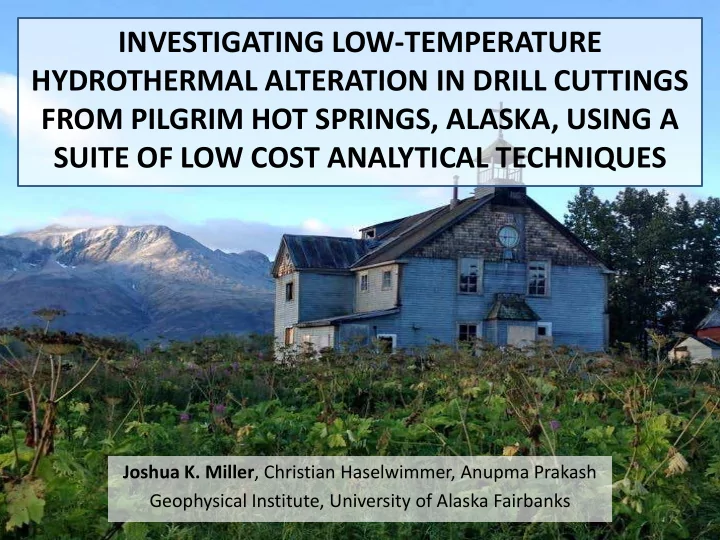
INVESTIGATING LOW-TEMPERATURE HYDROTHERMAL ALTERATION IN DRILL CUTTINGS FROM PILGRIM HOT SPRINGS, ALASKA, USING A SUITE OF LOW COST ANALYTICAL TECHNIQUES Joshua K. Miller , Christian Haselwimmer, Anupma Prakash Geophysical Institute, University
Joshua K. Miller, Christian Haselwimmer, Anupma Prakash Geophysical Institute, University of Alaska Fairbanks
Research funding provided by Department of Energy Geothermal Technologies Programme (CID: DE-EE0002846) and the Alaska Energy Authority Renewable Energy Fund Round III Project team headed by Gwen Holdmann (ACEP, Director), consultants William (Bill) Cumming and Dick Benoit, as well as many other organizations:
(Chittambakkam et al., 2013)
interaction of light with a medium that absorbs specific wavelengths that produces characteristic spectrums.
(Ruitenbeek et al., 2005)
Montmorillonite USGS Reference Sample Absorption Reflection
samples
– R: 2145 nm – G: 2205 nm – B: 2235 nm PS-12-2 Hyperspectral Cube
(Calvin et al., 2010)
5 10 15 20 25 30 MgChlorite Muscovitic Illite Muscovite FeMgChlorite Siderite Kaolinite Montmorillonite
5 10 15 20 25 30
Hornblende Biotite Ankerite Siderite Calcite Muscovite Muscovitic Illite Montmorillonite MgChlorite Phlogopite FeMgChlorite
PS-12-2 Sediments PS-12-2 Core Micas Clays
clay
for PS-12-2
samples
Methylene Blue results comparison
particles and saturated with ethylene glycol
(B)iotite, (K)aolinite detected
S N W E
S N W E
Groundwater flow
Biotite schist Pegmatitic dike Diabase dike Biotite schist/pegmatitic dike contact