Joint work with Stability of difference equations with an infinite - - PowerPoint PPT Presentation

joint work with stability of difference equations with an
SMART_READER_LITE
LIVE PREVIEW

Joint work with Stability of difference equations with an infinite - - PowerPoint PPT Presentation

Bohl-Perron Theorems - DDE Approach Bohl-Perron Theorems - DDE Approach Reduction Method Reduction Method Reduction for Infinite Delays Reduction for Infinite Delays Joint work with Stability of difference equations with an infinite delay


slide-1
SLIDE 1

Bohl-Perron Theorems - DDE Approach Reduction Method Reduction for Infinite Delays

Stability of difference equations with an infinite delay

Elena Braverman University of Calgary, Canada The 18-th International Conference on Difference Equations and Applications, Barcelona, Spain, July 23-27, 2012

Elena Braverman University of Calgary, Canada Stability of difference equations with an infinite delay Bohl-Perron Theorems - DDE Approach Reduction Method Reduction for Infinite Delays

Joint work with

◮ Leonid Berezansky

(Ben Gurion University, Israel)

◮ Illia Karabash

(Inst. Applied Math. Mechanics, Donetsk, Ukraine)

Elena Braverman University of Calgary, Canada Stability of difference equations with an infinite delay Bohl-Perron Theorems - DDE Approach Reduction Method Reduction for Infinite Delays

Joint work with

◮ Leonid Berezansky

(Ben Gurion University, Israel)

◮ Illia Karabash

(Inst. Applied Math. Mechanics, Donetsk, Ukraine)

Elena Braverman University of Calgary, Canada Stability of difference equations with an infinite delay Bohl-Perron Theorems - DDE Approach Reduction Method Reduction for Infinite Delays Introduction Stability Main Theorem - Bounded Delay

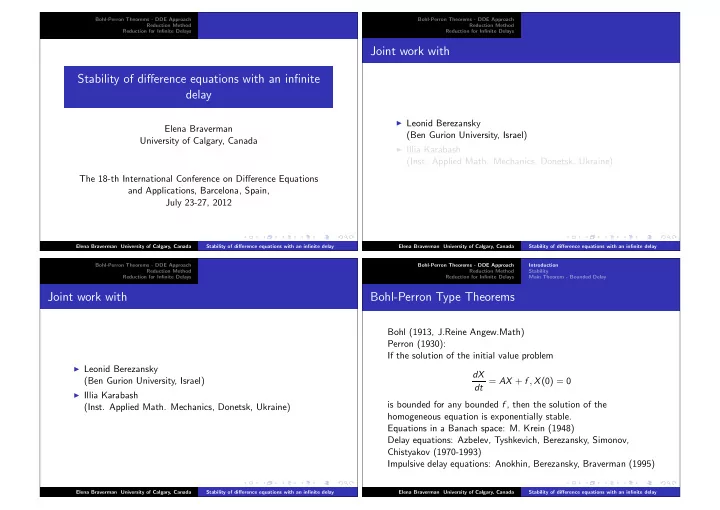
Bohl-Perron Type Theorems

Bohl (1913, J.Reine Angew.Math) Perron (1930): If the solution of the initial value problem dX dt = AX + f , X(0) = 0 is bounded for any bounded f , then the solution of the homogeneous equation is exponentially stable. Equations in a Banach space: M. Krein (1948) Delay equations: Azbelev, Tyshkevich, Berezansky, Simonov, Chistyakov (1970-1993) Impulsive delay equations: Anokhin, Berezansky, Braverman (1995)

Elena Braverman University of Calgary, Canada Stability of difference equations with an infinite delay
slide-2
SLIDE 2

Bohl-Perron Theorems - DDE Approach Reduction Method Reduction for Infinite Delays Introduction Stability Main Theorem - Bounded Delay

Difference equations

Bohl-Perron type result for a nondelay difference equation: [1] C.V. Coffman and J.J. Sch¨ affer, Dichotomies for linear difference equations, Math. Ann. 172 (1967), pp. 139–166. [2] B. Aulbach, N. Van Minh, The concept of spectral dichotomy for linear difference equations. II, J. Differ. Equations Appl. 2 (1996), 251–262. Theorem [2]. If a solution of the equation xn+1 = Anxn + fn (1) belongs to ℓp, 1 ≤ p ≤ ∞, for any sequence fn in the same space ℓp, then the solution of the homogeneous equation xn+1 = Anxn (2) decays exponentially with the growth of n.

Elena Braverman University of Calgary, Canada Stability of difference equations with an infinite delay Bohl-Perron Theorems - DDE Approach Reduction Method Reduction for Infinite Delays Introduction Stability Main Theorem - Bounded Delay

The case of different spaces

If for any fn ∈ ℓ1 the solution is bounded, then the equation is stable (but, generally speaking, not exponentially). Suppose a solution of xn+1 = Anxn + fn belongs to ℓ∞ for any fn from ℓp, 1 < p < ∞; what kind of stability can be deduced for xn+1 = Anxn? Quite recently it was proved in [3] M. Pituk, A criterion for the exponential stability of linear difference equations, Appl. Math. Let. 17 (2004), 779–783. that under the above conditions the solution is exponentially stable.

Elena Braverman University of Calgary, Canada Stability of difference equations with an infinite delay Bohl-Perron Theorems - DDE Approach Reduction Method Reduction for Infinite Delays Introduction Stability Main Theorem - Bounded Delay

Some other relevant references

  • K. M. Przyluski, Remarks on the stability of linear infinite-dimensional discrete-time systems, J. Differ.
  • Equ. 72 (1988), pp. 189–200.

  • S. Elaydi and S. Murakami, Asymptotic stability versus exponential stability in linear Volterra difference

equations of convolution type, J. Difference Equ. Appl. 2 (1996), pp. 401–410.

  • M. Pituk, Global asymptotic stability in a perturbed higher order linear difference equation, Comput.
  • Math. Appl. 45 (2003), 1195–1202.

  • V. B. Kolmanovskii, E. Castellanos-Velasco, and J.A. Torres-Mu˜

noz, A survey: stability and boundedness of Volterra difference equations, Nonlinear Anal. 53 (2003), pp. 861–928.

  • H. Matsunaga and S. Murakami, Some invariant manifolds for functional difference equations with infinite

delay, J. Difference Equ. Appl. 10 (2004), pp. 661–689.

  • B. Sasu and A. L. Sasu, Stability and stabilizability for linear systems of difference equations, J. Differ.

Equations Appl. 10 (2004), pp. 1085–1105.

  • H. Matsunaga and S. Murakami, Asymptotic behavior of solutions of functional difference equations, J.
  • Math. Anal. Appl. 305 (2005), pp. 391–410.

  • F. Cardoso and C. Cuevas, Exponential dichotomy and boundedness for retarded functional difference

equations, J. Difference Equ. Appl. 15 (2009), pp. 261–290. Elena Braverman University of Calgary, Canada Stability of difference equations with an infinite delay Bohl-Perron Theorems - DDE Approach Reduction Method Reduction for Infinite Delays Introduction Stability Main Theorem - Bounded Delay

Some other relevant references

  • K. M. Przyluski, Remarks on the stability of linear infinite-dimensional discrete-time systems, J. Differ.
  • Equ. 72 (1988), pp. 189–200.

  • S. Elaydi and S. Murakami, Asymptotic stability versus exponential stability in linear Volterra difference

equations of convolution type, J. Difference Equ. Appl. 2 (1996), pp. 401–410.

  • M. Pituk, Global asymptotic stability in a perturbed higher order linear difference equation, Comput.
  • Math. Appl. 45 (2003), 1195–1202.

  • V. B. Kolmanovskii, E. Castellanos-Velasco, and J.A. Torres-Mu˜

noz, A survey: stability and boundedness of Volterra difference equations, Nonlinear Anal. 53 (2003), pp. 861–928.

  • H. Matsunaga and S. Murakami, Some invariant manifolds for functional difference equations with infinite

delay, J. Difference Equ. Appl. 10 (2004), pp. 661–689.

  • B. Sasu and A. L. Sasu, Stability and stabilizability for linear systems of difference equations, J. Differ.

Equations Appl. 10 (2004), pp. 1085–1105.

  • H. Matsunaga and S. Murakami, Asymptotic behavior of solutions of functional difference equations, J.
  • Math. Anal. Appl. 305 (2005), pp. 391–410.

  • F. Cardoso and C. Cuevas, Exponential dichotomy and boundedness for retarded functional difference

equations, J. Difference Equ. Appl. 15 (2009), pp. 261–290. Elena Braverman University of Calgary, Canada Stability of difference equations with an infinite delay

slide-3
SLIDE 3

Bohl-Perron Theorems - DDE Approach Reduction Method Reduction for Infinite Delays Introduction Stability Main Theorem - Bounded Delay

Some other relevant references

  • K. M. Przyluski, Remarks on the stability of linear infinite-dimensional discrete-time systems, J. Differ.
  • Equ. 72 (1988), pp. 189–200.

  • S. Elaydi and S. Murakami, Asymptotic stability versus exponential stability in linear Volterra difference

equations of convolution type, J. Difference Equ. Appl. 2 (1996), pp. 401–410.

  • M. Pituk, Global asymptotic stability in a perturbed higher order linear difference equation, Comput.
  • Math. Appl. 45 (2003), 1195–1202.

  • V. B. Kolmanovskii, E. Castellanos-Velasco, and J.A. Torres-Mu˜

noz, A survey: stability and boundedness of Volterra difference equations, Nonlinear Anal. 53 (2003), pp. 861–928.

  • H. Matsunaga and S. Murakami, Some invariant manifolds for functional difference equations with infinite

delay, J. Difference Equ. Appl. 10 (2004), pp. 661–689.

  • B. Sasu and A. L. Sasu, Stability and stabilizability for linear systems of difference equations, J. Differ.

Equations Appl. 10 (2004), pp. 1085–1105.

  • H. Matsunaga and S. Murakami, Asymptotic behavior of solutions of functional difference equations, J.
  • Math. Anal. Appl. 305 (2005), pp. 391–410.

  • F. Cardoso and C. Cuevas, Exponential dichotomy and boundedness for retarded functional difference

equations, J. Difference Equ. Appl. 15 (2009), pp. 261–290. Elena Braverman University of Calgary, Canada Stability of difference equations with an infinite delay Bohl-Perron Theorems - DDE Approach Reduction Method Reduction for Infinite Delays Introduction Stability Main Theorem - Bounded Delay

Some other relevant references

  • K. M. Przyluski, Remarks on the stability of linear infinite-dimensional discrete-time systems, J. Differ.
  • Equ. 72 (1988), pp. 189–200.

  • S. Elaydi and S. Murakami, Asymptotic stability versus exponential stability in linear Volterra difference

equations of convolution type, J. Difference Equ. Appl. 2 (1996), pp. 401–410.

  • M. Pituk, Global asymptotic stability in a perturbed higher order linear difference equation, Comput.
  • Math. Appl. 45 (2003), 1195–1202.

  • V. B. Kolmanovskii, E. Castellanos-Velasco, and J.A. Torres-Mu˜

noz, A survey: stability and boundedness of Volterra difference equations, Nonlinear Anal. 53 (2003), pp. 861–928.

  • H. Matsunaga and S. Murakami, Some invariant manifolds for functional difference equations with infinite

delay, J. Difference Equ. Appl. 10 (2004), pp. 661–689.

  • B. Sasu and A. L. Sasu, Stability and stabilizability for linear systems of difference equations, J. Differ.

Equations Appl. 10 (2004), pp. 1085–1105.

  • H. Matsunaga and S. Murakami, Asymptotic behavior of solutions of functional difference equations, J.
  • Math. Anal. Appl. 305 (2005), pp. 391–410.

  • F. Cardoso and C. Cuevas, Exponential dichotomy and boundedness for retarded functional difference

equations, J. Difference Equ. Appl. 15 (2009), pp. 261–290. Elena Braverman University of Calgary, Canada Stability of difference equations with an infinite delay Bohl-Perron Theorems - DDE Approach Reduction Method Reduction for Infinite Delays Introduction Stability Main Theorem - Bounded Delay

Some other relevant references

  • K. M. Przyluski, Remarks on the stability of linear infinite-dimensional discrete-time systems, J. Differ.
  • Equ. 72 (1988), pp. 189–200.

  • S. Elaydi and S. Murakami, Asymptotic stability versus exponential stability in linear Volterra difference

equations of convolution type, J. Difference Equ. Appl. 2 (1996), pp. 401–410.

  • M. Pituk, Global asymptotic stability in a perturbed higher order linear difference equation, Comput.
  • Math. Appl. 45 (2003), 1195–1202.

  • V. B. Kolmanovskii, E. Castellanos-Velasco, and J.A. Torres-Mu˜

noz, A survey: stability and boundedness of Volterra difference equations, Nonlinear Anal. 53 (2003), pp. 861–928.

  • H. Matsunaga and S. Murakami, Some invariant manifolds for functional difference equations with infinite

delay, J. Difference Equ. Appl. 10 (2004), pp. 661–689.

  • B. Sasu and A. L. Sasu, Stability and stabilizability for linear systems of difference equations, J. Differ.

Equations Appl. 10 (2004), pp. 1085–1105.

  • H. Matsunaga and S. Murakami, Asymptotic behavior of solutions of functional difference equations, J.
  • Math. Anal. Appl. 305 (2005), pp. 391–410.

  • F. Cardoso and C. Cuevas, Exponential dichotomy and boundedness for retarded functional difference

equations, J. Difference Equ. Appl. 15 (2009), pp. 261–290. Elena Braverman University of Calgary, Canada Stability of difference equations with an infinite delay Bohl-Perron Theorems - DDE Approach Reduction Method Reduction for Infinite Delays Introduction Stability Main Theorem - Bounded Delay

Some other relevant references

  • K. M. Przyluski, Remarks on the stability of linear infinite-dimensional discrete-time systems, J. Differ.
  • Equ. 72 (1988), pp. 189–200.

  • S. Elaydi and S. Murakami, Asymptotic stability versus exponential stability in linear Volterra difference

equations of convolution type, J. Difference Equ. Appl. 2 (1996), pp. 401–410.

  • M. Pituk, Global asymptotic stability in a perturbed higher order linear difference equation, Comput.
  • Math. Appl. 45 (2003), 1195–1202.

  • V. B. Kolmanovskii, E. Castellanos-Velasco, and J.A. Torres-Mu˜

noz, A survey: stability and boundedness of Volterra difference equations, Nonlinear Anal. 53 (2003), pp. 861–928.

  • H. Matsunaga and S. Murakami, Some invariant manifolds for functional difference equations with infinite

delay, J. Difference Equ. Appl. 10 (2004), pp. 661–689.

  • B. Sasu and A. L. Sasu, Stability and stabilizability for linear systems of difference equations, J. Differ.

Equations Appl. 10 (2004), pp. 1085–1105.

  • H. Matsunaga and S. Murakami, Asymptotic behavior of solutions of functional difference equations, J.
  • Math. Anal. Appl. 305 (2005), pp. 391–410.

  • F. Cardoso and C. Cuevas, Exponential dichotomy and boundedness for retarded functional difference

equations, J. Difference Equ. Appl. 15 (2009), pp. 261–290. Elena Braverman University of Calgary, Canada Stability of difference equations with an infinite delay

slide-4
SLIDE 4

Bohl-Perron Theorems - DDE Approach Reduction Method Reduction for Infinite Delays Introduction Stability Main Theorem - Bounded Delay

Some other relevant references

  • K. M. Przyluski, Remarks on the stability of linear infinite-dimensional discrete-time systems, J. Differ.
  • Equ. 72 (1988), pp. 189–200.

  • S. Elaydi and S. Murakami, Asymptotic stability versus exponential stability in linear Volterra difference

equations of convolution type, J. Difference Equ. Appl. 2 (1996), pp. 401–410.

  • M. Pituk, Global asymptotic stability in a perturbed higher order linear difference equation, Comput.
  • Math. Appl. 45 (2003), 1195–1202.

  • V. B. Kolmanovskii, E. Castellanos-Velasco, and J.A. Torres-Mu˜

noz, A survey: stability and boundedness of Volterra difference equations, Nonlinear Anal. 53 (2003), pp. 861–928.

  • H. Matsunaga and S. Murakami, Some invariant manifolds for functional difference equations with infinite

delay, J. Difference Equ. Appl. 10 (2004), pp. 661–689.

  • B. Sasu and A. L. Sasu, Stability and stabilizability for linear systems of difference equations, J. Differ.

Equations Appl. 10 (2004), pp. 1085–1105.

  • H. Matsunaga and S. Murakami, Asymptotic behavior of solutions of functional difference equations, J.
  • Math. Anal. Appl. 305 (2005), pp. 391–410.

  • F. Cardoso and C. Cuevas, Exponential dichotomy and boundedness for retarded functional difference

equations, J. Difference Equ. Appl. 15 (2009), pp. 261–290. Elena Braverman University of Calgary, Canada Stability of difference equations with an infinite delay Bohl-Perron Theorems - DDE Approach Reduction Method Reduction for Infinite Delays Introduction Stability Main Theorem - Bounded Delay

Some other relevant references

  • K. M. Przyluski, Remarks on the stability of linear infinite-dimensional discrete-time systems, J. Differ.
  • Equ. 72 (1988), pp. 189–200.

  • S. Elaydi and S. Murakami, Asymptotic stability versus exponential stability in linear Volterra difference

equations of convolution type, J. Difference Equ. Appl. 2 (1996), pp. 401–410.

  • M. Pituk, Global asymptotic stability in a perturbed higher order linear difference equation, Comput.
  • Math. Appl. 45 (2003), 1195–1202.

  • V. B. Kolmanovskii, E. Castellanos-Velasco, and J.A. Torres-Mu˜

noz, A survey: stability and boundedness of Volterra difference equations, Nonlinear Anal. 53 (2003), pp. 861–928.

  • H. Matsunaga and S. Murakami, Some invariant manifolds for functional difference equations with infinite

delay, J. Difference Equ. Appl. 10 (2004), pp. 661–689.

  • B. Sasu and A. L. Sasu, Stability and stabilizability for linear systems of difference equations, J. Differ.

Equations Appl. 10 (2004), pp. 1085–1105.

  • H. Matsunaga and S. Murakami, Asymptotic behavior of solutions of functional difference equations, J.
  • Math. Anal. Appl. 305 (2005), pp. 391–410.

  • F. Cardoso and C. Cuevas, Exponential dichotomy and boundedness for retarded functional difference

equations, J. Difference Equ. Appl. 15 (2009), pp. 261–290. Elena Braverman University of Calgary, Canada Stability of difference equations with an infinite delay Bohl-Perron Theorems - DDE Approach Reduction Method Reduction for Infinite Delays Introduction Stability Main Theorem - Bounded Delay

Outline of Bohl-Perron type methods

◮ Application of solution representations.

Some proofs are based on the solution representation x(n) =

n

  • k=1

X(n, k + 1)f (k), (3) where X(n, k) satisfies the semigroup equality X(n, k) = X(n, i)X(i, k), n > i > k. (4) This is relevant for first order difference equations only.

◮ Results are applied to study stability properties.

(stability ⇔ a solution belongs to a certain space)

Elena Braverman University of Calgary, Canada Stability of difference equations with an infinite delay Bohl-Perron Theorems - DDE Approach Reduction Method Reduction for Infinite Delays Introduction Stability Main Theorem - Bounded Delay

Outline of Bohl-Perron type methods

◮ Application of solution representations.

Some proofs are based on the solution representation x(n) =

n

  • k=1

X(n, k + 1)f (k), (3) where X(n, k) satisfies the semigroup equality X(n, k) = X(n, i)X(i, k), n > i > k. (4) This is relevant for first order difference equations only.

◮ Results are applied to study stability properties.

(stability ⇔ a solution belongs to a certain space)

Elena Braverman University of Calgary, Canada Stability of difference equations with an infinite delay

slide-5
SLIDE 5

Bohl-Perron Theorems - DDE Approach Reduction Method Reduction for Infinite Delays Introduction Stability Main Theorem - Bounded Delay

Solution representation

For the delay difference equation x(n + 1) =

n

  • k=−d

A(n, k)x(k) + f (n), x(n) = ϕ(n), n ≤ 0, (5) with d = 0 (no prehistory) the solution representation for (5) is x(n) = X(n, 0)x(0) +

n

  • k=0

X(n, k + 1)f (k) (S. Elaydi,1994, S. Elaydi, S. Zhang,1994). Here X(n, k) = 0, n < k, X(k, k) = I (an identity operator). No semigroup equality is valid. For difference equations, there are two possible solutions of the problem.

Elena Braverman University of Calgary, Canada Stability of difference equations with an infinite delay Bohl-Perron Theorems - DDE Approach Reduction Method Reduction for Infinite Delays Introduction Stability Main Theorem - Bounded Delay

Difference and inverse operators

First, we can follow the steps of the proofs for delay differential equations.

Introduce the difference operator for the zero initial conditions L ({x(n)}∞

n=1) =

  • x(n + 1) −

n

  • k=1

A(n, k)x(k)

  • ,

x(0) = 0, and the Cauchy operator C ({f (n)}∞

n=0) =

  • y(n) =

n−1

  • l=0

X(n, l + 1)f (l) ∞

n=0

(at this step we do not specify the space of sequences).

Elena Braverman University of Calgary, Canada Stability of difference equations with an infinite delay Bohl-Perron Theorems - DDE Approach Reduction Method Reduction for Infinite Delays Introduction Stability Main Theorem - Bounded Delay

Assumptions

We consider an assumption that the sums of the operators A(n, l) are uniformly bounded (a1) there exists K > 0, such that sup

n≥0 n

  • l=−d

|A(n, l)| ≤ K; and a stronger restriction (the delay is also bounded) (a2) there exists T > 0 such that A(n, l) = 0 whenever n − l > T and A(n, l) are uniformly bounded: |A(n, l)| ≤ M for all n, l. Lemma 1. Suppose (a2) holds. Then the difference operator is a bounded operator in the space ℓp, 1 ≤ p ≤ ∞.

Elena Braverman University of Calgary, Canada Stability of difference equations with an infinite delay Bohl-Perron Theorems - DDE Approach Reduction Method Reduction for Infinite Delays Introduction Stability Main Theorem - Bounded Delay

Boundedness of delay is necessary

Unlike ℓ∞, where the boundedness of the delay is not necessary for the action of the operator, in ℓp it is crucial as the following example shows. Example 1. For the equation x(n + 1) = x(n) − x(2), n ≥ 2 the

  • perator

L({x(n)}) = {x(n) − x(2)} does not act in ℓp : for any sequence {x(n)} ∈ ℓp such that x(2) = 0 the resulting sequence does not tend to zero.

Elena Braverman University of Calgary, Canada Stability of difference equations with an infinite delay

slide-6
SLIDE 6

Bohl-Perron Theorems - DDE Approach Reduction Method Reduction for Infinite Delays Introduction Stability Main Theorem - Bounded Delay

Stability

Theorem 1. Suppose (a1) holds. Then the uniform estimate |X(n, k)| ≤ C holds if and only if for any {f (n)} ∈ ℓ1 the solution {x(n)} with the zero initial conditions is bounded {x(n)} ∈ ℓ∞. Corollary 1. If (a1) holds and for any {f (n)} ∈ ℓ1 the solution with the zero initial condition is bounded, then the equation is stable. It is similar to the result by Aulbach, Van Minh for first order equations.

Elena Braverman University of Calgary, Canada Stability of difference equations with an infinite delay Bohl-Perron Theorems - DDE Approach Reduction Method Reduction for Infinite Delays Introduction Stability Main Theorem - Bounded Delay

Bohl-Perron Theorem for Delay Difference Equation

Theorem 2. Suppose (a2) holds and for every sequence {f (n)} ∈ ℓp, 1 ≤ p ≤ ∞, the solution {x(n)} with the zero initial condition also belongs to ℓp. Then there exist N > 0, λ > 0 such that the fundamental function X satisfies |X(n, l)| ≤ Ne−λ(n−l). Corollary 2. Under the conditions of Theorem 2 the equation is exponentially stable.

Elena Braverman University of Calgary, Canada Stability of difference equations with an infinite delay Bohl-Perron Theorems - DDE Approach Reduction Method Reduction for Infinite Delays Introduction Stability Main Theorem - Bounded Delay

Boundedness of the delay is necessary

Example 2. Consider the equation with an unbounded delay x(n + 1) = 1 2x(n) + x(0) + f (n). Then for any right hand side bounded by f (|f (n)| ≤ f ) the solution is bounded by 2(|x(0)| + f ) (prove by induction!). However solutions of the corresponding homogeneous equation x(n + 1) = 1 2x(n) + x(0) do not decay exponentially: for example, a solution with x(0) = 1 (a scalar case) is increasing and tends to 2.

Elena Braverman University of Calgary, Canada Stability of difference equations with an infinite delay Bohl-Perron Theorems - DDE Approach Reduction Method Reduction for Infinite Delays Introduction Stability Main Theorem - Bounded Delay

Illustration for equations with two delays

As an illustration, consider the autonomous equation with 2 delays: x(n + 1) − x(n) = −a0x(n) − a1x(n − h1) − a2x(n − h2), (6) where h1 > 0, h2 > 0.

  • Corollary. Suppose at least one of the following conditions holds:

1) 1 > a0 > 0, |a1| + |a2| < a0; 2) 0 < a0 + a1 + a2 < 1, |a1|h1 + |a2|h2 < a0 + a1 + a2 |a0| + |a1| + |a2|; 3) 0 < a0 + a2 < 1, |a2|h2 < a0 + a2 − |a1| |a0| + |a1| + |a2|. Then Eq. (6) is exponentially stable.

Elena Braverman University of Calgary, Canada Stability of difference equations with an infinite delay

slide-7
SLIDE 7

Bohl-Perron Theorems - DDE Approach Reduction Method Reduction for Infinite Delays Introduction Stability Main Theorem - Bounded Delay

Known stability results - Cooke and Gy˝

  • ri

Cooke, Gy˝

  • ri (1994):

the equation x(n + 1) − x(n) = −

N

  • k=1

akx(n − hk), ak ≥ 0, hk ≥ 0, is asymptotically stable if

N

  • k=1

akhk < 1.

Elena Braverman University of Calgary, Canada Stability of difference equations with an infinite delay Bohl-Perron Theorems - DDE Approach Reduction Method Reduction for Infinite Delays Introduction Stability Main Theorem - Bounded Delay

Known stability results - Elaydi, Koci´ c and Ladas

Elaydi (1994), Koci´ c and Ladas (1993): the equation x(n + 1) − x(n) = −a0(n)x(n) −

N

  • k=1

ak(n)x(gk(n)), gk(n) ≤ n, is asymptotically stable if for some ε > 0

N

  • k=1

|ak(n)| ≤ a0(n) − ε, 0 < a0(n) < 1, 2 − a0(n) − ε 1 ≤ a0(n) < 2.

Elena Braverman University of Calgary, Canada Stability of difference equations with an infinite delay Bohl-Perron Theorems - DDE Approach Reduction Method Reduction for Infinite Delays Introduction Stability Main Theorem - Bounded Delay

Known stability results - Gy˝

  • ri and Pituk

Gy˝

  • ri, Pituk (1997):

the equation x(n + 1) − x(n) = −a(n)x(g(n)), a(n) ≥ 0, g(n) ≤ n is exponentially stable if

  • n=1

a(n) = ∞, lim sup

n→∞

(n − gk(n)) < ∞, lim sup

n→∞ n−1

  • l=mink{g(n)}

a(l) < 1.

Elena Braverman University of Calgary, Canada Stability of difference equations with an infinite delay Bohl-Perron Theorems - DDE Approach Reduction Method Reduction for Infinite Delays Introduction Stability Main Theorem - Bounded Delay

Known stability results - Gy˝

  • ry, Hartung

Gy˝

  • ry, Hartung (2001):

the equation x(n + 1) − x(n) = −

N

  • k=1

akx(gk(n)), ak ≥ 0, gk(n) ≤ n is exponentially stable if lim sup

n→∞ (n−gk(n)) < ∞, N

  • k=1

ak lim sup

n→∞ (n−gk(n)) < 1+ 1

e −

N

  • k=1

ak.

Elena Braverman University of Calgary, Canada Stability of difference equations with an infinite delay

slide-8
SLIDE 8

Bohl-Perron Theorems - DDE Approach Reduction Method Reduction for Infinite Delays Introduction Stability Main Theorem - Bounded Delay

Example - comparison to known results

Example 3. Consider the equation x(n + 1) − x(n) = −0.5x(n) − 0.2x(n − 5) − 0.3x(n − 1). Here a0 = 0.5, a1 = 0.2, a2 = 0.3, h1 = 5, h2 = 1. a1h1 + a2h2 = 1.3 > 1 ⇒ the conditions of Gy˝

  • ri and Cooke do not work.

Since a1 + a2 = 0.5 = a0 and a0 < 1, the conditions of Elaydi, Koci´ c and Ladas (a1 + a2 < a0 − ε) are not satisfied. a1h1 + a2h2 = 1.3 < 1 + 1/e − a1 − a2 (Gy˝

  • ri and Hartung) does not

hold as well. Part 3 of the corollary works: 0 < a0 + a2 < 1, a2h2 = 0.3 < a0 + a2 − a1 a0 + a1 + a2 = 0.6.

Elena Braverman University of Calgary, Canada Stability of difference equations with an infinite delay Bohl-Perron Theorems - DDE Approach Reduction Method Reduction for Infinite Delays Introduction Stability Main Theorem - Bounded Delay

Some Questions: Methods and Results

◮ Is it possible to use the same method to equations with

unbounded delays?

◮ The technique used is similar to delay differential equations.

Can we use a different method to obtain the same result?

◮ The answer to both questions is positive.

Elena Braverman University of Calgary, Canada Stability of difference equations with an infinite delay Bohl-Perron Theorems - DDE Approach Reduction Method Reduction for Infinite Delays Introduction Stability Main Theorem - Bounded Delay

Some Questions: Methods and Results

◮ Is it possible to use the same method to equations with

unbounded delays?

◮ The technique used is similar to delay differential equations.

Can we use a different method to obtain the same result?

◮ The answer to both questions is positive.

Elena Braverman University of Calgary, Canada Stability of difference equations with an infinite delay Bohl-Perron Theorems - DDE Approach Reduction Method Reduction for Infinite Delays Introduction Stability Main Theorem - Bounded Delay

Some Questions: Methods and Results

◮ Is it possible to use the same method to equations with

unbounded delays?

◮ The technique used is similar to delay differential equations.

Can we use a different method to obtain the same result?

◮ The answer to both questions is positive.

Elena Braverman University of Calgary, Canada Stability of difference equations with an infinite delay

slide-9
SLIDE 9

Bohl-Perron Theorems - DDE Approach Reduction Method Reduction for Infinite Delays Introduction Unbounded delay The main result and the proof Discussion

Reduction (a different method is possible)

Consider the non-autonomous difference equation of a constant order x(n + 1) =

r

  • k=0

A(n, k)x(n − k) + f (n), n ≥ 0. (7) If Y (n), Y0, F(n) and D(n) are defined as

Y (n) = 2 6 6 4 y1 y2 . . . yr+1 3 7 7 5 = 2 6 6 4 x(n) x(n − 1) . . . x(n − r) 3 7 7 5 , Y0 = 2 6 6 4 ϕ(0) ϕ(−1) . . . ϕ(−r) 3 7 7 5 , F(n) = 2 6 6 4 f (n) . . . 3 7 7 5 , D(n) = 2 6 6 4 A(n, 0) A(n, 1) . . . A(n, r − 1) A(n, r) I . . . I . . . . . . I 3 7 7 5 , (8)

then Eq. (7) with initial conditions becomes Y (n + 1) = D(n)Y (n) + F(n), Y (0) = Y0. (9)

Elena Braverman University of Calgary, Canada Stability of difference equations with an infinite delay Bohl-Perron Theorems - DDE Approach Reduction Method Reduction for Infinite Delays Introduction Unbounded delay The main result and the proof Discussion

Let us note the following.

  • 1. If sup

n≥0 n

  • k=max{n−r,0}

|A(n, k)| ≤ M for some M > 0, then in the induced norm |D(n)| ≤ M.

  • 2. {Y (n)} ∈ ℓp if and only if {x(n)} ∈ ℓp, where ℓp is over Br+1

and B, respectively.

  • 3. Exponential decay of |x(n)| is equivalent to the exponential

decay of |Y (n)|. Thus all results known for the first order equation can be applied to the delay equation with a bounded delay, in particular, the Bohl-Perron theorem.

Elena Braverman University of Calgary, Canada Stability of difference equations with an infinite delay Bohl-Perron Theorems - DDE Approach Reduction Method Reduction for Infinite Delays Introduction Unbounded delay The main result and the proof Discussion

Exponential Memory Decay

Consider the linear difference (Volterra) equation x(n + 1) =

n

  • k=0

A(n, k)x(k) + f (n), n ≥ 0, (10) Let us introduce the restriction that the memory decays exponentially: (a3) there exist M > 0, ζ > 0, such that |A(n, k)| ≤ Me−ζ(n−k). wh Example 4. The equation x(n + 1) = n

k=0 aλkx(n − k), 0 < λ < 1,

satisfies (a3) with M = |a|, ζ = − ln λ. Example 5. The equation x(n + 1) − x(n) = a exp{−βn}x([αn]), 0 < α < 1, β > 0, with a “piecewise constant delay” also satisfies (a2). Here [t] is the maximal integer not exceeding t, M = max{1, |a|}, ζ = β, since −βn ≤ −β(n − [αn]) for any n ≥ 1.

Elena Braverman University of Calgary, Canada Stability of difference equations with an infinite delay Bohl-Perron Theorems - DDE Approach Reduction Method Reduction for Infinite Delays Introduction Unbounded delay The main result and the proof Discussion

Bohl-Perron Theorem for Equations with Infinite Delay

Theorem 3. Suppose (a3) holds and for every bounded sequence {f (n)} ∈ ℓ∞ the solution {x(n)} of (10) with the zero initial condition is also bounded: {x(n)} ∈ ℓ∞. Then there exist N > 0, λ > 0, such that the fundamental function X of (10) satisfies the exponential estimate |X(n, l)| ≤ Ne−λ(n−l). (11) The proof uses the same ideas as for delay differential equations, in particular, applies the solution representations and the Uniform Boundedness Principle.

Elena Braverman University of Calgary, Canada Stability of difference equations with an infinite delay

slide-10
SLIDE 10

Bohl-Perron Theorems - DDE Approach Reduction Method Reduction for Infinite Delays Introduction Unbounded delay The main result and the proof Discussion

Some conclusions. What is next?

Under (a3) the exponential estimate of the fundamental function implies the exponential stability of the solution.

◮ The same method which was applied to equations with

bounded delays can be applied to unbounded (but finite delays) - under certain conditions (exponential decay of the kernel).

◮ For equations with finite delays, the reduction technique was

justified (with some inaccuracies in the proof of the equivalence) which allows to consider first order equations in Banach spaces.

◮ Can we apply the reduction technique to equations with

unbounded delays?

◮ Even equations with infinite memory can be considered this

way!

Elena Braverman University of Calgary, Canada Stability of difference equations with an infinite delay Bohl-Perron Theorems - DDE Approach Reduction Method Reduction for Infinite Delays Introduction Unbounded delay The main result and the proof Discussion

Some conclusions. What is next?

Under (a3) the exponential estimate of the fundamental function implies the exponential stability of the solution.

◮ The same method which was applied to equations with

bounded delays can be applied to unbounded (but finite delays) - under certain conditions (exponential decay of the kernel).

◮ For equations with finite delays, the reduction technique was

justified (with some inaccuracies in the proof of the equivalence) which allows to consider first order equations in Banach spaces.

◮ Can we apply the reduction technique to equations with

unbounded delays?

◮ Even equations with infinite memory can be considered this

way!

Elena Braverman University of Calgary, Canada Stability of difference equations with an infinite delay Bohl-Perron Theorems - DDE Approach Reduction Method Reduction for Infinite Delays Introduction Unbounded delay The main result and the proof Discussion

Some conclusions. What is next?

Under (a3) the exponential estimate of the fundamental function implies the exponential stability of the solution.

◮ The same method which was applied to equations with

bounded delays can be applied to unbounded (but finite delays) - under certain conditions (exponential decay of the kernel).

◮ For equations with finite delays, the reduction technique was

justified (with some inaccuracies in the proof of the equivalence) which allows to consider first order equations in Banach spaces.

◮ Can we apply the reduction technique to equations with

unbounded delays?

◮ Even equations with infinite memory can be considered this

way!

Elena Braverman University of Calgary, Canada Stability of difference equations with an infinite delay Bohl-Perron Theorems - DDE Approach Reduction Method Reduction for Infinite Delays Introduction Unbounded delay The main result and the proof Discussion

Some conclusions. What is next?

Under (a3) the exponential estimate of the fundamental function implies the exponential stability of the solution.

◮ The same method which was applied to equations with

bounded delays can be applied to unbounded (but finite delays) - under certain conditions (exponential decay of the kernel).

◮ For equations with finite delays, the reduction technique was

justified (with some inaccuracies in the proof of the equivalence) which allows to consider first order equations in Banach spaces.

◮ Can we apply the reduction technique to equations with

unbounded delays?

◮ Even equations with infinite memory can be considered this

way!

Elena Braverman University of Calgary, Canada Stability of difference equations with an infinite delay

slide-11
SLIDE 11

Bohl-Perron Theorems - DDE Approach Reduction Method Reduction for Infinite Delays Introduction Main result Examples and discussion References

We consider systems of linear difference equations with an infinite delay x(n + 1) = L(n)xn + f (n), n ≥ 0, (12) which in particular include Volterra difference systems x(n + 1) =

n

  • k=−∞

L(n, n − k) x(k) + f (n), n ≥ 0. (13) It is assumed that x(·) is a discrete function from Z to a (real or complex) Banach space X, f (·) is a function from Z+(= N ∪ {0}) to X, where | · | stands for the norm in X, xn is the semi-infinite prehistory sequence {x(n), x(n − 1), · · · , x(n + m), · · · }, m ≤ 0. The sequence x0 = {x(n + m)}0

m=−∞ of the initial conditions belongs to an

exponentially weighted ℓ∞-space Bγ (the phase space): for certain γ ∈ R |x0|Bγ := sup

m≤0

|x(m)|eγm < ∞ L(n), n ≥ 0 are bounded linear mappings from Bγ to X.

Elena Braverman University of Calgary, Canada Stability of difference equations with an infinite delay Bohl-Perron Theorems - DDE Approach Reduction Method Reduction for Infinite Delays Introduction Main result Examples and discussion References

Let us study relations between uniform exponential stability, uniform stability, and ℓp-input ℓq-state stability (or shorter (ℓp, ℓq)-stability) of (12). The problem of finding Bohl-Perron type stability criteria for difference systems with infinite delay naturally requires the phase space settings. We comprehensively solve this problem in the exponentially fading phase spaces Bγ, γ > 0. The method is based on the reduction of the difference system with infinite memory (12) to a first order system with states in the phase space. For systems with bounded delay we have already discussed this method. The main difficulty is the fact that the (ℓp, ℓq)-stability property of (12) is weaker than that of the reduced first order system.

Elena Braverman University of Calgary, Canada Stability of difference equations with an infinite delay Bohl-Perron Theorems - DDE Approach Reduction Method Reduction for Infinite Delays Introduction Main result Examples and discussion References

The Perron property and boundedness

Our main objects are the system (12) of nonhomogeneous linear functional difference equations and the associated homogeneous system x(n + 1) = L(n)xn, n ∈ Z+. (14) The nonhomogeneous system (12) is called ℓp-input ℓq-state stable ((ℓp, ℓq)-stable, in short) if x(·, 0, 0B; f ) ∈ ℓq(X) for any f ∈ ℓp(X). Theorem 4. Assume that 1 ≤ p, q ≤ ∞, γ ∈ R, and function L : Z+ → L(Bγ, X) defines system (12). If (12) is (ℓp, ℓq)-stable, then x(·, 0, 0B; f )q ≤ Kp,q,Lf p (15) for a certain constant Kp,q,L ≥ 1 depending on L. The proof is also based on the closed graph principle.

Elena Braverman University of Calgary, Canada Stability of difference equations with an infinite delay Bohl-Perron Theorems - DDE Approach Reduction Method Reduction for Infinite Delays Introduction Main result Examples and discussion References

The Main Theorem - Infinite Delay

Theorem 5.Let γ > 0 and let L : Z+ → L(Bγ, X) define system (12). phase space Bγ. Assume that the pair (p, q) is such that 1 ≤ p ≤ q ≤ ∞ and (p, q) = (1, ∞). (16) Then the following statements are equivalent: (i) System (14) is UES in X with respect to (w.r.t.) Bγ. (ii) System (14) is UES in Bγ. (iii) System (12) is (ℓp, ℓq)-stable and there exists m ∈ Z− such that L(·) Pr

[−∞,m] ∞ := sup n∈Z+ L(n)

Pr

[−∞,m] Bγ→X < ∞

(17)

Elena Braverman University of Calgary, Canada Stability of difference equations with an infinite delay

slide-12
SLIDE 12

Bohl-Perron Theorems - DDE Approach Reduction Method Reduction for Infinite Delays Introduction Main result Examples and discussion References

Some Comments and Remarks

The proof of this theorem shows that if any of statements (i)-(iii) is fulfilled, then supn∈Z+ L(n)Bγ→X < ∞. Let γ > 0 and let a function L : Z+ → L(Bγ, X) define system (12). Assume that L(·) Pr

[−∞,m] ∞ := sup n∈Z+ L(n)

Pr

[−∞,m] Bγ→X < ∞

  • holds. Then (ℓp, ℓq)-stability of (12) for a certain pair (p, q) satisfying

(16) implies the (ℓp, ℓq)-stability of (12) for all (p, q) satisfying (16). Since UE-stability does not depend on the choice of p and q in the (ℓp, ℓq)-stability property we get the following: Let γ > 0 and let a function L : Z+ → L(Bγ, X) define system (12). Assume that (17) holds. Then (ℓp, ℓq)-stability of (12) for a certain pair (p, q) satisfying (p, q) = (1, ∞) implies the (ℓp, ℓq)-stability of (12) for all (p, q) satisfying (p, q) = (1, ∞).

Elena Braverman University of Calgary, Canada Stability of difference equations with an infinite delay Bohl-Perron Theorems - DDE Approach Reduction Method Reduction for Infinite Delays Introduction Main result Examples and discussion References

Bounded Solutions for ℓ1 RHS

All the results can be applied to equations with a bounded delay. What happens with the pair (p, q) = (1, ∞)? The result coincides with the relevant theorem obtained by Aulbach, Van Minh (1996). Theorem 6. Let γ > 0 and let a function L : Z+ → L(Bγ, X) define system (12). Then the following statements are equivalent: (i) System (14) is uniformly stable in Bγ. (ii) System (12) is (ℓ1, ℓ∞)-stable and condition (17) is fulfilled.

Elena Braverman University of Calgary, Canada Stability of difference equations with an infinite delay Bohl-Perron Theorems - DDE Approach Reduction Method Reduction for Infinite Delays Introduction Main result Examples and discussion References

Assumptions are Necessary

Exponential decay of the memory is required. Example 6. Consider x(1) = f (0), x(n + 1) = a(n)x(1) + f (n), n ∈ N, (18) then for the solution x(n) = x(n, 0, 0B; f ) with f ∈ ℓp, we get x(n + 1) = a(n)f (0) + f (n), n ∈ N. For instance, if p = ∞, then any solution is bounded for a bounded {f }. However, the relevant homogeneous equation is obviously not UES. A more sophisticated example shows that the uniform boundedness of the projections cannot be replaced by the less restrictive condition sup

n∈Z+ L(n)

Pr

[−∞,mn] Bγ→X < ∞

(19) with non-positive mn such that lim

n→∞ mn = −∞.

Elena Braverman University of Calgary, Canada Stability of difference equations with an infinite delay Bohl-Perron Theorems - DDE Approach Reduction Method Reduction for Infinite Delays Introduction Main result Examples and discussion References

Assumptions are Necessary

Also, the phase space decay is required. Example 7. The system x(n + 1) = x(n) + a(n)x(0) + f (n). (20) One can see that: (i) system (20) is (ℓ1, ℓ∞)-stable, (ii) L(·) Pr[−∞,−1] p < ∞, (iii) but the homogeneous system associated with (20) is not US in X w.r.t. B0. Stability in the non-decaying phase spaces is still to be studied!

Elena Braverman University of Calgary, Canada Stability of difference equations with an infinite delay

slide-13
SLIDE 13

Bohl-Perron Theorems - DDE Approach Reduction Method Reduction for Infinite Delays Introduction Main result Examples and discussion References

Open Problem: Application to Control

x(n + 1) =

+∞

  • j=0

K(j)x(n − j) + Dv(n) y(n) = Ex

N(n) v(n) y(n)

Here v(n) = N(n)y(n), v is an input, y is the output.

Elena Braverman University of Calgary, Canada Stability of difference equations with an infinite delay Bohl-Perron Theorems - DDE Approach Reduction Method Reduction for Infinite Delays Introduction Main result Examples and discussion References

Outline

◮ Let γ > 0. Assume that either p = 1 or q = ∞. Then the

homogeneous system is uniformly exponentially stable in Bγ if and

  • nly if the system with the right-hand side is (ℓp, ℓq)-stable and

sup

n≥0

  • k≥l

ekγL(n, k)X →X < ∞ for some positive integer l. (21) The homogeneous system is uniformly stable in Bγ if and only if the non-homogeneous system is (ℓ1, ℓ∞)-stable and (21) holds.

◮ Under (21), (i) (ℓp, ℓq)-stability does not depend on p and q

(excluding the case (p, q) = (1, ∞)), (ii) exponential stability in Bδ does not depend on the choice of δ ∈ (0, γ].

◮ It is essential that we consider exponentially fading phase spaces

Bγ, γ > 0. To some extent, the assumptions of the theorems are necessary.

Elena Braverman University of Calgary, Canada Stability of difference equations with an infinite delay Bohl-Perron Theorems - DDE Approach Reduction Method Reduction for Infinite Delays Introduction Main result Examples and discussion References

Outline

◮ Let γ > 0. Assume that either p = 1 or q = ∞. Then the

homogeneous system is uniformly exponentially stable in Bγ if and

  • nly if the system with the right-hand side is (ℓp, ℓq)-stable and

sup

n≥0

  • k≥l

ekγL(n, k)X →X < ∞ for some positive integer l. (21) The homogeneous system is uniformly stable in Bγ if and only if the non-homogeneous system is (ℓ1, ℓ∞)-stable and (21) holds.

◮ Under (21), (i) (ℓp, ℓq)-stability does not depend on p and q

(excluding the case (p, q) = (1, ∞)), (ii) exponential stability in Bδ does not depend on the choice of δ ∈ (0, γ].

◮ It is essential that we consider exponentially fading phase spaces

Bγ, γ > 0. To some extent, the assumptions of the theorems are necessary.

Elena Braverman University of Calgary, Canada Stability of difference equations with an infinite delay Bohl-Perron Theorems - DDE Approach Reduction Method Reduction for Infinite Delays Introduction Main result Examples and discussion References

Outline

◮ Let γ > 0. Assume that either p = 1 or q = ∞. Then the

homogeneous system is uniformly exponentially stable in Bγ if and

  • nly if the system with the right-hand side is (ℓp, ℓq)-stable and

sup

n≥0

  • k≥l

ekγL(n, k)X →X < ∞ for some positive integer l. (21) The homogeneous system is uniformly stable in Bγ if and only if the non-homogeneous system is (ℓ1, ℓ∞)-stable and (21) holds.

◮ Under (21), (i) (ℓp, ℓq)-stability does not depend on p and q

(excluding the case (p, q) = (1, ∞)), (ii) exponential stability in Bδ does not depend on the choice of δ ∈ (0, γ].

◮ It is essential that we consider exponentially fading phase spaces

Bγ, γ > 0. To some extent, the assumptions of the theorems are necessary.

Elena Braverman University of Calgary, Canada Stability of difference equations with an infinite delay

slide-14
SLIDE 14

Bohl-Perron Theorems - DDE Approach Reduction Method Reduction for Infinite Delays Introduction Main result Examples and discussion References

References

◮ L. Berezansky and E. Braverman, On exponential dichotomy,

Bohl-Perron type theorems and stability of difference equations, J. Math. Anal. Appl. 304 (2005), pp. 511–530.

◮ L. Berezansky and E. Braverman, On exponential dichotomy

for linear difference equations with bounded and unbounded delay, Differential & difference equations and applications, pp. 169–178, Hindawi Publ. Corp., New York, 2006.

◮ E. Braverman and I. Karabash, Bohl-Perron-type stability

theorems for linear difference equations with infinite delay, to appear in Journal of Difference Equations and Applications, DOI: 10.1080/10236198.2010.531276

Elena Braverman University of Calgary, Canada Stability of difference equations with an infinite delay Bohl-Perron Theorems - DDE Approach Reduction Method Reduction for Infinite Delays Introduction Main result Examples and discussion References

References

◮ L. Berezansky and E. Braverman, On exponential dichotomy,

Bohl-Perron type theorems and stability of difference equations, J. Math. Anal. Appl. 304 (2005), pp. 511–530.

◮ L. Berezansky and E. Braverman, On exponential dichotomy

for linear difference equations with bounded and unbounded delay, Differential & difference equations and applications, pp. 169–178, Hindawi Publ. Corp., New York, 2006.

◮ E. Braverman and I. Karabash, Bohl-Perron-type stability

theorems for linear difference equations with infinite delay, to appear in Journal of Difference Equations and Applications, DOI: 10.1080/10236198.2010.531276

Elena Braverman University of Calgary, Canada Stability of difference equations with an infinite delay Bohl-Perron Theorems - DDE Approach Reduction Method Reduction for Infinite Delays Introduction Main result Examples and discussion References

References

◮ L. Berezansky and E. Braverman, On exponential dichotomy,

Bohl-Perron type theorems and stability of difference equations, J. Math. Anal. Appl. 304 (2005), pp. 511–530.

◮ L. Berezansky and E. Braverman, On exponential dichotomy

for linear difference equations with bounded and unbounded delay, Differential & difference equations and applications, pp. 169–178, Hindawi Publ. Corp., New York, 2006.

◮ E. Braverman and I. Karabash, Bohl-Perron-type stability

theorems for linear difference equations with infinite delay, to appear in Journal of Difference Equations and Applications, DOI: 10.1080/10236198.2010.531276

Elena Braverman University of Calgary, Canada Stability of difference equations with an infinite delay Bohl-Perron Theorems - DDE Approach Reduction Method Reduction for Infinite Delays Introduction Main result Examples and discussion References

Thank you for your attention!

Questions?

Elena Braverman University of Calgary, Canada Stability of difference equations with an infinite delay