Dynamic operation 20 A simple model for the propagation delay - - PowerPoint PPT Presentation

dynamic operation 20
SMART_READER_LITE
LIVE PREVIEW

Dynamic operation 20 A simple model for the propagation delay - - PowerPoint PPT Presentation

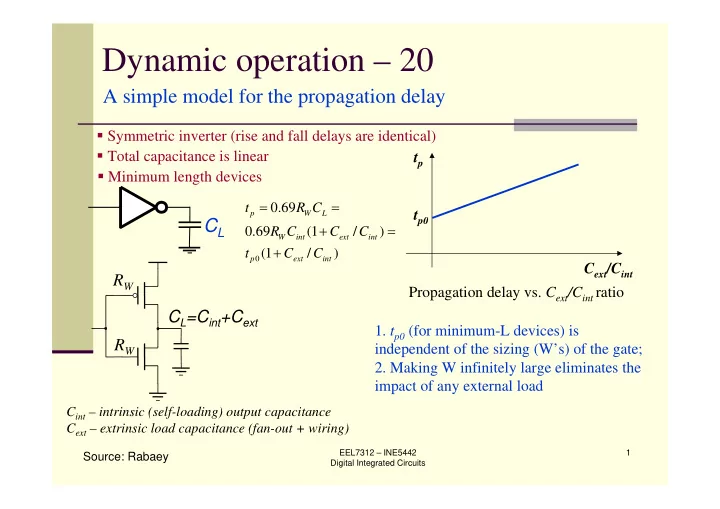
Dynamic operation 20 A simple model for the propagation delay Symmetric inverter (rise and fall delays are identical) Total capacitance is linear t p Minimum length devices = = t 0.69 R C t p0 p W L C L + = 0.69 R C (1


slide-1
SLIDE 1

EEL7312 – INE5442 Digital Integrated Circuits 1

Dynamic operation – 20

Propagation delay vs. Cext/Cint ratio

Source: Rabaey

CL

CL=Cint+Cext RW RW

Cint – intrinsic (self-loading) output capacitance Cext – extrinsic load capacitance (fan-out + wiring)

0.69 0.69 (1 / ) (1 / ) = = + = +

p W L W int ext int p ext int

t R C R C C C t C C

A simple model for the propagation delay

Symmetric inverter (rise and fall delays are identical) Total capacitance is linear Minimum length devices Cext/Cint tp tp0

  • 1. tp0 (for minimum-L devices) is

independent of the sizing (W’s) of the gate;

  • 2. Making W infinitely large eliminates the

impact of any external load

slide-2
SLIDE 2

EEL7312 – INE5442 Digital Integrated Circuits 2

Dynamic operation – 21

Source: Rabaey

Inverter Delay

  • Minimum length devices
  • Assume that for WP = 2WN =2W
  • same pull-up and pull-down currents
  • approx. equal resistances RN = RP
  • approx. equal rise tpLH and fall tpHL delays
  • Analyze as an RC network

W N unit N unit unit P unit P

R R W W R W W R R = = ⎟ ⎟ ⎠ ⎞ ⎜ ⎜ ⎝ ⎛ ≈ ⎟ ⎟ ⎠ ⎞ ⎜ ⎜ ⎝ ⎛ =

− − 1 1

tpHL = (ln 2) RNCL tpLH = (ln 2) RPCL Delay (D): 2W W

unit unit gin

C W W C 3 =

Load for previous stage:

2Wunit Wunit

Inverter Unit inverter

slide-3
SLIDE 3

EEL7312 – INE5442 Digital Integrated Circuits 3

Dynamic operation – 22

Source: Rabaey

Inverter Delay

Load Delay

Delay = 0.69RW(Cint + Cext) = 0.69RWCint + 0.69RWCext= 0.69RW Cint(1+ Cext /Cint) = Delay (Internal) + Delay (Load) Cint Cext CN = Cunit CP = 2Cunit 2W W

Note: RW ∝L/W Cint∝WL

slide-4
SLIDE 4

EEL7312 – INE5442 Digital Integrated Circuits 4

Dynamic operation – 23

Source: Rabaey

Note: RW ∝L/W Cint∝WL tp0∝L2 → minimum L for

minimum delay

Delay Formula

Cint = γCgin with γ ≈ 1 f = Cext/Cgin - effective fanout R = Runit/W ; Cint =WCunit tp0 = 0.69RunitCunit

( ) ( )

γ / 1 / 1

int

f t C C C kR t

p int ext W p

+ = + =

( ) ~ C C R Delay ext int W +

slide-5
SLIDE 5

EEL7312 – INE5442 Digital Integrated Circuits 5

Dynamic operation – 24

Sources: Rabaey Weste

Cint = γCgin with γ ≈ 1 f = Cext/Cgin =1

( ) ( )

γ / 1 / 1

int

f t C C C kR t

p int ext W p

+ = + =

Ring oscillators - 1

N: (odd) number of inverters (usually >5)

1 1 2 2 = → =

  • sc

p p

  • sc

f t Nt Nf

Ring oscillators are used as process monitors to verify if a chip is faster or slower than nominally expected. Ex: 31-stage ring oscillator in a 180 nm process oscillates at 540 MHz.

slide-6
SLIDE 6

EEL7312 – INE5442 Digital Integrated Circuits 6

Dynamic operation – 25

Source: www.keithley.com.cn/data?asset=51070

Ring oscillators - 2

N: (odd) number of inverters (usually >5)

slide-7
SLIDE 7

EEL7312 – INE5442 Digital Integrated Circuits 7

Dynamic operation – 26

Inverter chain - 1

Source: Rabaey

CL If CL is given:

  • How many stages are needed to minimize the delay?
  • How to size the inverters?

May need some additional constraints. In Out

slide-8
SLIDE 8

EEL7312 – INE5442 Digital Integrated Circuits 8

Dynamic operation – 27

Inverter chain - 2

Source: Rabaey

j-th inverter Cint=γCg.j Cg,j Cg,j+1

( ) ( )

, , 1 ,

1 / 1 /

+

= + = +

p j p g j g j p j

t t C C t f γ γ

CL In Out 1 2 N

First inverter is minimally sized

( )

, , 1 , , 1 1 1

1 / ;

+ + = =

= = + =

∑ ∑

N N p p j p g j g j g N L j j

t t t C C C C γ

N-1 unknowns: Cg,2, Cg,3, ….Cg,N-1, Cg,N

slide-9
SLIDE 9

EEL7312 – INE5442 Digital Integrated Circuits 9

Dynamic operation – 28

, 1 , ,1

/ /

+

= = = N

N g j g j L g

f C C C C F

Inverter chain - 3

Source: Rabaey

What´s N that minimizes delay?

( )

, , 1 , , 1 1 1

1 / ;

+ + = =

= = + =

∑ ∑

N N p p j p g j g j g N L j j

t t t C C C C γ

Let’s minimize Taking the N-1 derivatives partial derivatives and equating them to 0 we find that

, , 1 , 1 − +

=

g j g j g j

C C C

Thus, each inverter is sized up by the same factor f wrt the preceding gate The minimum delay is

( )

( )

1

1 / 1 /

=

= + = +

N N p p p j

t t f Nt F γ γ

slide-10
SLIDE 10

EEL7312 – INE5442 Digital Integrated Circuits 10

Dynamic operation – 29

( )

( )

1

1 / 1 /

=

= + = +

N N p p p j

t t f Nt F γ γ

Inverter chain - 4

Source: Rabaey

dtp/dN=0 The minimum delay is for N obtained from

  • r, equivalently

( )

1 ln / + − =

N F

F N γ

( )

1 / +

=

f

f e

γ

tpi: propagation delay of unit inverter loaded with another unit inverter

( )

,1

, ln ln / = = =

L g

f e N F C C

CL In Out 1 e eN-1 Cg,1

( )

,1

ln / =

p pi L g

t et C C

Canonical case: γ =0

slide-11
SLIDE 11

EEL7312 – INE5442 Digital Integrated Circuits 11

Dynamic operation – 30

Inverter chain - 5

Source: Rabaey

Optimum effective fan-out f

( )

f f γ + = 1 exp

fopt = 3.6 for γ=1

slide-12
SLIDE 12

EEL7312 – INE5442 Digital Integrated Circuits 12

Dynamic operation – 31

Inverter chain - 6

Sources: Weste and Rabaey

Buffer Design

1 64 1 8 64 1 64 4 16 1 64 2.8 8 22.6

N f tp 1 64 65 2 8 18 3 4 15 4 2.8 15.3

Small area and power and close to minimum tp * Values normalized to tpo

slide-13
SLIDE 13

EEL7312 – INE5442 Digital Integrated Circuits 13

Power, energy, and energy delay – 1

Source: Weste

Power is drawn from a voltage source

attached to the VDD pin(s) of a chip.

Instantaneous Power: Energy: Average Power:

( ) ( ) ( ) = p t i t v t ( ) ( ) ( ) = =

∫ ∫

T T

E p t dt i t v t dt

avg

1 ( ) ( ) = = ∫

T

E P i t v t dt T T

( ) ( ) =

DD DD

p t i t V

Delivered by the power source

slide-14
SLIDE 14

EEL7312 – INE5442 Digital Integrated Circuits 14

Power, energy, and energy delay – 2

Where Does Power Go in CMOS?

Source: Rabaey

  • Dynamic Power Consumption
  • Short Circuit Currents
  • Leakage

Charging and Discharging Capacitors Short Circuit Path between Supply Rails during Switching Leaking diodes and transistors

slide-15
SLIDE 15

EEL7312 – INE5442 Digital Integrated Circuits 15

Power, energy, and energy delay – 3

T vo VI

Dynamic Power Dissipation

VDD C fsw iDD(t) VI VO

2 DD

( ) ( ) = = = =

∫ ∫ ∫

DD

V T T DD DD DD DD DD

  • DD

E i t V dt V i t dt V Cdv CV

2

2 = = =

∫ ∫

DD

V T DD C

  • C
  • V

E v i dt v Cdv C

Energy delivered by the power supply (EDD) to charge C The energy stored in the fully charged capacitor is Where´s the other half of the energy delivered by VDD?

slide-16
SLIDE 16

EEL7312 – INE5442 Digital Integrated Circuits 16

Power, energy, and energy delay – 4

T vo VI

Dynamic Power Dissipation

VDD C fsw iDD(t) VI VO

( )

2

2 =

p DD

E M CV

( )

2

/ 2

N DD

E M CV =

Where´s the energy delivered by VDD? During the 1 →0 transition of the

  • utput, the energy stored on C is

dissipated into the n-channel transistor

HEAT

One half of the energy is stored in C whereas the other half is converted into heat in the pull-up network

slide-17
SLIDE 17

EEL7312 – INE5442 Digital Integrated Circuits 17

Power, energy, and energy delay – 5

T vo VI

Source: Weste

Dynamic Power Dissipation

C fsw iDD(t) VDD VI VO

[ ]

dynamic 2 sw sw

1 ( ) ( )

T T DD DD DD DD DD DD DD

V P i t V dt i t dt T T V Tf CV CV f T = = = =

∫ ∫

fsw = αfck, α → activity factor clock frequency = fck

For low power reduce C, VDD, and fsw

slide-18
SLIDE 18

EEL7312 – INE5442 Digital Integrated Circuits 18

Power, energy, and energy delay – 6

Source: Weste

Dynamic Power Dissipation

2 dynamic sw

37.5 5 fJ GHz=187.5 W

DD

P CV f μ = = ⋅ ⋅ Example:

C fsw VDD VDD=2.5 V C=6 fF Energy delivered by the power supply (EDD) to charge C

2 2 DD

6 2.5 37.5 fJ

DD

E CV = = ⋅ =

tp=50 ps Assume that fck=1/4tp=5 GHz For fsw=fck=5 GHz, the average dynamic power dissipation is For an activity factor of 0.1, the average dynamic power dissipation is ~ 18 μW One million identical inverters with the same activity factor of 0.1 would give a total power dissipation of ~ 18 W

slide-19
SLIDE 19

EEL7312 – INE5442 Digital Integrated Circuits 19

Power, energy, and energy delay – 7

Source: Rabaey

Short Circuit Currents

When transistors switch, both nMOS and pMOS transistors may

be momentarily ON at once

Typically < 10% of dynamic power if rise/fall times are

comparable for input and output

Vin Vout CL

Vdd

IVDD (mA) 0.15 0.10 0.05 Vin (V) 5.0 4.0 3.0 2.0 1.0 0.0

slide-20
SLIDE 20

EEL7312 – INE5442 Digital Integrated Circuits 20

Power, energy, and energy delay – 8

Source: Rabaey

Short Circuit Currents

slide-21
SLIDE 21

EEL7312 – INE5442 Digital Integrated Circuits 21

1 2 3 4 5 1 2 3 4 5 6 7 8

tsin/tsout Pnorm

Vdd =1.5 Vdd =2.5 Vdd =3.3

Power, energy, and energy delay – 9

Source: Rabaey

Short Circuit Currents

Minimizing Short Minimizing Short-

  • Circuit

Circuit Power Power

slide-22
SLIDE 22

EEL7312 – INE5442 Digital Integrated Circuits 22

Power, energy, and energy delay – 10

Source: Rabaey

Leakage → static dissipation

Sub-threshold current one of most compelling issues in low-energy circuit design! Vout

Vdd

Sub-Threshold Current Drain Junction Leakage

Reverse Reverse-

  • Biased Diode Leakage

Biased Diode Leakage

N p+ p+

Reverse Leakage Current +

  • Vdd

GATE

IDL = JS × A

slide-23
SLIDE 23

EEL7312 – INE5442 Digital Integrated Circuits 23

Power, energy, and energy delay – 11

Source: Rabaey

Leakage → static dissipation

~ ~

slide-24
SLIDE 24

EEL7312 – INE5442 Digital Integrated Circuits 24

Power, energy, and energy delay – 12

Source: Rabaey

Leakage → static dissipation

Subthreshold Subthreshold Leakage Component Leakage Component

In our simplified model, currents for VGS below VT were assumed to be zero. However, subthreshold current is very important, especially for advanced technologies (low VT’s) and can be the major component of power dissipation.

slide-25
SLIDE 25

EEL7312 – INE5442 Digital Integrated Circuits 25

Power, energy, and energy delay – 13

stat stat DD

P I V =

Source: Rabaey

Leakage → static dissipation

Static power is due to the current that flows between supply rai Static power is due to the current that flows between supply rails in the absence ls in the absence

  • f switching activity
  • f switching activity

tot stat dyn

P P P = +

Diode leakage + Diode leakage + subthreshold subthreshold current current Charge/discharge Cs + Charge/discharge Cs + short short-

  • circuit current

circuit current

Ptot Pstat fsw

slide-26
SLIDE 26

EEL7312 – INE5442 Digital Integrated Circuits 26

Power, energy, and energy delay – 14

Source: Rabaey

Power-Delay Product (PDP) =Average energy consumed per switching event (0→1 or 1→0) Energy-Delay Product (EDP) = quality metric of gate = E × tp

2

2

DD

CV PDP =

2

2

DD p p

CV EDP PDP t t = ⋅ =

VDD

Energy delay

0.5

Energy Delay

1.5 2.5 2.0 1.0