SLIDE 1
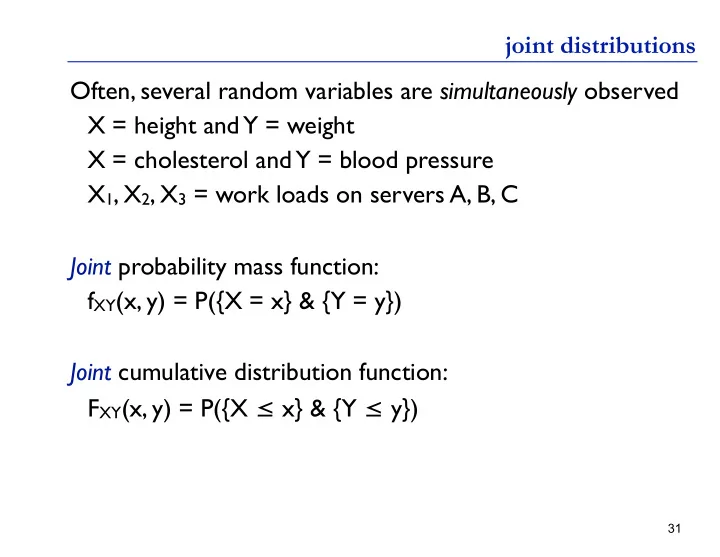
joint distributions Often, several random variables are simultaneously observed X = height and Y = weight X = cholesterol and Y = blood pressure X1, X2, X3 = work loads on servers A, B, C Joint probability mass function: fXY(x, y) = P({X = x} & {Y = y}) Joint cumulative distribution function: FXY(x, y) = P({X ≤ x} & {Y ≤ y})
31
SLIDE 2
examples Two joint PMFs
P(W = Z) = 3 * 2/24 = 6/24 P(X = Y) = (4 + 3 + 2)/24 = 9/24 Can look at arbitrary relationships among variables this way
32
W Z
1 2 3 1 2/24 2/24 2/24 2 2/24 2/24 2/24 3 2/24 2/24 2/24 4 2/24 2/24 2/24
X Y
1 2 3 1 4/24 1/24 1/24 2 3/24 3/24 3 4/24 2/24 4 4/24 2/24
SLIDE 3
marginal distributions Two joint PMFs
Question: Are W & Z independent? Are X & Y independent?
33
W Z
1 2 3 fW(w) 1 2/24 2/24 2/24 6/24 2 2/24 2/24 2/24 6/24 3 2/24 2/24 2/24 6/24 4 2/24 2/24 2/24 6/24 fZ(z) 8/24 8/24 8/24
X Y
1 2 3 fX(x) 1 4/24 1/24 1/24 6/24 2 3/24 3/24 6/24 3 4/24 2/24 6/24 4 4/24 2/24 6/24 fY(y) 8/24 8/24 8/24
SLIDE 4 marginal distributions Two joint PMFs
Question: Are W & Z independent? Are X & Y independent?
34
W Z
1 2 3 fW(w) 1 2/24 2/24 2/24 6/24 2 2/24 2/24 2/24 6/24 3 2/24 2/24 2/24 6/24 4 2/24 2/24 2/24 6/24 fZ(z) 8/24 8/24 8/24
X Y
1 2 3 fX(x) 1 4/24 1/24 1/24 6/24 2 3/24 3/24 6/24 3 4/24 2/24 6/24 4 4/24 2/24 6/24 fY(y) 8/24 8/24 8/24
fY(y) = Σx fXY(x,y) fX(x) = Σy fXY(x,y) Marginal PMF of one r.v.: sum
- ver the other (Law of total probability)
SLIDE 5
joint, marginals and independence Repeating the Definition: Two random variables X and Y are independent if the events {X=x} and {Y=y} are independent (for any fixed x, y), i.e. ∀x, y P({X = x} & {Y=y}) = P({X=x}) • P({Y=y}) Equivalent Definition: Two random variables X and Y are independent if their joint probability mass function is the product of their marginal distributions, i.e. ∀x, y fXY(x,y) = fX(x) • fY(y) Exercise: Show that this is also true of their cumulative distribution functions
35
SLIDE 6
expectation of a function of 2 r.v.’s A function g(X, Y) defines a new random variable. Its expectation is: E[g(X, Y)] = ΣxΣy g(x, y) fXY(x,y) Expectation is linear. E.g., if g is linear: E[g(X, Y)] = E[a X + b Y + c] = a E[X] + b E[Y] + c Example: g(X, Y) = 2X-Y E[g(X,Y)] = 72/24 = 3 E[g(X,Y)] = 2•E[X] - E[Y] = 2•2.5 - 2 = 3
36
X Y
1 2 3 1 1 • 4/24 0 • 1/24 -1 • 1/24 2 3 • 0/24 2 • 3/24 1 • 3/24 3 5 • 0/24 4 • 4/24 3 • 2/24 4 7 • 4/24 6 • 0/24 5 • 2/24
☜ like slide 17 recall both marginals are uniform
SLIDE 7
37
sampling from a joint distribution
bottom row: dependent variables Top row; independent variables (a simple linear dependence)
SLIDE 8 another example Flip n fair coins X = #Heads seen in first n/2+k Y = #Heads seen in last n/2+k
38
220 240 260 280 220 230 240 250 260 270 280
n = 1000 k = 0
X Y 320 340 360 380 320 340 360 380
n = 1000 k = 200
X Y 400 420 440 460 480 420 440 460 480
n = 1000 k = 400
X Y 460 480 500 520 540 500 1000 1500 2000
A Nonlinear Dependence
Total # Heads (X-E[X])*(Y-E[Y])