
SLIDE 1
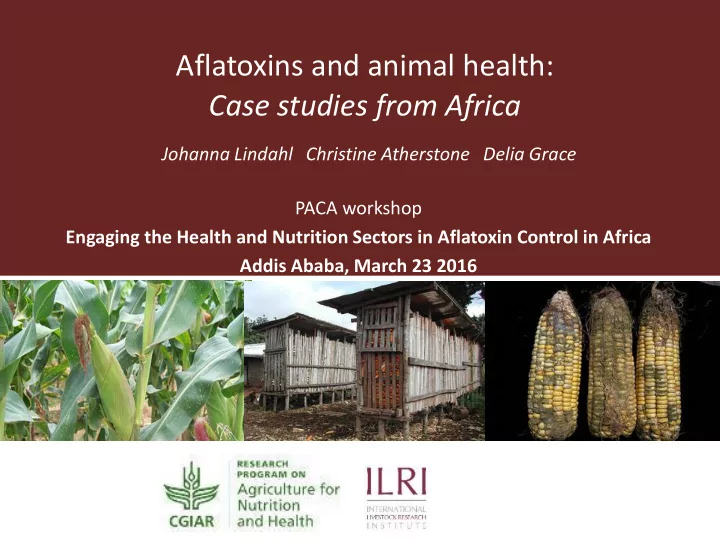
Aflatoxins and animal health: Case studies from Africa
Johanna Lindahl Christine Atherstone Delia Grace PACA workshop Engaging the Health and Nutrition Sectors in Aflatoxin Control in Africa Addis Ababa, March 23 2016 October 1 2014
Johanna Lindahl Christine Atherstone Delia Grace PACA workshop - - PowerPoint PPT Presentation
Aflatoxins and animal health: Case studies from Africa Johanna Lindahl Christine Atherstone Delia Grace PACA workshop Engaging the Health and Nutrition Sectors in Aflatoxin Control in Africa Addis Ababa, March 23 2016 October 1 2014 The talk
Johanna Lindahl Christine Atherstone Delia Grace PACA workshop Engaging the Health and Nutrition Sectors in Aflatoxin Control in Africa Addis Ababa, March 23 2016 October 1 2014
Highly susceptible: oral LD50 (<1 mg per kg body weight) Rabbits, ducks, cats, swine, rainbow trout Moderately susceptible: oral LD50 (1-2 mg per kg body weight) Dogs, horses, calves, turkeys, guinea pigs, sheep, baboon Relatively resistant: oral LD50 (5-10 mg kg body weight) Chickens, rats, macaque monkeys, mouse, hamsters
One teaspoon of aflatoxin is enough to kill 2,500 rabbits
aAndretta et al.Meta-analytical study of productive and nutritional interactions of mycotoxins in growing
bDersjant-Li et al. The impact of low concentrations of aflatoxin, deoxynivalenol or fumonisin in diets on
growing pigs and poultry. Nutr Res Rev. 2003;16(2):223–39.
cMonson et al.. Aflatoxicosis: Lessons from Toxicity and Responses to Aflatoxin B1 in Poultry. Agriculture.
Multidisciplinary Digital Publishing Institute; 2015;5(3):742–77.
Mycotoxin Main fungi Impact on animal health Aflatoxins Aspergillus spp All livestock susceptible to different degrees. Acute toxicity, hepatotoxic and
Growth impairment. Immunosuppression. Ochratoxin A Aspergillus spp, Penicillum spp Nephrotoxic Immunosuppression Possibly carcinogenic Fumonisins Fusarium spp Toxic to liver and central nervous system Possibly carcinogenic Zearalenone Fusarium spp Swine highly sensitive, cattle less sensitive. Endocrine disruption. Estrogenic effects, reduced reproduction, feminisation, malformations. Trichotecenes Fusarium spp Gastrointestinal disturbance. Reduced feed
Ref: Wu. VOL. 38, NO. 15, 2004 / ENVIRONMENTAL SCIENCE & TECHNOLOGY
– Estimate cost of feed discarded if enforced: >20 billion USD – Estimated impact of this on lost milk production>30 million USD
a Mugangai et al. 2016, submitted
a Kiruni et al. 2016, submitted, b Kiarie et al. 2016, submitted
social/cultural benefits
Feeding livestock contaminated feed
Livestock produce less because of toxic effects Animals metabolize toxins Aflatoxin contaminated feed given to livestock instead of humans Less aflatoxin contaminated crops reach humans- less crops reach food market A reduced amount of aflatoxins may reach humans through animal-source food Less animal-source food produced, reduced livelihoods of farmers
Clays (aluminosilicates)
in effectiveness
Yeast/bacterial cell wall extracts
Other binders
effectiveness
AMAs for poultry and swine were evaluated, only about 30% were effective
The presentation has a Creative Commons licence. You are free to re-use or distribute this work, provided credit is given to ILRI.