
SLIDE 1
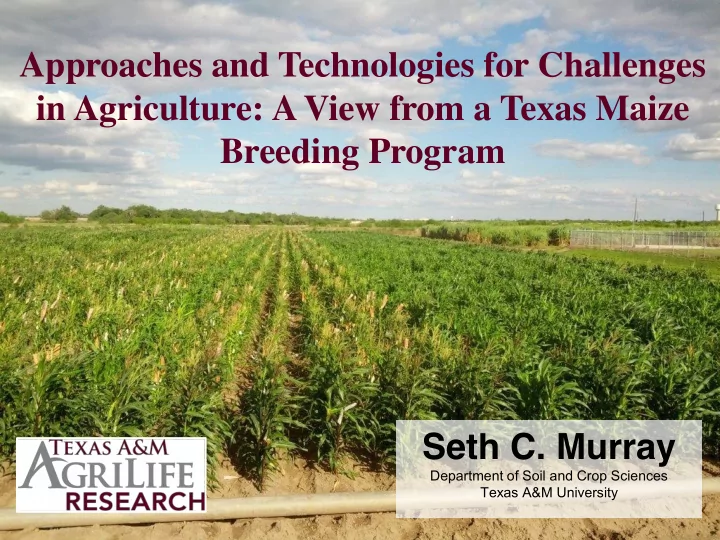
Approaches and Technologies for Challenges in Agriculture: A View from a Texas Maize Breeding Program Seth C. Murray
Department of Soil and Crop Sciences Texas A&M University
in Agriculture: A View from a Texas Maize Breeding Program Seth C. - - PowerPoint PPT Presentation
Approaches and Technologies for Challenges in Agriculture: A View from a Texas Maize Breeding Program Seth C. Murray Department of Soil and Crop Sciences Texas A&M University Maize in Texas 2013 Region Acreage planted Average yield
Approaches and Technologies for Challenges in Agriculture: A View from a Texas Maize Breeding Program Seth C. Murray
Department of Soil and Crop Sciences Texas A&M University
2013 Region Acreage planted Average yield High Plains 951,000 acres
(855,000 harvested)
204.8 bu/acre Rest of Texas 1,479,000 acres
(1,234,000 harvested)
89.6 bu /acre
Texas 2010 – 300 million bushels = $1.5 billion (12th in Country) Texas 2011 – 136 million bushels, heat and drought = $0.9 billion Texas 2012 – 202 million bushels = $1.46 billion Texas 2013 – 283 million bushels = $1.36 billion Texas 2014 – 295 million bushels = $1.31 billion
Maize in Texas
Texas Acres 2,430,000 Acres per bag
~ 3 Cost per bag
~ $150 Total $ on seed ~ $121 million
Texas maize production
Barrero et al. 2013, Field Crops Research
Data from USDA- NASS
Meta-analysis - minimal genetic yield gain in commercial varieties grown in Texas over the last 11 years
y = 0.1115x - 221.6 R² = 0.0019
10 20 30 1999 2001 2003 2005 2007 2009 2011 BLUPs Linear (BLUPs)
Hybrid BLUP SE Year Locs TG895W
7.088 2007 1 TRX01601X
6.892 2010 2 F3025
7.002 2001 3 DKC6469GENVT3P 19.35 8.548 2010 1 6361RB 20.3 3.928 2006 10 5202B 20.99 7.037 2002 3 Barrero et al. 2013, Field Crops Research
2000 2010 Year Best linear unbiased estimators (yield)
Data from Texas Extension Corn Performance Trials
~ 14,500 individual observations
Grain yield (tons/ha) Texas High Plains Rest of Texas Dryland Plant height (cm) 0.61*** 0.19*** 0.46*** 0.45*** Ear height (cm) 0.56*** 0.03NS 0.40*** 0.35*** Days to silk 0.13***
0.05***
Plant density (plants/ ha) 0.66*** 0.44*** 0.51*** 0.36*** Lodging (% plants/ plot)
Moisture (%) 0.55*** 0.04* 0.28*** 0.30*** Test weight (kg/hl) 0.33*** 0.04NS 0.45*** 0.50***
Barrero et al. 2013, Field Crops Research
Agronomic traits are more highly correlated with yield in the lower yielding Texas environments
~ 14,500 individual observations on each trait ~ 1,000 commercial hybrids
Midwestern bias
USDA heat zone map and maize relative maturity zones
https://www.pioneer.com/CMRoot/pioneer/us/images/agronomy/field_facts /soybeans/maturity_ratings/soybean_maturity_fig1.jpg MBS seeds www.planthardiness.ars.usda.gov/
Why do we need a public breeding program on corn? Aren’t ¡the ¡companies ¡doing ¡this?
adaptation (aflatoxin, heat, drought, etc.)
corn, QPM, perennial corn, high biomass corn
– Primarily in industry
– perennials
Tx782 X LH287RR2 Tx782 LH287 Tx777 x LH195RR2 Tx777 LH195RR2
Most commercial inbred lines are not adapted to Texas heat and drought
LH195 x Tx775 Tx775 LH195 Tx773 x TR7322 Tx773 TR7322
2013 inbreds and hybrids demonstration
Temperate high yield corn Tropical corn with good traits: Aflatoxin resistance, stress tolerance, etc.
X
Identify parents and make crosses (one to two years)
Self pollinate and select (three to five years)
AgriLife inbred corn: ears look good but does it yield and have resistance?
X
Cross AgriLife inbred to two older commercial tester lines (one to two years)
Stiff stalk tester inbred Non-stiff stalk tester inbred
Discard trash Discard trash
Test hybrid aflatoxin resistance Ok yield (~two years)
FINISHED GERMPLASM RELEASE! (BLACK BOX) Along the way we: 1) Trained students 2) Increased knowledge and wrote papers 3) Assisted growers, students and researchers with corn research
Assisting Texas Growers Increase Profit
Previous phase of public corn breeding at Texas A&M (the last seven to eleven years) – Corn breeding at A&M started in 1927
Increasing focus on best yielding lines
2010 2011 2012 2013 2014 2015 Summer Testers 2 4 15 17 12 5 Summer TAMU lines 646 + 2 ISO 665 278 67 37 + 2 ISO 7 +2 ISO Winter Testers 2 9 10 19 14
TAMU lines 364 + 2 ISO 70 25 33 32
for winter nursery the following year (maybe)
INBRED BREEDING
INBRED SALES
TESTING
HYBRID SALES
HYBRID SEED PRODUCTION TRAIT SUPPLIERS ? A few
Assisting Texas Growers Increase Profit
Today’s ¡corn seed chain and where public breeders fit (a personal opinion)
Independents Seed Sales Contractors Independent Breeders
723 hybrids tested in 2012 across six environments
Rank Hybrid Bu/ Acre above mean Std Error P 1
Tx777 X SS2
51.5
± 11.3 ****
2
Tx954 X SS5
49
± 16.8 **
3
Commercial Hybrid #09 (TX company)
46.8
± 5.4 ****
4
Commercial Hybrid #08 (TX company)
46.2
± 13.7 ***
5
Commercial Hybrid #02 (TX company)
45.1
± 4.8 ****
6
Tx114 X Tx120
44
± 14.5 **
7
Commercial Hybrid #04 (National company)
43.3
± 6.7 ****
8
Commercial Hybrid #05 (National company)
42.3
± 13.7 **
9
NSS1 X Tx150
40.7
± 11.3 ***
10
Tx773 X NSS2
38.1
± 8.9 ****
11
SS1 X Tx149
37.5
± 9.6 ***
12
DKB 64-69
37.2
± 6.1 ****
13
Tx777 X NSS2
37.1
± 9.6 ***
14
Tx775 X NSS2
37
± 14.5 *
15
SS1 X Tx904
36
± 14.6 *
16
Commercial Hybrid #11 (TX company)
35.9
± 6.3 ****
17
Tx150 X SS4
35.5
± 10.2 ***
.
.
.
. .
29
TX740 X SS3
31.9
± 8.9 ***
.
.
.
. .
50
Commercial Hybrid #06 (TX company)
26.5
± 6.4 ****
.
.
.
. .
56
Commercial Hybrid #10 (National company)
25.6
± 13.7 NS
57
(LAMA2002-22-3-B-B1-B-B/LAMA2002-10-1-B-B-B-B)-2-3-B-2-1 X SS2
25.4
± 12.4 *
58
Commercial Hybrid #07 (TX company)
24.9
± 13.7 NS
60
TX740 X NSS2
12.6
± 16.8 NS
Table 1: Grain yield (Bu Ac-1) trial results over 15 trials in 2013.
2013 SERAT yield data from North Carolina out of 37 hybrids including 7 commercial checks
http://www.fgmorph.com/fg_5_2.php
Important origins of germplasm to the TAMU Maize Breeding Program
http://www.fgmorph.com/fg_5_2.php
Southern rust resistance
TAMU Hybrids with ½ tropical background Commercial hybrids from 100% temperate material
DuPont Pioneer public array 636 SNPs 380 genotypes PC 1 ~ 11% PC 2 ~ 7%
B104
Mo17 NC300 LH123
B73/ Mo17
LH132 LH195 LH151 LH151
LH82
LH123 ex-pvp Tx114 Tx714
B73
Tx732 Tx736 Tx772
Tx739 Tx741
Tx770
Tx774 Tx782 Tx784
PHV63 Tx777 Tx775
Tx780
Tx902 Tx903
Tx906 Tx811 Va35
PHT60
Seagull
LH57 LH54
DKMBNA
PHW65 PHG83 NK793 NS701
LH149
Color coding by Structure PCoA by Powermarker and R Schuyler Smith Elliot Heffner
PH207 Iodent PHH93 Iodent
Summer yield trials
Summer nursery
CS = College Station, TX WE= Weslaco, TX Jan Feb Mar Apr May Jun Jul Aug Sep Oct Nov Dec Prepare Nursery CS CS WE Plant Nursery CS WE Pollinate CS WE Harvest CS WE Process Seed WE WE CS CS Prepare Yield Trials WE CS Plant Yield Trials WE CS CS Agronomics CS CS CS CS CS Notes CS CS CS Inoculate AF CS Harvest WE CS Grind, NIRS, Aflatest CS Analyze Data
Downtime!
Corn breeding program timeline
Information management
– Over 4679 Summer yield trial plots:
– Summer nursery >6007 seed stocks – Weslaco winter nursery (2011) 3584 seed stocks – Genotyping results >2000 plants
Still green!
Unadapted germplasm to the Midwest (IA)
Mahan et al. 2013, Crop Science
FT-NIRS Design, Simulations Analysis
http://maizeatlas.org/
G2F: Maize G X E Project
Genomes to Fields
v v v 23 Hybrid locs 17 Inbred locs Courtesy of Dr. Natalia de Leon, and the work of many researchers throughout the US Goal: To Enhance ability to predict plant performance and a deeper understanding of relevant biology Apply the maize genome sequence, multi-location phenotypes and environmental data to identify useful genetic diversity Set of ~250 hybrids, 2 reps per loc. 10 hybrids common across locations 2014 testers are LH198, LH185, LH195, PB80 and CG102 Genotyped using GBS Set of 31 inbreds Build and strengthen the community of maize breeders and researchers
Southeast Regional Aflatoxin Trials (SERAT)
Current locations Past locations Goal: To determine the multi-environmental adaptation and phenotype of breeding material for aflatoxin resistance, with high yield and associated agronomic traits. * Started in 2003 * Set of ~32 hybrids, 3 reps per loc.
* Inoculated for Aspergillus flavus (various methods) *Measure yield, aflatoxin and other traits Current project expansion (USDA and AMCOE) *Inbred screening *Interaction of resistance genetics and atoxigenics *Meta-analysis of historical data
NC – Dr. Krakowsky GA – Drs. Ni, Guo,Scully MS – Drs. Williams, Windham, Warburton Tx1 – Drs. Xu, Odvody Tx2 – Drs. Isakeit and Murray Companies: BH Genetics – Dr. Raab and Arnold, Pioneer, Monsanto – Dr. Gorman
Aflatoxin contamination
– Above 500ppb corn must be destroyed!
– Kenya 2004: 125 people died, 192 poisoned (levels to 2,000ppb) – US 1998: 25 dogs died eating levels of 100-200ppb for 3 months
problems in humans and animals
– 1.7cm decrease in height for highly exposed children in Benin – Higher rates of liver cancer in China – Varying sensitivities among species
Clean feed contaminated feed
Courtesy of Velazquez, Bailey, Deng, and Dixon; Texas AgriLife (2010 - unpublished data)
Aflatoxin
Challenges in developing lines with good aflatoxin resistance and yield under stress
Row number Kernel size Ear length Lodging Kernel density Stress Resistance Stay Green
How do we make gains from selection
traits ? How do we separate these various correlated traits ?
Harvesting yield trials Inoculating yield trials with colonized kernels
Sporulation
T. Isakeit
Fourier Transformed Near Infrared Reflectance Spectroscopy FT-NIRS (Thermo Antaris II) Vicam AflaTest immunoaffinity columns
Multi-parent populations to pyramid aflatoxin resistance sources and yield
et al.)
4-Way Cross Populations; Ne=200+
a (Tx740/Mp313E)//(Tx772/Mp715) fourway 3 sib mated b.(Tx772/Mp313E)//(Tx740/Mp715) fourway 3 sib mated
8-Way Cross Populations (3 ); Ne=100+
c ((CML 108/Mp715))//(A6 /Tzi 8)///((Tzi 18/Ki3)//(NC334/Hi27))
18/Mp313E)//(CML 311/Mp715))
108/A6)//(CML 311/Mp715))
Tx714 (zmlox4-10::mu/zmlox4-10)
2011, 2012 Yield trials: 3410 plots in College Station, TX 580 plots in Mississippi State, MS
Tx714 (zmlox5-3::mu/zmlox5-3)
Inbred females 357 diverse lines Hybrids (ZmLOX5, zmlox5-3::mu) Hybrids (ZmLOX4/zmlox4-10::mu) College Station, TX Weslaco, TX 2010 2011 2010 2011
Hybrid crossing scheme
Limited and full irrigation Test drought tolerance
Test aflatoxin resistance Tx714 inbred
Testers used: Va35 [(C103 X T8) T8] – NSS – Warburton et al. 2013, Crop Science TX714 [(K55/3*B73)-B-B-B)/B73]-1-B-B – SS – Barerro et al. 2015 PLoS ONE
Pleiotropic effects of loci – agronomics and yield
QTL variant Bin
Effect Description Grain yield 1 7.04 7 C N 5-7 bu/ac Leucine rich repeat 2 2.03 2 N A 3 to 8 bu/ac PUT-2-171a-Zea_mays-13770 3 9.06 9 N A 3-5 bu/ac ATP-dependent CLP protease Plant height 1 7.04 7 C N 2 inches Leucine rich repeat 4 3.05 3 A C 1 to 3 inches Chromatin assembly factor I 3 9.06 9 N A ~1.5 inches ATP-dependent CLP protease Days to silk 1 7.04 7 C N 1.8 days Leucine rich repeat 5 8.05 8 C N 1 day Protein tyrosine kinase motif
CHR MAF FDR_adj_P Log10 Effect R2 (%) CS11-WWa (log10 [aflatoxin + 10]) 4 0.32 0.2 5.48
5.27 CS12-WWa (log10 [aflatoxin + 10]) 4 0.32 0.23 5.43
5.69 RCBD (log10 [aflatoxin + 10])
Barerro et al. 2015 PLoS ONE
Great….more ¡significant ¡QTV ¡SNPs…. But how do you validate and use them?
dependent,
relevant for other reasons?
individuals with the SNPs of interest (Romay et al. 2013)
Population F2:4 N= SNP1 SNP2 SNP3 LH82 X (LAMA2002-12-1-B-B-B-B/LAMA2002-1- 5-B-B-B-B)-3-2-B-1-B3-B) 178 X X Tx740 x NC356 110 (55) X X Ki3 x NC356 239 (72) X X X
SNP2 Ear height P < 0.03 Level LS Means N = X:X 22.5 156 X:Y 21.5 144 Y:Y 21.2 182 Pop effect P < 0.0001 482 (45 missing) Good results considering
SNP1 Plant height P < 0.01 Level LS Means N = X:X 62.5 56 X:Y 61.2 64 Y:Y 59.2 86
206 (33 missing)
SNP3 Plant height P < 0.003 Level LS Means N = X:X 59.0 70 X:Y 63.2 60 Y:Y 61.4 87 Pop3
217 (22 missing)
Validating these SNPs in three bi-parental linkage populations
Genotyped ¡with ¡KASPAR ¡assay’s
F1 Self to homozygosity RIL’s
Raven, 1999.
In Plant Breeding and Genetic Linkage Mapping effective recombination is more often becoming the limiting factor
Introgression of gene we would still expect linkage drag. Not near “gene” resolution for map based cloning
Effective recombination Total recombination <
Predicted distributions of effective recombination events under different population development scenarios
μ ¡= ¡1.83 σ ¡= ¡1.86 Event / gen. = 0.92 μ ¡= ¡3.57 σ ¡= ¡4.83 Event / gen. = 0.45 μ ¡= ¡5.41 σ ¡= ¡6.58 Event / gen. = 0.60 μ ¡= ¡1.84 σ ¡= ¡1.91 Event / gen. = 0.92 μ ¡= ¡9.68 σ ¡= ¡11.51 E./ g. = 0.81 μ ¡= ¡12.7 σ ¡= ¡15.92 E./ g. = 1.06
Unprecedented population designed to measure recombination
Slide modified from R. Wisser
n = 117
4 way, F6
n = 129
2 way, F6
n = 130
2 way, F6 5195 ¡SNP’s
INTERMATE
575
4 way, 3 sib, F5
n = 213
4 way, 1 sib, F6
n = 515 n = 97
4 way, 2 sib, F6
Self Self Self Self Self
n = 1201 total
(had 1432)
Self
Tx906 Tx903 Tx772 B73Olc1
Ref. B73Olc1 Tx903 Tx772 Tx906 Reference 100% 98.5% 64.7% 40% 44.9% B73olc 100% 64.7% 40.1% 44.9% Tx903 100% 40.9% 42.9% Tx772 100% 40.7% Tx906 100%
107,308 total markers B73 x Tx903 44,581 markers Tx772 x Tx906 73,717 markers Polymorphic in both 11,149 markers
107,308 markers *1207 lines = 129,000,000 marker data points @ $0.0004 per data point
Marker results
Huge power to detect QTLs with high resolution
Chromosome
y1, yellow endosperm1
Manhattan plot of all 4-parent individuals (899 observations); ~130,000 SNPs
% blue % white % yellow % seg. 23.1 31.3 33.0 12.6
Kernel color distribution Blue kernels were dissected to determine endosperm color
yellow endosperm1 (y1) on Chromosome 6
Group n Chr. Peak position (bp) LOD Confidence interval distance (bp) all subpops 1141 6 82,017,348 107.08 54 all4ways 899 6 82,017,348 87.2 54 4way3sib 488 6 82,017,402 48.95 54 4way2sib 89 6 83,621,389 11.89 2,712,138 4way1sib 203 6 82,017,348 26.85 7,303,989 4way0sib 109 6 83,621,056 14.74 757,405 B73xTx903 121 6 78,735,091 16.90 3,618,539 Tx772xTx906 121 6 82,764,656 14.81 747,254 all2ways 242 6 82,017,348 29.41 845,669
Tx772xTx903 B73xTx906 4way3sib-10 4way3sib-9 4way3sib-8 4way3sib-7 4way3sib-6 4way3sib-5 4way3sib-4 4way3sib-3 4way3sib-2 4way3sib-1 Entire pop.
121 individuals used
(10 Subsamples from 4way3sibF5 population)
242 individuals used
Combined both two-way populations
Physical distance (bp) Physical distance (bp)
Commercial Hybrid
shattering
X
F1 Lines derived from Z. mays X
X Shavers populations ~F4
Weslaco, December 2013 Note differences in roots
‘Perennial’ ¡ crosses
Parent 1 Parent 2
Flow Cytometer Genotyping By Sequencing
Mixing of parents Sorting of zygotes Culture of individual zygotes
D N A
Culture somatic cells
Cycling Of Gametes In Vitro
Tissue culture Induction of gametes Grow plantlets “progeny” Recycling of cells
Marker Assisted Selection
Progeny A Progeny B Increase seed Field trials
B E H F C G A D F B D H E C A G B E H F C G A D F B D H E C A G
Environment 1 Environment 2 Phenotype (i.e. yield ) Selection of promising zygotes by MAS Update model with new progeny Predictive genetic marker estimates Statistical analysis (QTL, GS) Genotype (from before selection) Estimated breeding value Yield = G + E + GxE + ¡R ¡+ ¡… ¡+ ¡error Field validated plants recycled for crossing
Murray et al. 2013, Nature Biotechnology De La Fuente, Frei & Lübberstedt 2013, Trends in Plant Science
Cycling of gamete in vitro (COGIV)
Davis
These projects were supported by the Agriculture and Food Research Initiative Grant no. #2010-85117-20539 USDA-NIFA Plant Breeding and Education Program Grant no. #2011-67003-30342 USDA-NIFA Climate Change Mitigation and Adaptation in Agriculture Program Grant no. #2014-68004-21836 USDA-NIFA Food Security
Eugene Butler Endowed Chair in Agricultural Biotechnology Texas A&M Agrilife Research Texas Corn Producers Board USDA-Hatch USDA-SCA Texas AgriLife Research Monsanto Fellowship Pioneer Hybrid Fellowship USDA-APHIS
Acknowledgments - Funding
Acknowledgments
Predecessors
Frank Foight Critical assistance Texas A&M Weslaco Center staff Beto Garza and the Weslaco Special Projects unit crew Al Nelson and the Brazos Bottom Farm crew David Baltensperger and the Department of Soil and Crop Sciences Collaborators and Contributions
Graduate Students
Meghyn Meeks Gerald De La Fuente Adam Mahan Jim Wilborn Ivan Barrero Rupa Kanchi Jeff Savage Schuyler Smith Jacob Pekar Justine Christman Kolomiets lab Undergraduates Amee R. Bumguardner Travis Rooney David Rooney Anthony Grassia Daniel Hillin John Price Ryan McHugh Dale Herrington Joeseph Beard (Intern) Andrew Beamsley (Intern) Alexandre Galea (Intern) Keith Sage Kimberley Wightman (Intern) Collaborators and Contributions
BH Genetics Golden Acres Genetics SERAT group Graduate Students (con’t) Steven Anderson Yuanyuan Chen Zoran Ilievski Nancy Wahl Visiting Scientists Amin Alhakimi Qingcheng Meng Dongyan Zhang Gustavo Hugo Undergraduates (cont’t) Maria Ypinia (Intern) Nicholas Ace Pugh Michael Spiegelhauer Olivia De Hoyos Many more