Rift Valley fever virus seroprevalence among ruminants and humans in - - PowerPoint PPT Presentation

rift valley fever virus seroprevalence among ruminants
SMART_READER_LITE
LIVE PREVIEW

Rift Valley fever virus seroprevalence among ruminants and humans in - - PowerPoint PPT Presentation

Rift Valley fever virus seroprevalence among ruminants and humans in northeast Kenya Johanna Lindahl 1,2 , Ian Njeru 3 , Joan Karanja 3 , Delia Grace 1 , Bernard Bett 1 1 International Livestock Research Institute, Nairobi, Kenya 2 Swedish


slide-1
SLIDE 1

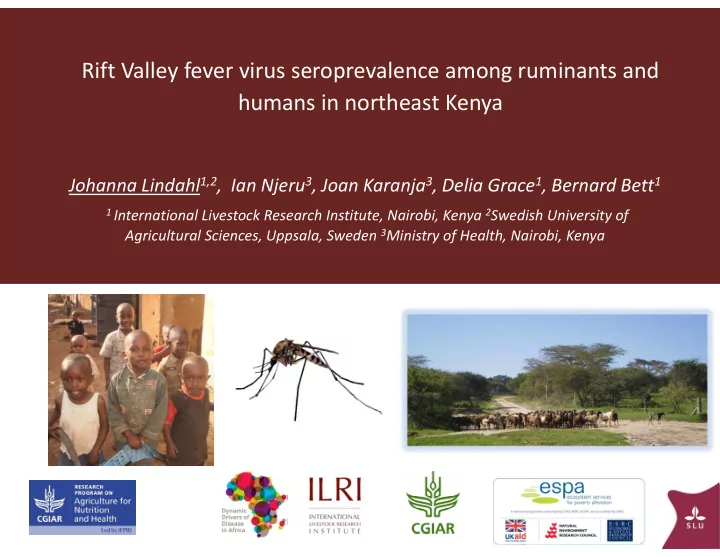
Rift Valley fever virus seroprevalence among ruminants and humans in northeast Kenya

Johanna Lindahl1,2, Ian Njeru3, Joan Karanja3, Delia Grace1, Bernard Bett1

1 International Livestock Research Institute, Nairobi, Kenya 2Swedish University of

Agricultural Sciences, Uppsala, Sweden 3Ministry of Health, Nairobi, Kenya

1

slide-2
SLIDE 2

Today’s talk

  • 1. An introduction to vector‐borne diseases and

Rift Valley fever

  • 2. Our project
  • 3. Conclusions
slide-3
SLIDE 3

Livestock Wildlife Humans

Ecosystem LH WL WH

X

Disease transmission Spillover event

slide-4
SLIDE 4

Ecosystem services – and disease emergence

Ecosystem service Importance Effect of decrease Provisioning Economics, livelihoods Increased poverty Regulating Health, environment Increased disease Cultural Well‐being, recreation Increased stress? Supporting Basis for the other services Increase in all above

slide-5
SLIDE 5

WNV WNV

Malaria

Malaria

Malaria

Dengue Zika Dengue Dengue Dengue Yellow fever Zika Yellow fever

TBE TBE RSSE Borrelia Borrelia RSSE JEV JEV MVE Ross River SLEV VEE, EEE, WEE VEE

Bluetongue Bluetongue African horse sickness African swine fever African swine fever Chikungunya Chikungunya

JEV

Babesia Babesia Anaplasma, Chikungunya Zika Sleeping sickness Chaga’s disease

RVF, WNV Chikungunya

Climate and climate changes Globalization Urbanization Land use changes

Why are vector‐borne diseases emerging?

slide-6
SLIDE 6

k= Probability that a vector feeding on an infected host gets infected Pf = Probability that a vector survives from one meal to the next Pe= Probability that a vector survives the extrinsic incubation period, EIP Q= Probability that a vector feeds from the right host – blood index for the host HBr= Host biting rate, the number of vectors feeding from an animal per day v= Probability of pathogens becoming infectious in the vector C= Vector capacity C= HBr Qvk Pe/(1‐ Pf) Vector capacity and competence

slide-7
SLIDE 7

Rift Valley fever

  • Bunyaviridae, phlebovirus
  • High mortality, abortions in ruminants
  • Haemorrhagic fever, encephalitis in humans
  • Arbovirus – but also directly transmitted
slide-8
SLIDE 8
slide-9
SLIDE 9

Why irrigation?

  • More and more range lands in Africa are being

converted to crop lands through irrigation to alleviate food insecurity

  • Results: major trade‐offs in ecosystem services
  • More food produced (provisioning services) at the

expense of biodiversity and regulatory services (disease, flooding, erosion)

slide-10
SLIDE 10

Anthropogenic action: Increased irrigation Effect on ecosystem: Creates more larval habitats

Vector consequence: More infected vectors

Epidemiologic consequence: More individuals exposed

Increased disease

Case study‐ irrigation and disease

slide-11
SLIDE 11

Our project

  • Rift Valley fever prevalence

– Humans – Ruminants

  • Land use changes

– Protected area vs. irrigated area – Pastoralist areas

slide-12
SLIDE 12

Hypothesis

  • Irrigation in an arid and semi‐

arid area increases the risk for Rift Valley fever

  • But other diseases can also be

affected by this…

  • … and the doctors don’t know

if it is Rift Valley fever

Study site with stagnant water in irrigation canals – source of water for the locals but also breeding grounds for mosquitoes

slide-13
SLIDE 13

Study area

slide-14
SLIDE 14
  • Tana River and Garissa

counties, northeastern Kenya

! . ! . Bura

Hola 10 20 30 40 5 Kilometers

´

Legend Settlements

Irrigation Schemes permanent mixed temporary

! .

Towns Study Block Tana River County Tana River Other Rivers Riverrine Forests

Study site

slide-15
SLIDE 15

Land use change

  • Making changes in a highly diverse landscape
  • Increased number of scavengers
  • Increased numbers of mosquitoes
slide-16
SLIDE 16
  • Cross‐sectional

– Humans – Ruminants – Mosquitoes – Wildlife – Ticks

  • Longitudinal

– Human febrile cases – Livestock: shoats – Mosquitoes

Dynamic drivers of disease in Africa Case study: Kenya

slide-17
SLIDE 17

Prevalence in humans

21.12% 21.70% 27.16% 21.94% 0.00% 5.00% 10.00% 15.00% 20.00% 25.00% 30.00% irrigation pastoral riverine Total

Significantly higher prevalence in men

slide-18
SLIDE 18

Prevalence in ruminants

Ruminants Overall seropositivity 25.59% Young 12.31% Adults 30.22% Male 14.81% Female 28.80%

slide-19
SLIDE 19

RVF‐only part of the problem

– Too many differentials: Malaria, RVF, Dengue, YF, Brucella, Leptospira, Chikungunya, CCHF – Socioeconomic consequences and factors

slide-20
SLIDE 20

Unwillingness to pay for prevention

Mosquito nets

Vaccines and routine clinic visits for kids Boiling or other water treatment Insurance (annual fee) Other health prevention Mean

762

254 6.8 0.9 586 Range

0‐3150

0‐5000 4 households paid between 150‐600 220 households paid nothing,

  • ne household

paid 200 0‐6000

How much did you spend last year on the following health protection (Kenyan shilling)?

Deworming Vaccinations (to prevent not to treat) Tick and fly treatments Insurance (annual fee) Mean 928 437 599 Range 0‐11000 0‐5000 0‐5000 Not existing

How much did you spend last year on the following health prevention for animals?

slide-21
SLIDE 21

The vicious cycle

Healthy livestock, more production Better livelihoods, healthier people Sick livestock, less income Poorer people, more disease

slide-22
SLIDE 22

Impact of poor animal health

Herrero et al. (2013)

GHG per kg of animal protein produced

slide-23
SLIDE 23

Conclusions

  • Land use changes can affect disease occurrence
  • Irrigation can sustain inter‐epidemic transmission
  • More people, more food insecurity and more

disease

slide-24
SLIDE 24

CGIAR Research Program on

Agriculture for Nutrition and Health

Thanks to: The whole DDDAC team All participants

Acknowledgements

slide-25
SLIDE 25

The presentation has a Creative Commons licence. You are free to re‐use or distribute this work, provided credit is given to ILRI.

better lives through livestock ilri.org