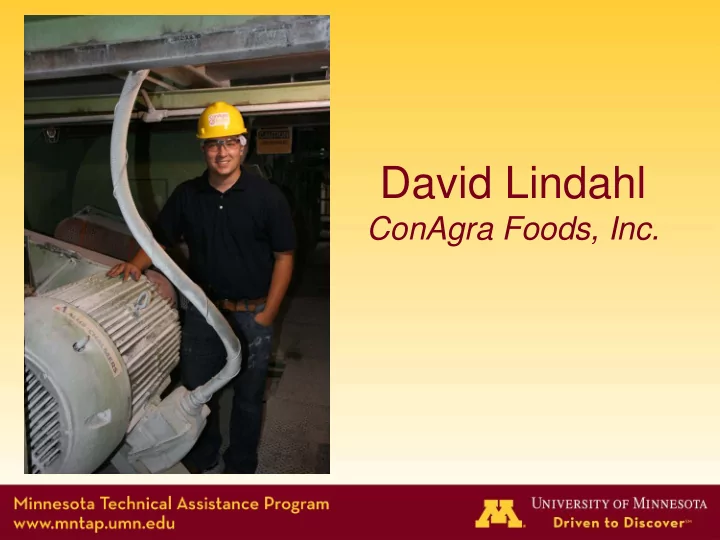
David Lindahl ConAgra Foods, Inc. Energy Efficiency at a Flour Mill - - PowerPoint PPT Presentation
David Lindahl ConAgra Foods, Inc. Energy Efficiency at a Flour Mill ConAgra Foods David Lindahl Advisor: AJ Van den Berghe Company Overview Leader in Commercial and Consumer food products Hastings Mill - Wheat flour and food
Energy Efficiency at a Flour Mill
ConAgra Foods
David Lindahl Advisor: AJ Van den Berghe
Company Overview
- Leader in Commercial and Consumer
food products
- Hastings Mill
- Wheat flour and food products
- Sold in commercial sized bags and
bulk to consumer food processing companies
Hastings Mill
Motivations for Change
- Cost savings from efficiency
improvements
- Delivers information to drive
improvement
- Advances company goal for continuous
improvement
Reasons for MnTAP Assistance
- Achieve a 2.5% reduction in energy
consumption
- Make energy management easier
Power Use Model
- Objectives
– Predict energy use for certain mill and pack output – Report and discuss days of high or low energy at Review & Response meetings – Use abnormalities to identify root cause and find solutions. – Measures effectiveness of solutions
kWh = Kj*(Mill cwt output)+ Ki*(Pack bags)+ Ko
Energy (kWh) Time
Actual vs. Predicted Energy Use
Energy Use kWh Predicted Energy Use
Model Accuracy R Squared: .982
Approach
Correct Energy Behaviors Replace Fix and Tune
Determining Inefficient Processes
- Observed Energy Saving Opportunities
– Compressed air – Lighting overuse – Incomplete shutdown – Conveyors
Determining Inefficient Processes
- Took baseline measurements to find
current system efficiencies
- Voltage
- Amperage
- Flow rates
- Static Pressures
Energy Behavioral Training
- Background
– Energy Awareness – Knowledge of cost
- Problem
– Inefficient energy practices
Energy Behavioral Training
- Solution
– Change Culture – Educate – Verify follow through
Vacuum System
- Background
– 4 vacuum systems (200hp total) – Mill Sanitation
Vacuum System
- Why is it a problem?
– Continuous operation – 2nd and 3rd shift demand – Simplicity for operators
- Solution
– Remotely-accessible,
- n-demand system
– 3 month payback
Filtration System
- Background
– Bag Filters – Air makeup – General suction
Filtration System
- Why is it a problem?
– Sock cleaning pulse rate control – Dirty socks compared to clean socks – Flow rate effects
Filtration System
- Solution 1
- Control sock pulse
- Delta P control
- Sock life
- Compressed air savings
Filtration System
- Solution 2
– Airflow Controller – Controls fan speed based on pressure differential – Designed flow rate
Lighting
- Background
– High bay fixtures are Class 2 Division 2 – Group G for combustible grain dust – High-intensity discharge (HID) metal halide lamps
Lighting
- Why is it a problem?
– Inefficient metal halide lamps – Low quality of light – Low bulb life – Lumen loss (45% MH, 6% fluorescents) – Excessive use
Lighting
- Solution 1
- Retrofit with T5 High Output (HO)
- Quick start
- 13 Watts less /fixture
- 4,000 more lumens /fixture
- 29 year payback
Lighting
- Solution 2
- Occupancy Sensors (non production
areas)
- Simple solution
- Rebates make them economical
(10 month payback)
Successful Process Changes
- 1,030 MWh feasible savings so far
- 1.87 million lbs CO2 savings
- $66,890 in energy savings identified
- More opportunity with continued study
Recommendations Overview
Waste reduction
- ption
Waste reduced (per year) Cost Cost savings (per year) Payback period Occupancy Sensor Installation 71,100 kWh $3,950 $4,622 10 months Energy Behavioral and Procedural Training Program 223,190 kWh $0 $14,580 Immediate Vacuum System Automation 735,000 kWh $14,000 $48,800 3 months Sock Clean Delta P Control $1,100 per unit Bag Filter Airflow Controller System more study needed more study needed
Personal Benefits
- Gained project management skills
- Grew personally and professionally
- Felt success
- Trip to ConAgra corporate headquarters