J.M. Lattimer and M. Prakash, Phys. Rep. 442 , 109 (2007) - - PowerPoint PPT Presentation

j m lattimer and m prakash phys rep 442 109 2007
SMART_READER_LITE
LIVE PREVIEW

J.M. Lattimer and M. Prakash, Phys. Rep. 442 , 109 (2007) - - PowerPoint PPT Presentation

Mean-field study of the hot b - stable matter of protoneutron star Dao Tien Khoa INST Hanoi, VINATOM EOS of hot nuclear matter with a high neutron-proton asymmetry. EOS of hot b - stable baryon-lepton matter of PNS: n - free and n - trapped


slide-1
SLIDE 1

INST Hanoi, VINATOM Dao Tien Khoa

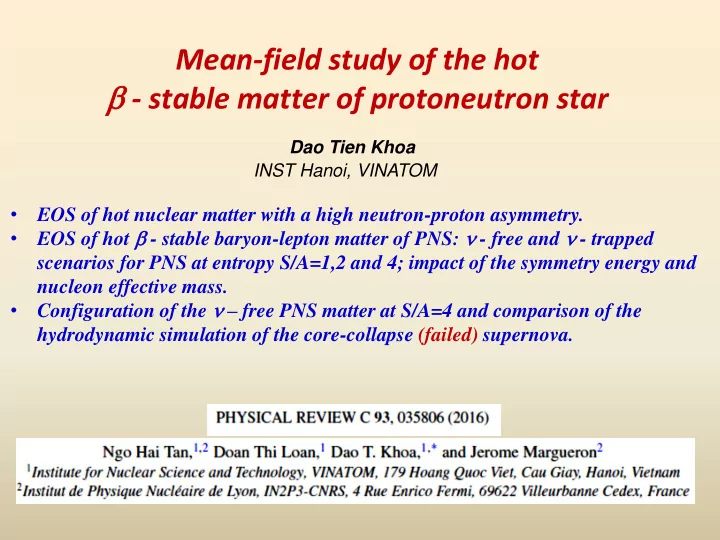
  • EOS of hot nuclear matter with a high neutron-proton asymmetry.
  • EOS of hot b - stable baryon-lepton matter of PNS: n - free and n - trapped

scenarios for PNS at entropy S/A=1,2 and 4; impact of the symmetry energy and nucleon effective mass.

  • Configuration of the n – free PNS matter at S/A=4 and comparison of the

hydrodynamic simulation of the core-collapse (failed) supernova.

Mean-field study of the hot b - stable matter of protoneutron star

slide-2
SLIDE 2

Proto-neutron star (PNS) is a unique test ground for the mean-field models of hot NM

  • A. Burrows and J.M. Lattimer, Astrophys. J. 307, 178 (1986);

J.M. Lattimer and M. Prakash, Phys. Rep. 442, 109 (2007)

slide-3
SLIDE 3

Equation of state of hot asymmetric nuclear matter

N.H. Tan, D.T. Loan, D.T. Khoa, J. Margueron, Phys. Rev. C 93, 035806 (2016).

HF energy density of hot NM in-medium NN interaction Neutron-proton asymmetry Nucleon momentum distribution Single-particle energy Density - and momentum dependent single-particle potential at finite temperature (based on HvH theorem)

slide-4
SLIDE 4

+ + + +… = +

In-medium (density dependent) NN interaction

Direct Exchange Direct Exchange D.T. Khoa and W. von Oertzen, Phys. Lett. B 304 (1993) 8; B 342 (1995) 6 E = D.T. Khoa, G.R. Satchler and W. von Oertzen,

  • Phys. Rev. C 56, 954 (1997);

D.T. Loan, B.M. Loc, and D.T. Khoa,

  • Phys. Rev. C 92, 034304 (2015).
  • N. Anantaraman, H. Toki, G.F. Bertsch
  • Nucl. Phys. A 398 (1983) 269.

CDM3Yn density dependence G-matrix based M3Y interaction

slide-5
SLIDE 5

CDM3Yn: D.T. Khoa, G.R. Satchler, and

  • W. von Oertzen, Phys. Rev. C 56, 954 (1997);

D.T. Khoa, H.S. Than, and D.C. Cuong,

  • Phys. Rev. C 76, 014603 (2007).

M3Y-Pn: H. Nakada, Phys. Rev. C 78, 054301 (2008); Phys. Rev. C 87, 014336 (2013) D1S: J.F. Berger, M. Girod, and D. Gogny,

  • Comp. Phys. Comm. 63, 365 (1991).

D1N: F. Chappert, M. Girod, and S. Hilaire,

  • Phys. Lett. B 668, 420 (2008).

SLy4: E. Chabanat et al.,

  • Nucl. Phys. A 635, 231 (1998)

HF results given by some mean-field interaction

APR: A. Akmal, V.R. Pandharipande, and D.G. Ravenhall, Phys. Rev. C 58, 1804 (1998)

Ab-initio variational calculation using Argon V18 NN + NNN inter.

slide-6
SLIDE 6

Different nuclear EOS’s affect the nucleon entropy density via the s/p potential entering the nucleon momentum distribution Different nuclear EOS’s affect the Helmholtz free energy (per baryon) and pressure of hot NM via both the total HF energy and s/p potential.

Basic thermodynamic properties of hot NM @ temperature T

Free symmetry energy per baryon Parabolic law: Quadratic dependence

  • n neutron-proton asymmetry d ?
slide-7
SLIDE 7

Helmholtz free energy

K=252 MeV K=218 MeV

Microscopic BHF calculation using Argon V18 NN + Urbana NNN term G.F. Burgio and H.J. Schulze, Astronomy & Astrophysics 518, A17 (2010).

slide-8
SLIDE 8

K=221 MeV K=230 MeV

D1N version of Gogny int. F. Chappert, M. Girod, S. Hilaire, Phys. Lett. B 668, 420 (2008); Sly4 version of Skyrme int. E. Chabanat et al., Nucl. Phys. A 635, 231 (1998).

slide-9
SLIDE 9

Free symmetry energy

F1(nb) based on the BHF results by Jeukenne, Lejeune, Mahaux, Phys. Rev. C 16, 80 (1977). Fine tuned to the CC results for charge exc. reactions to IAS. F1(nb) has the same functional form as F0(nb) suggested in D.T. Khoa, G.R. Satchler,

  • W. von Oertzen, Phys.
  • Rev. C 56, 954 (1997).

stiff soft

slide-10
SLIDE 10

D1N version of Gogny int. F. Chappert, M. Girod, S. Hilaire, Phys. Lett. B 668, 420 (2008); Sly4 version of Skyrme int. E. Chabanat et al., Nucl. Phys. A 635, 231 (1998). M3Y-Pn interactions: H. Nakada, Phys. Rev. C 78, 054301 (2008);

  • H. Nakada, Phys. Rev. C 87, 014336 (2013).

Soft sym. energy

slide-11
SLIDE 11

Parabolic law is not accurate at high temperature because of the finite entropy!

slide-12
SLIDE 12

EOS of b - stable baryon-lepton matter of hot PNS

Hartree-Fock energy density Relativistic Fermi gases EOS of baryon-lepton matter  Total free energy and entropy per baryon

N.H. Tan, D.T. Loan, D.T. Khoa, J.Margueron, Phys. Rev. C 93, 035806 (2016).

slide-13
SLIDE 13

Electron lepton fraction Ye ~ 0.4 and Ym ~ 0.

  • A. Burrows and J.M. Lattimer,
  • Astrophys. J. 307, 178 (1986).

Initial and final conditions of hot PNS

Neutrinos are trapped at the onset of PNS Most of neutrinos escaped before PNS cools down to NS or collapses to form BH

slide-14
SLIDE 14

b-equilibrium condition  Charge neutrality  Conservation of total lepton fractions  Neutron-proton asymmetry becomes a dynamic variable in the b-stable PNS matter. Impact of the nuclear symmetry energy is weaker in the presence of trapped neutrinos

slide-15
SLIDE 15

Density profiles of the entropy per baryon and temperature

  • f the b-stable baryon-lepton matter of hot PNS

Weaker impact of the symmetry energy at the

  • nset of PNS

(n-trapped case)

slide-16
SLIDE 16

Particle fractions in the b-stable and n-free PNS matter at S/A=1,2,4

Diminishing impact of the symmetry energy with increasing entropy

slide-17
SLIDE 17

Nucleon effective mass in the b - stable PNS matter

Determined at each point of the (S,T) grid Neutron effective mass in n-free PNS matter at S/A=1,2 and 4 Proton effective mass in n-free PNS matter at S/A=1,2 and 4

slide-18
SLIDE 18

Strong impact of the nucleon effective mass on temperature of PNS

slide-19
SLIDE 19

Mass ~ 40 Mo

PNS collapses directly to black hole in a failed supernova!

slide-20
SLIDE 20

Simulated PNS matter in a failed supernova

small v fraction @ the onset of collapse to BH  v-free matter Entropy per baryon S/A ~ 4 Maximum temperature of the PNS matter T ~ 80 – 100 MeV Only results given by CDM3Yn

  • int. agree with simulation !
slide-21
SLIDE 21

Gravitational mass of the b-stable PNS at different entropies

PNS NS

slide-22
SLIDE 22

Gravitational mass of the b-stable, n-free PNS at S/A=4 Delay time from the onset of collapse to the BH formation Open symbols based on the simulation by Hempel et al.

slide-23
SLIDE 23

Thank you