
SLIDE 1
Spring 2018: Week 09 ASTR/PHYS 4080: Introduction to Cosmology
Early Universe and BBN
1
ASTR/PHYS 4080: Intro to Cosmology Week 9
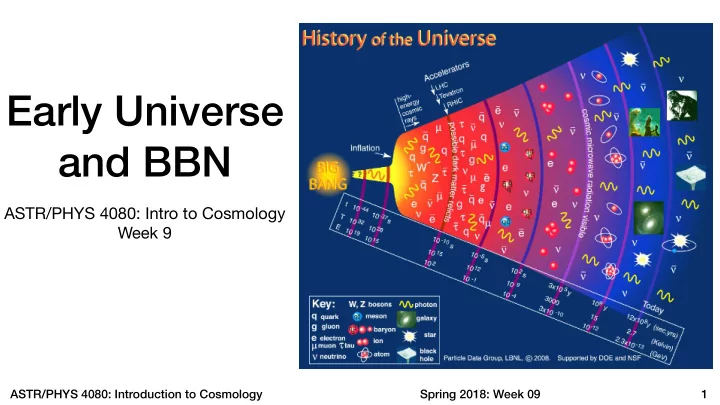
Early Universe and BBN ASTR/PHYS 4080: Intro to Cosmology Week 9 - - PowerPoint PPT Presentation
Early Universe and BBN ASTR/PHYS 4080: Intro to Cosmology Week 9 ASTR/PHYS 4080: Introduction to Cosmology Spring 2018: Week 09 1 Early Universe Timescales ASTR/PHYS 4080: Introduction to Cosmology Spring 2018: Week 09 2 Early Universe
Spring 2018: Week 09 ASTR/PHYS 4080: Introduction to Cosmology
1
ASTR/PHYS 4080: Intro to Cosmology Week 9
Spring 2018: Week 09 ASTR/PHYS 4080: Introduction to Cosmology
2
Spring 2018: Week 09 ASTR/PHYS 4080: Introduction to Cosmology
3
Spring 2018: Week 09 ASTR/PHYS 4080: Introduction to Cosmology
4
Spring 2018: Week 09 ASTR/PHYS 4080: Introduction to Cosmology
5
release energy expect nucleosynthesis to result in all atoms becoming iron does not happen - why not?
Spring 2018: Week 09 ASTR/PHYS 4080: Introduction to Cosmology
6
Spring 2018: Week 09 ASTR/PHYS 4080: Introduction to Cosmology
7
hydrogen hyperfine transition (electron spin flips) emits photon at 21cm (1.4 GHz) can observe at high (z~10) redshifts and see the first stars ionizing the neutral gas formed at recombination https://youtu.be/kifF3RYcfn0
Spring 2018: Week 09 ASTR/PHYS 4080: Introduction to Cosmology
8
Spring 2018: Week 09 ASTR/PHYS 4080: Introduction to Cosmology
9
Spring 2018: Week 09 ASTR/PHYS 4080: Introduction to Cosmology
10
Spring 2018: Week 09 ASTR/PHYS 4080: Introduction to Cosmology
11
release energy after 200s, all non-decayed neutrons could end up in a D nucleus, BUT D reactions can also occur: more likely
Spring 2018: Week 09 ASTR/PHYS 4080: Introduction to Cosmology
12
release energy Tritium and He-3 quickly interact with
Strong force reactions: large cross- sections and fast rates End up with mostly He-4, since it’s so tightly bound
Spring 2018: Week 09 ASTR/PHYS 4080: Introduction to Cosmology
13
release energy Can’t add p or n to He-4 to make a new atom, so have to use later products to form Li/Be nuclei Stable He-4 is made quickly, but harder to form higher A elements so their creation is slower no stable nuclei
Spring 2018: Week 09 ASTR/PHYS 4080: Introduction to Cosmology
14
Spring 2018: Week 09 ASTR/PHYS 4080: Introduction to Cosmology
15
Spring 2018: Week 09 ASTR/PHYS 4080: Introduction to Cosmology
16
Creation process depends on relative abundances at any given time, so have to calculate computationally Nucleosynthesis doesn’t run to completion like in stars — rapidly dropping temperature cuts it off and “freezes” abundance pattern Exact yields depend most on baryon- to-photon ratio: (determines temperature of nucleosynthesis)
Spring 2018: Week 09 ASTR/PHYS 4080: Introduction to Cosmology
17
quasar absorption lines CMB
Spring 2018: Week 09 ASTR/PHYS 4080: Introduction to Cosmology
18
Spring 2018: Week 09 ASTR/PHYS 4080: Introduction to Cosmology
19
Spring 2018: Week 09 ASTR/PHYS 4080: Introduction to Cosmology
20
no leftover antimatter from the early universe: Standard Model predicts existence of antimatter equally likely should be 1 quark-antiquark pair for every 2 photons in the early universe when temperature drops, quarks annihilate but are no longer produced —> universe should be entirely photons! must be a small asymmetry!