BBN-ANG-243 Advanced Phonology: Phonological Analysis Lecture 8: - - PowerPoint PPT Presentation

bbn ang 243 advanced phonology phonological analysis
SMART_READER_LITE
LIVE PREVIEW

BBN-ANG-243 Advanced Phonology: Phonological Analysis Lecture 8: - - PowerPoint PPT Presentation

Page 1 of 31 Phonological Analysis BBN-ANG-241_stress2 <EngPhonBA_243_stress2_2020_annotated.wpd BBN-ANG-243 Advanced Phonology: Phonological Analysis Lecture 8: Word Stress Part 2 Annotated version: see the Yellow Pages after sets of slides


slide-1
SLIDE 1

Phonological Analysis BBN-ANG-241_stress2 <EngPhonBA_243_stress2_2020_annotated.wpd

Page 1 of 31

BBN-ANG-243 Advanced Phonology: Phonological Analysis

Lecture 8: Word Stress Part 2 Annotated version: see the Yellow Pages after sets of slides

Kiss Zoltán / Starcevic Attila / Szigetvári Péter / Törkenczy Miklós

Dept of English Linguistics, Eötvös Loránd University

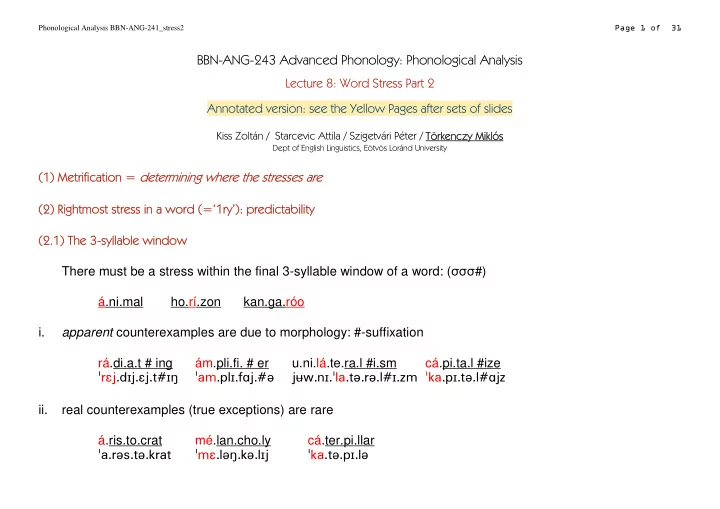
(1) Metrification = determining where the stresses are (2) Rightmost stress in a word (=‘1ry’): predictability (2.1) The 3-syllable window There must be a stress within the final 3-syllable window of a word: (σσσ#) á.ni.mal ho.rí.zon kan.ga.róo i. apparent counterexamples are due to morphology: #-suffixation rá.di.a.t # ing ám.pli.fi. # er u.ni.lá.te.ra.l #i.sm cá.pi.ta.l #ize !qDi-cHi-Di-s"HM !`l-okH-e@i-"? i|v-mH-!k`-s?-q?-k"H-yl !j`-oH-s?-k"@iy ii. real counterexamples (true exceptions) are rare á.ris.to.crat mé.lan.cho.ly cá.ter.pi.llar !`-q?r-s?-jq`s !lD-k?M-j?-kHi !j`-s?-oH-k?

slide-2
SLIDE 2

Phonological Analysis BBN-ANG-241_stress2 <EngPhonBA_243_stress2_2020_annotated.wpd

Page 2 of 31

THESE NOTES (THE YELLOW PAGES) ARE ANNOTATIONS EXPLAINING (LIKE THE ACTUAL LECTURE WOULD HAVE DONE VERBALLY) THE SLIDES THAT PRECEDE. THE NUMBERS IN BRACKETS ( ) REFER TO THE SECTION NUMBERS OF THE SLIDES. This is the second part of the two lectures are about word stress, i.e. the stressing of words spoken in isolation as if each word were a “one-word sentence” (not when words are combined into phrases

  • r sentences – phrase stress will be discussed in the set text on phrase stress/intonation). This part

is about metrification, specifically, about the predictability of the rightmost stress (i.e. the 1ry stress) in a word. (2.1) 1ry stress has to fall on one of the last three syllables of an English word, i.e. within ‘the final three-syllable window’. There are very few real counterexamples (2.1.i), and some words whose stress is outside the 3-syllable window are no real counterexamples because they contain a strong boundary suffix which is outside the domain of metrification (2.1.ii).

slide-3
SLIDE 3

Phonological Analysis BBN-ANG-241_stress2 <EngPhonBA_243_stress2_2020_annotated.wpd

Page 3 of 31

(2.2) Stress within the 3-syllable window: two views (2.2.1) The ‘no-pattern view’ English 1ry stress is lexical, i.e. (mostly/completely) unpredictable. It is lexically determined for every word and it can be anywhere within the 3-syllable window independently of the phonological properties of the syllables within the window and/or the morphological features of the word. (2.2.2) The ‘pattern-with-exceptions view’ English 1ry stress is mostly/generally predictable. Metrification has to take into consideration phonological properties of the syllables within the 3-syllable window, extrametricality and the morphological features of the word. The standard generative treatments are based on this view (what follows is based on the analysis

  • f Bruce Hayes)
slide-4
SLIDE 4

Phonological Analysis BBN-ANG-241_stress2 <EngPhonBA_243_stress2_2020_annotated.wpd

Page 4 of 31

There are two conflicting views about English stress. One view, the ‘no-pattern view' maintains that there is no stress pattern in English, i.e. English stress is not predictable. According to the other view, the ‘pattern-with-exceptions view’, there is a very intricate pattern (with many rules and exceptions). The ‘no-pattern view' According to proponents of the no-pattern view no rules that are sufficiently general can be formulated about the place of word stress, therefore English word stress is lexical and it has to be memorised for every word by native speakers. There are some regularities, e.g. 1ry stress has to fall on one of the last three syllables of an English word, i.e. within ‘the final three-syllable window', but the place of stress is unpredictable within the limits of these regularities. The ‘pattern-with-exceptions view' According to the pattern-with-exceptions view, there is a stress pattern in English, stress is (mostly) predictable: it is the result of several factors (partly morphological and phonological) and there are exceptions (English stress is partly lexical). The analysis I will present below is a pattern-with-exceptions view and follows the classic generative phonological analysis of English stress

slide-5
SLIDE 5

Phonological Analysis BBN-ANG-241_stress2 <EngPhonBA_243_stress2_2020_annotated.wpd

Page 5 of 31

(3) 1ry stress in polysyllabic words (3.1) 1ry stress in polysyllabic words (3.1.1) When the last vowel IS NOT a long V or a diphthong NOUNS VERBS = 2 σ #Lσ# !sD-m?ms ténant #Hσ# !oHi-s? Péter #σH# #σL# !uN-lHs !n9k-s? vómit álter #σHSH# sn9-!ldms tormént > 2 σ ...σLσ# !N-qH-cYHm órigin ...σHσ# g?-!q@i-y?m horízon ...σH# ...σL# H-!l`-cYHm c?!kHu? imágine delíver ...σσHSH# !cYD-mi?-ekDjs génuflect Generalisations: N The ultimate syllable is not stressed. Focus on the penultimate: stress the penultimate if it is heavy, but stress the antepenultimate if the penultimate is light. Apparent problem: #Lσ# ténant V The ultimate syllable can be stressed. Focus on the ultimate: stress the ultimate if it is superheavy, but stress the penultimate if the ultimate is heavy or light. Problem: ...σσHSH# génuflect

slide-6
SLIDE 6

Phonological Analysis BBN-ANG-241_stress2 <EngPhonBA_243_stress2_2020_annotated.wpd

Page 6 of 31

If we first examine words whose last syllable does not have a long vowel/diphthong, we find the following two patterns: the noun patterns and the verb pattern (3.1.1) THE NOUN PATTERN

  • i. 1ry stress falls on a H penult, if there is one

!H σ # examples: agénda, appéndix, horízon

  • ii. otherwise 1ry stress falls on the antepenult

!σ L σ # examples: América, ásterisk There is an apparent problem only: bisyllabic nouns whose initial syllable is light (e.g. ténant) get stress on their penultimate light syllable # !L σ # although according to (ii) above a penultimate light syllable should not be stressed. Clearly, this is only possible because they do not have an antepenultimate syllable that would

  • therwise get the stress.

THE VERB PATTERN

  • i. 1ry stress falls on a Superheavy ult, if there is one

!HSH # examples: prevént, condúct

  • ii. otherwise 1ry stress falls on the penultimate σ

!σ σ # examples: inhábit, imágine There is a problem here: verbs longer than bisyllabic whose ultimate syllable is superheavy (génuflect) have antepenultimate stress and not final stress as (otherwise) required by (ii) above. We will see that this is due to another rule (the Alternating Stress Rule) Nouns (typically), suffixed adjectives (typically) and some unsuffixed adjectives follow the noun pattern and verbs (almost always) and some unsuffixed adjectives and adjectives ending in -ic follow the verb pattern.

slide-7
SLIDE 7

Phonological Analysis BBN-ANG-241_stress2 <EngPhonBA_243_stress2_2020_annotated.wpd

Page 7 of 31

(3.1.2) When the last vowel IS a long V or diphthong NOUNS VERBS = 2 σ #σσ# aq?-!jDic a`l!a|v9 brocáde bambóo #σσ# r?-!cDis ?!aDi sedáte obéy > 2 σ ...σσσ# !c@i-m?-l@is !j`-a?-qDi dy 3namite cábaret ...σσσ# !P-o?-qDis r?!kHcHe@i óperate solídify Generalisations: There is no difference between the stressing of nouns and verbs. The ultimate syllable is stressed if the word is bisyllabic and the antepenultimate syllable is stressed if the word is longer than two syllables

slide-8
SLIDE 8

Phonological Analysis BBN-ANG-241_stress2 <EngPhonBA_243_stress2_2020_annotated.wpd

Page 8 of 31

This can be expressed by two rules: Long Vowel Stressing (LVS): stress long-vowelled final syllables Alternating Stress Rule (ASR): σ σ σ 3 # = σ 3 σ σ # where LVS must apply before ASR Derivation: UR # sedate # # cabaret # LVS # sedáte # # cabarét # ASR – # cábaret # SR Zr?!cDis\ Z!j`a?qDi\

slide-9
SLIDE 9

Phonological Analysis BBN-ANG-241_stress2 <EngPhonBA_243_stress2_2020_annotated.wpd

Page 9 of 31

(3.1.2) Let us examine words whose last syllable does have a long vowel/diphthong, (i) long vowels/diphthongs in final syllables are regularly stressed in bisyllabic words (even in nouns), and (ii) a word (of any word class) regularly has antepenultimate stress if it is longer than two syllables and has a long vowel/diphthong in its final syllable (even if it is a verb). This is expressed by two rules: Long Vowel Stressing (LVS) and the Alternating stress Rule (ASR) LVS precedes ASR and if the word is long enough, both apply (e.g. cábaret) but if the word is shorted than three syllables, only LVS can (sedáte). . .

slide-10
SLIDE 10

Phonological Analysis BBN-ANG-241_stress2 <EngPhonBA_243_stress2_2020_annotated.wpd

Page 10 of 31

(3.2) The noun pattern and the verb pattern can be seen as ONE stress pattern IF we assume that (i) the last syllable is outside the domain of metrification for nouns and (ii) the last consonant is outside the domain of metrification for verbs: ! nouns and verbs differ in extrametricality not in stress pattern ! extrametricality: nouns <σ># verbs <C># N O U N S V E R B S = 2 σ # L < σ > # !sD-<m?ms> # H < σ > # !oHi-<s?> # σ L < C > # # σ L # !uN-lH<s> !n9k-s? # σ H < C > # sn9-!ldm<s> > 2 σ .. . σ L < σ > # !N-qH-<cYHm> . . . σ H < σ > # g?-!q@i-<y?m> . . . σ L < C > # . . . σ L # H-!l`-cYH<m> c?!kHu? . . . σ σ H < C > # !cYD-mi?-ekdj<s> G e n e r a l M a i n S t r e s s R u l e ( M S R ) : W i t h i n t h e d

  • m

a i n

  • f

m e t r i f i c a t i

  • n

s t r e s s t h e r i g h t m

  • s

t σ i f i t i s H ,

  • t

h e r w i s e s t r e s s t h e p r e c e d i n g σ

slide-11
SLIDE 11

Phonological Analysis BBN-ANG-241_stress2 <EngPhonBA_243_stress2_2020_annotated.wpd

Page 11 of 31

Derivations UR LVS Extr MSR ASR SR animal – ani<mal> áni<mal> – Z!`mHl?k\ horizon – hori<zon> horí<zon> – Zg?!q@iy?m\ vomit – vomi<t> vómi<t> – Z!uNlHs\ adopt – adop<t> adóp<t> – Z?!cNos\ genuflect – genuflec<t> genufléc<t> génuflec<t> Z!cYDmi?ekdjs\

slide-12
SLIDE 12

Phonological Analysis BBN-ANG-241_stress2 <EngPhonBA_243_stress2_2020_annotated.wpd

Page 12 of 31

(3.2) The two basic patterns, the noun pattern and the verb pattern can be seen as phonologically the same if we assume that he only difference between them is the domain of metrification, i.e. extrametricality (see 2.4 of the previous lecture). Specifically, extrametricality is different for noun pattern items and verb pattern items. In noun pattern items it is the last syllable of the word that is extrametrical, while in verb pattern items it is only the last consonant (if there is one). Extrametricality does not apply if the word-final syllable ha a long vowel/diphthong Given this assumption we can have just one General Main Stress Rule (MSR) for all items, which derives the correct stress patterns. Look at the sample derivations on page 11, where extrametricality is indicated by angled brackets < > and the change introduced by each rule is highlighted in red in the appropriate line. Notice that the stress pattern of génuflect is explained: it gets final stress regularly by MSR which is then moved two syllables to the left (regularly) by ASR. .

slide-13
SLIDE 13

Phonological Analysis BBN-ANG-241_stress2 <EngPhonBA_243_stress2_2020_annotated.wpd

Page 13 of 31

(4) Some problems (4.1) Conversion (zero derivation): no change chihuahua ZsRH!v@9v?\ Don't chihuáhuaV my plátypusN! platypus Z!okzs?o?r\ Don't plátypusV my chihuáhuaN! (a) conversion: có<mment>N; có<mment>V vs. (b) derivation by restressing: ré<cord>N; recór<d>V Problem: (a) vs. (b) is unpredictable (4.2) Some ‘prefixes' of Latin origin in verbs:

  • =, ex=, im=, con=, re=, inter=, contra=, intro=, re=

! may not receive 1ry stress – although they receive 2ry stress regularly

  • =mít

(compare édit) inter=véne (compare óperate) ! analysis: they are outside the domain of 1ry stress assignment:

  • =mí<t>

inter=vé<ne> Problem: circularity, often nothing other than stress itself identifies them

slide-14
SLIDE 14

Phonological Analysis BBN-ANG-241_stress2 <EngPhonBA_243_stress2_2020_annotated.wpd

Page 14 of 31

(4.3) Internal sC clusters (i) Two syllabifications of word-internal sC clusters (a) s.C (b) .sC (ii) Examples (a) σ. H 3 .<σ># (b) ! σ. L.<σ># σ. VS s. C- σ. VS . sC- `y-!aDr-s?r !lH-mH-rs? asbéstos mínister Aláska áncestor Francíscan órchestra aspidístra índustry contéstant Prótestant Problem: (a) vs. (b) is unpredictable

slide-15
SLIDE 15

Phonological Analysis BBN-ANG-241_stress2 <EngPhonBA_243_stress2_2020_annotated.wpd

Page 15 of 31

(4.4) Syllabification of diphthongs (i) Two interpretations of diphthong

  • a. D = VL

ne.on mHi - ?m HH

  • b. D = VSC

ne.on mH - i?m LH (ii) Examples (a) σ. H 3 .<σ># (b) ! σ. L.<σ># cH-!y@i-? !r`-s@-i? desíre sátire esquíre émpire paríah sápphire Messíah úmpire Problem: (a) vs. (b) is unpredictable

slide-16
SLIDE 16

Phonological Analysis BBN-ANG-241_stress2 <EngPhonBA_243_stress2_2020_annotated.wpd

Page 16 of 31

(4.5) VANILLA nouns Penultimate LIGHT syllable gets stress (irregularly) ! L < σ > # (a) vaní<lla> vs. (b) áni<mal> (regular) anténna, assássin, dilémma, gorílla, guerílla, Henriétta, Nantúckett, savánna, spaghétti, Mississíppi, Kentúcky, umbrélla, vanílla Problem: (a) vs. (b) is unpredictable (4.6) CARESS verbs Final VSC syllable gets stress (irregularly) !Vs<C># (a) caré<ss> vs. (b) edi<t> (regular) abét, abhór, addréss, asséss, begín, caréss, conféss, discúss, forgét, fulfíll, progréss, rebél, repél, impél Problem: (a) vs. (b) is unpredictable (4.7) Nouns stressed on their final short vowelled syllable Final syllable gets stress although vowel is short (irregularly) !VsC# (a) hotél vs. (b) cá<mel> (regular) batón, Brasíl, canál, duét, duréss, giráffe, hotél, quartét, sedán, Sudán, Susánne Problem: (a) vs. (b) is unpredictable

slide-17
SLIDE 17

Phonological Analysis BBN-ANG-241_stress2 <EngPhonBA_243_stress2_2020_annotated.wpd

Page 17 of 31

(4) There are some stress patterns that are not predicted by the rules above and therefore must be considered irregular under this analysis. (4.1) Conversion In English, verbs can be freely derived from nouns by conversion (zero derivation) without any change in pronunciation (including stress). Take, for instance, the nouns plátypus (Ornithorhynchus anatinus, ‘kacsacsőrű emlős') and chihuáhua (‘a Mexican breed of dog '), both of which follow the noun pattern: pláty<pus> .!ok`s?o?r. and chihuá<hua> .sRH!v@9v?.. In the examples in (4.1) the word for the same animal is a noun in one sentence and a verb in the other – nevertheless the stressing does not change, it remains chihuahua .sRH!v@9v?. and platypus .!ok`s?o?r.. The problem is that in this way there is a great number of verbs that actually follow the noun stress pattern. (4.2) Some ‘prefixes' of Latin origin in verbs These are not proper prefixes in the sense that in English as they do not have an identifiable meaning and the bases that they precede do not have an identifiable meaning either (e.g. omit, explain, confess, intervene, etc.). However, they may interfere with the stress rules (MSR, ASR) discussed. Typically, they fall outside the domain of 1ry stress placement, may not receive 1ry stress (although they receive 2ry stress regularly) and only the base is visible to the stress rules discussed above. E.g. the verb omít should be *ómit according to the MSR (*ómi<t>, compare édi<t>), but it must be analysed as o=mít to get the actual stressing .?!lHs.. The problem is that, as there is no real morphological motivation for analysing these word-initial sequences as prefixes, the analysis is circular: the ‘prefix’ analysis is only motivated by the anomalous stressing it is designed to explain. (4.3) Two syllabifications of word-internal sC clusters In some words a medial sC cluster appears to syllabify as an onset (V.sC), in others as a coda+onset sequence (Vs.C). If the vowel preceding the sC cluster is short, then its syllable should count as light under the former syllabification, but as heavy under the latter one (because a closed syllable is heavy even if its vowel is short). Compare the nouns mínister .!lHmHrs?. and asbéstos .`r!adrs?r.. Different words may require different syllabifications. The problem is that it is unpredictable which word belongs to which group. (4.4) Two analyses of diphthongs Diphthongs may be analysed in two ways: either as a long vowel or as a short vowel followed

slide-18
SLIDE 18

Phonological Analysis BBN-ANG-241_stress2 <EngPhonBA_243_stress2_2020_annotated.wpd

Page 18 of 31

by a consonant (a glide). This has a consequence for the weight of the syllable they are in: (a) under the first interpretation it is heavy (since the diphthong counts as a long vowel), (b) under the second it is light: it is an open syllable with a short vowel (because the consonant (the glide) syllabifies into the next syllable due to Onset Maximisation); see (2.3.ii) of the previous lecture. The stress rules discussed in this lecture assume the first interpretation: desíre /cH-!y@i-?.. However, some words seem to require the second interpretation: sátire .!r`-s@-i?.. The problem is that it is unpredictable which word belongs to which group. (4.5) Vanilla nouns There are some nouns longer than two syllables whose penultimate syllable is light and (nevertheless) stressed, e.g. vanílla, anténna, assássin, dilémma. The problem is that it is unpredictable which nouns belong to this group rather than the regular one with antepenultimate stress. (4.6) Caress verbs There are some verbs whose ultimate syllable is stressed although it is not superheavy, e.g. haráss, acquiésce, begín, omít, prefér. The problem is that it is unpredictable which verbs belong to this group rather than the regular one that have final stress. (4.7) Nouns stressed on their final short vowelled syllable There are some nouns whose ultimate syllable has a short vowel but nevertheless gets stressed, e.g. cemént, ellípse, etc. The problem is that it is unpredictable which nouns belong to this group rather than the regular one with non- final stress.

slide-19
SLIDE 19

Phonological Analysis BBN-ANG-241_stress2 <EngPhonBA_243_stress2_2020_annotated.wpd

Page 19 of 31

(5) Derived words: affixes and stress; the relationship between affix shape and stress placement (5.1) Stress-neutral suffixes: strong-boundary suffixes, which do not change the stress-pattern of their bases féver féverish édit éditing ! analysis: they are outside the domain of metrification fé<ver>#ish édi<t>#ing (5.2) Stress-placing suffixes: weak-boundary suffixes, which may change the stress-pattern of their bases ! analysis: they are inside the domain of 1ry stress assignment = metrified together with their bases: sán+i<ty> ! (sometimes) there is a connection between the shape of a weak boundary suffix and the position of stress assigned by it Problem: given the above assumption about the metrification of weak boundary suffixes we would expect words containing them to behave like monomorphemic words (=no internal boundary). This is not always the case: σL<σ> (noun) sá.ni.ty T but no.ve. létte X compare: ánimal

slide-20
SLIDE 20

Phonological Analysis BBN-ANG-241_stress2 <EngPhonBA_243_stress2_2020_annotated.wpd

Page 20 of 31

(a) pre-stressed 1: primary stress falls on the syllable preceding the suffix. Shape (i)

  • uble, -ity, -ety, -erie, -ion, -ular, -logy, -meter, -graphy, -poly, -tomy, -pathy, -thesis, -gamy

! these suffixes follow the noun pattern and stress placement follows from their shape abíli<ty> confórmi<ty> (ii) -H

  • ic, -ishV/N

! these suffixes follow the verb pattern and stress placement follows from their shape anatómi<c> militarísti<c>

slide-21
SLIDE 21

Phonological Analysis BBN-ANG-241_stress2 <EngPhonBA_243_stress2_2020_annotated.wpd

Page 21 of 31

(b) pre-stressed 1/2 1ry stress falls on the syllable preceding the suffix if it is H, but on the 2nd syllable preceding the suffix if the syllable preceding the suffix is L. Shape (i)

  • σ
  • age, -al, -ous, -ive, -ant, -ance, -ent, -ence

! these suffixes follow the noun pattern and stress placement follows from their shape medíci<nal> parén<tal> (ii) -σσ

  • ative, -ature, -ible, -ery, -ary, ory

! 1ry stress placement does not follow from the shape of these suffixes. fí.gu.rative de.món.strative

slide-22
SLIDE 22

Phonological Analysis BBN-ANG-241_stress2 <EngPhonBA_243_stress2_2020_annotated.wpd

Page 22 of 31

(c) Pre-stressed 2 1ry stress falls stress on 2nd syllable preceding the suffix (if possible) Suffix shape

  • (C)V:(C)
  • ateV, -ize, -ite, -ene, -ine, -cide, -oir, -ose, -tude, -(i)fy

! These suffixes place 1ry stress by Long Vowel Stressing (+ the Alternating stress Rule) rádiate, sedáte

slide-23
SLIDE 23

Phonological Analysis BBN-ANG-241_stress2 <EngPhonBA_243_stress2_2020_annotated.wpd

Page 23 of 31

(d) auto-stressed: 1ry stress falls on the suffix itself Auto-stressed suffixes are exceptional and 1ry stress placement does not follow from their shape Shape (i) -(C)VV(C) -ade, -ese, -ique Zh9j\, -ee Zh9\ lemonáde (ii) -VCC

  • esque

picturésque (iii) -VC

  • esce, -ette

novelétte

slide-24
SLIDE 24

Phonological Analysis BBN-ANG-241_stress2 <EngPhonBA_243_stress2_2020_annotated.wpd

Page 24 of 31

(5) Derived words There are two kinds of suffixes: (5.1) stress-neutral suffixes leave the original stress of the base intact and (5.2 (i) stress-placing suffixes determine the place of primary stress in the word, they may ‘overwrite', i.e. not preserve, the stress of the base (5.1) Stress-neutral suffixes The following are some common stress-neutral suffixes: -able, -ly, -ing, -ed, -es, -er, -ist,

  • ism, -ful, -less, -ness, -hood, -ishadj , -ment, -wise.

Stress-neutral suffixes are outside the domain of metrification i.e. neutral suffixes are disregarded when primary stress placement is determined and the rest of the word is metrified without the suffix: (5.2) Stress-placing suffixes Words (only) containing stress-placing suffixes are metrified in the same way as underived words, i.e. (i) the reason why stress-placing suffixes influence the placement of stress is that they are metrified together with the base they are added to and (ii) (ideally) the way a particular stress/placing suffix influences the placement of primary stress derives (a) from the phonological shape of the suffix and (b) its morphological properties (i.e. whether it derives nouns, verbs, etc.). For example the suffix -ity places the stress on the syllable preceding the suffix because it derives a noun, so its final syllable will be extrametrical and its initial syllable is light, -ity is -L<σ> , therefore the MSR stresses the syllable preceding it: σ ! L<σ> Unfortunately, stress assignment by some stress-placing suffixes is not so straightforward..

slide-25
SLIDE 25

Phonological Analysis BBN-ANG-241_stress2 <EngPhonBA_243_stress2_2020_annotated.wpd

Page 25 of 31

1ry stress is

! calculated R>L from # boundary ! weight-sensitive ! non-iterative (MSR applies only once) ! not stress preserving ! partially unpredictable: many exceptions

slide-26
SLIDE 26

Phonological Analysis BBN-ANG-241_stress2 <EngPhonBA_243_stress2_2020_annotated.wpd

Page 26 of 31

(6) Reliability (6.1) “Exceptions” (see (4) above) (6.1.1) When the last vowel IS NOT a long V or a diphthong NOUNS VERBS = 2 σ

#Lσ# !sD-m?ms ténant r?-!lDms cemént #Hσ# !oHi-s? Péter g?v-!sDk hotél #σH# #σL# !uN-lHs vómit !n9k-s? álter qHf!qDs regrét – #σS# sn9-!lDms tormént !jN-ldms cómment

> 2 σ

...σLσ# !N-qH-cYHm órigin u?!mHk? vanílla ...σHσ# g?-!q@i-y?m horízon !j`-q?j-s? cháracter ...σH# ...σL# H-!l`-cYHm imágine c?!kHu? delíver ? !l`-r?-j? mássacre ...σσS# !cYD-mi?-ekDjs génuflect $jNl-oq?-!gDmc comprehénd

slide-27
SLIDE 27

Phonological Analysis BBN-ANG-241_stress2 <EngPhonBA_243_stress2_2020_annotated.wpd

Page 27 of 31

(6.1.2) When the last vowel IS a long V or diphthong NOUNS VERBS = 2 σ #σσ# aq?-!jDic brocáde !q`a@i rábbi #σσ# r?-!cDis sedáte !l`m-cDis mándate > 2 σ ...σσσ# !c@i-m?-l@is dy 3namite $j`M-f?-!q|v kàngaróo ?-!kUl-m@i alúmni ...σσσ# !N-o?-qDis óperate $uN-k?m-!sH9 vòluntéer

slide-28
SLIDE 28

Phonological Analysis BBN-ANG-241_stress2 <EngPhonBA_243_stress2_2020_annotated.wpd

Page 28 of 31

?!`m`Hl?k ánimal horízon vanílla

slide-29
SLIDE 29

Phonological Analysis BBN-ANG-241_stress2 <EngPhonBA_243_stress2_2020_annotated.wpd

Page 29 of 31

cháracter ánimal enígma vanilla

slide-30
SLIDE 30

Phonological Analysis BBN-ANG-241_stress2 <EngPhonBA_243_stress2_2020_annotated.wpd

Page 30 of 31

(6) Reliability This part of the lecture wants to show you that (a) for almost every pattern considered regular according to the rules we discussed there are counterexamples, see the examples in orange in (6.1.1) and (6.1.2) and (b) even the “regular” patterns are not equally reliable (figures 4.1, 4.2), e.g the pattern σLσ# is a lot less reliable for nouns than the σHσ# pattern (the stressed syllable is underlined and emboldened) because there are significantly more irregular vanílla words compared to the regular ánimal words than there are irregular cháracter words compared to the regular enígma words (or irregular (hypothetical) . !`m@il?k. words compared to the regular horízon words). This makes the reliability of the classic pattern-with-exceptions analysis presented here somewhat doubtful.

slide-31
SLIDE 31

Phonological Analysis BBN-ANG-241_stress2 <EngPhonBA_243_stress2_2020_annotated.wpd

Page 31 of 31

a page intentionally left blank for no reason whatsoever