Issues in High Resolution Data Assimilation Met Office Website - - PowerPoint PPT Presentation

issues in high resolution
SMART_READER_LITE
LIVE PREVIEW

Issues in High Resolution Data Assimilation Met Office Website - - PowerPoint PPT Presentation

Issues in High Resolution Data Assimilation Met Office Website Nancy Nichols Gillian Baxter, Sarah Dance, Amos Lawless, Sue Ballard* * NCEO: Delivering world-class science by unlocking the full potential of Earth Observation to monitor,


slide-1
SLIDE 1

Issues in High Resolution Data Assimilation

Nancy Nichols

Gillian Baxter, Sarah Dance, Amos Lawless, Sue Ballard*

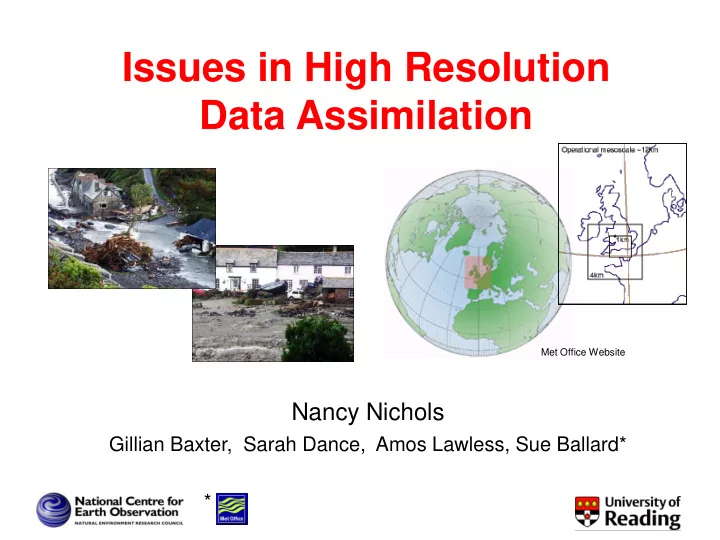
Met Office Website
*

slide-2
SLIDE 2

NCEO:

Delivering world-class science by unlocking the full potential of Earth Observation to monitor, diagnose and predict environmental and climate change, and ensuring that scientific advances translate into public good.

slide-3
SLIDE 3
slide-4
SLIDE 4

* *

slide-5
SLIDE 5

Outline

  • Motivation
  • Challenges
  • Multi-scale Modelling
  • Summary and Outlook
slide-6
SLIDE 6

Hazardous weather and flooding

Picture from Ross Bannister

Observations Data assimilation NWP model Hydrological model

Boscastle storm 2004

Leeds University bbc.co.uk

Heathrow fog, Christmas 2006 Birmingham tornado 2005

bbc.co.uk bbc.co.uk

Snow, 2009

slide-7
SLIDE 7
  • New observation types

providing detail on required scales

  • Operational storm-scale

(1.5km) limited area models now expected – possibly higher resolution in future.

  • Improvements in hydrological models, including

increased interest in the use of more sophisticated data assimilation techniques.

slide-8
SLIDE 8

Data assimilation on convective scales is a NEW problem – very different in character from assimilation on synoptic scales.

What are the challenges?

slide-9
SLIDE 9
  • 1. Observations
  • 2. Background Covariances
  • 3. Multi-scale Dynamics / Coupled Systems
  • 4. Nonlinearity and Uncertainty
  • 5. Model Reduction

Challenges

slide-10
SLIDE 10
  • 1. Observations
  • 2. Background Covariances
  • 3. Multi-scale Dynamics / Coupled Systems
  • 4. Nonlinearity and Uncertainty
  • 5. Model Reduction

Challenges

slide-11
SLIDE 11
  • need to update fine-scale information while

preserving large scale information

  • need lateral boundary conditions for nested

limited area models from synoptic-scale data

  • need to retain rapid convergence of all

important scales in the optimization algorithm

Multi-Scale Dynamics

Strong dynamical forcings and feedback exist between synoptic and storm-scale systems. In high resolution convective models:

slide-12
SLIDE 12

Question:

  • Study aliasing problems in limited area models:

examine how different wave lengths are projected onto the limited area analysis, using a simple nested advection-diffusion model.

  • Examine methods for

combining longer wave- lengths from the global model with shorter wave- lengths from the LAM. How are different scales treated in a LAM?

slide-13
SLIDE 13

Model

The 1D linear advection-diffusion equation with periodic boundary conditions for the parent model and the parent analysis for the LAM boundaries. Discretization is explicit time, up-wind advection and centred diffusion.

,

In buffer zone:

b b

slide-14
SLIDE 14

Experimental System Assimilation System

  • Uses 4DVar
  • Transforms to spectral space using double-

sine control variable transform

  • Perfect observations at all points
  • LAM boundary conditions from parent analysis
  • Davies Relaxation at LAM boundaries
  • High Resolution LAM = 4 x parent
  • High Resolution truth = 2 x LAM
slide-15
SLIDE 15

Experiment 1 : Long and short waves

) 16 sin( ) 8 sin( ) 2 sin( 2 ) 4 / sin( 2 truth x x x x

  • observations
  • -- truth
  • -- parent analysis --- LAM analysis

2 ~

| |

k

f

Power spectrum LAM domain

slide-16
SLIDE 16
  • Higher resolution allows higher wave-numbers

to be captured by the LAM

  • A large proportion of the “long wave”

information is aliased onto wave-number k=1

  • Some “long wave” information is aliased onto

higher wave-numbers

  • These conclusions can be shown to hold

mathematically for a general case using discrete Fourier transforms

Summary:

slide-17
SLIDE 17

, ,

Assimilation in Spectral Space

slide-18
SLIDE 18

Background Matrix B

= diag{1.0,0.5,0.1,0.01,0.005} = diag{0.005,0.01,0.1,0.5,1.0}

1 2

Correlation structure Red = B1 Blue = B2

B1 B2

slide-19
SLIDE 19

I Σ

1

I Σ

1

I Σ

1

I Σ

1

Different weightings in spectral space on background

  • observations
  • -- truth
  • -- parent analysis --- LAM analysis

LAM domain Power spectrum

slide-20
SLIDE 20
  • Wave-lengths shorter than the resolution of

the global models can be analysed in the LAM, but longer wave-lengths may be incorrectly represented due to aliasing.

  • Weighting global background differentially

in spectral space can affect scales analysed in LAM model.

G.M. Baxter, PhD Thesis, 2009

Conclusions

slide-21
SLIDE 21

Further Work - ???

slide-22
SLIDE 22

Further Work - ???

  • Test methods for combining long wave

information from Global models with high frequency information from the Lam via control variable transforms more generally

  • Improved treatment of boundary conditions
  • Scale-dependence of 4DVar convergence
slide-23
SLIDE 23
slide-24
SLIDE 24
  • Convergence of the inner loop of the Met

Office incremental 4DVar data assimilation system at different Fourier scales has been

  • analysed. Multi-level optimization methods

are planned for development.

  • Conditioning of the linearized minimization

problem as a function of the length-scales in the background covariances and as a function of the observation variances.

Multi-scale systems (2)

slide-25
SLIDE 25

Fourier spectrum of pressure increment at lowest model level as inner loop converges.

Wave number Log (Power) Faster convergence at large and small scales Slower convergence at intermediate scales 1st iterate Final iterate

slide-26
SLIDE 26

Conditioning of 3DVar

Bij =

Condition Number of (B-1 + HR-1HT) vs Length Scale

Periodic Gaussian Exponential Laplacian 2nd Derivative Blue = no obs Red = with obs variances 0.1 / 0.2

slide-27
SLIDE 27
  • The Met Office inner loop converges more

slowly at mid-wave-lengths. Multigrid approach might improve rates.

  • Conditioning of inner linear system

decreases with the length scales in the background error covariance matrix.

  • Conditioning is improved by the addition of

the observations

Results:

Haben et al., Internal Reports, 2009

slide-28
SLIDE 28
slide-29
SLIDE 29

The Discrete Fourier sine Transform of a function is

πjk/N) f f

N j j k

sin(

1 1 ^

gridpoints

  • f

number the is and wavenumber the is where N k

j

f

slide-30
SLIDE 30
slide-31
SLIDE 31