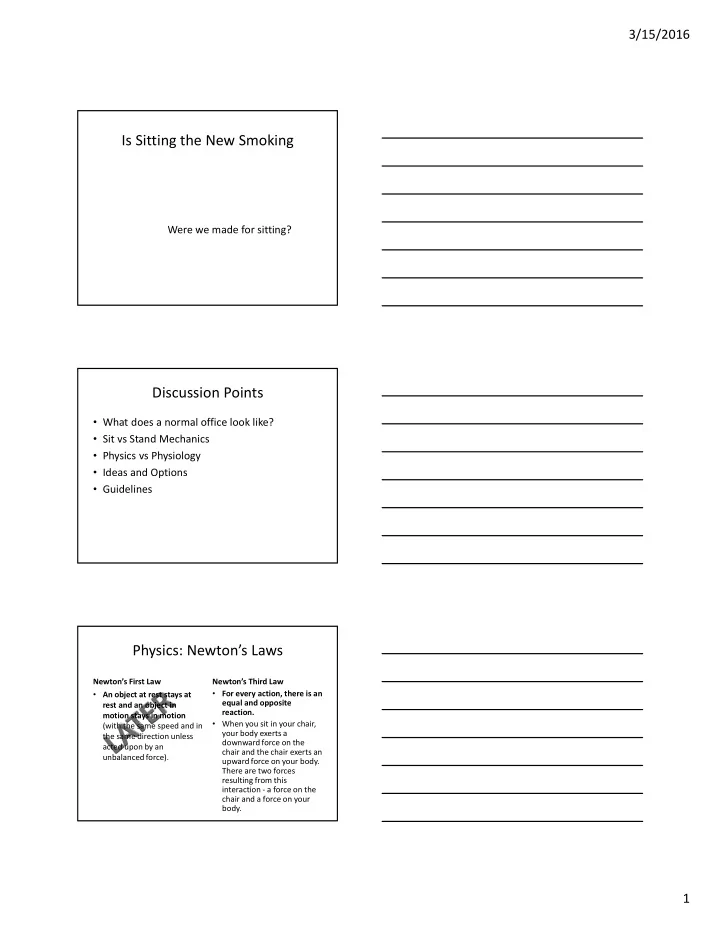
Is Sitting the New Smoking Were we made for sitting? Discussion - - PDF document

is sitting the new smoking
SMART_READER_LITE
LIVE PREVIEW

Is Sitting the New Smoking Were we made for sitting? Discussion - - PDF document

3/15/2016 Is Sitting the New Smoking Were we made for sitting? Discussion Points What does a normal office look like? Sit vs Stand Mechanics Physics vs Physiology Ideas and Options Guidelines Physics: Newtons Laws


slide-1
SLIDE 1

3/15/2016 1

Is Sitting the New Smoking

Were we made for sitting?

Discussion Points

  • What does a normal office look like?
  • Sit vs Stand Mechanics
  • Physics vs Physiology
  • Ideas and Options
  • Guidelines

Physics: Newton’s Laws

Newton’s First Law

  • An object at rest stays at

rest and an object in motion stays in motion (with the same speed and in the same direction unless acted upon by an unbalanced force). Newton’s Third Law

  • For every action, there is an

equal and opposite reaction.

  • When you sit in your chair,

your body exerts a downward force on the chair and the chair exerts an upward force on your body. There are two forces resulting from this interaction - a force on the chair and a force on your body.

slide-2
SLIDE 2

3/15/2016 2

Blood Flow

  • U.S. study published in the British Medical

Journal found that women who sat for a long time every day had double or even triple the risk of a dangerous blood clot.

How Does Standing Help?

  • Research has demonstrated that six hours
  • f uninterrupted sitting counteracts the positive

health benefits of one hour of exercise.

  • So the foundation for good health is

regular movement.

  • Eighty percent of Americans fail to meet

the recommended amount of exercise, which is 2.5 hours of moderate-intensity activity or 1.25 hours

  • f vigorous-intensity activity each week, along with

twice weekly strength-training workouts.

These are the “official” U.S. government exercise recommendations.

Standing: How Does it Help?

  • Research published in the European Heart

Journal7 showed that swapping 2 hours of sitting a day with 2 hours of standing led to:

– 2 percent lower fasting plasma glucose – 11 percent lower triglycerides – 6 percent lower total/HDL-cholesterol ratio

slide-3
SLIDE 3

3/15/2016 3

Standing: How Does it Help?

  • In a European Heart Journal study7, when 2

hours of sitting a day was swapped with 2 hours of stepping, it led to:

– 11 percent lower body mass index (BMI) – 7.5 cm (about 3 inches) lower waist circumference – 11 percent lower 2-hour plasma glucose – 14 percent lower triglycerides

Sitting

  • Sitting for eight hours or more each day is

associated with heart disease, cancer, type 2 diabetes and all-cause mortality

  • Taking 10,000 steps a day may lead to weight

loss and lower blood pressure

How Does Activity Help?

  • 1,580 participants in the Framingham Heart Study were
  • analyzed. At the outset, all were free of dementia and

heart disease. Each person took a treadmill test, which was then duplicated 20 years later. An MRI scan was also done during the follow-up.

  • The more fit they were the larger the brain, the less fit,

the smaller the brain. The researcher also observed that participants who had an especially high heart rate and blood pressure during the most vigorous exercise had notably smaller brain volumes two decades later.

  • Neurology, February 10, 2016
slide-4
SLIDE 4

3/15/2016 4

How Bad Could It Be?

  • The World Health Organization (WHO) states

physical inactivity is the fourth leading risk factor for premature death worldwide.3

Laptops & iPads & Phones- Oh My!

  • People who use a computer for 11 hours or

more a week, or watch TV for 21 hours or more a week, are more likely to be obese than those who use a computer or watch TV for 5 hours a week or less. British Journal of Sports Medicine

There’s More?

  • People who drank sugary drinks "gained 27

percent more visceral fat than people who never or almost never drank them.“ An average of 852 cubic centimeters more (~3.5” cube) 1.

slide-5
SLIDE 5

3/15/2016 5

Simple Changes

  • Simple changes throughout your day can also

add up to less time spent sitting and more time moving.

  • Walk while you’re talking on the phone, use

speaker phone and be active at something.

  • When watching television do a few jumping

jacks or crunches during the commercials.

  • Park on the outskirts of the parking lot and

take the stairs whenever you can.

What Can I do?

  • Simply standing up over 30 times a day is a

powerful antidote to long periods of sitting and is more effective than walking.

  • There are virtually unlimited opportunities for

movement throughout the day, from doing housework or gardening, to cooking and even just standing up every 10 minutes

  • It’s not how many hours of sitting that's bad for

you; it’s how often you interrupt that sitting that is GOOD for you

What Do The Experts Say?

Alan Hedge

– design and ergonomics professor Cornell University – suggested approach in the Boston Globe

  • “Sit for no more than 20 minutes at a time,
  • Stand in one position no more than 8 minutes,
  • Take a 2 minute moving break at least twice an

hour to stretch or walk around.”

slide-6
SLIDE 6

3/15/2016 6

What Do The Experts Say?

  • There are now more than 300 peer-reviewed

research studies looking into the health effects of taking 10,000 daily steps.6

  • Among them are studies showing this simple

intervention may lead to weight loss and lower blood pressure.

Disclaimer

  • Check with your physician before beginning

any exercise program.

  • Know how to take your pulse and what is

normal.

  • Have a convenient way to take your blood

pressure.

  • Understand the difference between pain and

discomfort.

  • Start slow and increase as you feel able.

COMING SOON

www.kyelgroup.com/office.html

slide-7
SLIDE 7

3/15/2016 7

Work Cited

  • 1. Jiantao, MA, et al; Sugar-Sweetened Beverage Consumption is Associated With

Change of Visceral Adipose Tissue Over 6 Years of Follow-Up. Circulation (NHLBI). November 16, 2015

  • 2. European Heart Journal, July 30, 2015
  • 3. World health Organization, Physical Activity
  • 4. Hypertens Res. 2000 Nov; 23(6):573-80
  • 5. NHS The 10,000 Steps Challenge
  • 6. Am J Health Promot. 2006 Nov-Dec;21(2):85-9